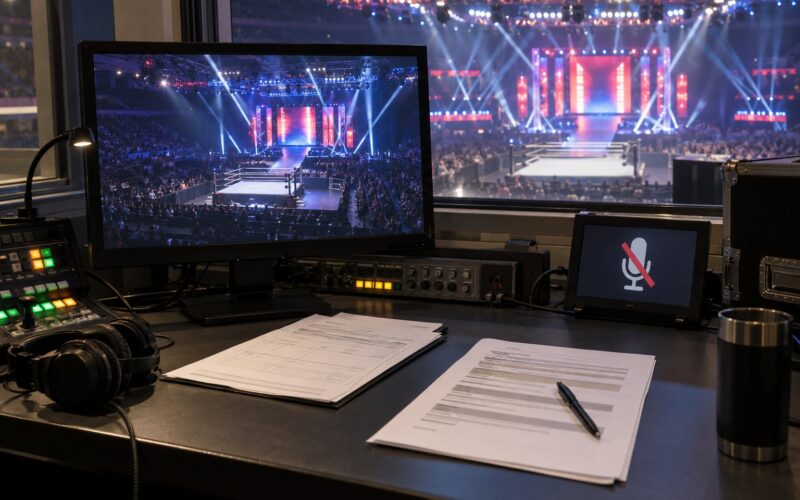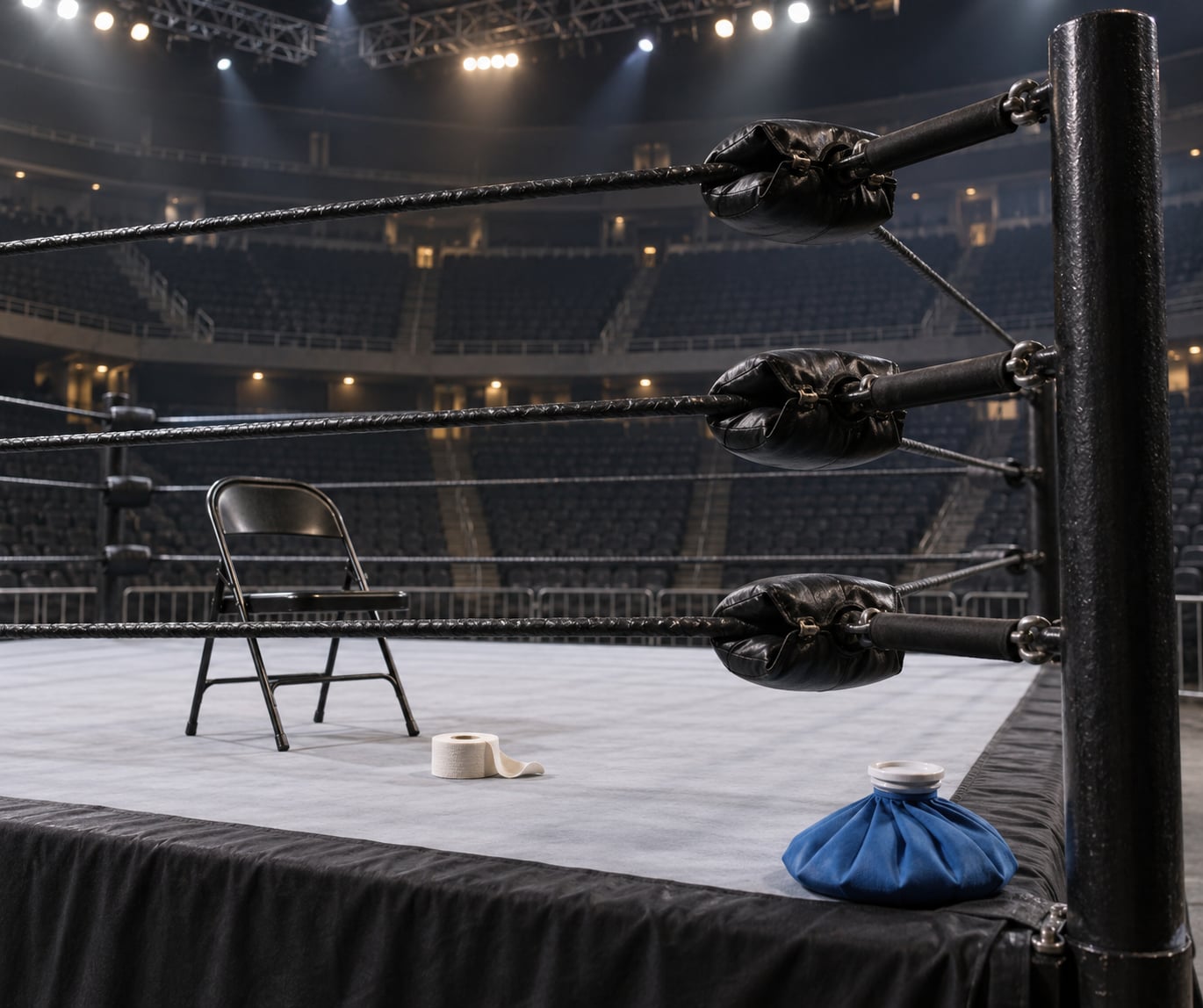
When a wrestler is genuinely hurt on a live broadcast, the referee waves an X above their head to summon the ringside medic, the ringside athletic trainer steps in to assess, and a backstage producer is told what happened through the referee’s earpiece. The match usually ends on the spot as a count-out, no-contest or medical forfeit so the injured performer can exit for treatment. That is how wrestling handles injuries on live television, and it happens in seconds with no second take available.
Most of what you see on a wrestling broadcast is presented, but the response to an injury is not. The confusion starts because a scripted storyline injury looks exactly like a real one on camera, and because nobody on television ever explains the hand signals afterward.
Table of Contents
- How Wrestling Handles Injuries on Live Television
- What Happens Immediately After a Wrestler Goes Down?
- Why Do Wrestlers Sometimes Finish a Match After an Injury?
- What Role Do Referees, Commentary, and Medical Staff Play?
- How Does a Wrestler Return After a Serious Injury?
- Can Wrestling Injuries Be Hidden or Exaggerated for TV?
- Frequently Asked Questions
- Why do wrestlers sometimes keep performing after being hurt?
- How can viewers tell if a wrestling injury is real or scripted?
- Who decides whether an injured wrestler should finish a live match?
- What happens after a wrestler is injured during a televised bout?
- How long does a wrestler usually need to recover before returning?
- How does a referee signal for a doctor during a match?
- Conclusion
How Wrestling Handles Injuries on Live Television
Live wrestling cannot pause, reshoot or cut away to fix a problem. So the injury protocol is built around a fixed chain of people, each with a narrow job: the referee on the floor, the medical staff at ringside, and the production team backstage who decide how the segment ends.
A few pieces of jargon explain almost everything you see:
- X signal — the referee crosses both arms above their head to call for a doctor. It can be thrown by a referee or by the injured wrestler themselves.
- Legit — short for a legitimate, unscripted injury.
- Hide — choreographing around an injury so the match never shows it, letting a performer work while protecting something.
- Audible — a message from backstage to the referee, usually through an earpiece.
- Local medical facility — the scripted line used when a wrestler is written off as being sent somewhere else for treatment.
- Medical forfeit — a match ended early because a competitor cannot continue, as opposed to a default, which is losing by failing to answer the bell.
Getting those definitions straight matters because a medical forfeit and a count-out are not the same result, and viewers routinely conflate them.
What Happens Immediately After a Wrestler Goes Down?
The sequence is short and it is almost identical on every show. Six steps, in order:
- The performer goes down or stops moving normally. The referee notices first, often before the crowd does.
- He or she signals for help. Either the wrestler throws the X, or the referee throws it after a look at the downed wrestler. The earpiece goes live at the same moment, telling production that the match is no longer a normal finish.
- Medical staff respond. The ringside athletic trainer steps through the ropes or comes in from the floor while the referee keeps the other competitor away.
- Commentary and cameras adjust. The announcers stall with general talk, the director cuts to a wide shot or the arena crowd, and a commercial break is frequently used to create room.
- A new finish is improvised. The referee signals the outcome the producer chooses: count-out, double count-out, disqualification, no-contest or medical forfeit.
- The wrestler exits and is assessed. The performer is rolled or helped out, moves toward gorilla position at the back of the arena, and is evaluated by the medical team. Follow-up usually appears on the next episode.
An in-arena account posted on r/SquaredCircle described exactly this path after a live injury: the wrestler stayed down with the medic, was rolled out of the ring, tried to walk out on his own, could not manage it, and was carried to the bottom of the ramp and back through gorilla position.
Why Do Wrestlers Sometimes Finish a Match After an Injury?
There are two completely different reasons a match continues, and they look identical on television.
A planned injury is choreography. The finish was agreed beforehand, the spot was rehearsed where possible, and the result is written into the story. Nobody is being reckless, and the response to it is theatrical.
An unexpected injury is different. A landing goes wrong, a wrist catches on a turnbuckle, and suddenly nobody is in control of what happens next. Continuing from that point is a decision, not a default, and the promoter and the wrestler make it together.
Performers commonly finish because they cannot tell the difference in the moment between a serious problem and adrenaline masking one, and because a visible hobble would contradict weeks of story work. Discussion on pa-wrestling forums draws the line the way the rules do: a medical forfeit ends the match early by decision, while a default is a loss, so a wrestler who cannot continue is not the same as a wrestler who failed to answer the bell.
Wrestlers also throw the X themselves. Threads on Reddit reference Ivar signalling during an eight-man tag in 2019, which is the clearest answer to the question fans keep asking: yes, a performer can call their own injury without saying a word out loud.
What Role Do Referees, Commentary, and Medical Staff Play?
Each of these people reacts differently in the same ten seconds, which is why the broadcast sometimes looks confused when something happens.
The referee is the only official on the floor and the only person who can end the match on their own authority. Referees are not sports officials in the athletic sense, they are performers, but they are trained and drilled on medical calls so that the X comes out correctly and the next action is the right one.
The medical team at ringside does the assessing. Their job is to decide whether the performer can continue, needs to be pulled, or needs transport. Their call outranks the storyline, and the executive view on record is blunt about it: talent safety is the priority, no matter how it looks on television.
Commentary has the least authority and the most visible job. The announcers have no medical information beyond what production gives them, so the standard move is to fill time. Forum discussion of live injuries often criticises that stall as awkward or repetitive, and it usually is. It is not incompetence, it is a lack of information.
Producers are the decision-makers. They hear the referee’s audible, they know how much time is left in the segment and in the hour, and they choose the new finish and whether to insert a commercial. A talent’s own team, often a trainer or coach, can also flag concerns and change how a match is worked on the fly.
On the broadcast side, the pattern is usually: hold on a wide arena shot, let the commentary run, break for commercial, and come back to a match that has already been decided. Some shows follow up with an injury segment on the next episode or main event instead.
How Does a Wrestler Return After a Serious Injury?
Coming back is slower than leaving. Most injuries that get an X signal are bumps, sprains and strains that need weeks, while head and neck injuries take far longer and go through more paperwork.
The first step is evaluation by the ringside medical team, and anything more serious is sent out for imaging or hospital care. Rest and treatment follow, with the promotion aware of the diagnosis and roughly how long recovery is expected to take.
Head injuries get their own process. Concussion protocol is a separate track with baseline testing at the start of a wrestler’s employment and repeat testing before a return, which is why a concussion usually costs months rather than weeks. AEW has said publicly that its concussion and medical protocols change frequently, with regular meetings on the process and named medical staff involved, and that talent safety outweighs how an injury looks on screen. The WWE runs an equivalent wellness policy and a Performance Center where talent is evaluated, treated and rehabbed in house.
Return planning is gradual and documented. A wrestler cleared to return may still be restricted from the moves that caused the problem, and if a return is needed for television, storylines get rewritten around the absence rather than around an injury that never happened.
Can Wrestling Injuries Be Hidden or Exaggerated for TV?
Both happen, and they are different problems. Exaggerating a real injury for television is a long-standing wrestling tradition. A performer who needs stitches will get them live on camera, and a storyline injury can be invented from nothing and resolved weeks later.
Hiding a real injury is the opposite case. It means the hide, where the match is choreographed so the affected body part is never touched, or the performer works through something without reporting it. Forum discussion on WrestlingFigs makes the distinction that matters for viewers: referees check for concussion not because the moves cause it inherently, but because a botched landing can.
Protocols are tightening on both sides of the business. AEW published an internal safety memo in 2023 that banned a list of moves outright, required backstage pre-approval for a second list of high-risk spots, restricted crowd interaction and intentional bleeding, and barred performers from faking concussion or seizure symptoms to sell a move. WWE applies its own wellness policy, medical staffing and concussion testing, though details of internal memos have not been published the same way.
Independent promotions operate on a much smaller budget. Medical coverage varies by the size of the show, and the person deciding whether to stop a match is often a promoter with no ringside trainer on hand. The protocol is the same chain of reasoning, but with far fewer people in it.
What a viewer can actually take from all this is a simple rule. A scripted injury always gets a follow-up segment, a return date and a storyline. A real one often gets a short clip, an absence with no explanation, and a lot of people on the internet guessing.
Frequently Asked Questions
Why do wrestlers sometimes keep performing after being hurt?
Most matches continue because the finish was already agreed with the promoter, and stopping would break a storyline several weeks in the works. After an unexpected injury, performers often finish because adrenaline masks pain and they cannot assess severity from inside the ring. Some matches end early instead, as a medical forfeit or no-contest, when the ringside medical team pulls the wrestler.
How can viewers tell if a wrestling injury is real or scripted?
There is no reliable on-air tell, because both look identical on camera. Patterns help: scripted injuries get a follow-up segment, a return date and later payoff, while genuine ones often produce an unexplained absence with no story attached. Production also cuts to a wide shot, stalls commentary and often takes a commercial, but that pattern appears in both cases, so it is a hint rather than proof.
Who decides whether an injured wrestler should finish a live match?
The referee can end a match on their own authority by making the appropriate call, and does so after hearing the situation through an earpiece from backstage. The real decision is shared between the performer, the ringside medical team, the wrestler’s own coach or trainer, and a backstage producer who owns the segment. Medical staff can override the storyline and pull a performer at any point.
What happens after a wrestler is injured during a televised bout?
The referee signals for the ringside medic with the X, medical staff enter and assess, and commentary stalls while cameras cut away. The match is usually ended immediately as a count-out, double count-out, disqualification, no-contest or medical forfeit. The wrestler exits toward gorilla position for treatment, and the injury is generally reported on the following episode.
How long does a wrestler usually need to recover before returning?
Soft tissue injuries such as strains, sprains and bruised ribs commonly need a few weeks of rest and treatment before clearance. Concussions follow a separate protocol with baseline and follow-up testing, and usually cost months rather than weeks. Severe injuries, including torn ligaments, dislocations and fractures, can end a career, and each case is assessed individually by medical staff.
How does a referee signal for a doctor during a match?
The X signal is made by crossing both arms above the head, and it can be thrown by the referee or by the injured wrestler themselves. It calls for ringside medical staff and simultaneously alerts backstage through the referee’s earpiece. Wrestling community sources note the X is rarely used, since performers and referees usually prefer to work through an injury rather than stop a live match.
Conclusion
The next time somebody goes down on live television, watch for three things in order: the X signal, the crowd going quiet as the medic comes in, and the camera cutting wide while commentary fills the gap. Those are the machinery of how wrestling handles injuries on live television, and they run the same whether the injury was planned or a botched landing nobody expected.