
A championship unification match is decided exactly the way any other professional wrestling match is decided: by a pinfall, a submission, a count-out or a disqualification, depending on the stipulations announced beforehand. What makes it a unification is the consequence. Win the match and you take both championships that were on the line, and what happens to the two belts afterward is entirely the promotion’s decision.
- Pinfall — the referee hits the mat three times while both shoulders are down.
- Submission — a wrestler taps, verbally submits, or has the hold applied until they signal it.
- Count-out — a wrestler fails to answer the ten count after going through the ropes or under the ring.
- Knockout — a wrestler is rendered unconscious and cannot respond to the count.
- Disqualification — a wrestler breaks the stated rules badly enough for the referee to call it.
- Elimination — in a multi-winner match, the last wrestler or team standing takes the titles.
Most explainers skip the in-match side of things, which is odd, because it is the literal question. Plenty of coverage tells you what happened to the belts afterward and never explains how the match itself ends. Updated for October 2026, with the reasoning that follows.
Table of Contents
- What Is a Championship Unification Match?
- Why Do Wrestling Promotions Hold Unification Matches?
- How Championship Unification Matches Are Decided
- What Determines the Winner?
- How Are the Championships and Stakes Selected?
- Do Rules Change for Different Wrestling Promotions?
- How Does the Unified Title Affect Future Matches?
- How Championship Unification Matches Are Decided by Referees
- Can a Unification Match Have More Than One Winner?
- What Happens If a Unification Match Has No Winner?
- Frequently Asked Questions
- Who decides the winner of a championship unification match?
- Can a championship unification match end in a draw?
- Does the winner of a unification match get both belts?
- Can someone wrestle in a unification match as a substitute champion?
- Can unified titles be split apart later again?
- Conclusion
What Is a Championship Unification Match?
A championship unification match pits two reigning champions against each other with both of their titles on the line at the same time. There is no separate ruleset for it. The announcement matters, not the terminology: if the graphic says both championships are on the line, then one win transfers both.
The word gets used loosely, which is where most of the confusion comes from. A unification match is not the same as a title tournament, even when a unification is the final match of one. It is not a rematch, because a rematch is usually about settling a score rather than consolidating titles. It is not a title defense either, since both participants enter as champions rather than one entering as the odds-on favorite.
It is also not automatically the same as a Winner Takes All match. That match type sets a specific consequence — the winner receives the opponent’s championship in addition to their own — and the phrase describes the stakes. A unification describes the booking intent. In practice the two overlap almost completely, because a promotion that wants one champion holding two belts will usually write the match as a Winner Takes All contest for clarity.
So when someone asks how championship unification matches are decided, the honest answer has two halves. The first half is the finish, which is ordinary and familiar. The second half is the paperwork, which is entirely up to the promotion and is where most arguments actually live.
Why Do Wrestling Promotions Hold Unification Matches?
Wrestling is a business that runs on scarcity. Every extra championship in a division dilutes the others, and a fan who thinks four main-roster belts matter equally will be excited about none of them. Consolidating titles fixes that in one match.
The other reasons are less tidy. A unification solves a storyline that has gone on too long without a resolution. It creates an event worth buying, because two champions facing each other with everything on the line is an easier sell than a single title defense. It can repair a division that got messy after a roster acquisition or a brand split. And sometimes it simply makes room for a division reset, where a mid-card title needs a champion again after the last one moved brands.
Consider a hypothetical case. A promotion has two world championships with a six-month gap in prestige between them. Rather than spend a year slowly pushing the lower one, the booker schedules the champions against each other on a pay-per-view and merges the lineages afterward. Now there is one undisputed champion, one obvious main event, and one championship with a claim to being the top title.
Now consider the failure mode, which is just as common. The same promotion runs the unification, the new champion is credible, and three months later a roster move or a brand split puts one champion on Raw and the other on SmackDown. Two belts exist again and the audience has just watched a company promise consolidation and then reverse itself.
How Championship Unification Matches Are Decided
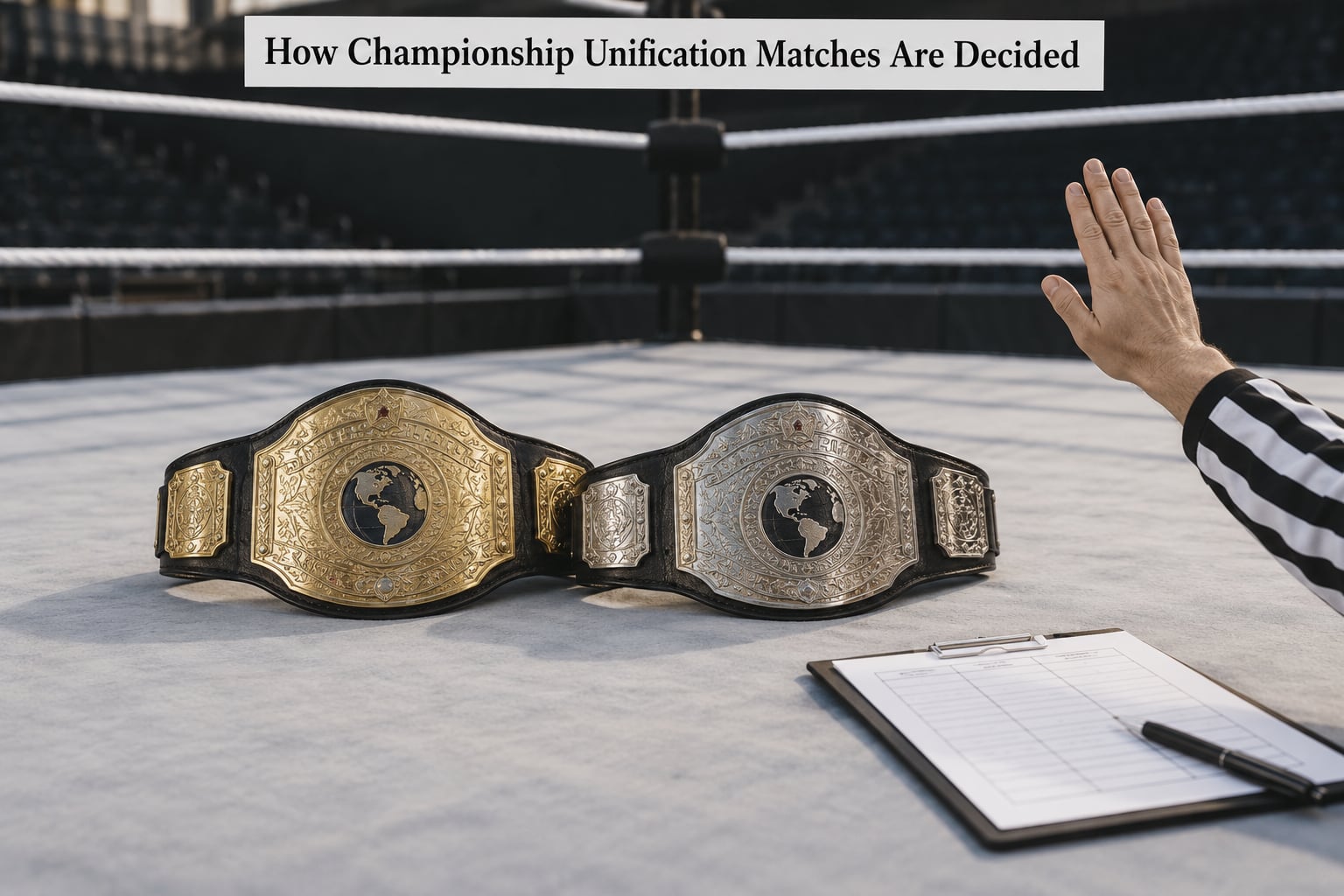
The standard win conditions apply. A unification match has no special finish of its own, so a competitor who wins by pinfall with both titles on the line becomes the holder of both. The same is true for a submission finish, a count-out, or a knockout in a no-disqualification match.
The stipulation changes which of those finishes is available. A ladder match offers climbing and retrieving a suspended championship as an additional route to victory, alongside a fall. Tables, ladders and chairs add weapon-based pinfalls and count-outs but usually remove the ability to win by submission or knockout. A Pure rules match strips out weapons, outside interference and the count-out, which usually leaves pinfall or submission as the only paths to a decision. A two out of three falls match stops after two pinfalls or submissions, and in a triple threat the two championships usually come as a package on one decision rather than needing separate falls.
Here is the part most guides skip. Winning the match settles the champion. It does not settle the titles. Once the bell rings, the promotion picks one of three paths for the championships, and that decision is announced separately, often weeks later, once a new belt design is manufactured.
The three outcomes are worth holding onto, because every lineage argument you have seen online is really an argument about which of these the promotion chose:
- One title is deactivated. The losing champion’s belt is retired and its lineage ends. Its history stays in the record books as a closed chapter, and the winning champion keeps a single belt with a clean history. This was effectively the approach used with the WCW World Championship lineage after the 2001 era of consolidation.
- A new championship is created. Both lineages are folded into a brand-new title with a fresh design and a new start date. The old belts leave the show, but the records survive as prehistory. The Undisputed WWE Championship built around SummerSlam 2022 works this way.
- Both lineages are preserved under one champion. Nothing is retired. One wrestler is simply recognized as the holder of both championships and defends them separately until a later date. This is what happened after WrestleMania 38 in 2022, and it remains the most confusing of the three for anyone tracking records.
That third option is the one that produces the head-scratching entries in official title histories, where a wrestler is listed as the champion of two championships that no longer exist as separate titles.
What Determines the Winner?
Every finish has something specific the referee has to observe. Once that observation happens, the impact on the two championships is almost always the same, which is why the table below reads as repetitive and is still worth reading.
| Victory condition | What the referee must observe | Effect on the championships |
|---|---|---|
| Pinfall | Both shoulders of the losing wrestler touching the mat, with a completed three count | Winner is champion of both titles |
| Submission | A verbal submission, or a hand or verbal response used while trapped in a hold | Winner is champion of both titles |
| Count-out | Wrestler outside the ring or under it fails to answer the ten count | Winner is champion of both titles |
| Knockout | Wrestler is unresponsive and cannot be woken before the count finishes | Winner is champion of both titles |
| Disqualification | A stated rule broken severely enough, such as a blindfolded wrestler being handed an illegal object or a manager interfering | Usually no champion, titles revert or are vacated pending a rematch |
| Elimination | Competitor is thrown over the top rope, through a table, or otherwise sent over the barricade in an elimination match | Last wrestler or team standing takes both titles |
| Time limit expiration | Bell rings at the announced limit with no finish | Usually a draw; the titles stay with their champions unless stated otherwise |
Disqualification is the row that generates the most confusion. When two championships are on the line and one champion is disqualified, the safe assumption is that no championship changes hands, because the disqualifying wrestler cannot win the title of the wrestler they fouled. Promotions differ on whether the other belt is affected, which is exactly why the announced stipulation matters more than a general rule.
A title match also has a time limit in most major promotions, usually ten minutes. When that limit expires without a finish, the standard outcome is a draw and both championships remain with their existing holders. Some promotions add a tiebreaker or a sudden-death overtime rule at the card level, and a few title matches are announced without a limit at all.
How Are the Championships and Stakes Selected?
The booker chooses the participants and the championships. Nobody earns a unification match on the strength of a ranking system, because there is no ranking system.
Which also means the winner is decided before the bell rings. Professional wrestling is a scripted entertainment product, and the finish of a unification match is decided in a production meeting like every other match on the card. What looks like competition in a unification is competition, but the outcome is not in doubt for anyone except the audience.
Practically, that shapes a lot of what you can predict. If a promotion has spent a year building a champion as the company’s centerpiece, a unification loss is off the table. If two championships need to be merged before a brand split, the promotion needs a winner it can move to either show. The stipulation gets chosen to fit the story: a no-disqualification finish when the winner needs to look legitimate, a weapons stipulation when the audience is expected to be skeptical, or a ladder match when the visual of two belts hanging above the ring is the whole point.
Participants can change before the match happens, and the replacement changes the math. If a champion is injured, a promotion has several options: postpone, replace the wrestler and keep the match champion versus champion, hold the unification with the belt holder’s chosen stand-in carrying the championship, or cancel it entirely. A champion who cannot wrestle may also vacate a championship rather than risk the belt’s credibility, which is different from being stripped of it after the fact. A stripped title was removed by the promotion over a rule violation or a contract breach. A vacated title was given up, usually because of an injury or a failure to appear.
The timing of the announcement matters for how a unification is received. Unifications announced well in advance with the graphic and the stakes stated get treated as a real main event. Unifications dropped in with no warning on a weekly show tend to read as an attempt to fix a division that was already in trouble.
Do Rules Change for Different Wrestling Promotions?
At the level of finish conditions, barely. Major promotions share the same core vocabulary: pinfall, submission, count-out, knockout, disqualification, and a draw at the time limit. What differs is which options the standard championship ruleset leaves open.
Traditional North American style usually allows submissions and count-outs in singles championship matches, with outside interference a variable rather than a permanent fixture. Japanese promotions have a long convention of count-out finishes counting the whole and requiring a wrestler to be touching the mat with both shoulders before the count ends, and many Japanese championships are defended under rules with no time limit. Independent promotions vary widely, and some run title rules where weapons are permitted from the bell.
Tag team championships have their own framework. A typical tag unification is a fatal four-way elimination, where both teams defend their championships simultaneously and the last team standing takes both. Elimination rules mean a single pinfall does not end the match, so a team can lose its own championship and still be in the contest for the other one, which produces very different title outcomes than a singles match.
Open challenge rules change the entry logic rather than the finish. Some unified championships are defended against any challenger who answers the challenge, so a unification can generate a long series of defenses instead of a single match.
One contrast is worth stating plainly because the two get mixed up constantly. A unification fight in boxing or MMA is not a scripted outcome. Those are genuine athletic contests where a decision, knockout or submission produces a real, unscripted result, and the promotions involved have no say in who wins. A unification match in professional wrestling is booked. Different word, completely different mechanism.
How Does the Unified Title Affect Future Matches?
A successful unification changes the division’s whole booking picture. The most obvious effect is the contender list. Two separate title scenes each had a top two or three. Now there is one champion and one list of challengers, and half of those names either get moved down the card or moved to another division entirely.
The second effect is on the champions who just lost. Some are immediately re-inserted into the picture as the number one contender, which keeps the division deep. Others are placed elsewhere and the division gets noticeably thinner. Fans tend to react badly to the second version because the unification was sold as fixing something.
The third effect is temporal. Unified titles have a habit of not staying unified. The WWE and Universal titles were recognized as held by one wrestler after WrestleMania 38 in 2022 but stayed formally separate for well over a year before a single new design replaced them. The Undisputed WWE Tag Team Championship, created in 2022, was split apart at WrestleMania XL in 2024, with each former lineage returned to its own team. Divisions get restructured far more often than titles get merged, and that mismatch is the main reason unifications do not always stick.
Confirmed outcomes and general possibilities are easy to blur together here. A specific unification in a specific promotion has a specific recorded result. Statements about what usually happens next are patterns, not rules.
How Championship Unification Matches Are Decided by Referees
The referee’s job is observation and rule enforcement, not selection. They watch for shoulders on the mat, count the count, watch for a hand tapping or a verbal submission, count to ten for a wrestler outside the ring, watch for an illegal object entering from ringside, and signal eliminations in an elimination match. They also decide whether a disqualifying offense is severe enough to justify ending the contest.
Referees do not decide which champion should win. They cannot see the script, they are not consulted on the finish, and the person calling the match in the production meeting has already made that call. A referee who appeared to hesitate on a count is not a plot twist about the outcome.
Can a Unification Match Have More Than One Winner?
Yes, and it is more common than most newcomers expect. Several endings leave both championships without a single undisputed holder.
A draw at the time limit is the cleanest case. Both champions walk out still holding their own championship and the question of consolidation is deferred, usually to a rematch clause or a tournament bracket announced later.
A no-contest ending happens when the match cannot continue. An injury, an in-ring object that cannot be removed, or a disqualification deemed insufficient to decide anything can produce it. Nothing changes hands.
A disqualification with two titles on the line can also leave the result ambiguous. The offending wrestler cannot take the other champion’s title, and whether their own championship survives the ruling depends on how the match was announced. This comes up in fan arguments constantly because the announcement is often shorter than the argument.
In a triple threat or fatal four-way, two wrestlers can win different championships from the same match if the stipulation allows separate belts to be decided by separate falls. It is unusual and it is a mess for anyone maintaining a title history, but it is legal.
What Happens If a Unification Match Has No Winner?
Nothing is decided, and the promotion picks a resolution. There is no universal rule here, and the choice is a booking decision like any other.
The most common resolution is an immediate rematch, sometimes with a date and stipulations already attached. A time-limit draw in a unification almost always gets this answer, and the rematch is frequently announced with a steel cage or the ropes taped shut to force a finish.
A tournament is the other frequent answer. If the promotion has several titles or contenders to sort out, it runs a bracket and makes the unification its final. The 2001 WWF and WCW consolidation is the example fans still bring up for this structure, because the stakes were built across three matches rather than compressed into one.
A decisive contest or a split can also resolve it. One championship goes to one wrestler and the other to a different one, with the promotion treating the failed unification as a storyline rather than an error. A no-contest ending sometimes leads to the titles being held separately while a new rivalry is built from the incident.
There is no industry-standard playbook. Two promotions facing the same situation can take two completely different routes and both be defensible as booking.
Frequently Asked Questions
Who decides the winner of a championship unification match?
The promotion does, and it is decided before the bell rings. Professional wrestling is scripted, so the finish of a unification match is set in a production meeting well ahead of the event. The stipulation is also chosen in advance to suit the intended result, such as a no-disqualification finish when the winner needs to look legitimate.
Can a championship unification match end in a draw?
Yes. Most major promotions put a time limit on championship matches, and when the bell rings at that limit without a pinfall, submission, count-out or knockout, the result is a draw. Both champions keep their own championship. Promotions usually follow a draw with an announced rematch rather than leaving the division unresolved for long.
Does the winner of a unification match get both belts?
Usually yes. Winning the match transfers both championships to the winner, who is then recognized as holding both. Whether one belt is retired, a brand new championship is created, or both lineages continue under a single champion is a separate announcement the promotion makes afterward, and it can take weeks while a new belt is manufactured.
Can someone wrestle in a unification match as a substitute champion?
It happens, and the replacement changes the outcome. If a champion is injured or unavailable, a promotion may use a stand-in carrying the championship, replace them with a different wrestler entirely, or cancel and vacate the contest. That last option is why an injured champion may vacate a championship rather than risk the belt’s credibility.
Can unified titles be split apart later again?
Yes, and it happens often. Brand splits, roster moves and fresh storylines all break unifications apart. A single title can be retired or deactivated without splitting, but some promotions separate the lineages again and award each to a different wrestler, which is what happened to the Undisputed WWE Tag Team Championship at WrestleMania XL.
Conclusion
How championship unification matches are decided comes down to two separate questions that fans routinely bundle together. The first is the finish, and it is ordinary: pinfall, submission, count-out, knockout or disqualification, exactly as in any other match, with the winner taking both championships that were on the line.
The second is what the promotion does with the two titles afterward, and that is a booking decision, not a rule. One belt gets deactivated, a brand new championship gets created, or both lineages continue under one champion. Nothing in the match itself forces that outcome.
If you are arguing about a specific finish, check the event’s announced rules and the official title history for the result before drawing a conclusion. Half the disputes I have seen trace back to a stipulation nobody read or a record that took months to be amended.
Last updated: October 2026