A run-in changes a wrestling match ending when someone who is not a legal participant enters the action and breaks the rules at the wrong moment. Because interference is illegal, the referee can stop the bout and disqualify the wrestler who benefited, converting a pinfall or submission that was already in progress into a DQ, a double DQ, or a no contest with no official winner. If you have watched a match where the obvious winner lost to a distraction, here is what actually happened in the rules.
The phrase search behind that question gets crowded with football results, so it is worth being blunt about the subject: this guide is about professional wrestling, the scripted athletic theater that the industry calls sports entertainment. Wrestling has five normal ways to score a fall, and a run-in exists specifically to interfere with the one about to be scored.
No single authority governs interference in wrestling. Each promoter writes its own rules, which is why the same shove can be waved off in one company and ring the bell in another. Hold that fact in mind and the rest of the mechanics fall into place.
Table of Contents
- What Is a Run-In in Professional Wrestling?
- How a Run-In Changes the Momentum of a Match
- Common Ways a Run-In Can Change the Finish
- Why Wrestling Promoters Use Run-Ins
- How to Tell a Planned Run-In from a Real One
- Frequently Asked Questions
- What is a DQ in wrestling?
- What gets you disqualified in wrestling?
- Can a run-in make a match a no contest?
- What happens if both wrestlers’ allies interfere?
- What move is banned from WWE?
- Why did WWE stop using run-ins so often?
- Conclusion: Start by Watching the Interruption
What Is a Run-In in Professional Wrestling?
A run-in in professional wrestling is when a non-participant, such as a manager, second, ally, or interfering heel, enters the ring or apron area during a match and strikes, grabs, or otherwise touches a competitor, breaking the match rules and typically altering who is supposed to win.
That definition is the snippet-shaped answer. The part people miss is who gets punished for it, and the honest answer is that it depends entirely on who the referee wants to win.
A run-in is not the same thing as a legal save, and the difference explains most fan confusion:
- Run-in: a non-participant touches a competitor, or attacks the referee, or enters the ring illegally. The offence exists and the referee may call for a disqualification.
- Legal save: a teammate who is legally in the match, usually a legal tag-team partner, breaks a pinfall or stops a submission in progress. No foul is committed because the partner has a right to be in the ring.
- Manager distraction: a manager on the apron argues, waves a towel, or makes noise near the referee to break a competitor’s focus without ever entering the ring or touching anyone. This is legal, and it is a different beat entirely.
- Post-match assault: an attack after the bell has already rung. It changes nothing about the official result, though it frequently sets up the next match.
One exception covers the case where a manager briefly grabs a competitor and is ordered to leave the ring, with the match continuing. Same physical act, no disqualification. That inconsistency is the single biggest source of arguments about run-ins, and it comes down to the promotion’s ruleset rather than any universal principle.
How a Run-In Changes the Momentum of a Match
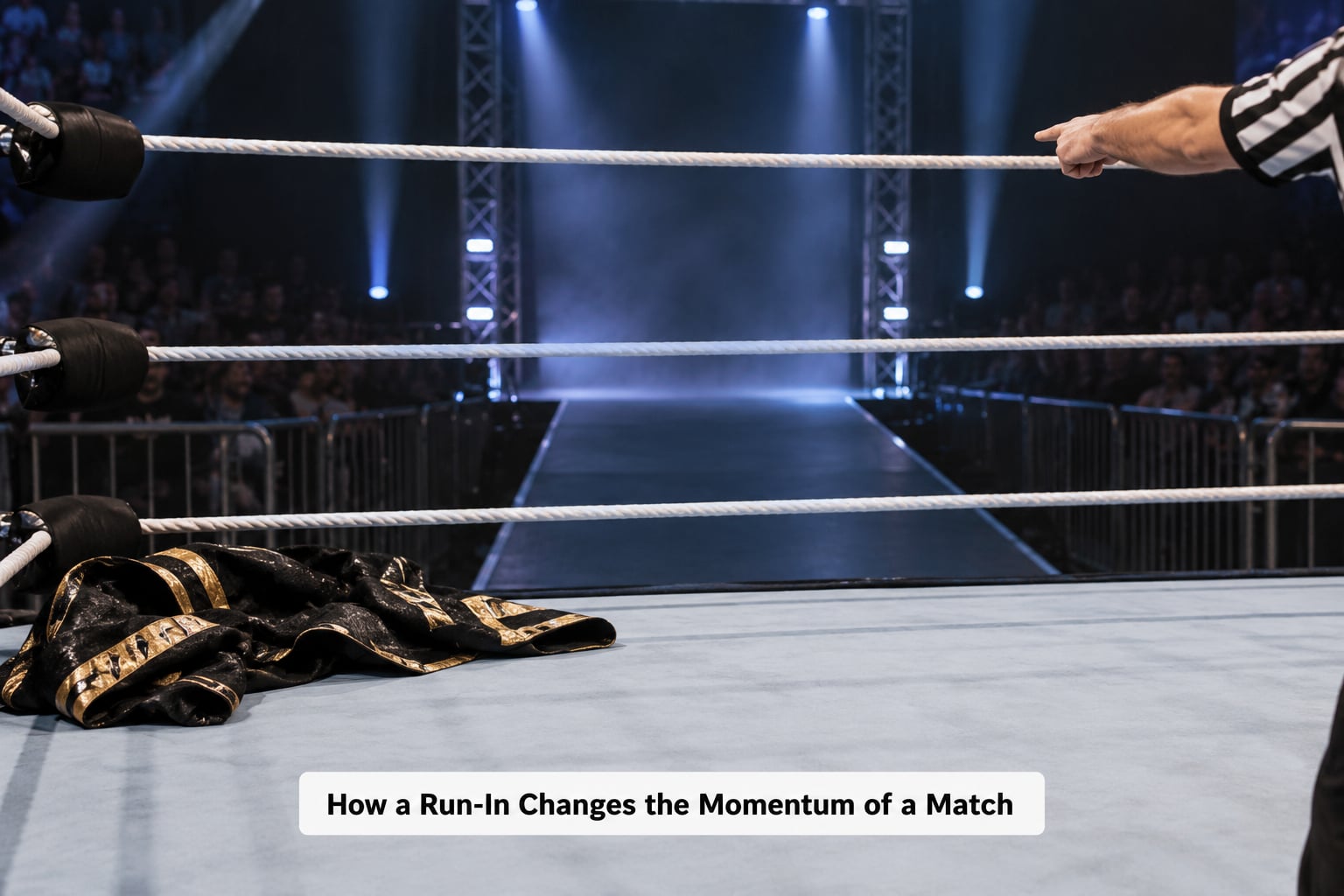
The immediate effect is that control changes hands, sometimes in under a second. A wrestler who has had the other one pinned, working through a submission, or running out the clock suddenly finds someone else deciding the outcome.
Momentum shifts in four ways at once, and they happen together:
- Loss of control. The person who was winning stops being the one dictating terms. His finisher gets interrupted, or his corner gets pulled into it.
- A crowd swing. A heel’s run-in usually produces heat, and a face’s save usually produces a pop. The same physical interruption can swing the room in opposite directions depending on who did it.
- A strategy change. Often the losing wrestler instantly reverses the role, now playing defense, and the match becomes a different contest from where it was thirty seconds earlier.
- The possibility of reversal. The run-in creates an opening for a new outcome, which may or may not be taken. A referee distraction that breaks the cover can be a gift to the wrestler who was about to be pinned, or a wasted chance if the distracted wrestler has no legal partner.
The dramatic tension also changes. A match that was building toward a clean finish suddenly carries a question: is the referee watching the right thing, and how long can the referee be distracted before the plot demands something louder?
Jim Ross put the argument plainly when discussing why rule-breaking still matters: heels need rules to break. Without a referee, a no-DQ stipulation, or an illegal maneuver that carries consequences, an antagonist has no tools. The run-in is a deliberate pressure valve, not an accident.
Common Ways a Run-In Can Change the Finish
Start with the baseline. A wrestling match ends one of five ways when nobody breaks the rules:
| Finish | What causes it | Can a run-in produce it? | Effect on the announced result |
|---|---|---|---|
| Pinfall | Shoulders held down and counted to three | Yes, by breaking a cover before the third count | Usually none if the count stops; a stolen cover can hand the win to the wrong wrestler |
| Submission | Tapping out to a hold | Yes, by attacking the arm or the referee mid-hold | Converted to a DQ if the tap was forced by illegal interference |
| Count-out | A wrestler is out of the ring or over the ropes when the count reaches ten | Yes, by throwing a wrestler outside or blocking a legal re-entry | The win can reverse; sometimes the team or manager does the throwing |
| Knockout | A wrestler cannot answer a ten-count after legal contact | Rarely, and only if the interference is a legal strike | Rarely the intended result of a run-in |
| Disqualification | Breaking a rule the promotion has codified | Yes, this is the most common outcome | The win is awarded to the other wrestler, or to nobody in a double DQ |
Now the five outcomes a run-in can force. Each one is a real finish that has been announced on a televised show:
- Single disqualification. The referee sees the illegal act and calls for a DQ. The disqualified wrestler loses, even if they were seconds from winning. The Hulk Hogan and Randy Orton main event at WrestleMania 18 in 2002 ended without a pinfall after illegal chair interference pulled the referee away, and it remains one of the most debated results of that era.
- Double disqualification. Both corners interfere and the referee disqualifies both, or disqualifies the wrestler who was saved for something they would have won anyway. At WrestleMania III, Randy Savage’s attack on the Honky Tonk Man with the championship microphone while the referee was looking away produced a double DQ and a draw. It protected the championship while giving neither man the win.
- No contest. A match can be declared no contest or a draw when the result cannot be fairly determined, often because a disqualifying act happened before or during a decisive moment, or because a competitor could not continue. Legally, nobody wins, and any championship on the line stays where it was.
- Count-out reversal. A run-in that throws the other wrestler out of the ring, or that pulls a wrestler away from a legal re-entry, can convert a comeback into a counted-out loss. The tag team equivalent is throwing a legal partner outside so his tag cannot happen.
- Reversal after the bell. The bell rings, the result is announced, and then the run-in happens anyway as a post-match attack. The official scoreboard does not change. What changes is the next match, the crowd’s anger, and often the loser who now has a reason to come back.
There is a sixth possibility worth naming because it frustrates fans most often. The run-in happens, the DQ is called, and the fan who watched a legitimate pinfall now watches a wrestler be robbed of a clean win. Wrestling forums describe this as a finish robbery, and the criticism is fair: a DQ is a real finish, but a poor one when it exists only to stop a good match from ending properly.
Why Wrestling Promoters Use Run-Ins
The answer is not that a run-in fixes a bad match. It is that a run-in converts a result into a reason for the next match.
Protecting a planned finish. Sometimes the booked outcome cannot happen on the night. A champion is injured, a debut goes long, a script gets rewritten in the dressing room after a match. Rather than change the announced result on the fly, the referee can be distracted, a bell can be missed, and the segment can end without a clean finish, keeping the original plan intact.
A heel reveal. The highest-value payoff in wrestling history came from a run-in that turned into a turn. Paul Orndorff saved Hulk Hogan at WrestleMania III, then followed him with the Annihilator after the bell. An ally became a villain in one sequence, and the crowd went from cheering the rescue to booing the man who performed it.
Rewarding an ally. A manager who has spent months losing on television gets one moment of relevance when their wrestler is losing anyway. It builds heat for that manager and keeps them attached to a wrestler nobody wants to watch.
Making a face look vulnerable. A babyface who is about to win cleanly and then gets stripped of it looks like a victim, which raises the stakes for the rematch. This is also why the same device applied to a face can cost credibility if the crowd expected better.
Tag team matches, historically. Tag ropes and the rule that a legal partner could be in the corner created a natural home for interference. A team could legally double-team, and an illegal run-in was a way to escalate past even that. When tag ropes were removed from major promotion ring setups, part of what went with them was the structural excuse for a heel corner to run in.
None of this is a secret to the audience. Wrestling is performed, and the convention of kayfabe means the crowd accepts the fictional frame while evaluating the execution. A worked run-in that pays off is praised. A run-in used because the booking had nothing else is the version that draws criticism, and Jim Ross’s point about heels needing rules to break is a defense of the tool, not a defense of every use of it.
How to Tell a Planned Run-In from a Real One
Because the result is announced rather than fought for in any rule-governed sense, there is no way to be certain from home. What you can do is read the setup and know which ruleset you are watching.
Entrance timing. A planned run-in usually has someone visible or audible before it happens. A jacket thrown onto the ring apron, a silhouette on the entrance ramp, or music cutting out early all give the crowd a half-second of warning. A genuinely unplanned run-in usually has none of that.
Camera work. The hard camera holds a wide shot through the interference rather than cutting to the attacker, which lets the audience see the whole thing. When a broadcast cuts away to someone reacting at ringside right before the bell rings, that reaction is part of the story, not incidental.
Commentary. A play-by-play announcer saying something is getting away from the official, or using words like illegal and distraction instead of describing the hold, is telling you how the finish will be scored.
Crowd reaction. A planned run-in lands as pop or heat in a specific shape. A face being attacked gets boos for the attacker, and a heel being saved gets cheers. When the crowd is flat, the interruption was not built for them.
Body language of the referee. The official who glances toward the announce table or deliberately looks away is signaling that the result is being decided elsewhere. A blip in a match, by contrast, is usually a genuine referee error: a broken cover, a missed interference, or an impact the official did not see.
Here is the part most guides skip, and it is the answer to whether a run-in is even a foul tonight. Rules vary by promotion and by stipulation:
- Standard rules: interference is a disqualifying offence, and the referee has discretion over when to call it.
- No DQ stipulations: any and all interference is legal. The run-in still changes the match, but it cannot change the result, because there is no disqualification.
- Pure Rules style stipulations: closed-fist strikes, closed-eye attacks, and interference are treated as disqualifying, and the restriction is usually stated and enforced at the bell.
- First-fall matches: a team only needs one fall, so a run-in that would be survivable in a best-of-three match can decide the whole contest, which is exactly how the Hart Foundation and the British Bulldogs finished their two-of-three falls match at WrestleMania III with the Bulldogs taking the first fall by disqualification.
Professional wrestling has no governing body. Each promoter sets its own rules, and the same interference can be a DQ in one company, a warning in another, and a legal tactic in a no-DQ match. That variation is not a loophole, it is the actual state of the industry.
Frequently Asked Questions
What is a DQ in wrestling?
A DQ, or disqualification, is a match-ending ruling handed to a wrestler who breaks a codified rule. The other wrestler is awarded the win, usually by count-out or by forfeit. In wrestling a DQ is a real finish, not a protest, and it counts toward a wrestler’s record the same way a pinfall does.
What gets you disqualified in wrestling?
Common disqualifying offences include outside interference by a manager or teammate, striking the referee, entering the ring illegally, using a banned substance, and leaving the ring during a count-out in most promotions. The specific list belongs to the promotion, because there is no single governing body. Stipulations such as no DQ reverse the whole list.
Can a run-in make a match a no contest?
Yes. When a disqualifying act happens at a decisive moment, or when a competitor cannot continue because of what happened, a referee can declare the bout a no contest or a draw. Nobody is awarded the win and any championship involved stays where it was. Promotions use this when they want to keep a finish in reserve.
What happens if both wrestlers’ allies interfere?
That is a double disqualification. If both corners break the rules and neither side is clean, the referee can disqualify both competitors, leaving the match with no official winner. The Randy Savage and Honky Tonk Man match at WrestleMania III ended this way after a microphone attack while the referee was distracted.
What move is banned from WWE?
There is no published list of banned moves. Promotions restrict certain weapons and dangerous maneuvers, restrict specific finishing moves in some divisions, and rely on referee discretion for everything else. Referees in WWE are trained and monitored on specific things they cannot miss, but a wrestler is rarely disqualified for the move itself, rather for an illegal interference or weapon.
Why did WWE stop using run-ins so often?
Run-ins were never banned outright, they were priced out of most matches. Tag ropes were removed from ring setups, matches got shorter, and finishes moved toward clean pinfalls because shorter cards leave no room for a payoff that requires another match. Jim Ross’s argument that heels need rules to break is the standard defense of the tactic among longtime viewers.
Conclusion: Start by Watching the Interruption
A run-in changes a wrestling match ending by converting one finish into another, or by removing the winner entirely. Watch three things in order: what the run-in interrupted, whether the legal result changed, and whether the announced winner actually moved.
If the finish was a pinfall and the bell never came, that is a broken cover or a robbery. If the finish was a DQ, a no contest, or a count-out reversal, then the interruption decided the result and the story around it was built on purpose. Everything else is the crowd arguing about a rulebook nobody wrote down.