Wrestling pay per views moved to streaming because the old cable model stopped making money: each event used to be bought one at a time, and the promotions found that a flat monthly subscription delivered more reliable income. That is how wrestling pay per views moved to streaming, in stages, from cable buys to WWE Network in 2014, then Peacock, then a split between Netflix outside the United States and ESPN platforms inside it.
The word pay-per-view is now mostly nostalgia. WWE renamed its events Premium Live Events because you no longer buy them individually, and other promotions followed with their own naming. What replaced the per-event purchase is a subscription, and the practical question for any fan is simple: which service holds what, and where did the archive go?
Table of Contents
- Why Did Traditional Wrestling Pay-Per-Views Decline?
- How Wrestling Pay Per Views Moved to Streaming
- 2014-2015: WWE Network and the End of the Regular PPV
- 2016-2019: AEW’s Arrival and WWE’s Tiered Options
- 2020-2023: Streaming Becomes the Mainstream
- 2024 and Beyond: The Shift to Flexible Wrestling Pay Models
- What Changed for Wrestling Fans?
- Did Streaming Replace Every Wrestling Pay-Per-View?
- Frequently Asked Questions
- What was WWE’s last traditional pay-per-view?
- Which was the first WrestleMania available on WWE Network?
- Why did AEW keep pay-per-view events while WWE canceled them?
- Is WWE Network the same service as Peacock?
- Can you still buy major wrestling events separately?
- Where should wrestling fans watch events after streaming became standard?
- Conclusion
Why Did Traditional Wrestling Pay-Per-Views Decline?
Three things broke at once, and no single one of them would have ended the cable pay-per-view.
First, buy rates fell. A pay-per-view was a one-time purchase for a fan who was already paying a cable bill every month, so each event needed its own marketing push and a fresh excuse to spend. Promotions watched those numbers slide for years while the events themselves kept growing in stature.
Second, the audience changed habits. Streaming moved from a convenience to the default way people watch, and the generation that paid sixty dollars for a Sunday night in 2004 already had cord-cutters for parents.
Third, an event is a good tentpole but a bad product. A live show draws viewers, sells merchandise, fills arenas and drives season-ticket demand. Wrapping it in a subscription turns that spike into recurring revenue instead of a one-off spike, and it gives the promoter a library nobody has to re-market.
That last point is why the live crowd never went away. Arenas still sell out, the same marquee nights still feel like nights out, and promotions still build story arcs toward them. What changed is the transaction at the other end of the television, not the crowd in the arena.
How Wrestling Pay Per Views Moved to Streaming
The shift was not one event or one promotion. It was a decade of separate decisions by different companies, and the table below is the quickest way to see how wrestling pay per views moved to streaming from a cable box to an app.
| Era | Platform | Launch | Business model | What changed |
|---|---|---|---|---|
| Cable era | Cable and satellite providers, on-demand ordering | Through the 1990s and 2000s | One purchase per event | Fans bought every show separately |
| WWE Network | WWE’s own streaming service | February 2014 | Flat monthly subscription, events included | The regular monthly pay-per-view ended |
| Post-Network shift | WWE content on third-party services outside the US | 2016 onward | Regional partnerships, varying tiers | Event access began to depend on tier and country |
| Peacock era | NBCUniversal’s Peacock, US | 2021 | Premium tier with events included | WWE Network was retired as a standalone service |
| International Netflix | Netflix, most countries outside the US | January 2025 | Standard subscription, every event included | International viewers got one flat service |
| US ESPN move | ESPN’s direct-to-consumer platforms, US | September 2025 | Premium tier, plus simulcast on linear networks | The US split away from the rest of the world |
2014-2015: WWE Network and the End of the Regular PPV
WWE Network launched in February 2014 with a message that was simple enough to write on a banner: every pay-per-view is included. The monthly special, the quarterly special, the big four, all of it, in one subscription.
The company retired the traditional monthly pay-per-view almost immediately. Events that had been an every-other-Sunday purchase for two decades became part of the subscription, and the language changed with them. WWE calls them Premium Live Events now because nothing is bought at the point of the event.
Two years in, the biggest nights had moved to the platform too. WrestleMania 31 in 2015 was the first WrestleMania to air on WWE Network, with Sunday and Monday night shows sold together as a package. By then, buying a card à la carte felt old-fashioned to most fans, and the company stopped offering it in the US.
Longtime fans still argue that this was the sweet spot, and there is some truth to it. One modest monthly fee, no price spikes before a big match, and an archive that grew every year. On r/SquaredCircle and r/WWE, people still describe the WWE Network era as the last stretch when following all of wrestling felt affordable.
2016-2019: AEW’s Arrival and WWE’s Tiered Options
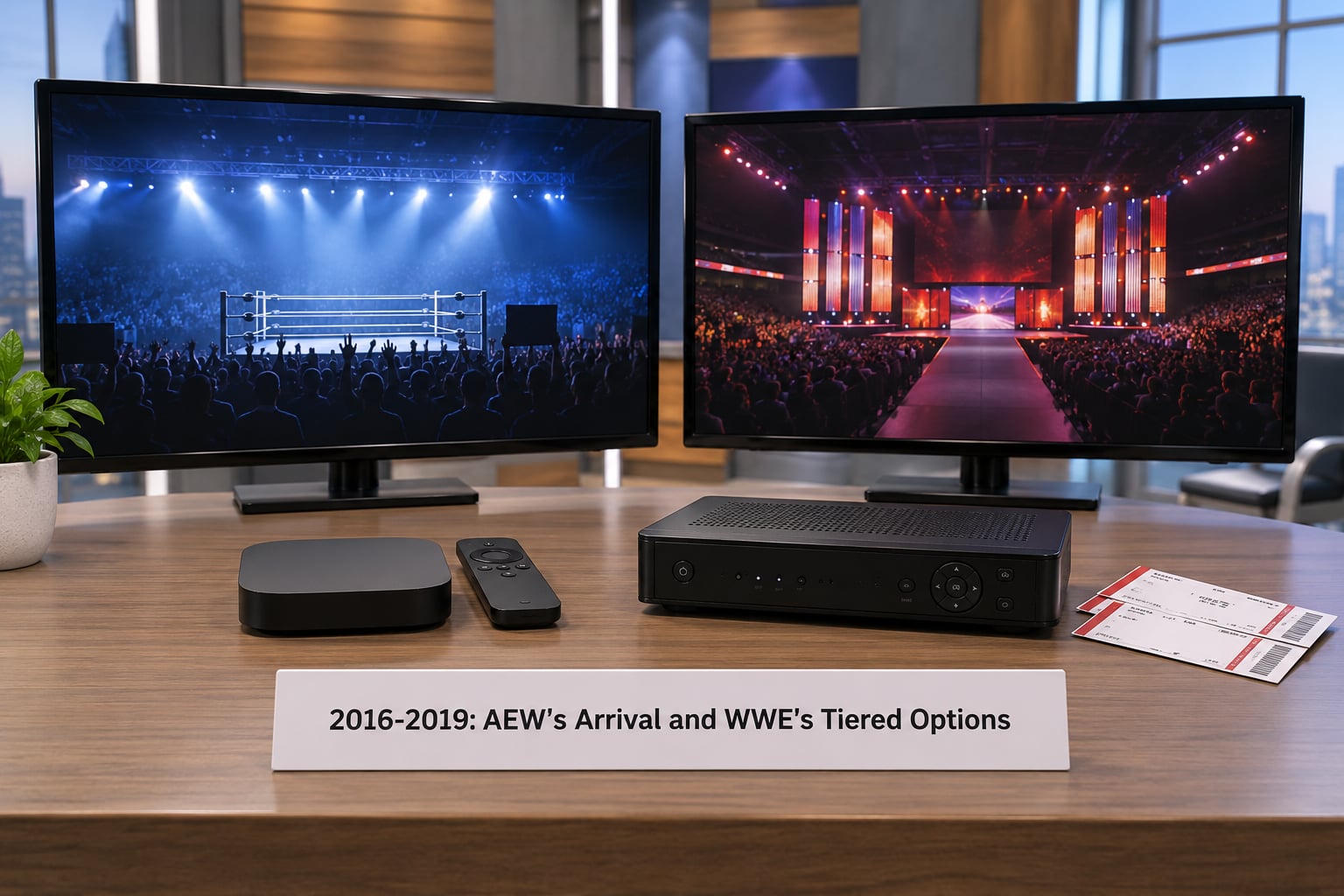
AEW launched in 2019 and changed the argument. It did not arrive with a cheap subscription, it arrived with events that had to stand on their own, so pay-per-views became a way to prove a new promotion could draw a crowd on its own terms rather than borrow a fan base from somewhere else.
Meanwhile WWE kept moving content around. UK viewers were sent to a different partner than US viewers, Canada landed somewhere else again, and events started sitting behind different subscription levels depending on where you lived. A fan who wanted WrestleMania and a fan who wanted Raw could be looking at two different services in two different countries.
This is the part of the shift people forget: streaming did not produce one global home for wrestling. It produced a patchwork where the same event had a different address depending on your region, which is where a lot of the confusion still comes from.
2020-2023: Streaming Becomes the Mainstream
The pandemic removed the last argument against remote watching, and promotions used that window to experiment. Empty arenas made live crowds harder to sell, so the product became the stream rather than the building.
WWE Network shut down as a standalone service in 2021, and its content moved into Peacock, where events sat in a premium tier rather than being sold one at a time. The company stopped owning the customer relationship and rented space inside somebody else’s app, which is a very different business from running your own subscription.
AEW took the opposite route. It kept events individually purchasable alongside a bundled tier, gave viewers a broad free-to-air show to build habit around, and let the live audience stay central. That structure is still how the promotion sells itself, and it is the clearest example of streaming hosting a pay-per-view instead of replacing one.
2024 and Beyond: The Shift to Flexible Wrestling Pay Models
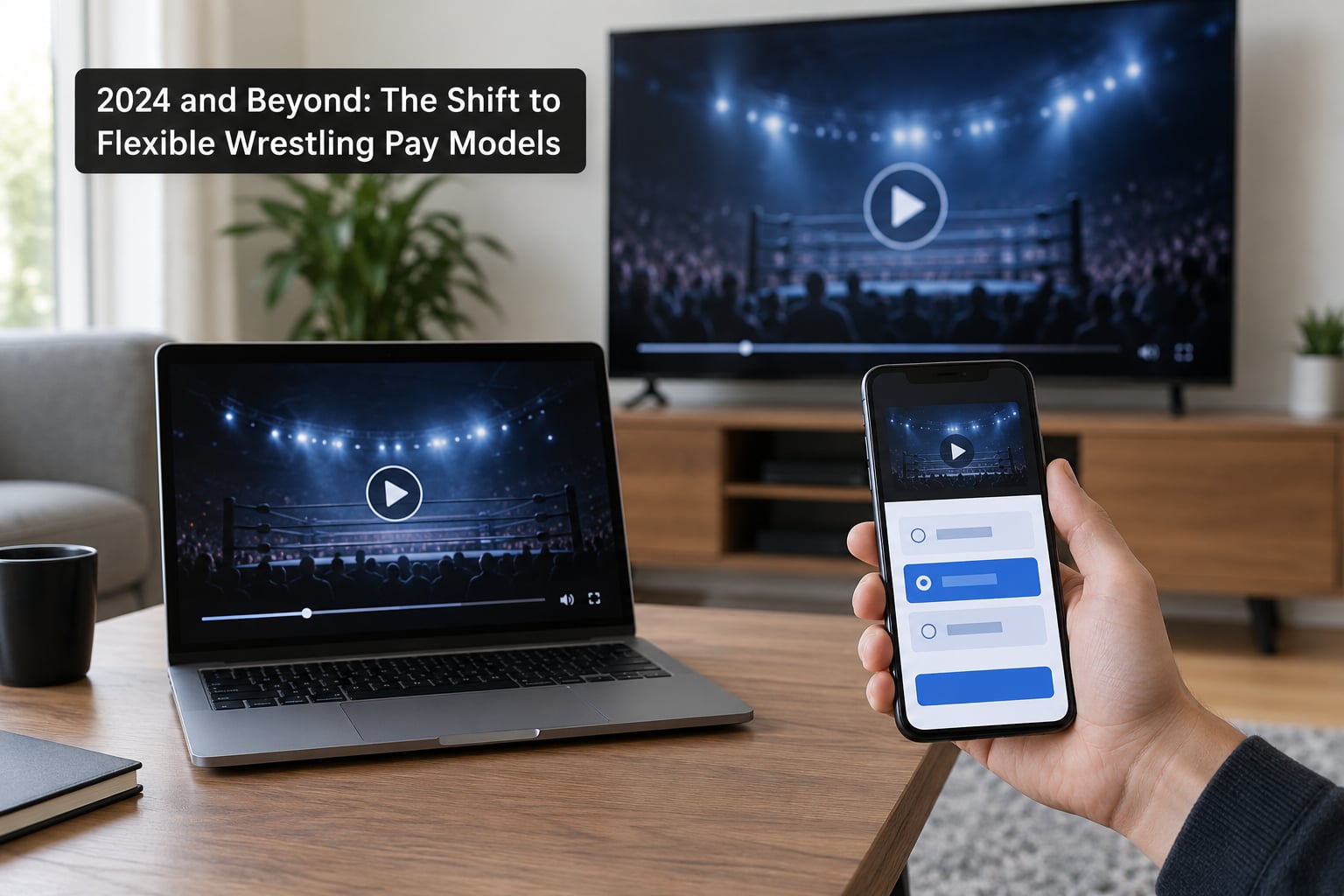
The most recent phase split wrestling by geography. From January 2025, Netflix carried WWE programming and every Premium Live Event across most countries outside the United States, replacing a patchwork of regional partners with one subscription.
In the US, WWE events moved to ESPN’s direct-to-consumer platforms in September 2025, starting with Wrestlepalooza, while events also simulcast on ESPN’s linear networks. The US is the odd market out now, which is the single most common source of confusion among fans in other countries reading the same headlines.
The back catalog fractured along the same lines. The older library landed on Netflix in the US, WWE Network-era programming stayed available outside the US, and the newest events stay with whichever service holds current rights. Libraries from acquired promotions such as WCW and ECW are less certain, and nobody has announced a permanent home for all of it.
| What you want to watch | Where it generally lives | Watch for |
|---|---|---|
| Current WWE events in the US | ESPN direct-to-consumer platforms, with linear simulcasts | The newest cards appear here first and stay here longest |
| Current WWE events outside the US | Netflix | Regional availability differs by country |
| Older WWE event archive in the US | Netflix, a partial selection | The very newest events are not in the back catalog |
| WWE Network-era shows outside the US | Regional streaming partners | Availability varies by country |
| AEW events | The promotion’s own services and its free-to-air show | Some events are sold separately as well as in a bundle |
| WCW and ECW archives | Unsettled | Destinations change with each new rights deal |
Rights move. That is the part to hold onto, and it is why anyone still puzzling over a specific card should check the promotion’s official service page before planning a watch night.
What Changed for Wrestling Fans?
The experience is not simply better or worse than the cable days. It is a different set of trade-offs, and the same fan can win on one line and lose on another.
| Factor | Old cable model | Streaming model |
|---|---|---|
| Cost shape | A large jump before every big show | A steady monthly payment year round |
| Event access | Buy any card you want, skip any you do not | Mostly bundled, occasionally a separate tier |
| Platform control | Your cable provider decided what aired | The promotion picks the service and the region split |
| International viewing | Often delayed or cut entirely | Usually available, sometimes months behind the US |
| Old events | A disc or a deep catalog search | Split across two or three services, or nowhere |
| Rewatching a live event | DVR, then on-demand later | Usually a replay window, with little rewind during the show |
The rewind point stings more than people expect. On streaming, a live event is genuinely live, so if you miss ten minutes you often cannot jump back until it has finished. Cord-cutters and screen-recorder communities built whole setups around that gap before the major services added any kind of pause or rewind.
The archive point is the other one. No single service holds the full history of wrestling, and the newest events are usually the hardest to find later because they sit with the current rights holder first. A fan who watched a live show in 2026 can be told a year later that the service carrying it has changed hands.
Did Streaming Replace Every Wrestling Pay-Per-View?
No. Streaming replaced the ecosystem that surrounded pay-per-views, cable ordering, the monthly special, the separate purchase. It did not eliminate the idea of paying for a premium wrestling event, because for at least one major promotion that event is still the point.
AEW sells its marquee shows individually as well as through a subscription, and that structure has held up. Some promotions and independent brands also sell ad-free single-event passes, which is a format that only makes sense in a streaming world.
So the honest answer to how wrestling pay per views moved to streaming is that the dominant model changed and one exception survived on purpose. Bundled access is now the default, and paying once for one night remains a real option for promotions that want the event itself to be the product.
Frequently Asked Questions
What was WWE’s last traditional pay-per-view?
Starrcade in 2007 is generally treated as WWE’s final event sold purely as a pay-per-view. Some markets kept buying TLC as a pay-per-view for a couple of years after that, and WrestleMania XXVIII was offered as a pay-per-view in a few international territories in 2012. From 2014 onward every major event came with a subscription instead of a separate purchase.
Which was the first WrestleMania available on WWE Network?
WrestleMania 30 in 2014 was the first WrestleMania carried on WWE Network, arriving just weeks after the service launched in February 2014. It was included with the subscription rather than sold on its own, and the following year’s WrestleMania 31 deepened the pattern with a two-night package sold as a bundle. Both set the template for the streaming era.
Why did AEW keep pay-per-view events while WWE canceled them?
The two promotions faced different problems. WWE owned a decades-old fan base and a monthly special that audiences already treated as routine, so bundling it cost less revenue than it gained. AEW launched later and needed events that proved a new company could fill arenas on its own, so individually sold shows became both a revenue stream and a statement. AEW has kept both individual sales and a subscription tier.
Is WWE Network the same service as Peacock?
No. They are separate services at separate times. WWE Network was WWE’s own streaming product, which launched in February 2014 and ran until 2021. When it shut down, WWE’s content moved into Peacock in the United States as part of a premium tier, while other countries went to different partners. WWE Network no longer exists as a standalone subscription today.
Can you still buy major wrestling events separately?
Yes, depending on the promotion. AEW continues to sell its premium events individually alongside a bundled subscription, and some independent brands offer ad-free single-event passes. WWE no longer sells its Premium Live Events one at a time; they are included with a subscription. Promotions and platforms change these arrangements regularly, so check the promotion’s own listing before you plan around a specific card.
Where should wrestling fans watch events after streaming became standard?
It depends on the region and the promotion. In the US, WWE events moved to ESPN’s direct-to-consumer platforms in September 2025, while most other countries moved to Netflix in January 2025. AEW events sit with the promotion’s own services. Because rights and availability shift between territories and change with each deal, the official service page for your promotion is the reliable answer.
Conclusion
Wrestling pay per views moved to streaming for a simple business reason: a subscription pays more reliably than twelve separate purchases, and the events themselves never got smaller. Cable gave way to WWE Network, then to Peacock, then to a world where Netflix serves most countries and ESPN platforms serve the US.
What that costs fans in practice is a steadier bill and a messier archive. Before you sign up for anything, check your promotion’s official service and event listings for your country, since both the platform and the price move when contracts change.