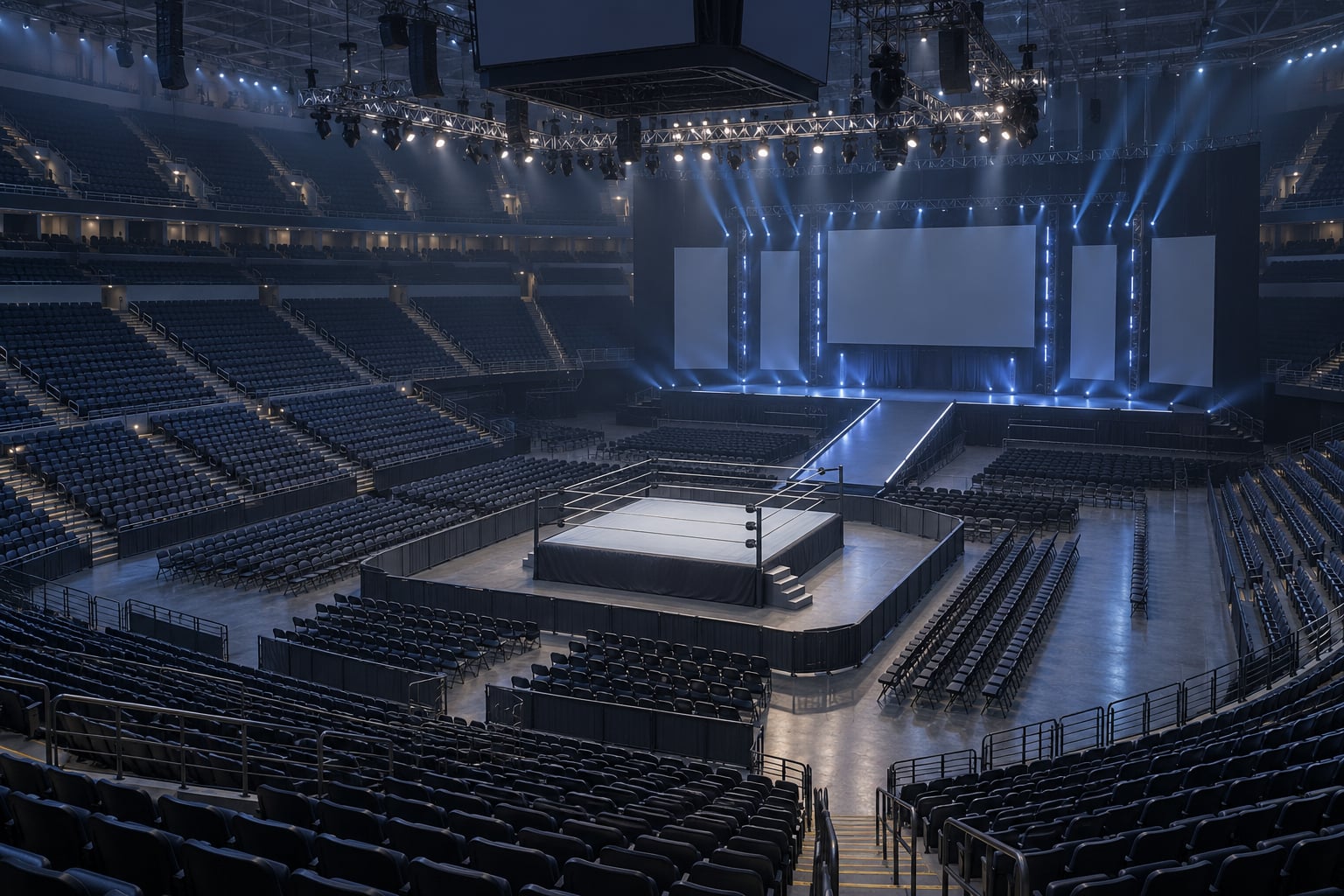
Arena capacity affects a wrestling show far more than the number on the door suggests. It decides how much of the room can see the ring, how many people it takes to make that room loud, how long the card can run before the crowd goes slack, and how much ticket revenue the promoter can realistically book. A promotion running the same roster in a 1,500-seat club arena and a 15,000-seat arena is not running the same show twice.
The useful number is not the building’s seating capacity. It is the crowd-to-ring ratio: how many people are close enough to the ring for their reactions to register on camera and in the building. Get that ratio wrong and everything downstream goes wrong, from pacing to profit.
Table of Contents
- What Is Arena Capacity in Professional Wrestling?
- How Arena Capacity Affects a Wrestling Show at a Glance
- How Capacity Changes Ticket Demand and Sales
- Why Attendance and Sellouts Are Different Measures
- What Capacity Means for Revenue and Profit
- How a Larger Venue Can Change the Show
- Does Arena Capacity Affect Wrestler Performance?
- How Promoters Should Choose the Right-Sized Arena
- Frequently Asked Questions
- Does a bigger arena make a wrestling show better?
- Why does a packed arena look half empty on television?
- Why is a 4,500 capacity arena only set up for 1,461 people?
- What is the difference between tickets distributed and paid attendance?
- Is WWE attendance decreasing?
- What is the largest attendance figure for a wrestling event?
- Conclusion: Match the Venue to Real Demand
What Is Arena Capacity in Professional Wrestling?
Arena capacity is the number of spectators a building can hold. In wrestling it is the least interesting of four numbers, and confusing it with the other three causes most of the arguments you see online.
Here is the vocabulary the rest of this article uses:
- Building capacity — the venue’s official maximum, usually configured for concerts with floor seating.
- Wrestling configuration capacity — how many seats exist once the floor is rebuilt into a bowl around the ring, with a ramp, camera platforms, lighting and production load-in taking up footprint.
- Tickets distributed — what the promoter gave away or sold, including comps, giveaways, group buys and paper.
- Paid attendance — what actually came through the box office after those comps and giveaways are removed.
- Turnaways — the people turned away at the door, which is the only honest evidence of a real sellout.
PWTorch’s preview of a TNA IMPACT taping at The Pinnacle in February 2026 is a clean illustration. WrestleTix had reported 1,285 tickets distributed, the room was set up for 1,461, and the building’s concert capacity was 4,500. Three numbers, one venue, and the third is irrelevant to that show.
How Arena Capacity Affects a Wrestling Show at a Glance
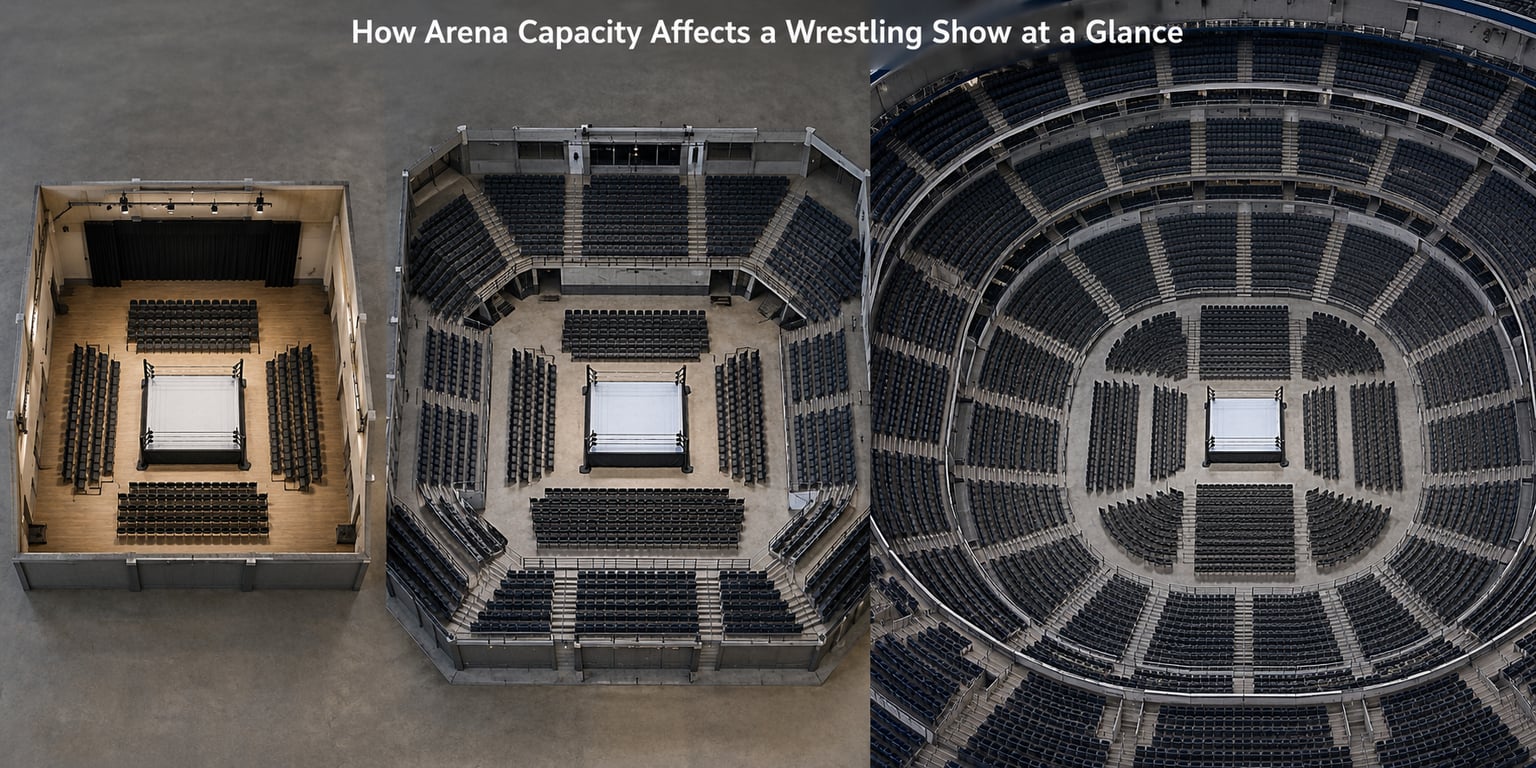
| Venue tier | Typical building capacity | Wrestling setup | Crowd reaction | Card pacing | Ticket-sales pattern |
|---|---|---|---|---|---|
| Armory, VFW hall, college gym | 300 to 1,200 | Bowl tucked tight to a small ring, often no ramp | Very loud; every seat within earshot of the action | Long matches, slow pacing, heat carried all night | Sells out weeks ahead; premium pricing for the best seats |
| Club or regional arena | 1,500 to 4,000 | Floor bowl plus lower bowl, one seating level or two | Strong when near full, thin and flat when a third is empty | Balanced; production can afford real staging | Steady advance sales, heavy dependence on the headline card |
| Major arena | 8,000 to 20,000 | Full bowl, long ramp, large video boards, extended lighting | Diffuse; reactions come in waves rather than a wall of noise | Compressed; spectacle replaces sustained in-ring story | Multi-city rankings and single-show sellouts are both common |
| Stadium | 40,000 and up | Field or floor sections, huge video boards, concert-scale rig | Enormous but distant; the reaction is felt more than heard | Shortest matches on the card; entrances and set pieces carry it | Not a touring format; a few tentpole events a year |
How Capacity Changes Ticket Demand and Sales
More seats do not automatically mean more demand. A promoter with a proven 2,000-seat room and a 12,000-seat building available has a choice, and the wrong one costs money twice: once in empty seats, again in a room where the tenth row cannot hear the announce.
What actually moves ticket sales is the perceived scarcity of the good seats. Front-row and ringside inventory is the scarce product; the upper bowl is filler that only sells when the demand is real. A small room generates urgency, because tickets genuinely run out. A large room invites a fan to wait for a better deal, and a fan who waits is a fan who stays home.
Pricing follows the same logic. Promoters run a wider price spread in bigger buildings, with cheap upper-bowl seats designed to catch casual buyers. That spread dilutes the average ticket, so a 15,000-seat room has to sell a lot of cheap seats to match the gate of a full 2,000-seat room. Scale down instead, and the same demand pays a much better average price.
Why Attendance and Sellouts Are Different Measures
Attendance and sellout are not the same claim, and promotions know it. A sellout means the configured room was filled or tickets were turned away. An attendance announcement is a number the promoter issued, and issued numbers across professional sports are worked figures, wrestling included. Fans on ProBoards and wrestlingforum make the same point about every sport, not just this one, and treating an announced figure as a ticket scan is the fastest way to argue in circles.
The MLW case discussed on r/SquaredCircle is the case study worth remembering. The promotion was reported as claiming 2,400 fans when the neighbouring hockey game sharing that building was the number that fit the story. Nothing about arena capacity was wrong there. The problem was that a capacity-adjacent number got attached to the wrong event, and once fans distrust one number they discount all of them.
A capacity figure tells you the ceiling. Tickets distributed tell you the ambition. Paid attendance tells you the business. Turnaways tell you whether the ceiling was actually the limit.
There is a second measure fans use constantly and rarely name: how engaged the crowd looks from the hard camera. A packed bowl can read as half empty on television because the camera sees the whole room, including the sections behind the production. That is a framing effect, not a decline, and it is the source of most arguments that a promotion is shrinking.
What Capacity Means for Revenue and Profit
Bigger rooms gross more, but they also cost more, and the two effects are not the same size. Talent, travel, production crew, staging, rigging, pyro and venue rental all scale with room size, while ticket revenue scales with seats actually sold.
Work it roughly. A 1,500-seat room at a 30-dollar average ticket produces about 45,000 dollars at a full sell. A 15,000-seat room needs to average three dollars a ticket to reach the same gate, which tells you how far the second room is from break-even. To be fair to the large room, it can charge more ringside and much more for premium floor blocks, and it can sell sponsorship, merch and concessions at a scale the small room cannot touch.
But the small room’s costs collapse in exactly the places the big room’s grow. Less rigging, shorter load-in, less travel per head, and the talent works once in front of everyone rather than across a multi-building tour. House shows are where this shows up most clearly. A promotion that can fill a 2,000-seat room five nights a week covers its talent conditioning and development costs with the gate alone, the same four-legged table Eric Bischoff described when he put live gate revenue next to pay-per-view, merchandising and licensing.
No-show rate cuts the other way. A percentage of distributed tickets never get used, and that loss is proportionally larger in a room where tickets were pushed to fill empty sections.
How a Larger Venue Can Change the Show
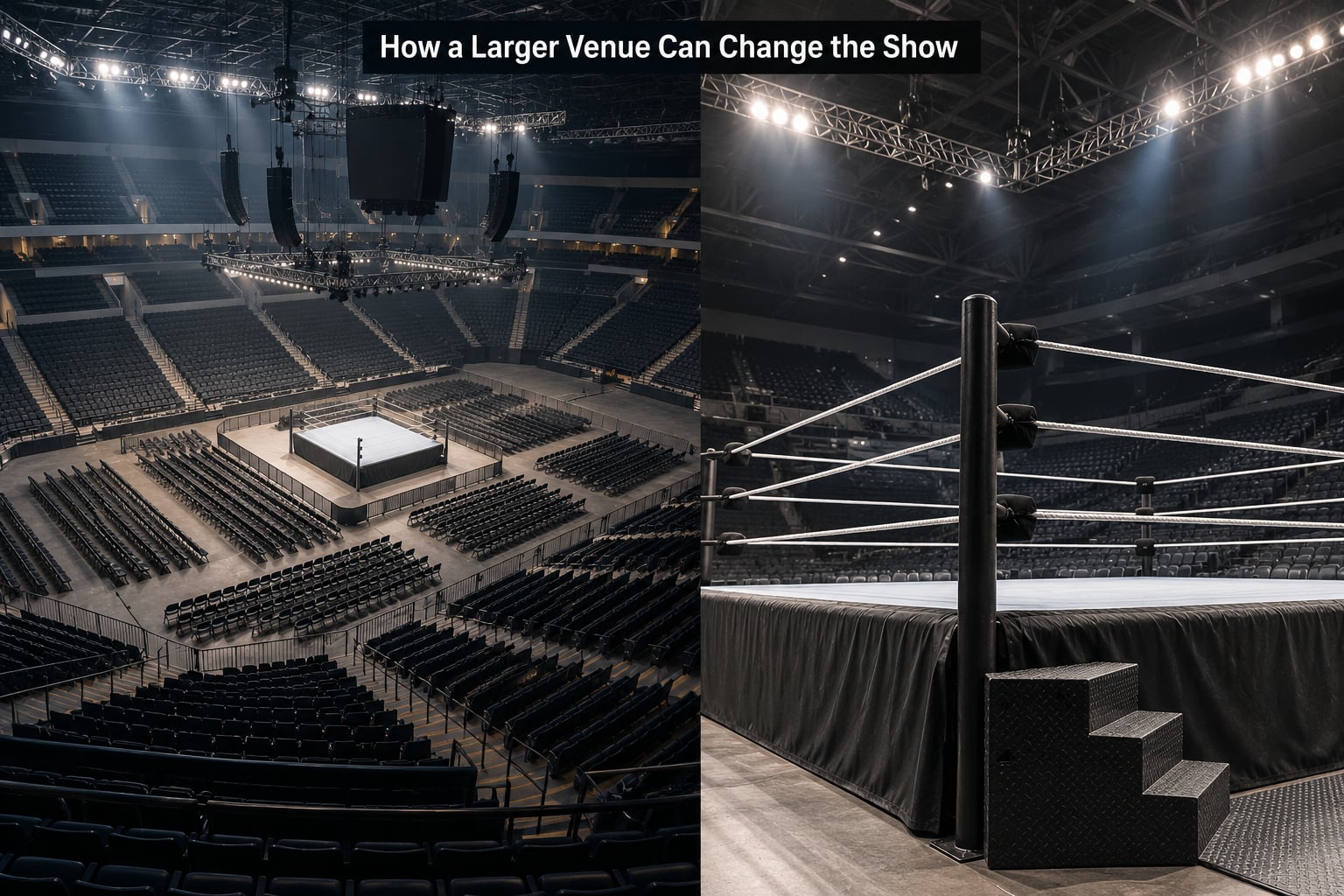
Sightlines are the first casualty. Move the hard camera to the back of the upper bowl to hold a 15,000-seat room in frame and the wrestlers become figures in a wide shot for most of the match. The tighter you want the in-ring work, the smaller the room has to be, or the more you have to rely on tighter secondary cameras and jumbotron shots.
Audience volume and audience clarity are different things. A small room concentrates the same reaction into fewer, closer bodies, which makes pops for a returning wrestler feel enormous. A large room spreads the same enthusiasm across rows that cannot see the entrance, so the pop arrives late and out of sync with the moment.
Staging responds to footprint. Longer entrance ramps, bigger video boards, elevated lighting trusses and larger pyro all cost money and all need floor space, which is why wrestling configuration capacity routinely runs well under concert capacity in the same building.
Aisle traffic matters more than promoters expect. Ten sections means more ushers, more entrance points, more staff toilets and longer queues at merchandise. A packed small room keeps most of its audience in one block with one way in, and that is worth real money in concessions and gift-shop sales.
Does Arena Capacity Affect Wrestler Performance?
Yes, mostly through intimacy and pacing. Wrestlers work off response in front of a live crowd, and a wall of noise from every seat is a different instrument than a tight room where a section of regulars reacts to a shrug. Wrestlers consistently describe the smaller room as easier to feed off, and it is the same reason a territory-era armory show could feel louder than a modern arena.
Pacing shifts with the room. A small crowd in a small space tolerates a twenty-five minute match because the tension is close and constant. In a large room, the same match length reads as a long silence with occasional noise, so cards get compressed and longer story segments move to entrances and video packages.
Heat works differently too. In a tight room a heel can absorb and feed on boos face to face. In a large room the boos arrive as general ambience, which flattens the star’s ability to play off an individual section.
Capacity also caps how far a promotion can grow in place. The AWA numbers discussed in detail on a ProBoards thread illustrate it: a fixed room of roughly 12,000 seats and a promotional audience that outgrew it after Hogan drew bigger houses than the building could seat. From that point the ceiling is not popularity, it is the door. The same problem shows up today with regional promotions that fill a 1,500-seat room every night and have nowhere to go on the weekend.
How Promoters Should Choose the Right-Sized Arena
Book the smallest room that holds your real demand with five to ten percent of headroom. Headroom matters because it is the buffer against a soft ticket cycle, and because a room that is technically full on paper is psychologically full to a fan.
Work from ticket history, not announcements. Look at the last six to twelve events in that market, strip out comps and giveaways, and treat the median paid attendance as the demand figure. Then add a small allowance for a headline card, not for a whole year of growth.
Cross-check with territory population and announced draw. A market with 400,000 people inside a two-hour drive cannot support eight shows a year in a 12,000-seat arena, no matter how strong the top two names are. The wrestling audience is loyal but it is also local, and drive time is the real ceiling.
Then work the costs honestly. Add per-head talent and production cost for the larger room, add the extra load-in days, and add the sponsorship and merch upside that only comes with a bigger footprint. When the larger room wins on revenue, it usually wins narrowly, and the margin is thinner than the gross figures suggest.
Finally, check the production requirement against the room. If the show depends on long entrances, big video boards and a full lighting rig, an undersized room kills the plan. Build the show for the room you can fill, not the room you would like to fill.
Frequently Asked Questions
Does a bigger arena make a wrestling show better?
Not on its own. A bigger room gives you more gross revenue and more sponsorship surface, but the same roster in a 12,000-seat arena in front of 4,000 people is a worse show than the same roster in a full 2,000-seat club arena. Capacity sets the ceiling on crowd energy rather than guaranteeing it, so match the room to your real paid demand.
Why does a packed arena look half empty on television?
Because the hard camera has to frame the whole bowl, so the sections behind the production and above the video boards stay in shot. A room that is genuinely full can read as half empty purely as a framing effect. That is why many arguments about a promotion being in decline are really arguments about how arenas look on television.
Why is a 4,500 capacity arena only set up for 1,461 people?
Because wrestling is configured differently from a concert. The floor seating comes out to make a bowl around the ring, and a long entrance ramp, camera platforms, lighting trusses and production load-in all need footprint. A TNA IMPACT taping at The Pinnacle was reported as set up for 1,461 inside a building with 4,500 concert capacity, which is normal.
What is the difference between tickets distributed and paid attendance?
Tickets distributed is everything the promoter issued, including complimentary tickets, giveaways, group blocks and paper. Paid attendance is what came through the box office after those are removed. A promoter can announce the larger figure and still be describing a show that was half empty, which is why fans argue about the numbers rather than the night.
Is WWE attendance decreasing?
Announced house show figures and the televised audience are two separate things, and neither is published consistently enough to build a clean trend line from outside the promotion. Buildings change, configurations change, and the reporting method changes with the era. Comparing one year of announcements to another tells you more about method than about the audience.
What is the largest attendance figure for a wrestling event?
The largest figure ever attached to a professional wrestling event is the 93,173 announced for WrestleMania III at the Pontiac Silverdome in 1989, a stadium show rather than a house show. Announced attendance is a promotional claim in every major sport, not a ticket count, so it should be read as a marker of how the event was sold rather than a headcount.
Conclusion: Match the Venue to Real Demand
How arena capacity affects a wrestling show comes down to four things: the ceiling it puts on crowd energy, the pacing the card can carry, the production design it forces, and the live-gate economics that decide how often the promotion tours. A room that is too large hurts all four at once.
Start where the promoter should start, with conservative paid ticket data from recent shows in that market, and add a modest allowance for a headline card. Ignore the building’s official capacity, discount announced attendance, and pick the smallest room that comfortably holds real demand.