Fact checking wrestling history claims means tracing each one back to a dated, independent source — a newspaper report, an official result, a court or corporate record, archived footage — and then rating how well that source actually supports the statement. Promos, Wikipedia, and twenty-year-old forum consensus do not count as evidence.
Wrestling is a harder subject to research than most sports, and the reason is unusual. Some of the records people want you to check were deliberately written to be false. Kayfabe means promoters invented lineages, gate sizes and record crowds on purpose, then let those fictions harden into accepted history.
There is also almost no mainstream journalism gatekeeping the industry. Nobody is holding promoters to an accurate public record, so a claim can sit unchallenged for thirty years simply because no outlet was ever going to check it. The checking work falls on whoever is curious enough to do it.
The method below takes about twenty minutes per claim once you have the habit, and it mostly consists of writing things down.
Table of Contents
- What You Need to Fact Check Wrestling History Claims
- Step-by-Step: How to Fact Check Wrestling History Claims
- 1. Break the Claim Into One Testable Statement
- 2. Decide What Counts as Proof
- 3. Locate the Original Event Record
- 4. Find Contemporary Coverage
- 5. Check the Full Match Instead of the Clip
- 6. Compare Independent Sources
- 7. Test the Claim for Common Logic Errors
- 8. Classify and Cite the Verdict
- Common Mistakes When Checking Wrestling History
- Treating a database as infallible
- Building on one viral clip
- Trusting a quote screenshot
- Ignoring kayfabe-era context
- Skipping the date check
- Reading absence as proof
- Frequently Asked Questions
- How do I fact check wrestling history claims about a disputed match result?
- What should I do if there is no full match video available?
- Why do official wrestling results sometimes conflict with other records?
- Are unsourced wrestling social media posts reliable historical evidence?
- What is the difference between verifying a match result and a story about what happened?
- Conclusion
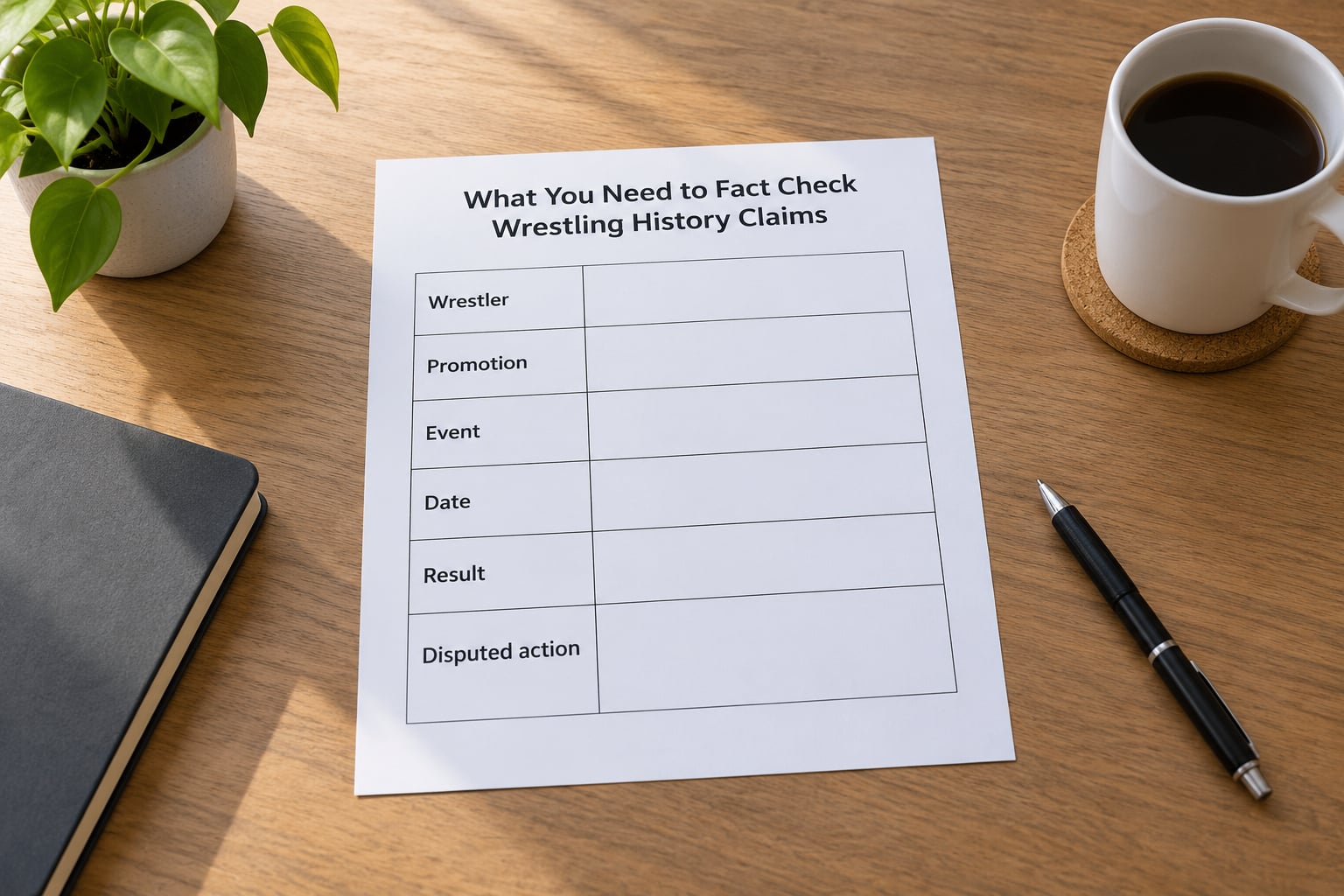
What You Need to Fact Check Wrestling History Claims
Start with the claim itself written down in one sentence. Vague claims cannot be verified, and half of wrestling arguments collapse the moment you force the person making it to state exactly what they are asserting.
You also need somewhere to read primary material, and that means knowing which archive answers which question.
- Newspaper archives. Chronicling America at the Library of Congress covers 19th-century papers for free. Google News Archive and archive.org both hold large runs of regional sports pages, including a good share of territory-era coverage nobody wrote books about.
- Trade publications. The Wrestling Observer Newsletter is the single most-cited wrestling source in existence, with decades of continuity. Older issues are harder to get at than recent ones, and some run behind paywalls.
- Reference encyclopedias. The Krause Publications encyclopedia, digitized on archive.org, is useful for cross-checking dates, results and name spellings. Treat it as a finding aid, not as an oracle.
- Official records. Court filings, census entries, obituaries and corporate registrations settle the boring factual questions — whether a company existed in a given year, whether a person was born and where, whether a death date is right.
- Archived pages. Dead fan sites, defunct news posts and old promo pages sometimes hold claims no one has re-examined since. Save them before they vanish.
- A note system. A document with columns for source, date, what it actually says, and what it does not say. Spreadsheets work. So does the notes app on your phone, badly.
Official records are the backbone here, but they need company. A trademark filing proves a promotion was trading in 1987. It says nothing about the crowd size or the story the promoter was telling about where that company came from.
Step-by-Step: How to Fact Check Wrestling History Claims
1. Break the Claim Into One Testable Statement
Broad claims drift. “Wrestling has always been fake” is not a fact-checkable statement. “The 9/13 SmackDown taping drew the largest crowd for any wrestling show after September 11, 2001” is.
Knowing how to fact check wrestling history claims starts right here. Fill in six boxes before you search anything: wrestler or promoter, promotion, event, date, result, and the specific action being alleged. If you cannot fill all six, the claim is still too fuzzy. Each box gives you a search term and tells you which archives are worth opening.
You know it worked when a stranger who knows nothing about the argument could look at your sentence and tell you what evidence would settle it.
2. Decide What Counts as Proof
Rank your evidence before you go looking, so you do not collect things that cannot settle anything. From strongest to weakest:
- Full match video or full uninterrupted commentary — the record of what physically happened
- Official results issued at or near the event
- Contemporary journalism written within days of the event
- Documented interviews where the date of the conversation is known
- Established wrestling databases
- Memoirs and autobiographies
- Fan newsletters and podcasts
- Wikipedia and fan wikis
- Forum posts and unsourced social media clips
Two things are worth internalising here. A claim can be true about the event and wrong about the timing, the wording, or the significance people attached to it. And a shoot interview is not a neutral record — it was usually negotiated, and what counts as on the record varies by agreement.
3. Locate the Original Event Record
Search promotion archives and established match databases by date, event and participant names. When two records disagree, write both versions down rather than quietly keeping the one that suits your claim.
Discrepancies are data. A promotion that lists a different opponent for the same date usually means a card was changed late, and a promoter with an inflated lineage problem shows up as repeated small inconsistencies that add up to something.
4. Find Contemporary Coverage
Now read what was written at the time, not what was published twenty years later about what was written at the time. Reports filed within days have witnesses, record books and quoted promoters available to them. Retrospective accounts do not.
Separate reporting from commentary while you read. A paper noting that 12,000 paid is a record. A paper explaining why the promotion deserved 12,000 paid is a promoter talking, and promoters are not neutral about their own history.
That distinction matters most in the territory era, where the local paper may have covered a show as a community event and a fighter’s gym as a publicity exercise, with both writers working from the promoter’s press release.
5. Check the Full Match Instead of the Clip

A ninety-second clip can be made to prove almost anything. What it drops is usually the entire argument: the interruption, the rules change, the time limit, the no-disqualification stip that makes the finish legitimate, the scripted post-match beat that explains the result.
Watch the whole thing when video exists. Note whether the finish was clean or whether there was a bell, a distraction, or a count that ended it. Check what the announcers say versus what the crowd heard — they frequently disagree on purpose.
If the footage is gone, say so plainly and move on. Missing footage is a gap in the record, not proof that nothing happened.
6. Compare Independent Sources
Pick at least two sources that do not descend from each other. A wiki article citing a newsletter that cited a promo flyer is one source wearing three hats, and treating it as corroboration is the most common circular sourcing failure in this hobby.
Resolve conflicts with four questions: how close to the event was this written, does it contain direct observation, is the writer’s method visible, and does an unrelated source agree. When nothing breaks the tie, the verdict is disputed, and disputed is a legitimate ending.
7. Test the Claim for Common Logic Errors
- Quotation drift — a line reappearing for thirty years in a form nobody in the original interview used
- Date confusion — an event from one year attached to a crowd or result from another
- Causation swap — a booking decision treated as the cause of a later outcome rather than a symptom
- Cherry-picking — the one match that supports the claim when the era’s record runs the other way
- Era-conditional truth — a claim true of territory wrestling in 1974 presented as true of the same promotion in 1997
- False equivalence — two genuinely different situations described as the same to make a pattern
The kayfabe trap deserves its own line. The fact that a storyline was worked does not prove or disprove a real-life allegation about the people involved. Those are separate questions and they need separate evidence.
8. Classify and Cite the Verdict
Give the claim a label rather than a shrug. Confirmed, mostly true, partly true, misleading, false, unverifiable. Then state the strongest evidence in one sentence, name the biggest limitation, and cite it precisely — publication, date, and where the reader can find it.
A verdict someone else can reproduce is worth ten times one they have to take on faith. If they follow your citations and reach a different label, you have both learned something.
Common Mistakes When Checking Wrestling History
Treating a database as infallible
Databases are crowd-sourced with varying standards and they inherit the promo’s framing when nobody recorded the original result. Use them to find the event, then confirm it elsewhere.
Building on one viral clip
The clip is a starting point for a search, not the search itself. Before repeating anything from it, find the full bout or the original newspaper item.
Trusting a quote screenshot
Screenshots of text posts are the weakest tier there is, and they get cropped, faked and shared for years. Find the post, the account and the date, or treat the quotation as unattributed.
Ignoring kayfabe-era context
Nothing said on a 1975 TV broadcast was a press release. Fiction was the product. Read promo-era claims as performances unless something independent contradicts them.
Skipping the date check
A surprising number of arguments collapse because two events got merged. Write the date down first, every time, before you read anything about the match.
Reading absence as proof
No surviving footage, no contemporary wire story, no mention in a newsletter does not mean it never happened. Territory wrestling was local, undocumented and often unrecorded, and whole cards vanish from the record without anyone lying.
A few habits help more than any single source. Keep one document per claim so you never merge two investigations. Date every clipping and screenshot the day you find it. Prefer the oldest surviving account over the most detailed one, since detail is what gets added to retelling. And when two credible sources disagree, write both down and say so — that sentence is often the most useful thing in the whole write-up.
Frequently Asked Questions
How do I fact check wrestling history claims about a disputed match result?
Pull the official result first, then find a report written within days of the event, then locate the full match video if it survives. Where the three disagree, note whether the disagreement is about the finish, the date, or the card order. Give each source a reliability rank before you weigh it, and publish the conflict rather than resolving it silently.
What should I do if there is no full match video available?
Work from documents instead: official results, contemporary local newspaper reports, promoter listings in trade publications, and the recollections of people who were in the building. Treat interviews as dated testimony rather than recording. If no independent source survives, the honest verdict is unverifiable, which is a real finding and worth stating plainly.
Why do official wrestling results sometimes conflict with other records?
Cards get changed late, matches get rescheduled, and finishers get renegotiated on the night. Promotions also altered records deliberately to build a promoter’s reputation, which is exactly why an official listing is not automatically the accurate one. Check the date each record reflects, and prefer whichever version independent observers of that era backed.
Are unsourced wrestling social media posts reliable historical evidence?
No. An unsourced post is a lead at best — something to search for, not something to cite. Screenshots of posts circulate long after accounts are deleted, and their original context rarely survives. If you cannot find the person, the post and the date behind a quotation, attribute it as a rumour circulating in the community and move on.
What is the difference between verifying a match result and a story about what happened?
The result is a fact you can settle: who won, on what date, under what stipulations. The story behind it is an interpretation built from interviews, commentary and later retelling, and it can shift while the result stays fixed. Confirm the result first, then check each story element separately against dated sources before you accept it.
Conclusion
Here is the whole method in one pass. Write the claim as a single testable sentence with a date attached. Decide in advance what would count as proof. Find the original event record and note every discrepancy instead of picking a favourite. Read coverage published close to the event, and separate what was reported from what was promoted. Watch the complete bout rather than the clip when video exists. Corroborate across two sources that do not share an ancestor. Then publish a verdict — confirmed, mostly true, partly true, misleading, false, or unverifiable — with citations precise enough that someone else can walk the same path.