Wrestling archives are digitized and restored by inspecting the original material, grading its condition, capturing it through a stable analog-to-digital chain, encoding a preservation master, cataloguing it with searchable metadata, and then storing and publishing it so the record stays verifiable. Restoration is the second half of that job: cleaning up what the capture inherited from the tape without inventing anything that was never there.
That is the honest version, and it is a slower process than most fans expect. A tape in a shoebox is not a file, and a file on a laptop is not an archive. What separates the two is a documented chain from physical object to searchable page, with every hand-off recorded.
Two forces make the work urgent. The carriers are decaying right now — magnetic tape sheds oxide, grows sticky with binder hydrolysis, and cinches inside its own shell — and the decks that can still play them are disappearing. On the other end, a generation of wrestling history was never filmed at all, so the recordings that do exist carry a weight out of proportion to their abundance.
Table of Contents
- What Does Digitizing a Wrestling Archive Mean?
- What Is Already Permanently Lost
- How Wrestling Archives Are Digitized and Restored
- The Eight-Step Pipeline, Start to Finish
- Pre-Capture Inspection and Condition Grading
- Choosing the Right Capture Method for Each Format
- Why Digitized Wrestling Tapes Often Look Worse Than the Tape
- Key Terms You Will Hear in Any Archive Workflow
- Who Should Do the Capture: Home Setup, Specialist Lab, or Facility
- Preservation Master and Delivery Copy Are Two Different Files
- How Archivists Preserve the Context Around a Match
- Rights, Ownership, and What a Collector Can Actually Publish
- How Broken Wrestling Websites Are Rebuilt
- A Worked Example: Rebuilding an Independent Promotion’s Results Page
- How Archivists Verify OCR, Dates, and Historical Details
- What Storage and Backup Practices Protect an Archive?
- How Restored Wrestling History Becomes Searchable
- Frequently Asked Questions
- Can an old wrestling website be restored if its original server is gone?
- How do archivists recover text from a scanned wrestling magazine?
- What is the difference between restoring an archive and rewriting its history?
- Which wrestling materials should be digitized first?
- Do archive restorations include copyrighted match footage and photographs?
- How can a fan donate or lend a wrestling collection safely?
What Does Digitizing a Wrestling Archive Mean?
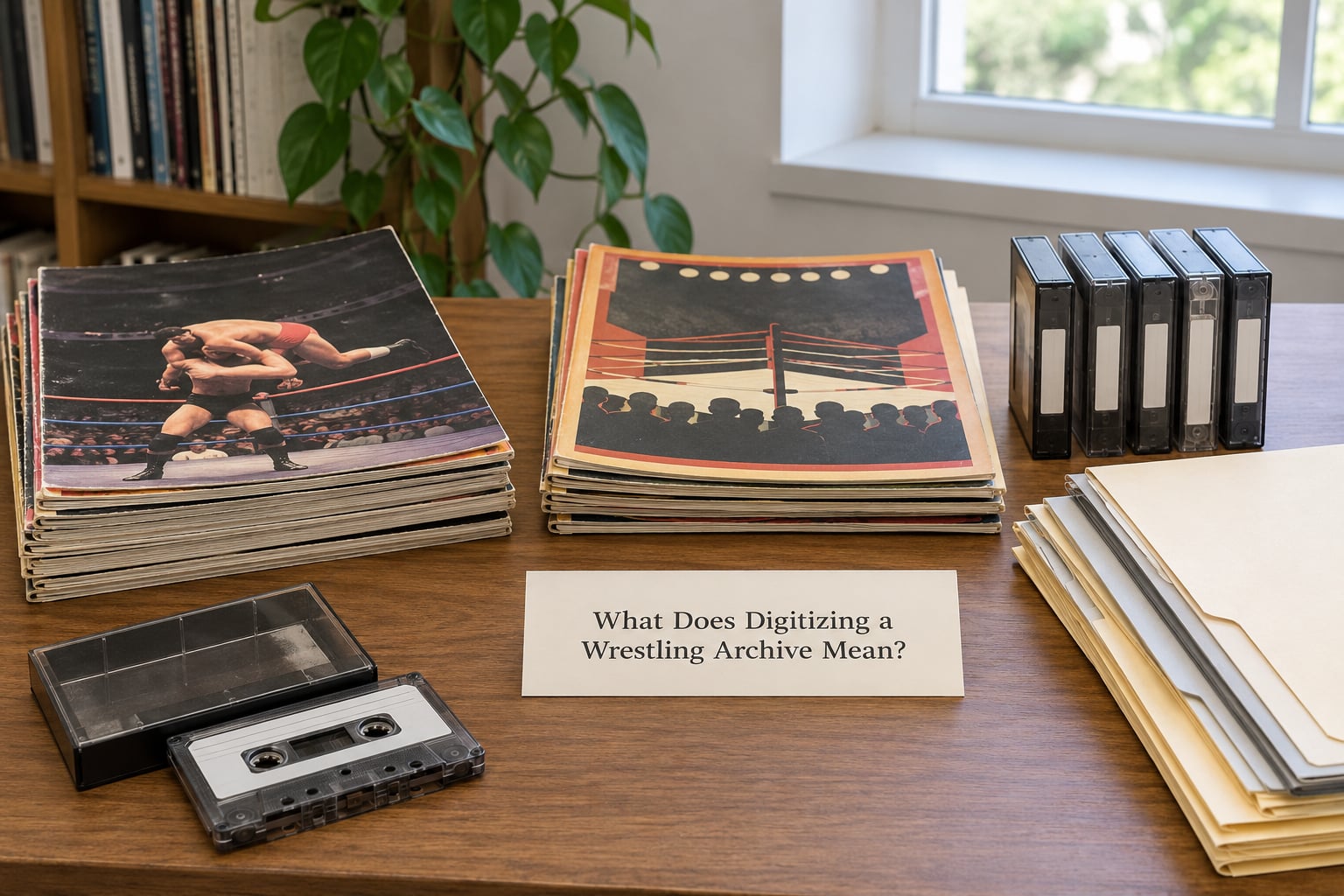
Digitizing a wrestling archive means converting physical and analog source material into digital files that can be stored, searched, copied without further loss, and consulted without handling the original. Restoration is what happens after the capture: removing artifacts that came from the carrier, repairing what can be repaired, and documenting whatever cannot.
Access is the third part. A restored file sitting on a single drive is not usable. An archive only counts as accessible when someone can find it, tell what it is, and trust that it is an accurate record of the source.
Wrestling collections divide into three very different material classes, and they need different methods.
- Analog audio-visual carriers — VHS, Betamax, S-VHS, U-matic, Betacam SP, Hi8, MiniDV, open reel, plus Super 8 and 16mm territory film. These need physical inspection, playback equipment, a capture chain, and time.
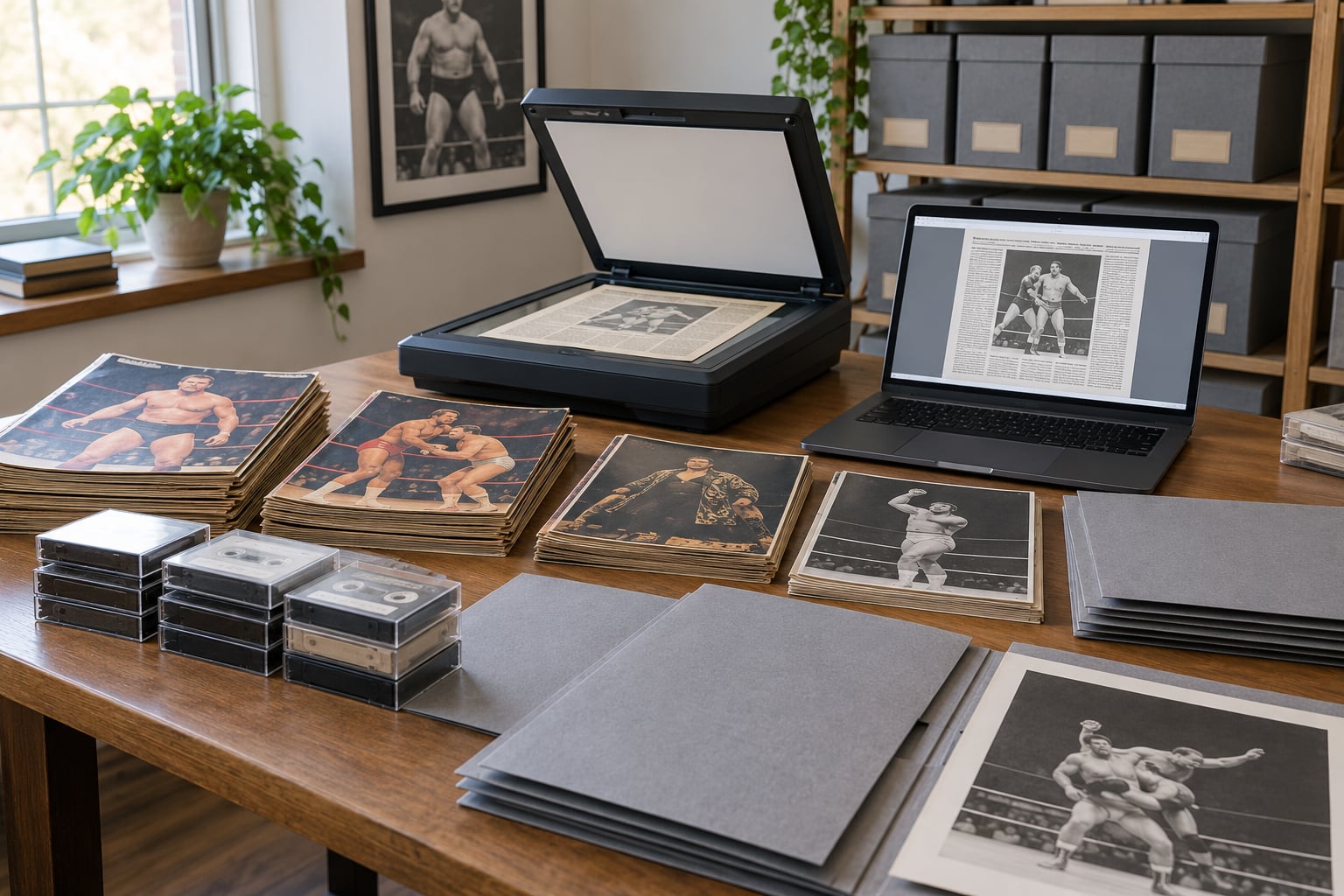
- Print and ephemera — program sheets, magazines, flyers, newspaper clippings, photographs, handbills, correspondence. These need scanning, optical character recognition, and careful metadata.
- Born-digital records — websites, fan databases, message board archives, newsletters, social accounts. These need web archiving, crawl data, and careful reconstruction when a server disappears.
Promotions and collectors tend to start with the tapes because the tapes look the most urgent. A publisher who spends a year scanning back issues ends up with a searchable resource, which is arguably harder to replace later than a cassette, and far cheaper per hour of access.
What Is Already Permanently Lost
An honest account of preservation has to start with the losses that already happened, because they shape what the surviving material means.
The biggest category is unfilmed. Large stretches of territory wrestling were never recorded at all, or recorded once on a single machine with no intention of keeping it. Some promotions shot on tape for their own booker and reused the cassettes, so the same hour of footage exists nowhere else. Some shows were filmed by one person who took the tapes home, and the collection went to a garage sale.
The second category is rights fragmentation. A corporate archive holding tens of thousands of hours often cannot show a match because a single performer, or a promotion absorbed years later, holds a share of the rights, or because the archive bought a physical tape library without buying the underlying footage rights. A well-preserved master sitting in a vault because of one licensing dispute has effectively been lost to the public anyway.
The third is generational loss of documentation. House shows were booked by telephone, sometimes on index cards, sometimes not at all. When a promoter dies, the records of who billed whom in which town can vanish with them, and a restored video then has no context at all: a crowd, a ring, and four names that appear in no other source.
This is why the context work later in the article is not housekeeping. Digitization without documentation produces a large pile of files that historians can rarely use.
How Wrestling Archives Are Digitized and Restored
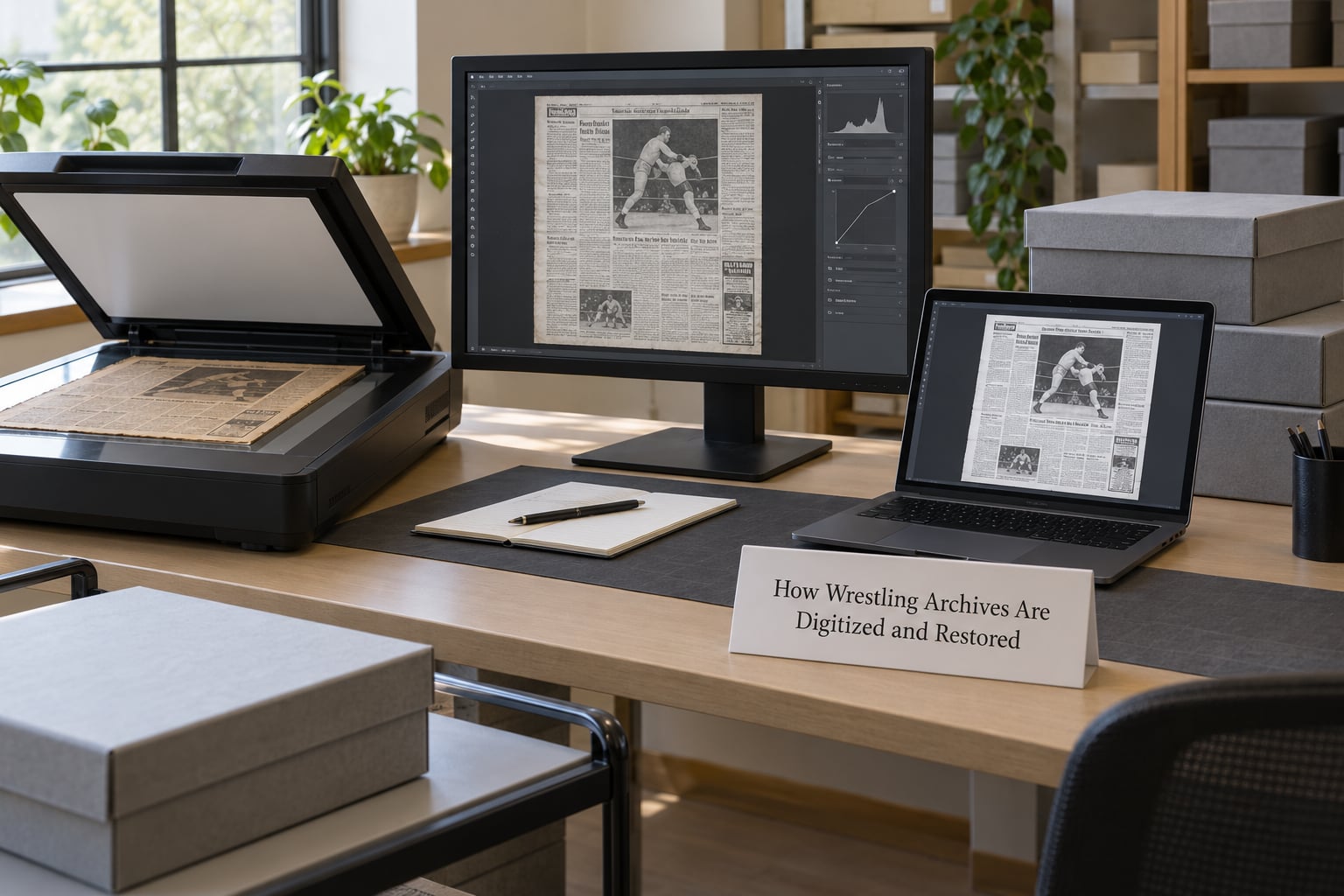
This is where the actual wrestling archive digitization happens. The work runs in eight steps, and the order matters more than the speed at which any one step is done.
The Eight-Step Pipeline, Start to Finish
- Intake and inventory. Every item gets an identifier before it is touched. Record the format, the source of the item, who supplied it, and whether it is the only known copy.
- Physical inspection and condition grading. Check the shell, the hubs, and the tape pack. Assign a condition tier that decides whether the item plays straight through, needs a controlled rewind, needs cleaning, or should not be played at all yet.
- Rights and use review. Establish what the archive may do with the item — preserve privately, share with researchers, or publish online. This is a documentation step, not a legal opinion, but it must happen before the files are described in public.
- Capture. Play the source through the best available deck and capture chain, taking a lossless intermediate first.
- Encode. Produce a preservation master and, separately, a delivery encode. Never encode straight from the tape.
- Quality control. Watch or scrub the whole file against the source, generate a checksum, and record both the checksum and the result of the review.
- Metadata and cataloguing. Attach the descriptive fields, keywords, and relationships that make the item findable.
- Storage and access. Keep at least two independent copies in different places, one of them offsite, and publish access through a site or catalogue with stable links.
The two steps beginners skip are quality control and metadata. Both are the reason a project that took six months becomes unusable in three years, because nobody can find the file or tell whether it is intact.
Pre-Capture Inspection and Condition Grading
Inspection happens before any equipment is switched on, because the transport is the part most likely to destroy the material it is trying to save. It is also the step that tells you which items deserve the scarce hours of capture time and which need repair first.
Start with the shell. Look for cracks, a loose or rotating hub, a broken tape-retaining screw, and a door latch that no longer holds. Then look through the window at the pack: a pack that sits unevenly, with visible air gaps or a ridge, has been through temperature changes and is the main cause of tape cinching on playback. Finally, test pack tension by hand with a gentle movement of the hub, feeling for a pack that gives unevenly or slips.
The defects worth knowing by name are all in the same family, and all of them mean a tape should not simply be played and trusted.
| Defect | What it looks like | Transport risk | Action |
|---|---|---|---|
| Cinch | Edge of the pack has creased and folded over | High. Playback tears the tape and can jam the deck | Controlled rewind or pack redistribution before any playback |
| Popped strands | Loops of tape standing proud of the pack | High. Strands snag and shed oxide inside the machine | Manual correction, then a slow test pass |
| Windowing | A band of tape pressed into the shell wall | High. Causes dropouts and physical damage on the spool | Specialist redistribution, not a casual rewind |
| Fold or kink | A hard crease across the tape path | Moderate to high. Read errors at that point on the tape | Note the position so the defect is expected in QC |
| Sticky tape | Tape sticks to itself or transfers residue to fingers | Moderate. Blocks the head drum on a long pass | Baker’s heat treatment in a ventilated space, then cleaning |
| Mold or debris | Cloudy residue, matting, a musty smell from the shell | High. Spreads to neighbouring tapes and the deck | Quarantine and isolate. Do not play. Clean before anything else |
| Shed oxide | Gritty black residue on the tape or in the shell | Moderate. Wears the heads and marks the whole batch | Clean the tape path and the transport, then grade and record |
| Hub lock failure | Traction wheel slipping; reel will not hold position | Moderate. Causes mid-tape drift and uneven tension | Do not fast-forward or rewind. Play through or transfer by another route |
Grade every item into a tier and let the tier decide the route: play straight through, controlled rewind and retest, clean and treat before any attempt, or hold as a candidate for specialist or lab transfer. Record the grade in the intake record, because the grade is the explanation for whatever the capture looks like later.
Mold deserves a separate word of warning. It spreads by contact and by damp, so a batch with visible growth gets separated immediately, handled outdoors or in a ventilated space, and treated before a single tape goes near a deck. It is also the one defect where waiting is genuinely costly, because the neighbours of an affected tape are being affected while you decide.
Wrestling-specific note: a bootleg copy is often the only surviving copy of an event, which makes its condition rating a preservation priority rather than a quality judgement. Rank by rarity and sole-copy status, not by how good the picture looks today.
Choosing the Right Capture Method for Each Format
Match the capture method to the carrier, not to the software you happen to have. A flatbed scanner is a poor fit for glossy magazine pages that reflect the platen glass, and a video capture chain is a terrible fit for a handwritten ledger.
For born-digital pages such as a defunct wrestling results site, the capture method is archiving: snapshots, crawls, and saved page source. For print, it is photography or scanning plus OCR. For audio and video, it is a transfer chain. For film, it is a film scanner that handles the format’s sprocket and frame rate properly.
| Format | Era it covers | Primary risk | Capture method |
|---|---|---|---|
| VHS SP | 1980s onward, most home and syndicated wrestling | Cinch, popped strands, shed oxide, tracking loss | Deck plus external time base corrector, lossless capture |
| VHS EP and LP modes | Extended play filler and long-form copies | Very low line resolution, generation loss | Same chain, but expect detail that cannot be recovered |
| S-VHS | Late 1980s to early 1990s | High-grade decks and tapes are scarce | S-Video output into the same chain, never composite |
| Betacam SP | Broadcast master feeds, 1980s onward | Deck wear, dropout, oxide loss on second-generation dub | Betacam SP deck, ideally through a frame-accurate chain |
| 3/4-inch U-matic | 1970s through the 1980s | Mold, sticky tape, very limited playback hardware | Service or lab transfer where the deck is hard to source |
| Hi8 and Video8 | 1990s consumer and semiprofessional | Head switching noise at the frame bottom | Deck with a stable lock, S-Video if available |
| Open reel 1/2 inch | 1970s territory and regional broadcast | Shrinkage, tension, sprocket and guide damage | Specialist open-reel transport, tensioned path |
| MiniDV | 2000s onward, often already degraded once | Sticky tape, dropped frames, repeated dubbing | FireWire or SDI readout where the tape still loads |
| Super 8 and 16mm | Pre-1985 territory footage | Vinegar syndrome, perforation damage, color fade | Wet-gate or dry film scanner, frame by frame |
Note what the table implies. A great deal of the pre-1990 wrestling record exists in formats where working hardware is now the rarest object in the chain, which is why labs and hobbyists often pool effort on a shared deck rather than each buying one.
Why Digitized Wrestling Tapes Often Look Worse Than the Tape
Most disappointing captures are not restoration failures. They are capture failures that get frozen in the file. A consumer deck without a time base corrector produces unstable timing, and the software then dutifully records the instability frame by frame.
Three effects cause most of the disappointment.
- Head switching noise — a torn band of distortion across the bottom of the frame, appearing when the deck struggles to lock onto a weakening signal. A stable transport and a time base corrector between the deck and the capture device remove most of it.
- Chroma bleed and color smearing — color information spreading sideways over high-contrast edges, from an old tape and a composite output combined.
- Timing jitter and field blending — comb-like artifacts in motion, caused by poor deinterlacing or by aggressive filtering applied to make the file look tidy.
The habit that prevents all three: capture to a lossless intermediate first, keep that intermediate untouched, and make every delivery file from the intermediate. Encoding is where decisions get made, and decisions should not be made once and baked into the only surviving copy.
There is also a recurring false alarm worth naming. Without a time base corrector, many decks signal that a tape is copy-protected when it is not, and the capture software refuses to record. Home-recorded wrestling tapes are the most common false positive, which is exactly why collectors hit it so often.
Key Terms You Will Hear in Any Archive Workflow
- Time base corrector (TBC)
- An external device that sits between the playback deck and the capture device, cleaning up line and field timing. Veterans in capture communities treat it as the single component that decides whether a transfer is worth keeping, because a deck without one can produce output too broken to correct later.
- Pack winding
- The wound cylinder of tape on a hub. A deformed pack cinches inside the shell, and playback tears the tape instead of reading it.
- Preservation master
- The highest-quality, minimally compressed copy kept permanently. Every other version, including anything streamed, is derived from it.
- Deinterlacing
- Converting the two-field interlaced signal into progressive frames. Done badly it turns motion into combing; done well it leaves the frame alone.
- Fixity checking
- Re-running a checksum on a stored file to prove it has not silently corrupted since it was written.
- Media asset management (MAM)
- The system that stores assets alongside their metadata so they can be found, versioned, and delivered to someone who asked for them a decade later.
Who Should Do the Capture: Home Setup, Specialist Lab, or Facility
Three routes get a wrestling collection digitized, and the honest comparison is not about which produces the better picture. It is about which produces a defensible, repeatable result at the scale of your collection.
The practical constraint everyone underestimates is time. A tape plays in real time, so one hour of footage takes one hour of attention, plus inspection, rewinds, cleaning between tapes, and the QC pass. A two-hour match tape realistically occupies a half-day slot. A hundred tapes is a two-month commitment, and a thousand is a small business.
| Route | Best for | What you get | What it costs you |
|---|---|---|---|
| Home setup | Fans with a modest personal collection, under a few hundred items | A correct result, if the chain includes a time base corrector, and full control of the source | The equipment outlay, your time, and a real risk of learning as you go |
| Specialist lab | Mold, sticky tape, or unusual formats like U-matic and open reel | Repairs and transfers that hobby equipment cannot attempt, on media that would otherwise be lost | The highest per-item cost, and the wait |
| Commercial facility | Large institutional collections, promotion archives, whole libraries | Documented, repeatable output with fixity regime, redundant storage, and delivery formats | Project scale, contracts, and rights paperwork |
Home capture is genuinely viable and the equipment holds its value, which is why it is the normal choice for personal collections. What it costs is attention, and the specific trap is skipping the time base corrector because it seems like an extra box. Without it, many decks also misread home-recorded tapes as copy-protected and refuse to record them, which is the single most confusing failure a beginner hits.
The decision rule is simple. If the tape is in decent condition and you have the hours, do it at home. If it is moldy, sticky, or in a format whose working deck is hard to find, send it out. If the collection is large enough that a documented, redundant, checksum-verified result is a requirement rather than a hope, that is facility work.
Preservation Master and Delivery Copy Are Two Different Files
The most consequential habit in the whole workflow is keeping two distinct files, and it costs almost nothing to do it correctly.
| Preservation master | Delivery copy | |
|---|---|---|
| Purpose | Kept permanently as the source of truth | What people watch, in the browser or a player |
| Compression | Lossless intermediate, or the least compression that keeps quality intact | Efficient delivery encode, sized to the viewing screen |
| Field structure | Kept as the interlaced signal the source actually carries | Progressive, deinterlaced carefully so motion does not comb |
| Editing | Never touched after capture | Can be re-encoded any time, because the master survives |
| Scale of storage | Heavy. A lossless capture runs to tens of gigabytes per hour of footage | Light, because it is recompressible from the master any day |
Encoding straight to a small delivery file, discarding the intermediate, and treating that as the archive is the most common irreversible mistake in amateur tape digitization. It throws away information the source contained, locks in whatever decisions were made on a laptop at midnight, and leaves nothing to re-derive when better tools appear in five years.
How Archivists Preserve the Context Around a Match
The file is the easy half. What actually makes an archive useful is everything that lets a researcher interpret the file: the date, the promotion, the event name, the venue and city, the card position, the wrestlers, the announcers, the tape generation, and where the item came from.
Wrestling has a specific contextual problem. The same event is frequently called something different by the promotion, the announcer, the tape distributor, and later fans. A 1985 house show in a midwest armory might be listed as a date with no name, a tape title with a misspelled promotion, and a fan database entry with a different town. Without recording all three versions, the record is technically complete and practically useless.
A workable metadata set for a wrestling event file looks like this.
- Promotion, in its own spelling at the time of the event, with the modern equivalent name as a separate field rather than an overwrite.
- Date, plus the date as printed on the source and the date as inferred, kept distinct when they disagree.
- Event title and venue with city, state, and country.
- Card position and running time of the match or segment.
- Wrestlers and teams, including ring names and the identity behind them where that is documented.
- Announcers, commentary language, and era markers such as kayfabe framing or shoot-style interviews.
- Tape generation — whether this is a first-generation dub, a broadcast copy, a bootleg, or a re-record of a re-record.
- Condition and defects observed during inspection, so a later reader knows the limits of the file.
- Provenance — who supplied the item, when, and under what terms.
- Rights status and permitted uses.
- Related items — the same card from another angle, a magazine issue covering it, a photograph from the crowd.
Item ten is the one most personal archives skip, and the one that decides whether a donation can be published at all.
The same principle applies to print. A magazine column about a wrestler means little scanned in isolation, so the archive captures the issue number, the page, the author, the issue date, and the surrounding pages, because the surrounding pages are what explain the tone.
Rights, Ownership, and What a Collector Can Actually Publish
Owning a physical tape does not transfer the rights to the footage on it. The rights usually sit with the promotion, the performers, or a later corporate owner, and buying a VHS at a thrift store transfers nothing. This is not a fine point, and it is the question most often left unanswered in fan circles.
Three positions come up, and they are worth separating clearly.
- Preserving for yourself is broadly fine. Making a personal digital copy of material you own, to watch and to keep from decaying, is the ordinary case and carries the least risk.
- Sharing or publishing is where it changes. Putting a digitized tape on a public page, a video platform, or a download link is a distribution act, and it is a different legal question from making the copy.
- Promotion archives face the most complex version, because the rights are often split. Talent agreements, corporate acquisitions, and pre-existing licences mean that owning an original master and having the right to publish it are two different facts.
The scale of the corporate side gives some context. One major promotion’s library is reported at more than 75,000 hours of material, assembled largely by acquiring other promotions’ libraries over decades. Digitizing that volume is an industrial operation, and its commercial driver is selling restored footage rather than preserving history. That is the honest picture: massive preservation happens where there is a business reason for it, and a lot of wrestling history survives only because it was saleable.
What that means for an archive is that rights review belongs in the catalogue, not in someone’s memory. Record who holds the rights, what use is permitted, and when that was last checked, so a future volunteer is not left to guess. Anyone weighing publication of third-party footage should get a specific answer from a qualified professional rather than a general one from a forum, and the archive’s job is to make the question visible to the person making the decision.
How Broken Wrestling Websites Are Rebuilt
Plenty of wrestling history exists only on sites that no longer exist. Results pages, promotion histories, fan databases, argument threads, independent promotion archives — a server switch or a lapsed domain can take years of records in one move.
Before anything else, check whether the content was already preserved. Web archives capture pages on their own schedule, and a site that has been up for a decade usually has some coverage. Search the archived snapshots by date, not by URL, because wrestling sites reorganized their paths constantly and the current path is often not the path that was captured.
What remains after that check gets assembled from several partial sources, in rough order of reliability.
- Archived snapshots of individual pages, taken across several years so the union covers more than any single capture.
- Crawl data and sitemaps, which reveal page titles and structure and often list pages that were never captured.
- Search engine caches and text indexes, which preserve fragments of pages whose images and layout are long gone.
- Print sources — a magazine results section or a newspaper report can confirm a date, an opponent, or a result that the web page got wrong.
- Fans who remember, interviewed and cited, for context rather than for facts that need sourcing.
Reconstruction follows the site’s own structure once you have enough of it. Page templates from surviving pages tell you how a results entry was laid out, which columns existed, and what the navigation looked like, so recovered entries can be restored in a consistent form rather than a mishmash of formats.
A Worked Example: Rebuilding an Independent Promotion’s Results Page
Take a common case. A regional promotion ran a results page from the late 2000s that listed every show by date, venue, and headliner. The site is gone, and someone asks whether the history can be recovered. Here is how the pieces come back together in practice.
Search the web archives by date range rather than by address, because the site moved its results to a different path partway through and the original path was never crawled. That typically returns a scatter of snapshots across several years, which is enough to establish the page structure but rarely enough to cover every show.
From a snapshot with a full month of entries, the layout is readable: date, venue, attendance figure, and a headliner line. That becomes the template, and the recovered snapshots are transcribed into it. Where a show appears in two snapshots, the newer capture is used and the older kept, because edits to a results page are themselves part of the record. Promotions routinely change a name or a billing after the fact.
For the gaps, the other sources do the work. A fan database entry that lists the same date, venue, and three of the five matches is not enough to fill in the remaining two, but it does establish that the show happened and where the partial information came from. A magazine issue covering the promotion that month sometimes carries a written report with card details. A photograph of a flyer from someone’s private collection closes a specific hole with a primary source.
What goes into the rebuilt page is the date, the venue, the promotion name, and every match that at least two sources confirm, each with its source noted. What stays as an explicit gap is everything else, marked as unrecovered with the reason. A researcher looking at that page six years later can tell exactly what is known, what is inferred, and what is missing, and can go looking for the missing pieces themselves. A page quietly padded with plausible guesses tells them nothing except that whoever built it was guessing.
The rule that governs the whole job: never invent a missing entry. If the archive listed a show on a date and the results are gone, the page keeps the date, the venue, and the promotion, and says plainly that the results were not recovered. A gap that is labelled is evidence. A gap that has been filled with a plausible guess is a fabrication that will be quoted for the next twenty years as fact.
Redirect every recovered page from its old address to its new one, so links circulating in forums and on fan sites still land somewhere useful.
How Archivists Verify OCR, Dates, and Historical Details
Optical character recognition is fast and wrong often enough that nobody publishes wrestling archive text straight out of it. A scanned program from 1991 may have a three-line type treatment, paper yellowing, and a fold running through the date, and OCR will read the fold as a character and the small type as noise.
Verification runs like this.
- Correct the text layer against the image line by line for anything meant to be quoted. Names, numbers, and dates get checked character by character.
- Cross-check against a second source. A date on a flyer versus a date in a magazine versus a date in a fan database: two out of three agreeing is a signal, and the odd one out is usually worth a note rather than a silent overwrite.
- Flag uncertain names. A wrestler whose ring name is illegible is marked as uncertain in the record. Uncertain is a legitimate archival value; confidently wrong is not.
- Watch for duplicated pages. Scans often contain a blank verso or a repeated insert, which inflates page counts and confuses sequence numbers.
- Watch for later alteration. Programs get corrections pasted on them, and reprints get taped in. An archive records the physical fact, not the intent.
That last point leads to the distinction that matters most. Preserving a source and correcting a source are different acts, and only one of them belongs in an archive.
A 1986 program that advertised a wrestler under a name he had not yet adopted is a record. So is a program with a typographical error in a date, and so is one with a match result that later records contradict. The archivist’s job is to preserve what the object says and describe the discrepancy, not to smooth it. Correcting an error in a catalogue entry is legitimate. Changing the text of a document is not, and an archive that quietly does it has stopped being evidence and started being a story.
The same rule governs video. Stabilizing shaky footage, repairing a dropped frame from its neighbours, and removing tracking noise are restorations. Painting a new crowd onto a low-quality transfer, recoloring black and white footage, or generating a shot that was never filmed is not. The line is not about how good the result looks; it is about whether the result could be mistaken for something the source actually contained.
Wrestling history groups are blunt about the second kind. Collectors in preservation-focused communities have argued consistently that enhancing old wrestling photos distorts the record, and the objection is not aesthetic. A colorized or upscaled image is an interpretation presented as an artifact, and once it circulates, nobody downstream can tell which is which.
What Storage and Backup Practices Protect an Archive?
Storage is where archives quietly fail. The files get made, the drive fills, somebody copies them to an external disk, and two years later the disk is unreadable and the original tapes were thrown out years ago.
Two rules cover most of it. Keep at least two copies, in physically separate locations, so a flood, a fire, or a theft cannot take everything. And run fixity checks, which is just recomputing the checksum of a stored file and comparing it to the value recorded when the file was written, so silent corruption is found while a second copy still exists.
Beyond that, the working practices are unglamorous and proven.
- Open, non-proprietary formats for the preservation master, so a file written today is still readable in twenty years. This is the argument for lossless intermediate video and plain image and text formats rather than proprietary editing projects.
- Format migration on a schedule, moving masters forward before the software that reads them stops running.
- Two tiers of file. A readable working copy for researchers and a preservation master kept in a format nobody edits. Mixing the two is how archives damage themselves, because the working copy gets touched.
- Offsite copies in a facility with its own environmental control and its own fixity regime. A second drive in the same closet is not a backup.
- Tape originals kept, always. The recurring advice from people who do this for a living is not to discard a source after capture, because a mediocre transfer today can be redone properly in a decade and a lost original cannot be recovered at any price.
For a tape archive, the environment matters as much as the drive. Heat and humidity accelerate the decay the digitization was meant to outrun, so storage space is part of the preservation plan rather than an afterthought.
A note on the right way round: capture losslessly, keep that intermediate, and encode the viewing copies from it. Filters applied once and saved into the only copy are permanent. Filters applied to a derived file are a decision you get to make again in ten years with better tools.
How Restored Wrestling History Becomes Searchable
Restoration is finished when a stranger can find the record. That means transcription for anything that was only ever an image, structured metadata for everything, and a search interface that returns useful results without asking the visitor to know what a database calls things.
The practical sequence runs like this.
- Transcribe and correct every scanned page, so the text is searchable rather than merely viewable.
- Normalize the names into one authority list, with the original spellings kept as alternate names. A researcher typing a wrestler’s name should find every spelling.
- Give every item a stable URL that will not change when the site is redesigned, and redirect the old addresses.
- Generate a sitemap so search engines can reach the material, and keep it current as items are added.
- Tag by promotion, era, region, and event type so browsing works even for someone who does not know the exact title.
- Describe the condition in public. A visitor who knows a file is a second-generation dub with a damaged intro can work with it; a visitor who thinks it is a broadcast master is misled by the archive itself.
Full-text search across the whole collection is where the payoff shows. A single term can pull a magazine column, a flyer, a video, and a fan post about the same wrestler from four different decades, which is how most real historical discoveries get made.
Accessibility is part of the same job. Transcripts for video, alt text on photographs, and a page that works without the original playing all matter, because a large share of the people who need this archive are researching on a phone or using a screen reader.
The one thing to resist is dumping everything at once. An archive of forty thousand items with no hierarchy is overwhelming and effectively private. Grouping by promotion, era, and event type, with search across the whole thing, keeps a big collection easy to browse.
Frequently Asked Questions
Can an old wrestling website be restored if its original server is gone?
Usually yes, at least in part. Web archives, cached search results, sitemaps, and print sources together recover a surprising share of a vanished site. What cannot be recovered should be marked as missing rather than filled in, so the gap stays visible to anyone reading it later.
How do archivists recover text from a scanned wrestling magazine?
They run optical character recognition to get a first pass, then correct the text against the image line by line, checking names, numbers, and dates by hand. Small type, yellowed paper, and folds cause most of the errors, and anything still unclear after review is flagged as uncertain rather than guessed.
What is the difference between restoring an archive and rewriting its history?
Restoration repairs damage the carrier caused, such as tracking noise, dropped frames, or a broken scan. Rewriting changes what the source says, which might mean correcting a documented date, generating a shot that was never filmed, or recoloring footage. One preserves evidence; the other produces a story that looks like evidence.
Which wrestling materials should be digitized first?
Start with the rarest and most fragile items: sole-copy event recordings, pre-1985 territory film, and anything already showing mold, cinch, or shedding. Broadcast copies on healthy tapes can wait a year or two. Print ephemera decays slowly, and born-digital material is already at risk of disappearing the moment a server goes away.
Do archive restorations include copyrighted match footage and photographs?
Archives digitize the full range, but ownership of a physical tape does not transfer the rights to its content. Rights review decides whether an item is kept for private preservation, made available to researchers, or published online, and that decision gets recorded as a field in the catalogue alongside the footage itself.
How can a fan donate or lend a wrestling collection safely?
Start with a written agreement that says who owns the material, where the digitised files will live, and what the collection may be used for. Send items in batches rather than a whole attic, and get a receipt listing each piece, with a condition note for every item so nothing is lost in the handover.
Start where the decay is fastest, not where the collection is biggest. Build an inventory, grade condition on every item, and put the sole copies and pre-1985 film at the front of the queue. Everything downstream — capture, encoding, metadata, storage — goes more smoothly once that order is right.
That is how wrestling archives are digitized and restored: a documented chain from a physical object to a searchable, verified, honestly described record, with the originals kept and every gap labelled rather than filled in.