Wrestling misinformation spreads online because a rumor in wrestling travels the same way any rumor does, but with a built-in excuse: almost everything about wrestling is performed, so who can say what is real? A single unsourced claim usually gets repackaged by an aggregator with a louder headline, copied by a second site, quote-posted by fans who want to argue, and pushed by engagement ranking to people who never follow wrestling at all. The correction, when it comes, reaches a fraction of that audience. Learning how wrestling misinformation spreads online is mostly a matter of learning where that chain starts and how to step out of it before you add another copy.
Table of Contents
- Why Wrestling Rumors Feel More Credible Than Other News
- How Wrestling Misinformation Spreads Online
- The Lifecycle of a False Wrestling Claim
- Why False Rumors Persist After Corrections
- How to Spot Manipulated Wrestling News
- How Platforms and Wrestling Accounts Increase the Reach
- What Readers Can Do Without Sharing More False Information
- Frequently Asked Questions
- Does kayfabe make every wrestling rumor false?
- Are anonymous wrestling sources always lying?
- Why do old wrestling reports resurface as breaking news?
- Should I share a correction after a rumor has spread?
- Can commenting on a wrestling rumor make it spread faster?
- Conclusion
Why Wrestling Rumors Feel More Credible Than Other News
Four things stack up in wrestling that you rarely find together anywhere else, and together they make a weak claim sound strong.
The first is insider culture. Wrestling has a long tradition of people close to the business sharing information with each other, and legitimate reporters are used to protecting sources. That habit is exactly what a fabricated story needs to borrow.
The second is partial information. You see a wrestler leave a show early. You see a title change on television. On its own that could mean a dozen different things, and the twelve possible explanations all look identical in a screenshot.
The third is the kayfabe boundary. Kayfabe is a live performance convention where performers behave as though the story is real. A worked storyline and a real report can look identical on screen, and the audience is trained to accept that without asking.
The fourth is fan loyalty. People follow particular wrestlers, promotions and reporters with real attachment, and parasocial trust in a person travels to the claims they carry.
None of this makes wrestling journalism unreliable. It makes the environment unusually friendly to a rumor that arrives with the right packaging.
How Wrestling Misinformation Spreads Online
The short version: a claim is invented or distorted, given a confident headline, republished by sites that treat volume as corroboration, amplified by reactions on social platforms, rewarded by recommendation systems that rank replies and reposts, and then partly corrected, though the correction reaches almost nobody.
The four formats you meet most often behave differently, which is why some fall apart in a day and others survive for years.
| Rumor format | Typical origin | How it spreads | How long it lasts |
|---|---|---|---|
| Fabricated report | An invented personnel move or storyline change | Aggregator republishes it under a louder headline | Days, until an on-air or written denial |
| Manipulated clip | A real moment trimmed to change the meaning | Posted without context, quote-posted for outrage | Weeks, because the clip outlives the argument |
| Fake screenshot | A fabricated message, or an AI-generated image | Shared as proof; the screenshot is the source | Months, since it survives in image search |
| Recycled old news | A dated report reappearing as breaking | Aggregation and search results treat it as new | Years, through archives |
One common thread runs through all four. The packaging travels further than the claim deserves, and each retelling adds confidence while losing detail.
The Lifecycle of a False Wrestling Claim
Five stages, and each one is a place where a reader can stop the chain.
Origin. Somebody posts a specific-sounding claim, usually with no source attached. It may be a fabrication, an exaggeration of something real, or a genuine leak about a plan that later changes.
Packaging. A headline writer turns a hedge into a headline. “Reportedly,” “could,” and “according to a source close to the situation” become a flat statement in the title, because the title is what gets reposted.
Amplification. Sites that publish faster than they verify copy each other’s wording. Fans quote-post the claim to mock or celebrate it, and every reaction is a signal that the post is worth showing more people.
Attention or monetization. The story earns clicks, ad revenue, a repost quota, or simply the satisfaction of being first. Some accounts post fabricated wrestling stories deliberately and then admit it once the reaction arrives.
Correction. The real source denies it, or the claim quietly expires because nothing happened. By then the false version has the larger archive, the better search position, and the audience that already believes it.
Why False Rumors Persist After Corrections
Corrections lose structurally, not because people prefer to be wrong.
Reach asymmetry. The rumor was pushed to everyone who engaged. The correction is posted by an account only some of those people follow, and it lands with none of the novelty that made the original shareable.
Confirmation bias. Fans arrive with a position already formed. A rumor that supports the view they want gets read as plausible, and the same rumor viewed from the other side of the fan divide is dismissed as a plant.
Motivated reasoning. Supporters of one promotion assume a leak from another promotion is fabricated. Supporters of that other promotion assume the opposite. The source never gets a fair hearing either way.
Repetition. The same claim recurs in reposts, reaction videos and re-reports, and each repetition feels like independent confirmation even when every instance traces back to the first post.
Outrage. A rumor that insults or delights a faction gets reply chains, and reply chains are the currency the platforms push hardest.
Correction fatigue. Wrestling fans are asked to disbelieve something new several times a week. After a while, the skeptical posture gets tiring, and the lazy default is acceptance.
Then there are archives. Search engines and the platforms themselves keep old posts findable for years, so a debunked claim from one era still surfaces as something new to a reader who has never seen it before.
How to Spot Manipulated Wrestling News
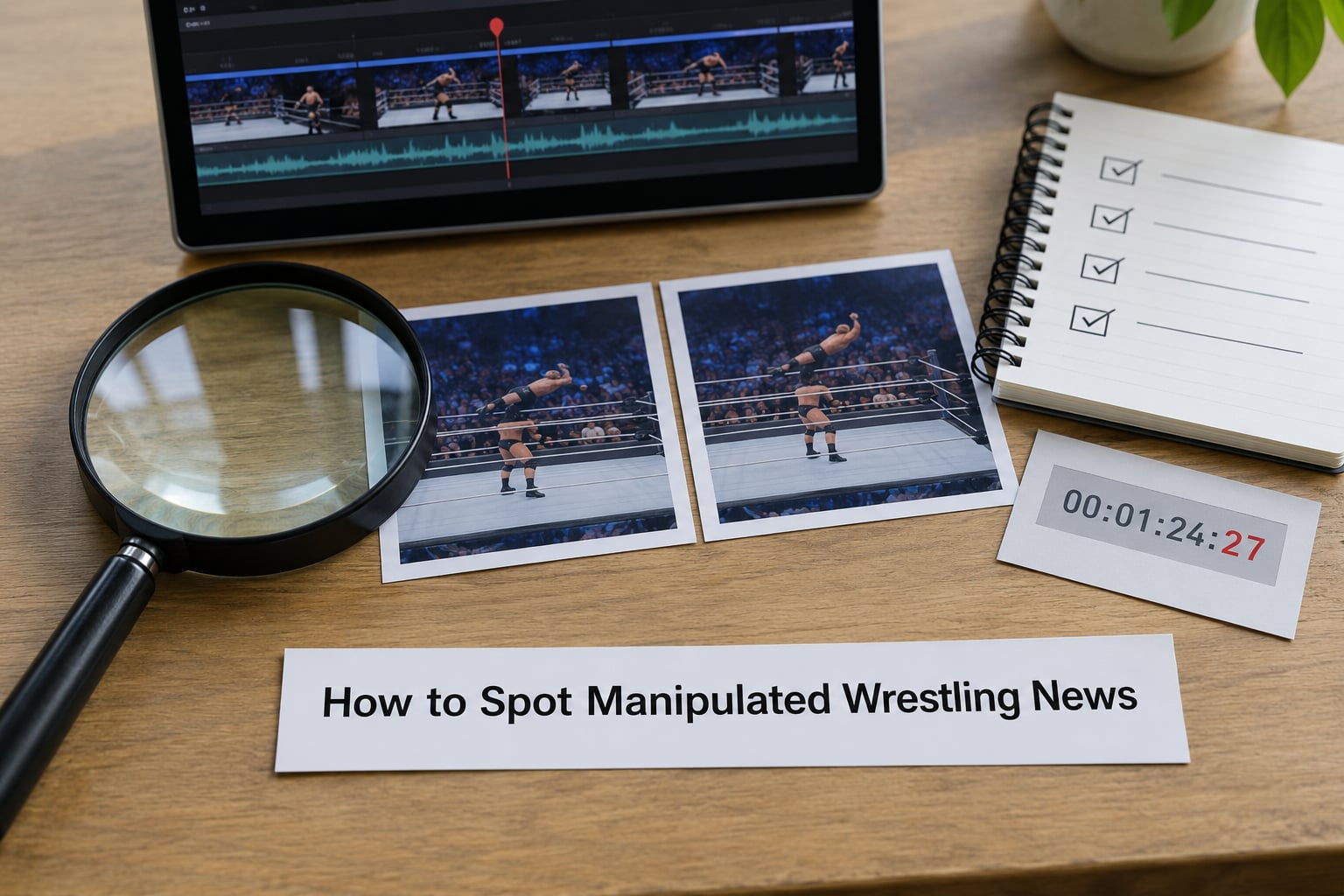
These checks take about a minute, and they catch most of what circulates.
Check the timestamp before the content. A screenshot with no visible date, or one edited so the top bar is cropped away, tells you nothing about when the message was sent.
Check whether the source is a person. A named reporter with a track record is checkable. “A high-ranking source at the company” is not, and cannot be verified by anyone, ever.
Look at image metadata. Right-click or long-press an image and check the file details for a creation date and the software that made it. Generated or heavily edited images often carry a mismatch.
Watch for the selective clip. If a video is presented as evidence, ask what happens five seconds before and five seconds after. Audio removed from a segment flips meaning more often than people expect.
Read the body, not the headline. A restrained headline over a hedged article usually means the article does not support the headline.
Watch the confirmation pattern. A post saying “sources are saying the same thing” with no sources attached is not two sources. Look for whether the second one is actually independent or just repeating the first.
Note where the language shifts. A well-written report separates what is confirmed from what is a rumor. Watch for phrasing that quietly moves the line between the two, and stay aware that plans genuinely change, so even careful reporting can be wrong later.
How Platforms and Wrestling Accounts Increase the Reach
Feed systems rank by predicted engagement, and a rumor is nearly ideal engagement bait: it is novel, it divides people, and it invites a confident reply.
Quote-posting turns a reaction into distribution. Every hot take about a rumor gives the original post a second audience, whether the poster is mocking it or celebrating it.
Screenshot posts carry no source link at all, so the claim arrives already stripped of the context that might have limited it. The image becomes the source.
Group chats and private communities do the quiet version of the same work. A link dropped in a wrestling chat becomes a dozen people with the impression that somebody verified it, because it came from inside the group.
Coordinated engagement is real too. Accounts that farm reactions can push a weak story to people who would never have seen it, and community platforms where votes decide visibility are easy to manipulate in the same direction.
These are platform mechanics and human incentives, not a conspiracy. No single company needs to control any of it for a rumor to reach millions.
What Readers Can Do Without Sharing More False Information
A short process, in order, that works most of the time.
Pause before you repost. The urge to warn someone else is the moment to slow down. Reposting is the only step here that is hard to undo.
Trace it to the earliest visible source. Follow the chain back until you hit something other than another person’s post about it. Chains that end in a screenshot end in nothing.
Compare against primary evidence. On-air segments, official announcements, and direct interviews with the people involved are checkable. A leak from an anonymous source is not.
Watch the full clip. Look for the part before and after the posted segment. Selective editing is common because it is cheap and effective.
Do not link sensational claims. Linking a story is a vote for it. If you want to point someone at something, say what you think of it in the sentence around the link.
Correct proportionally. If you shared it, say so briefly in the same thread where people saw it. A short correction under the original post reaches further than a new post hoping to travel on its own.
Frequently Asked Questions
Does kayfabe make every wrestling rumor false?
No. Kayfabe is a live performance convention, and it describes matches and segments, not backstage business reporting. A worked storyline can look exactly like real news, which is why screenshots get misread, but a report about contracts, injuries or ownership is judged on its sourcing like any other story. Kayfabe makes rumors easier to fabricate. It does not make honest reporting false.
Are anonymous wrestling sources always lying?
Not always. Protecting a source is a normal part of reporting, and some legitimate stories only exist because a source stayed unnamed. The problem is that anonymous sourcing cannot be checked by the reader, so it deserves corroboration and context. Treat an unnamed source as unconfirmed until a named outlet with a track record carries it, or until on-record evidence confirms it.
Why do old wrestling reports resurface as breaking news?
Because old posts stay searchable. A claim from years ago can appear in a recommendation feed or a search result with no visible date, and an aggregator republishing it gives it a fresh timestamp. Recycled reports often also start from something real, such as a genuine past change in direction, which makes the recycled version harder to check. Always find the original date before treating a wrestling report as new.
Should I share a correction after a rumor has spread?
Yes, if you shared it. Post a short correction in the same thread where the original appeared, because that is the only audience guaranteed to see it. Keep it factual: what you shared, what is actually true, and where the real information came from. A new post announcing that the old post was wrong usually reaches nobody who saw the original.
Can commenting on a wrestling rumor make it spread faster?
It often does. Reply-heavy posts get ranked up, and quote-posting gives the original a second audience regardless of whether your comment supports or mocks it. If your goal is to stop the spread, the most effective move is usually to correct quietly and selectively rather than to argue in the replies. Silence reads badly, but a fight guarantees more distribution.
Conclusion
Before you repost a wrestling claim, open the earliest source you can find and ask whether a named person with a track record stands behind it. If the answer is a screenshot, an anonymous source or another post about the same thing, you are looking at stage one of a chain you have not checked. Confident wording is a style choice, not proof. Treat it as something to verify rather than something that ends the conversation.