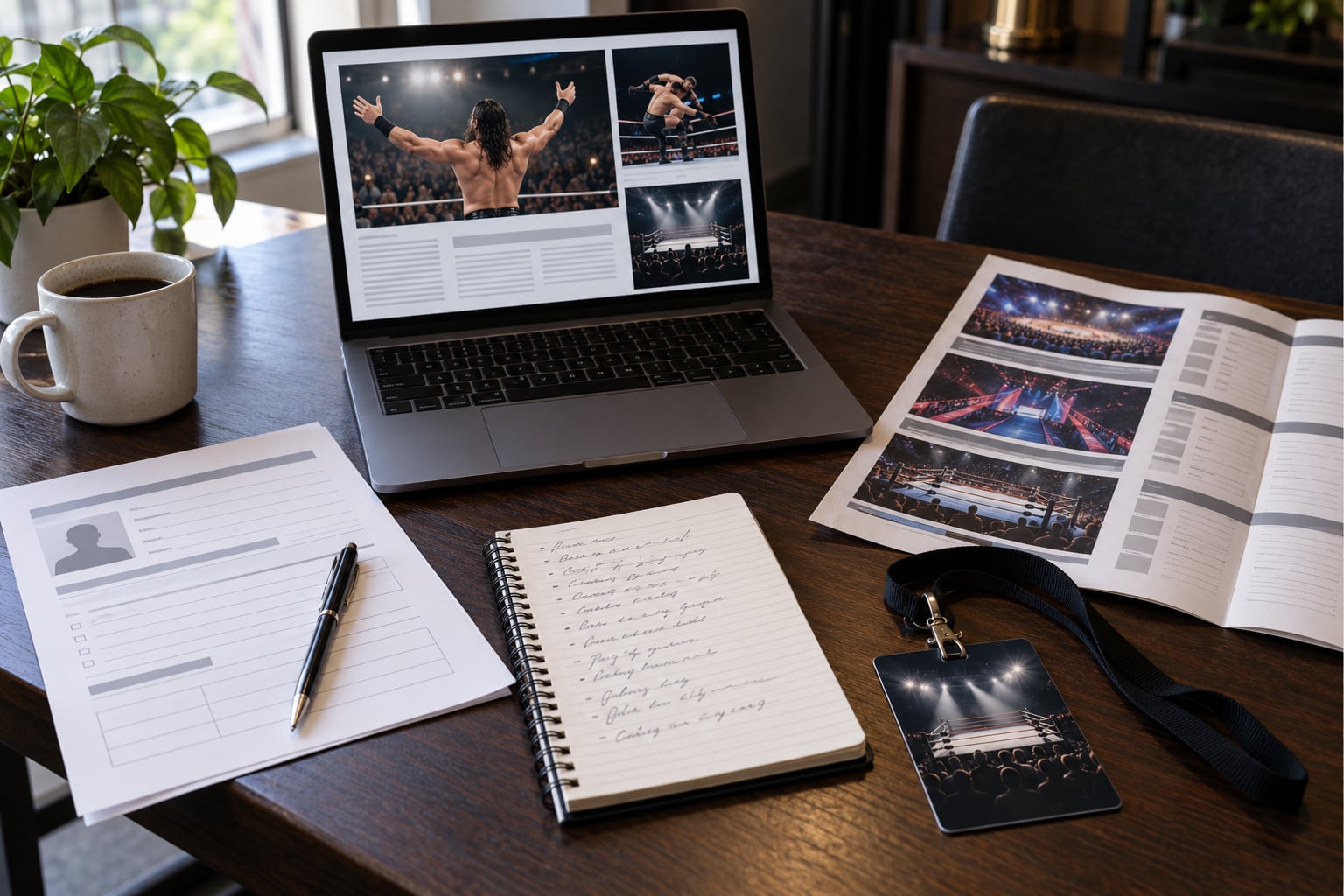
Wrestling journalists get press credentials by applying to the promotion’s media or public relations department, proving they publish verifiable coverage for a real outlet, and getting approved event by event. The credential itself is a wristband, lanyard, or printed badge tied to one specific show. Approval is discretionary, and almost no promotion publishes the full rulebook.
That’s the honest version. The rest of this guide covers what you need before you apply, the five-step process, what each pass actually unlocks, and where independent shows are far more forgiving than a televised major. Last reviewed October 2026, since credential policies get rewritten before every big card.
Quick answer: you get credentialed by being useful to someone who counts. Promotions hand out passes to people who already produce wrestling coverage that reaches an audience, not to people who hope to start. Bring a portfolio, an outlet, and a specific plan for the show. Everything else is detail.
Table of Contents
- What You Need
- A verifiable outlet
- A portfolio of published wrestling coverage
- Audience metrics
- Government photo identification
- An assignment plan
- The materials the event requires
- How Wrestling Journalists Get Press Credentials
- Step-by-Step: Getting Credentialed for a Wrestling Event
- Step 1: Build a credible wrestling news portfolio
- Step 2: Find the official media application
- Step 3: Submit complete and accurate information
- Step 4: Follow up professionally
- Step 5: Prepare to cover the event
- Common Mistakes
- Applying late
- Sending an incomplete application
- Claiming a press affiliation that does not exist
- Writing “I will cover the event” as an assignment
- Ignoring embargoes
- Assuming a credential guarantees interviews
- Publishing unverified material
- Treating a denial as permanent
- Frequently Asked Questions
- Do press credentials exist for wrestling events?
- Can I cover a wrestling event without credentials?
- How long does credential approval take?
- Do freelance photographers and writers get wrestling credentials?
- Why would a promotion deny a media credential request?
- What is a media scrum in wrestling?
- Conclusion
What You Need
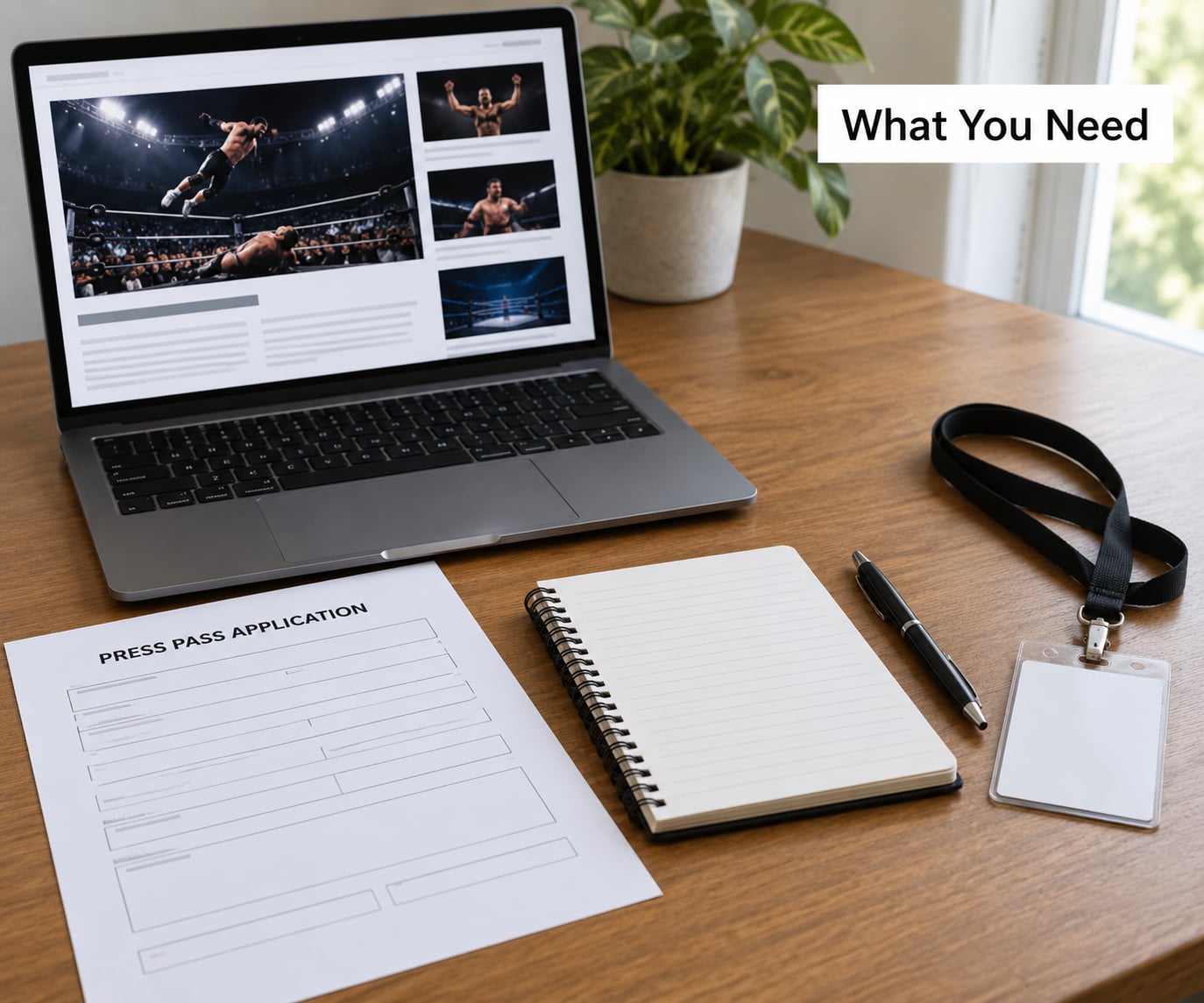
Applications get returned or denied for predictable reasons, and almost all of them trace back to something missing from this list.
A verifiable outlet
“Working media” is the phrase promotions use constantly, and it means you publish on a platform with a name on it that someone else owns. A newsletter with a signup form, a site with a masthead and an editor, a show with a published feed, a union or trade outlet. Personal accounts with no publishing structure usually do not qualify on a first request.
A portfolio of published wrestling coverage
Five to ten pieces, live, with your byline on them. Event recaps work. So do interviews, opinion columns with sourcing, power rankings argued from specific matches, and analytical pieces on a promotion’s booking. Photography portfolios with published images work the same way. What does not work is a private document you are hoping to show later, because the reviewer needs to click and read.
Audience metrics
Newsletter subscriber counts, average monthly visits, social following, video views on a comparable piece. The number does not have to be large, and promotions know that a small newsletter with real readers is more valuable than a large account with no engagement. Pull the numbers from your analytics the week you apply, not a screenshot from two years ago.
Government photo identification
Minor, not major, wrestling events and most venues will not admit anyone without it. Keep it current. If your name on the ID does not match the name on the application, that mismatch is a slow approval at best.
An assignment plan
This is the single most underused part of an application. Say what you are coming to do, in two or three lines. Preview coverage of a return, a documented attendance history at shows like this one, interview requests you have already sent, or a specific analysis angle nobody else is covering. “I will cover the event” tells a media relations manager nothing. “I will write a 1,200-word preview, a same-night results report, and a separate piece on the returns of the champion” tells them what they get for the badge.
The materials the event requires
Some shows ask for proof of vaccination status or require you to sign a media agreement. NCAA and conference championships publish a formal media credential criteria document with the rules attached; read it before you fill anything in, because the document is the application instructions.
How Wrestling Journalists Get Press Credentials
A wrestling media credential is a pre-approved, event-specific pass issued by a promoter’s media relations or public relations department. It verifies that you are working media and grants controlled access to restricted areas: ringside seating, the photo pit, the press conference room, backstage, and post-event media availability. Physically, it is usually a wristband, a lanyard with a laminated card, or a printed badge collected at a media desk on the day.
Four routes get you through the doors. Which one you use depends on who you are and how much the show publishes.
| Route | Who it suits | What you get |
|---|---|---|
| Accredited media credential | Staff reporters, photographers, and videographers at an established outlet | Whatever tier the promotion assigned, from general admission seating up to ringside and the pit |
| Sponsored freelancer | Freelancers with no staff job, usually photographers and contributors | Same as staff, but only after a news organization, school, or sponsor submits the request on your behalf |
| Guest pass or promotional comp | Creators, podcast hosts, and personalities with an existing audience | Admission and sometimes a better seat, but no press conference entry and no stated news purpose |
| Public ticket admission | Anyone, including a journalist covering the show as a fan would | Exactly what the ticket buys, which at most indies is everything the credential would have given you |
The last row is the one wrestling fans argue about most, and they are partly right. At a 300-seat independent show, a ticket gets you into the room and a ringside seat costs extra rather than requiring a credential. The credential has almost no market value there. At a televised major with a restricted pit, a locked-down production compound, and a scheduled press conference, admission control is physical, and the pass is the difference between working media and a customer.
Step-by-Step: Getting Credentialed for a Wrestling Event
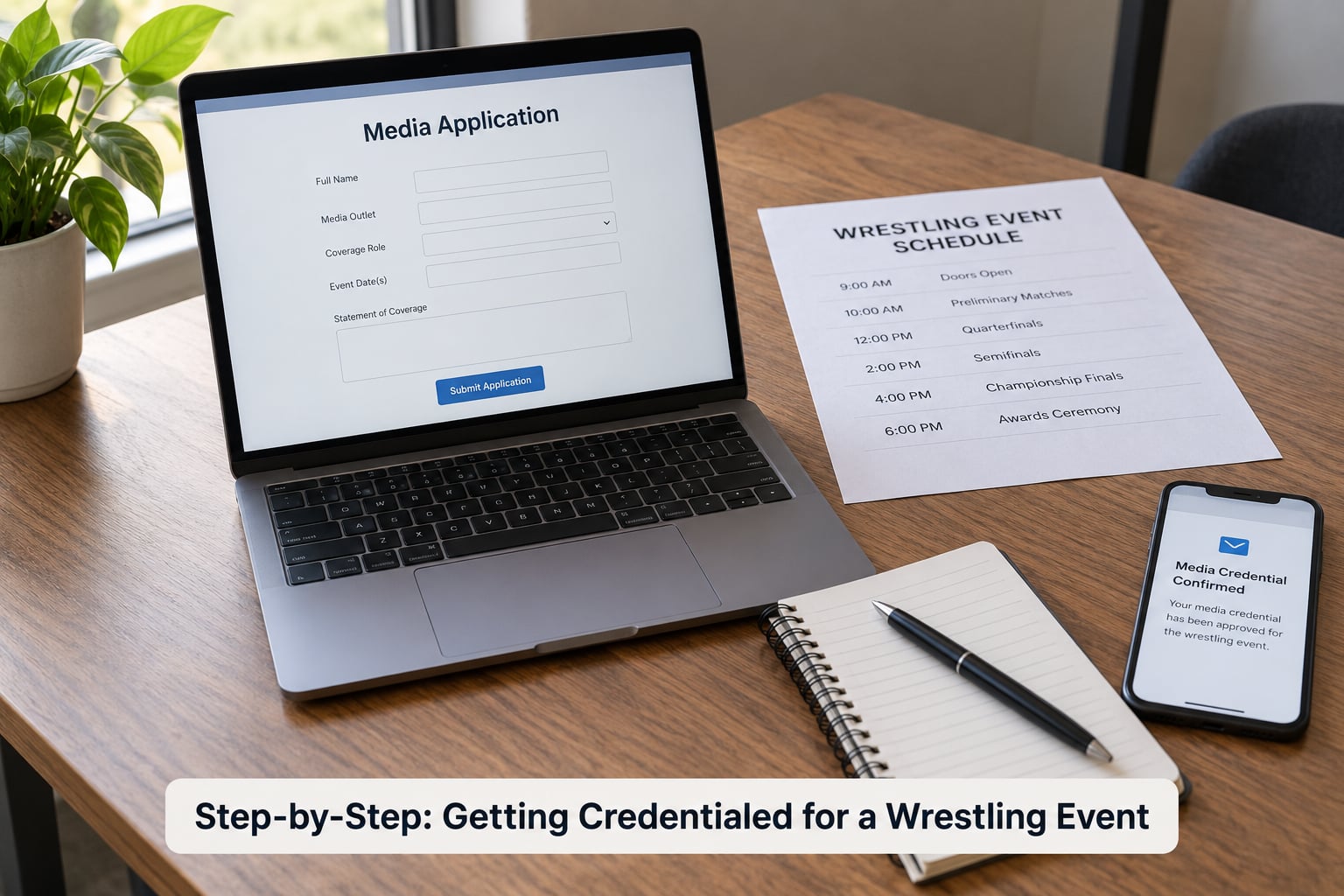
Step 1: Build a credible wrestling news portfolio
Do this first, before any application exists. Pick one beat and publish on it consistently for two or three months. Weekly indies, women’s wrestling, a single promotion’s booking, the business side of wrestling, or a podcast with written show notes all count. Consistency tells a reviewer you will still be publishing in three months, which is what they are actually calculating.
Then edit it. A portfolio full of recycled social posts and unedited recaps reads as a fan account no matter how many links are in it. Two or three deeply reported pieces carry more weight than thirty match results.
Pick the three or four links you want a reviewer to actually open and put them first. Then check them on a phone, on a browser with no login, and with ads and trackers blocked. If a link needs a subscription to view, know that before you send it.
Step 2: Find the official media application
Major promotions and most organized bodies keep a media or press page. WWE publishes media information, AEW and its parent TKO Group Holdings run press and media relations functions, and NJPW handles international media requests through its own press channels. Smaller independent promotions usually do not have a form at all; you contact the promoter or the publicist directly.
For collegiate wrestling, the process is the most documented of anything in this space. Championships operated under NCAA criteria direct applicants to the NCAA media credentials page, and organizations like the National Wrestling Media Association publish the season’s application window and eligibility rules. That published criteria document is the closest thing wrestling has to an official rulebook for credentialing, and it is worth reading as a model even if you never cover a college meet.
When no application exists, the routing is predictable: the promoter’s media email, the publicist named on the event announcement, or the sports information director at a school. Wrestling shows are often run by one person who also handles the booking, and a polite direct message reaches them faster than a generic contact form.
Step 3: Submit complete and accurate information
Applications usually ask for your name exactly as it appears on your ID, outlet name and URL, your role, the audience you serve, what you plan to cover, whether you need photo pit or ringside access, your equipment, and your prior credential history. A few also ask for insurance, accreditation letters, or an assignment letter from an editor.
Everything you submit has to be true, including the parts that feel embarrassing. Inventing an outlet, exaggerating reach, or claiming a byline you did not write is the fastest way to end a relationship before it starts, and it is the reason small writers who later break real stories sometimes cannot get back in. Promotions talk to each other and they remember.
Be specific about the assignment. A good assignment line names the matches, the talent, or the angle, and shows you know what the event is rather than what the promotion generally is.
Step 4: Follow up professionally
Turnaround varies more than most guides admit. The NCAA credential process published a 24 to 48 business hour approval window, which is fast because it is a standardized form. Independent shows can take days or never answer. Major televised events run on their own schedule and may not open applications until weeks before the show.
If a week passes with no response, send one short follow-up: restate the event, the date, your outlet, and what you are covering. Nothing else. No apology for the follow-up, no second paragraph of context, no implied threat about publishing a story about the delay.
If there is still no answer, move on and buy a ticket if the story matters enough. Chasing does not work, and a request for comment sent after publication is a legitimate way to cover a story you could not get credentialed for. It is also how a lot of independent promotions learn about writers who handle a refusal well.
Step 5: Prepare to cover the event
Approval usually arrives as an email with a media contact name, sometimes a media hotel booking link for major shows, sometimes an assigned seat or a call time. Read all of it, because arrival instructions are specific. Entry windows for media open earlier than public doors and close earlier too. Missing the window means missing the show.
Then research the card before you arrive. Know the storylines, the participants’ recent matches, the champion’s title reign length, and what the crowd already knows. A reporter who cannot explain why a match matters cannot get a quote about why it matters.
Request interviews in advance through the media contact rather than asking for them in the hallway. Confirm embargoed material, which is common with major shows: results, injury reports, and contract announcements are frequently embargoed until a specific time, and breaking an embargo is a reliable way to lose access permanently. Know the venue’s recording policy, and know which credential tier restricts what you can film.
On the day, be early, be quiet in the production area, and ask before you move anything. Access is conditional and can be withdrawn by a person standing ten feet away from you.
Common Mistakes
These are the errors that end applications, gathered from how credentialing actually works rather than how it is described. Each has a fix.
Applying late
Major events often close credential lists before the public on-sale, and ring deadlines get locked weeks ahead of the show. Work backwards from the show date instead of forward from the day you decide to go. Six to eight weeks is a reasonable planning window for a large event, and two weeks is already tight for anything with an assignment letter.
Sending an incomplete application
Blank fields, a missing outlet URL, no role, no assignment. Incomplete applications go to the bottom of the pile or into a rejection. Read every field before sending, and if a question genuinely does not apply, write “not applicable” rather than leaving it empty.
Claiming a press affiliation that does not exist
A self-started blog with no editorial structure, a defunct newsletter, a fan account rebranded as an outlet. This is the fastest way to get denied and remembered. If you have been published by someone else, link to that byline. If you have not, apply as what you are and accept a lower chance.
Writing “I will cover the event” as an assignment
The most common failure among people who clearly could be qualified. A media relations manager reads a hundred applications and can tell within one line whether the writer knows what the show is. Name the angle, the talent, and the format.
Ignoring embargoes
An embargo is a promise about timing in exchange for early access, and breaking one ends the relationship regardless of how accurate the reporting was. Put the embargo time in your notes, not in your memory. Nobody has ever lost access for being early to a published story.
Assuming a credential guarantees interviews
A pass gets you into the room. It does not get a quote. Whether someone speaks to you depends on your assignment, your outlet, your questions, and your track record, in that order. Treat the credential as the entry fee, not the outcome.
Publishing unverified material
That includes reporting on an injury you heard from one person in a hallway, a contract rumor from a single anonymous source, or a segment discussion as a real storyline. Accuracy history is the single biggest factor in whether a promotion gives you hard access next time. Wrestling audiences are unusually good at spotting invented stories, and so are promotions.
Treating a denial as permanent
Denied requests are common and rarely explained. Wrestling writers have discussed losing access after being critical, and have also described the pattern as a consequence of refusing to do the work rather than a formal blacklist process. There is no published appeal route at most promotions. The practical appeal is the next application, with a better body of work behind it.
Frequently Asked Questions
Do press credentials exist for wrestling events?
Yes. Promotions issue event-specific media credentials, usually a wristband, lanyard, or laminated badge. They come from the media relations or public relations department and grant controlled access to areas a paying customer cannot reach: ringside seating, the photo pit, the press conference room, and post-event interviews. NCAA and conference championships publish formal media credential criteria, while most independent shows either issue simple passes or do not run a credential system at all.
Can I cover a wrestling event without credentials?
At most independent shows, yes. A general admission ticket usually gets you into the building, and at a 300-seat venue that is effectively the same access a credential provides. Credentialing matters at televised majors, where the pit is restricted, backstage is controlled, and press conferences are credential-only. If you cannot get approved, you can still cover the show as a paying customer and publish afterward, though you will not get interviews on the record.
How long does credential approval take?
It depends entirely on the organization. The NCAA credential process published a window of 24 to 48 business hours, because the application is standardized. Independent promoters may take several days or not reply at all. Major televised events run on their own schedule and may not open applications until weeks before the show. Apply as early as the window allows rather than assuming a standard turnaround exists.
Do freelance photographers and writers get wrestling credentials?
Usually, but they almost always need a sponsoring request from someone else. NCAA and conference criteria require freelance photographers to have a request submitted by an immediate news organization or school. In pro wrestling the pattern is similar, though less formally published. A freelance writer who also publishes for an established outlet has a much easier time than one asking for a pass on the strength of a personal project alone.
Why would a promotion deny a media credential request?
The usual reasons are an unverifiable outlet, missing assignment information, a request submitted after the deadline, an incomplete application, or a record of inaccurate reporting. Capacity limits also drive denials, since a televised event may cap credentials per outlet. Promotions rarely explain a denial, and there is generally no formal appeal. The only reliable appeal is a stronger application for the next event.
What is a media scrum in wrestling?
A scrum is the short window when several reporters surround a person who is available to answer questions, usually immediately after a press conference or match. There is no moderator and no order, so the loudest voice gets the most airtime. Ask your question once, clearly, and move on. Wrestling scrums are also where most credentialed reporting actually breaks, which is why access to them matters.
Conclusion
The first thing to do is publish. Open an outlet with a real name, put five to ten edited pieces under a byline, and get your audience numbers in front of you before you apply for anything.
Then find the official media application for the specific event, read the eligibility criteria in full, and send one complete request with a two-line assignment plan. Apply weeks ahead of any major show, treat the pass as a beginning rather than a guarantee, and treat a denial as a temporary answer rather than a verdict.
Access in wrestling journalism is earned in the same room it is handed out in. Nobody has ever walked into a press conference with a better application than the person who actually covered the last thirty shows.