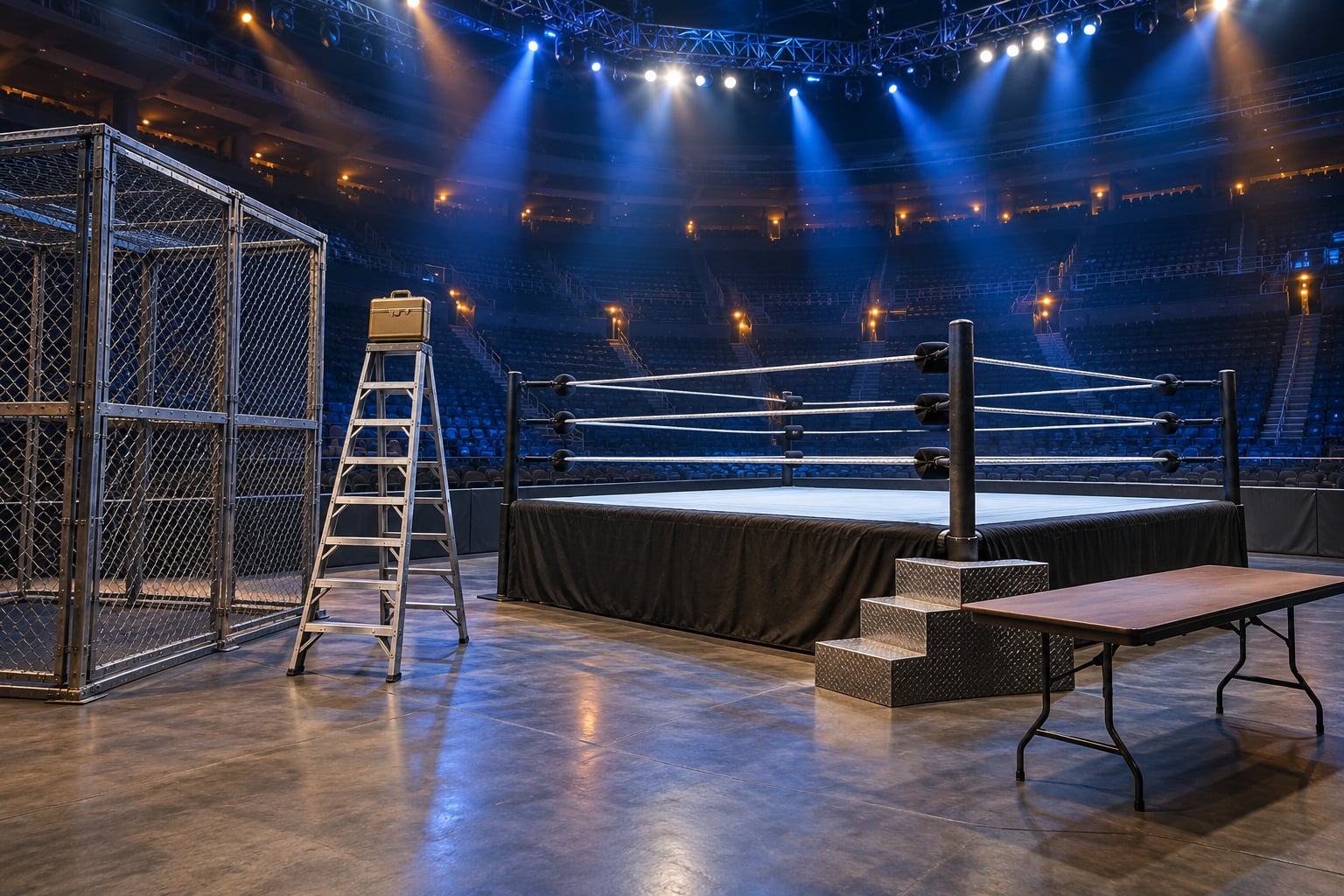
A stipulation match raises the stakes by rewriting the win conditions and attaching consequences that an ordinary one-on-one contest does not have. Instead of only pinning your opponent, you might have to escape a steel cage, reach a hanging briefcase, score two falls inside an hour, or be the last competitor still standing. That added rule narrows what a wrestler can do, forces a plan they cannot ignore, and gives the crowd a clear thing to react to.
The difference is easy to feel even if you cannot articulate it. A regular match asks a question with one acceptable answer. A stipulation match asks the same question and then removes some of the answers the wrestler had grown comfortable with.
Table of Contents
- What Is a Stipulation Match?
- Stipulation match, gimmick match, specialty match
- How Do Rules Change the Stakes?
- Narrowed win conditions
- Clear victory conditions
- Forced strategy changes
- Visible consequences
- How Do Weapons Increase the Suspense?
- Why Do Stakes and Consequences Matter?
- How Does Physical Endurance Change the Story?
- Stipulation Match Types and Their Win Conditions
- What Makes a Stipulation Match Feel Believable?
- How Do Stipulation Matches Affect Wrestling Stories?
- Frequently Asked Questions
- What are the stipulations for a WWE stipulation match?
- What are the rules for a ladder match in WWE?
- What are the rules for a steel cage match in WWE?
- How many falls does it take to win an Iron Man match?
- Are winners of WWE matches predetermined?
- What stipulation makes you lose interest in a match?
What Is a Stipulation Match?
A stipulation match is any match in which the normal win conditions are changed, extended or replaced. The referee will usually announce the added rule before the bell, and that rule is the whole match. Everything the wrestlers do in the ring is filtered through it.
New fans often hear three terms used as if they were the same thing, so it helps to split them.
Stipulation match, gimmick match, specialty match
A stipulation match changes a formal rule. The winner is decided by a defined condition: two falls, a time limit, escaping a structure, last competitor standing. The result is verifiable and the outcome is clean.
A gimmick match is a themed variation that changes the presentation more than the rulebook. Backstage brawls, parking lot fights, barbed wire death matches and themed retirements all sit here. Some gimmicks have a real win condition; many are decided by creative fiat when the fight is over.
A specialty match is the broadest term. It simply means a match outside the standard singles or tag format, which makes it a catch-all rather than a category with its own rules.
For new readers, the base win conditions are worth memorizing before anything else, because almost every stipulation is a modification of one of them:
- Pinfall — the referee counts to three with both shoulders touching the mat.
- Submission — the opponent taps or verbally submits to a hold.
- Knockout — a wrestler is unable to continue and cannot beat the count.
- Count-out — a wrestler leaves the ring and is not back before the referee’s count finishes.
- Disqualification — the referee stops the match and rules for the other wrestler, usually for a rule break.
How Do Rules Change the Stakes?
The core mechanics of how stipulation matches raise the stakes come down to four things: fewer ways to win, clearer victory conditions, forced strategy changes and visible consequences. Every serious stipulation pulls on at least one of them.
Narrowed win conditions
In a normal singles match a wrestler can win roughly five ways, so a good opponent can always pivot to the next one. Remove pinfall and submission and only a knockout counts. Put both competitors on the same legal escape clause in a steel cage and the escape becomes the only route, and every setup now points in one direction.
Clear victory conditions
Ambiguity kills crowd investment. When a fan cannot tell whether a wrestler is winning, they stop reacting. A stipulation hands the audience a shared scoreboard, which is why Iron Man matches generate a running count in the crowd and why a cage escape has a clear finish line.
Forced strategy changes
A wrestler who relies on a mat wrestling game loses value in a ladder match. A high-flyer who never sells a punch loses value in an Iron Man match. The stipulation quietly auditions each competitor and exposes the parts of their game that cannot answer the question in front of them.
Visible consequences
When a rule attaches a real consequence to losing, the audience treats the outcome as meaningful rather than cosmetic. That is the difference between a match that announces a new title on the line and one that announces the same title on the line for the fourth time this year.
How Do Weapons Increase the Suspense?
Weapons raise the stakes because they introduce uncertainty into a contest the audience already knows how to read. A wrestler has a limited number of things they can do safely; a chair, a table, a kendo stick or a set of steel steps adds variables that nobody has fully mapped yet.
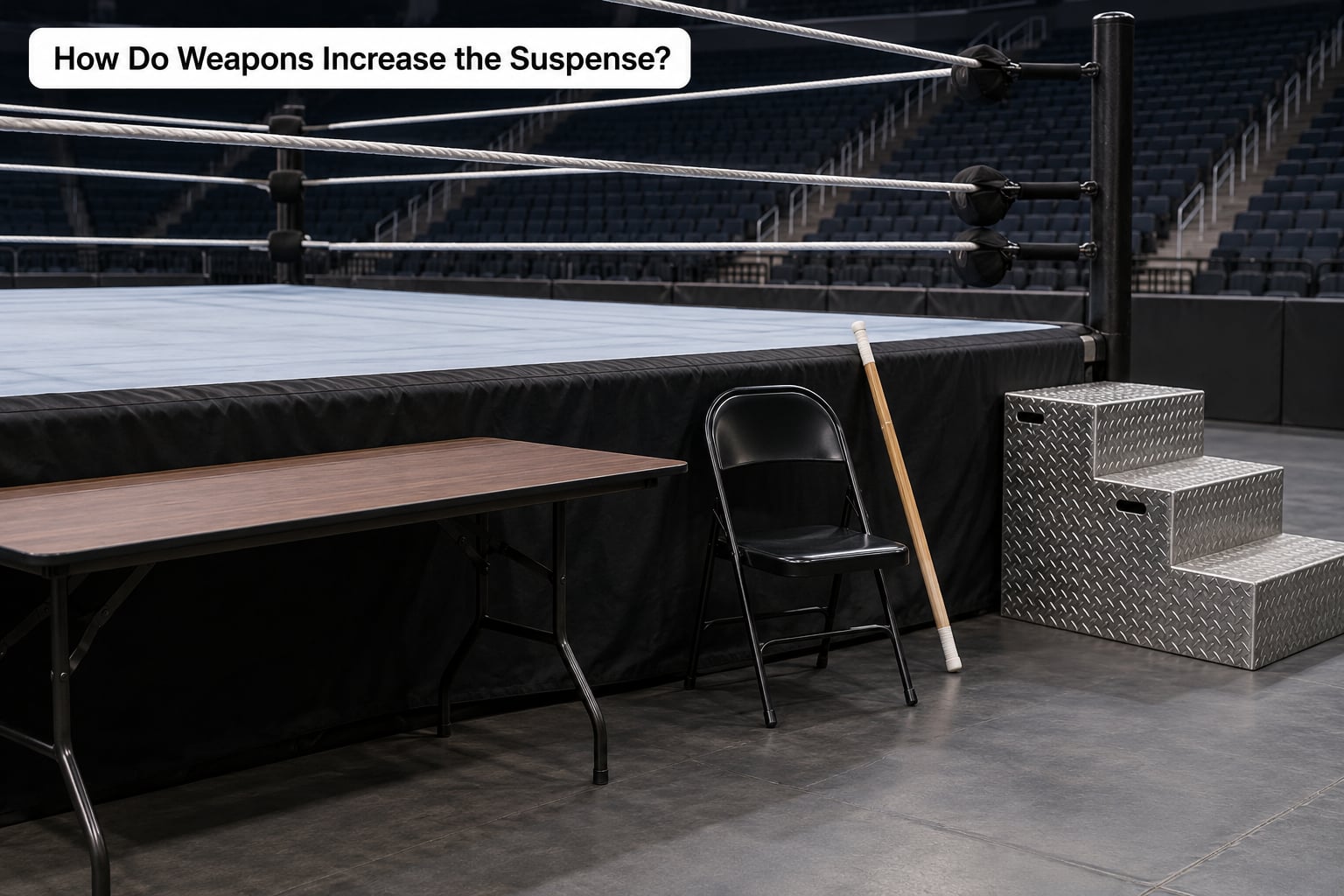
They also punish predictable tactics. A wrestler who leans on rope runs and safe resets finds that the environment no longer tolerates that approach, so the match has to invent new answers in real time.
What weapons do not do is make a match good on their own. Fans on r/SquaredCircle and r/WWE keep returning to the same complaint: a Tables, Ladders and Chairs match with nothing hung above the ring is just weapon bashing with extra steps, because the gimmick has nothing to deliver. The weapon has to be attached to a goal or it is just noise.
Why Do Stakes and Consequences Matter?
Stakes are what turn a match into an event. A title on the line, a job on the line, a mask or a retirement all attach consequences to the result, and consequences are what make a crowd care about who wins rather than merely watching.
The history is full of stipulations that carried real weight. Shawn Michaels versus Bret Hart at WrestleMania 12 in 1996 was an Iron Man match for the championship, with two falls in sixty minutes required, and the win came only after nearly an hour. Bret Hart versus Owen Hart at SummerSlam 1994 was a steel cage match between family members, and the cage turned a wrestling match into an escape problem that neither man could solve alone.
The pattern repeats outside WWE too. NJPW has used time limits and junior heavyweight rules to force quick, honest displays of offense, and AEW has revived buy-in and title-for-title stipulations that make the consequence literal: win the belt or the belt is gone.
How Does Physical Endurance Change the Story?
Endurance formats change the story by making the body part of the plot. Fatigue is visible, cumulative damage accumulates, and the finish tends to arrive when a wrestler has the least left to give. That is the reason a submission match or an Iron Man bout feels different from a twelve-minute sprint.
Time limits also reward pacing. A wrestler who burns energy in the first ten minutes of a sixty-minute contest loses the match on paper before it matters. Good Iron Man matches alternate bursts of intensity with long stretches of tactical patience, and the reversals come from stamina rather than from a fresh finisher.
Stipulation Match Types and Their Win Conditions
Here is the part that trips up most new fans. Every stipulation has one specific way to finish, and the table below lists them.
| Stipulation | How You Win | Added Risk | Effect on the Story |
|---|---|---|---|
| Ladder match | Climb the ladder and retrieve the hanging object | Falling from height | Turns a strength contest into an athletic showcase |
| Tables, Ladders and Chairs | Reach the briefcase or championship through the obstacles | Falls and weapon contact | Chaos that usually needs a real objective to work |
| Steel cage | Pin, submit or escape over or through the cage | No ringside help, limited weapons | Forces a finish inside the ring or a real escape |
| Hell in a Cell | Win inside the structure, or escape and lose the fall at ringside | Extreme height and confined space | Signals that the feud has passed the point of talking |
| Iron Man match | Score two falls before one hour expires | Pace management over a long bout | Rewards patience and makes every fall decisive |
| 60-minute time limit draw | Win by pinfall, submission or knockout before time | Finishing ability and endurance | Often creates career-defining classic bouts |
| Royal Rumble | Be the last competitor standing after entering at an interval | Entry order and constant fresh opponents | Allows underdogs and returning favorites to shine |
| Elimination Chamber | Win or escape the pod, then win the match | Multiple opponents and the closed structure | Layers several win conditions into one match |
| No disqualification | Any legal finish, with weapons allowed | Everything the referee has to police | Removes the safety net that guides matches |
| First Blood | Draw first blood on the opponent | Any deliberate injury ends the match | Reverses the usual goal: avoid finishing |
| Tables match | Put an opponent through a table | Repeated impact on solid objects | Simple, readable and unusually well suited to grudge feuds |
| Backstage brawl | Usually decided by creative after the fight | Whatever happens in the crowd | Sacrifices clarity for emotional escalation |
What Makes a Stipulation Match Feel Believable?
A stipulation match works when five conditions are met, and experienced fans can usually tell within the first two minutes which ones are missing.
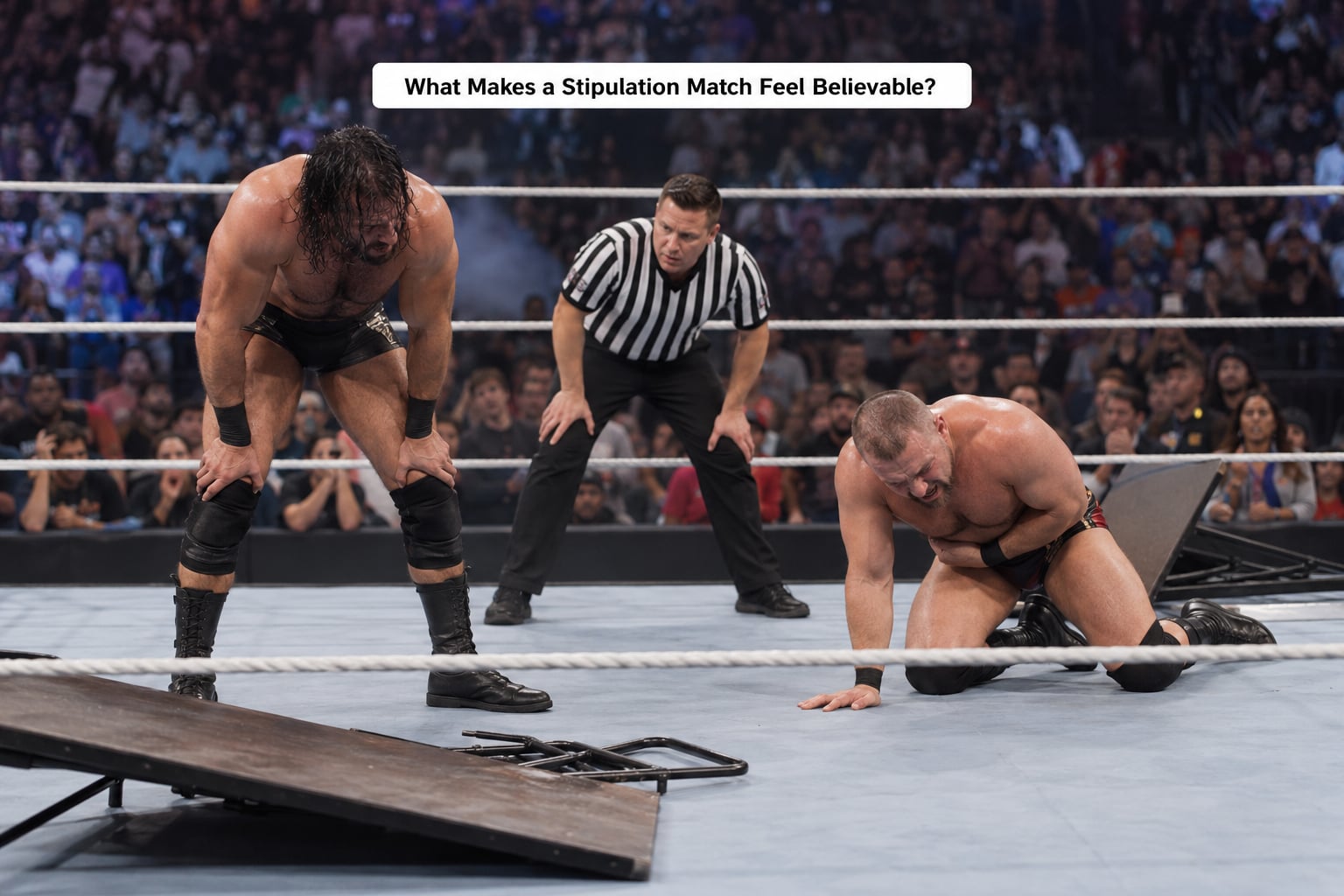
- The rule is stated clearly. If fans cannot repeat the win condition afterwards, the match failed before the bell.
- The consequence is credible. The thing on the line has to mean something to both wrestlers, not just be a belt everyone has already defended a dozen times.
- The pacing serves the rule. A ladder match builds toward a climb, a cage match builds toward an escape, and a submission match slows down until the hold locks in.
- The character choices make sense. The wrestler who cannot work at height should not be winning a ladder match, and the technician should not be the one who needs a sixty-minute limit.
- The payoff follows from the stakes. A match advertised around a consequence has to pay that consequence off, or the audience reads it as a bait and switch.
Fail any one of those and the reply is predictable. A long-running r/SquaredCircle thread asking which stipulation makes people lose interest collects almost the same answers: unconvincing rules, stipulations added to a feud that never earned them, and gimmicks that are announced and then never actually delivered.
How Do Stipulation Matches Affect Wrestling Stories?
A stipulation is not decoration around the story. It is a piece of story structure that produces consequences for everything booked after it.
Most often it creates or settles a rivalry. Two wrestlers who have traded promos for months usually cannot settle anything in a normal match, so the booking adds a rule that forces one of them to physically lose something. Bret Hart and Shawn Michaels spent nearly a year on the road to WrestleMania 12, and that road is the reason the Iron Man match landed.
It can also test a character rather than a skill. A heel who relies on dirty tactics can be handed a no disqualification match and exposed when the referee stops watching. An underdog can be handed a sixty-minute limit and be forced to prove they can last. In both cases the stipulation reads as a question about who the wrestler is.
Finally, a stipulation carries forward. Whoever wins gets a story beat that gets referenced in later promos, and whoever loses inherits a defeat that can be avenged later. That is why the difference between how stipulation matches raise the stakes and simply adding a gimmick is measurable in the weeks that follow.
Frequently Asked Questions
What are the stipulations for a WWE stipulation match?
The stipulation is the added rule announced before the bell, and it replaces or extends the normal win conditions. In a ladder match you must retrieve a hanging object, in a cage match you can win by escaping, in an Iron Man match you need two falls inside sixty minutes. Everything else about the match is standard wrestling unless the stipulation says otherwise.
What are the rules for a ladder match in WWE?
Two or more wrestlers compete in singles action in a normal ring, and one or more ladders are placed in the ring. A target object such as a briefcase, a belt or a cash prize is hung above the ring. Only one ladder may be in use at a time, and a referee stands on the floor to retrieve it when it leaves the ring. The match ends when a competitor climbs a ladder and retrieves the object, or when someone is pinned or submitted.
What are the rules for a steel cage match in WWE?
The match takes place inside a roofed steel cage surrounding the ring. The cage has one door that is locked for the duration, so leaving means climbing over or through it. Weapons are not allowed, and the referee stays inside with the competitors. You win by pinfall, submission or knockout inside the cage, or by escaping the cage, after which the match continues in the ring and you must pin or submit your opponent before the count is broken.
How many falls does it take to win an Iron Man match?
Two falls, and both competitors must score one. The bout has a sixty-minute time limit, and if neither wrestler has two falls when time expires, the match is declared a draw. Because falls accumulate rather than ending the match, both wrestlers keep working after scoring one, which is what makes Iron Man matches pace differently from normal singles matches.
Are winners of WWE matches predetermined?
Match outcomes in modern professional wrestling are worked in the sense that performers know the intended finish in advance and rehearse the ending, while the movement, psychology and most of the action are performed live in the ring. A stipulation match is no different in that respect. Knowing the result is not the same as every moment of the match being scripted, and the standard for good stipulation work is a finish that follows logically from the announced rules.
What stipulation makes you lose interest in a match?
The one the match never pays off to. Fans most often cite Tables, Ladders and Chairs matches where nothing is actually hung above the ring, because the match then becomes generic weapon bashing with no stated goal. Rules that seem arbitrary, such as first pinfall wins in a three-way tag match, and stipulations announced for a feud that never earned them, are the other common complaints.
The short version is that a stipulation raises the stakes by taking something away. It removes comfortable strategies, removes obvious endings, and forces both wrestlers and the audience to care about a specific outcome that could not have happened the week before. A match built that way tends to be remembered for years, and that is the whole reason wrestling keeps coming back to it.
If you want to start with one, watch an Iron Man match where two falls decide the winner. Everything the format does shows up inside the first twenty minutes.