A retirement match in professional wrestling is planned like a season finale: months of story decisions, a booking room conversation, rehearsal, a promotional rollout, and a backup plan for the night itself. Here is how a retirement match is planned, step by step, from the first pitch to the moment the bell rings.
One note before we start, since the search results for this phrase get muddled. This is about a wrestler’s farewell in the ring, not about an employer matching retirement savings. Different topic entirely.
Table of Contents
- Why Promotions Plan Retirement Matches Differently
- How a Retirement Match Is Planned From the Story Angle
- Who Makes the Creative and Logistical Decisions
- Booking the Opponent, Stipulation, and Finish
- The Planning Timeline From Concept to Event Night
- How Promos, Entrances, and In-Ring Story Beats Are Rehearsed
- How Promotions Handle Safety and Last-Minute Changes
- What Happens After the Retirement Match
- Frequently Asked Questions
- How far in advance is a wrestling retirement match planned?
- Who chooses the opponent for a wrestler’s retirement match?
- Do wrestlers have creative control over their retirement match?
- Why do some retirement matches not stick?
- What is the difference between a retirement match and a Loser Leaves Town match?
- What happens after a wrestler’s final match?
- Conclusion
Why Promotions Plan Retirement Matches Differently
A retirement match is the final competitive match of a wrestler’s career, built so the crowd feels the weight of it. That is different from three related things fans often lump together.
- A standard singles match exists to move a storyline forward. Nobody outside the company cares that it is anyone’s last one.
- A farewell segment is a speech or celebration. The wrestler can give one and still wrestle the following month.
- A retirement match is a match with the career on the line, either formally or by understood agreement, where the finish is designed to close a chapter.
The distinction matters because the cost of getting it wrong is high. A botched farewell gets talked about for years, and fans tend to blame the promotion more than the wrestler. Advance planning is the only way to protect the emotional payoff.
Retirement matches also carry a scheduling problem the rest of the card does not have. You are asking an aging or injured performer to deliver a memorable match on a specific date, with a fixed opponent, while every other storyline in the company keeps moving around them.
How a Retirement Match Is Planned From the Story Angle
Every retirement match starts as a narrative question, not a match announcement. The first real discussion is almost always about why this person is leaving and what the match is supposed to prove.
Writers typically settle four things in that first conversation. The emotional conflict has to be clear, usually respect earned over years or a debt that has gone unpaid. The finish has to be decided early, because the whole angle is built backward from it. The opponent has to earn the moment, which usually means a real connection rather than a name thrown in for a headline. And the retiring wrestler needs a reason to be in a match at all, whether that is a title shot, a grudge settlement, or a passing of the torch.
That last point is where the rival versus rising star debate usually shows up. A r/Wrasslin thread recently argued both sides, with the majority leaning toward the rival: a shared history gives the audience something to feel that no amount of good wrestling can manufacture. Writers often split the difference, giving a retiring legend a rival for the emotional beat and a younger wrestler for a post-match moment.
Who Makes the Creative and Logistical Decisions
A retirement match is one of the few matches in wrestling with a wide circle of people who all have a stake. Typical responsibilities look like this.
- The booker owns the final call on opponent, stipulation, and finish, and has to fit it into the wider card.
- Head writers draft the angle, write the promos, and design the beats they need on the night.
- Producers handle the physical execution, cue sheets, and rehearsal coverage.
- The retiring wrestler and their agent negotiate the date, the opponent, and any creative lines they will not cross.
- The opponent helps shape the match in the ring and has to agree to lose, which is a bigger ask than it sounds.
- The referee briefs on finish timing and signal methods in case the script needs adjusting.
- Event and production teams plan entrances, lighting, music, pyro, and the post-match presentation.
- Broadcast partners get advance notice so they can build the match into the week’s story and promo cycle.
Nobody books a retirement match alone. In practice it takes agreement from every name on that list, which is why the announcement often comes well after the idea started circulating.
Booking the Opponent, Stipulation, and Finish
Opponent selection is usually the first decision and the hardest. Promotions weigh three things: does the crowd believe these two have history, is the opponent physically able to deliver, and will putting over the legend raise or lower the opponent’s standing.
Stipulations then follow from the story rather than from novelty. The common options are a career versus career match, a career versus title match, a Loser Leaves Town bout, a lucha de apuestas where a mask or hair is on the line, or a straight ceremonial farewell with no formal stipulation at all.
The finish gets decided in the booking meeting, usually before the match is announced, because the promo writers need to know what they are selling. Clean finishes get the most consistent support from wrestling fans, who tend to punish a farewell that ends in a cheap finish.
Timing is the last piece. Promotions usually give a legend a strong stretch near the end, then a protected final minute, then a post-match moment where the opponent hands the spotlight back. The retiring wrestler’s reaction in that moment often gets more attention than the match itself.
The Planning Timeline From Concept to Event Night
How far ahead the work happens depends on the wrestler. A working full-timer with a contract ending on schedule gets months. An injury-forced retirement gets days. The longer runway looks roughly like this.
- Six to twelve months out: informal conversations between agent, wrestler, and producer about whether a farewell is wanted at all.
- Four to six months out: creative commitment, opponent shortlist, and date selection around the schedule.
- Three months out: story finalized, finish locked, promos drafted, ticket and merchandise plans set.
- Six weeks out: full angle announced, video packages produced, and the promotional rollout starts.
- Two to three weeks out: rehearsal in a practice space, entrance and theme locked, cue sheets written.
- Show week: medical checks, final production meeting, contingency finishes agreed with the referee.
- Event night: the match, the ceremony, and a short-term window where the story either lands or needs rescuing in a post-show segment.
Advance announcement is the part fans notice most. A farewell revealed six months out feels like an event; the same match revealed on the episode it airs feels like an afterthought.
How Promos, Entrances, and In-Ring Story Beats Are Rehearsed
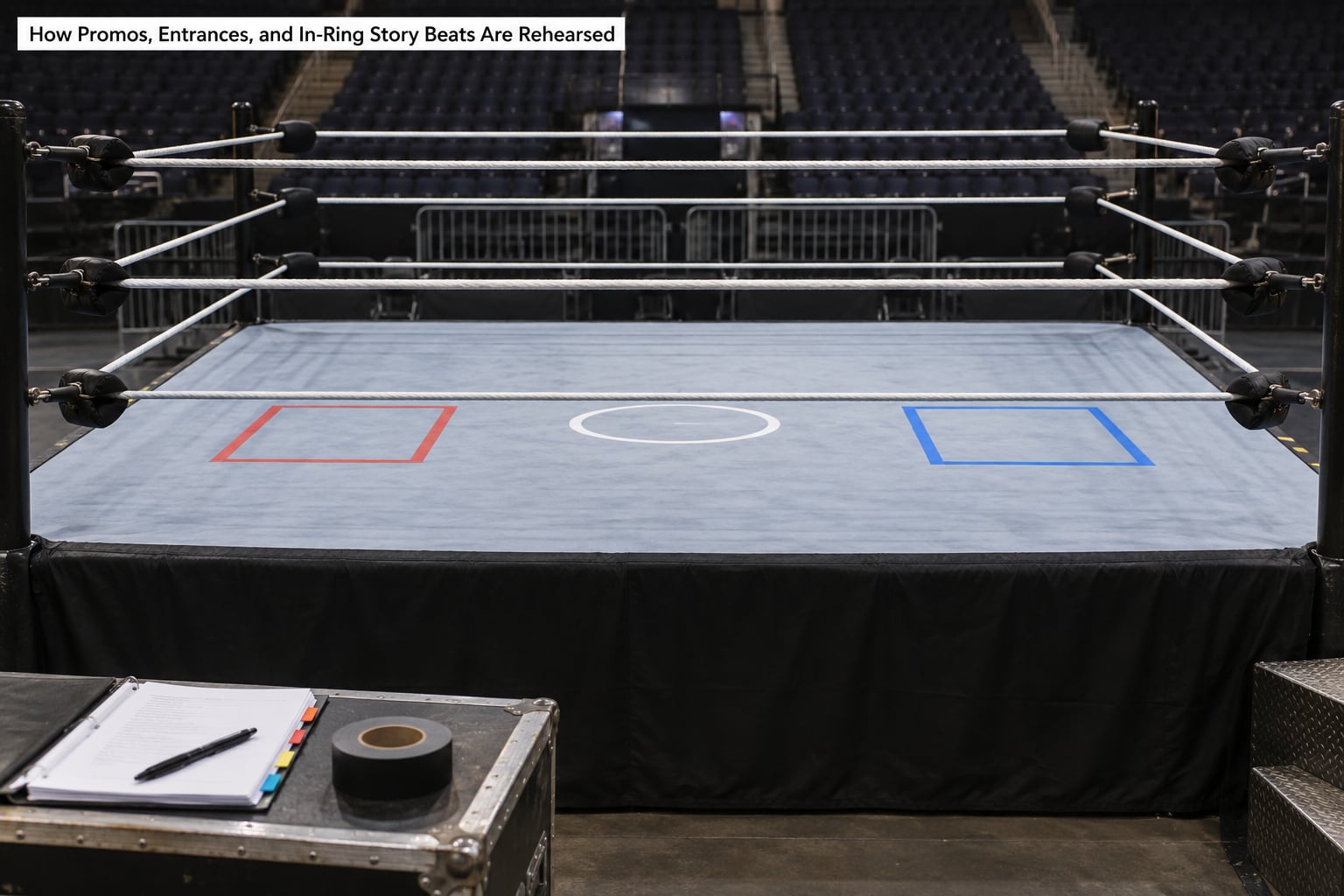
Not every retirement match is heavily scripted, and the ones that look loosest often had the most rehearsal beforehand. What gets rehearsed is usually entrances, key dialogue, and a handful of signature moments, while the connecting work stays improvised.
Entrances get the most attention because they carry emotion rather than technique. Themes are cued, timers are set, pyro and lighting cues are tested, and the route to the ring is timed so the camera is on the right face at the right moment.
In the ring, the ending gets drilled repeatedly. Wrestlers rehearse the finish, the referee practices the count or submission, and everyone agrees on signals for when something goes wrong. Promos on the mic are usually written but lightly rehearsed, since a retired wrestler speaking live tends to land better than a scripted read.
How Promotions Handle Safety and Last-Minute Changes
The first gate is the wrestler’s own approval. A retired performer who does not trust the match will not take the risk, and no promotion overrides that. Producers also ask about injuries, neck history, and anything the doctor has flagged, then remove moves from the agreed list rather than working around them on the night.
Concretely, that means a written list of prohibited moves, a pacing plan so nobody has to work a long match on a bad night, and a second and third finish held in reserve. The referee gets those backups before the match starts, not after something breaks down.
Last-minute changes are normal rather than a sign of failure. A wrestler pulls a move because of a sore shoulder, a broadcast partner asks for extra time after an emotional promo, or a competitor arrives late from travel. When that happens the cue sheet gets adjusted in the moment, and the change stays invisible to the audience.
What Happens After the Retirement Match
The bell is the easy part. The post-match window runs from a few seconds to several minutes, and the planning for it is nearly as detailed as the match itself.
Immediately after the bell there is a planned beat, usually the opponent helping the retiring wrestler to their feet or standing beside them while the crowd reacts. Promos cut from that moment are recorded, and photographers and camera operators have positions assigned in advance because the most-shared image usually comes in the ninety seconds after the finish, not during the match.
After the show, the footage feeds a documentary segment, a social campaign, and later a Hall of Fame induction package. Promotions also send the footage to other wrestlers who worked with the person retiring, which is how a legacy segment ends up including people who were never in the match.
On the business side, feedback comes back within days from the live crowd data and the broadcast partners. If the angle landed, it feeds the next appearance, whether that is a one-off legend run or a trainer and ambassador role.
Frequently Asked Questions
How far in advance is a wrestling retirement match planned?
For a planned retirement, work usually starts six to twelve months ahead, with the angle, opponent, and date confirmed three to four months out and promotion beginning about six weeks before the show. An injury-forced retirement compresses that into days, which is why those farewells usually feel rougher. Full-timer farewells get the long runway.
Who chooses the opponent for a wrestler’s retirement match?
The booker makes the final call, but the choice is negotiated. The retiring wrestler and their agent usually have approval rights, and the opponent has to agree to the finish in advance. Promotions also weigh whether the crowd believes the two have history and whether the opponent can physically deliver the match.
Do wrestlers have creative control over their retirement match?
More than they have on most matches, especially when it comes to date, opponent, and lines they refuse to cross. Veteran wrestlers with leverage usually get a say in the finish too. Talent who are leaving on their own terms tend to have the most room, while injury-forced farewells tend to be shaped almost entirely by the promotion.
Why do some retirement matches not stick?
Several reasons show up repeatedly. The wrestler misses the adrenaline after the match, the company offers a return that pays better than the alternative, health issues resolve slower than expected, or the opponent’s momentum gets sacrificed for a farewell that was never meant to end a run. Fans tend to accept a later return more readily when the farewell was well built.
What is the difference between a retirement match and a Loser Leaves Town match?
A Loser Leaves Town match is a stipulation in which the loser is forced to leave the promotion, usually permanently. A retirement match is broader: it can be that stipulation, a career versus title match, or a ceremonial farewell with no formal consequence at all. Loser Leaves Town is a contract-level tool, and a retirement match can happen without it.
What happens after a wrestler’s final match?
The planned post-match moment comes first, usually a few seconds to a few minutes with the opponent helping the legend stand or speaking on the mic. Then comes footage for documentaries and social posts, a Hall of Fame and legacy track, and often a reduced schedule in an ambassador or trainer role. Feedback from the crowd and broadcast partners follows within days.
Conclusion
A retirement match works when five things line up: a story the audience already cares about, an opponent the crowd believes belongs in that ring, a finish that gives the retiring wrestler a real final moment, rehearsal that protects their body, and promotion that builds anticipation instead of spoiling it.
If you are tracking a farewell as a fan, watch the announcement date and the opponent first. Those two details tell you more about how seriously the promotion is taking it than anything that happens on the night.