
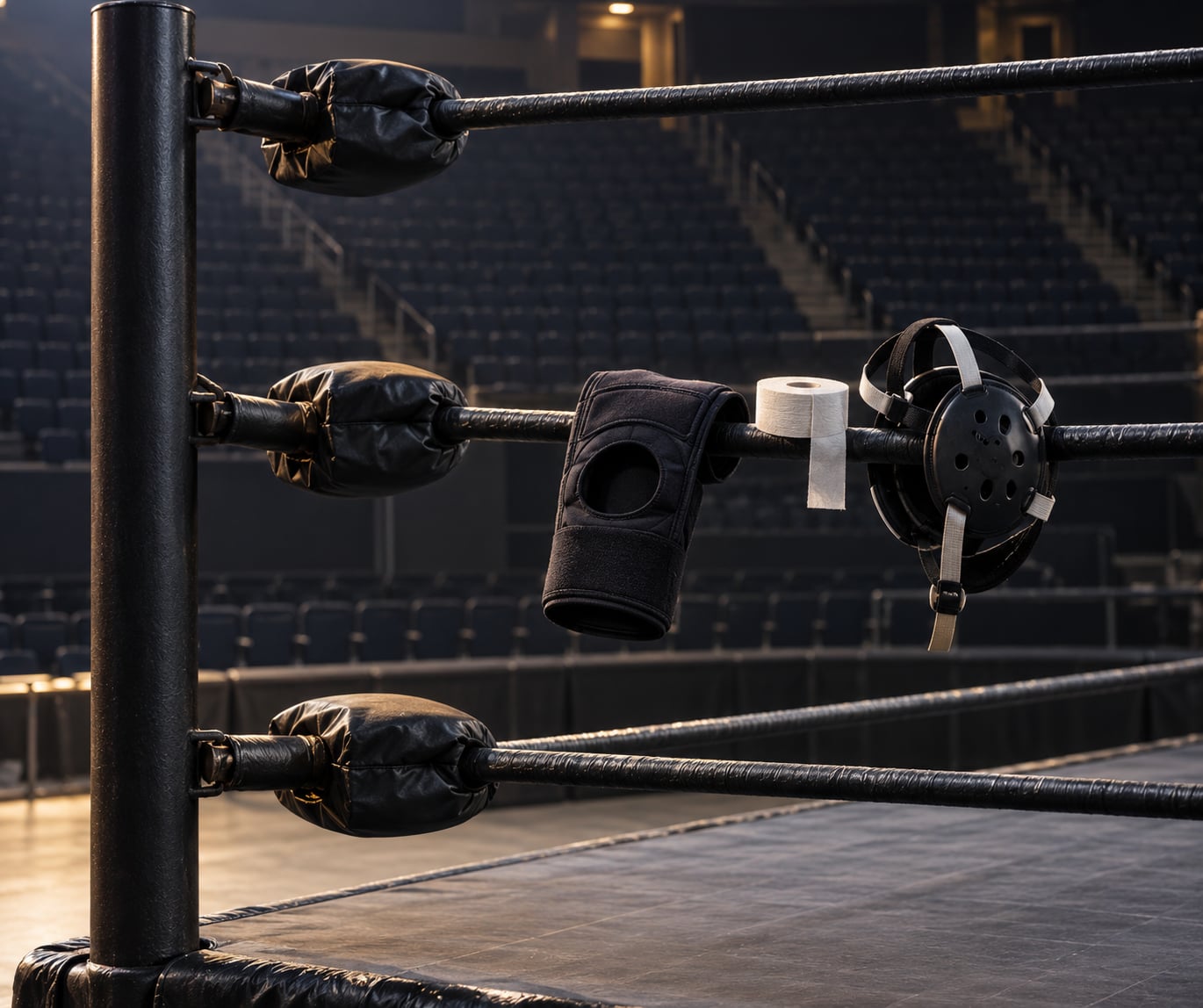
Wrestlers work hurt because a scripted match still transfers real force through the body. When a wrestler takes a fall, absorbs a strike or lands a finisher, the impact is genuine even though the outcome was decided beforehand. Working hurt simply means competing through a true injury — a torn ligament, a bruised spine, a bad knee — instead of sitting out the show.
That distinction is the whole thing. The pain you see on television can be a performance layered over a real ache, or it can be a real injury being performed well. Both things are happening, usually in the same thirty seconds, and telling them apart takes a little practice.
Table of Contents
- How Wrestlers Work Hurt and Why They Do It
- What Does It Mean to Work an Injury in Wrestling?
- How Wrestlers Work Hurt When the Story Is Predetermined
- Why Wrestlers Perform With Pain
- How Selling a Move Is Different from Taking a Real Injury
- How Wrestlers Protect Themselves While Working Hurt
- Can Working Hurt Cause Permanent Damage?
- How the Business Balances Performance and Medical Safety
- Frequently Asked Questions
- Do professional wrestlers really feel pain when they work hurt?
- Is it normal for wrestlers to keep performing after an injury?
- How can a fan tell selling apart from a real injury?
- Why do wrestlers hide injuries from the audience?
- Can a wrestler work with a concussion?
- Do wrestlers lose weight by working hurt?
- Conclusion: Watch the Performance, but Notice the Injury
How Wrestlers Work Hurt and Why They Do It
Wrestlers work hurt because the schedule, the character and the business rarely allow a pause. The match is choreographed, but the impacts inside it are not simulated. A wrestler who tears something during the tour may still take the match the following night, tap down differently to protect the bad shoulder, and sell it harder because the story needs it.
There are really four separate things happening on screen, and they get mixed up constantly:
- Performing pain — a reaction with no injury behind it, timed to the hard camera.
- Selling a move — a real impact absorbed with trained technique, then amplified.
- Working a planned injury — a scripted storyline where the hurt is written in advance.
- Concealing a real problem — an actual injury that nobody behind the scenes knows about, or has decided to ignore.
The fourth one is the one that matters medically, and it is the one nobody can see from the arena seat.
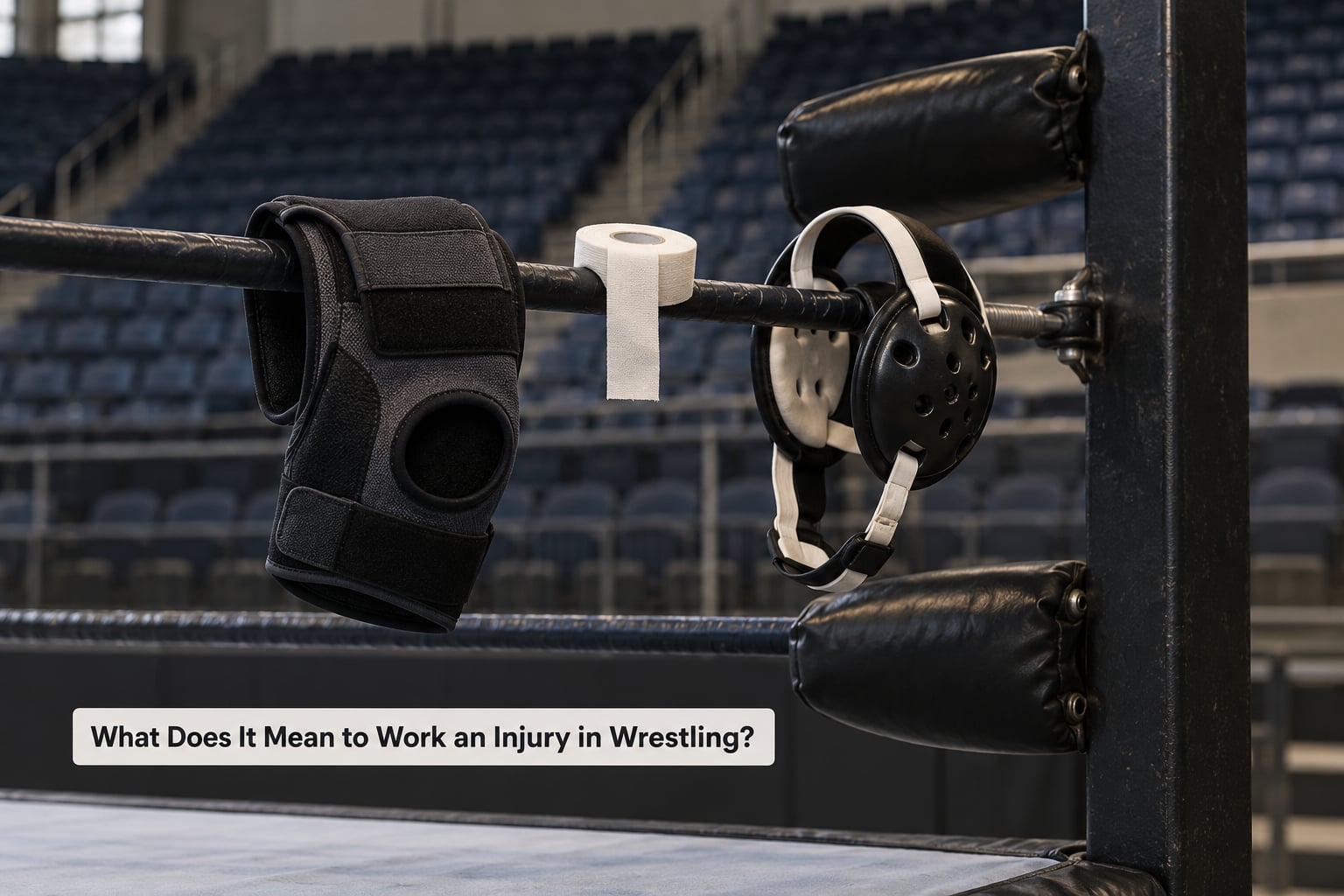
What Does It Mean to Work an Injury in Wrestling?
Working hurt means competing while genuinely injured. Working an injury means the injury itself is part of the story — the wrestler was written to be hurt, and the reaction you see is a rehearsed performance of a problem that does not exist.
A few terms make this clearer. Kayfabe is the pretense that the rivalries, injuries and outcomes of professional wrestling are genuine. A bump is a scripted match, and by extension the impact a wrestler absorbs on a scripted fall. To sell something is to perform the reaction to it. And the spot is a pre-arranged sequence in a match, plus the term for the quiet signal a wrestler uses to flag a real problem mid-match without stopping the action.
Some of the clearest vocabulary in the business is also the least visible. A wrestler who calls for a specific spot is not improvising; the sequence was agreed beforehand, and the landing position was negotiated down to the inch.
How Wrestlers Work Hurt When the Story Is Predetermined
When the story requires a wrestler to be hurt, everything stays a secret to protect the outcome while the performance looks spontaneous. Movement gets shorter and heavier. A wrestler shifts weight off a bad leg, holds a shoulder slightly higher on one side, and talks through a post-match interview as if the pain just arrived.
The person watching has no idea whether any of it is real. That ambiguity is the craft. A wrestler who can hold a convincing hurt act while genuinely hurt is doing two performances at once, and only a handful of people in the building know which half is real.
Why Wrestlers Perform With Pain
The reasons stack, and none of them exist in isolation.
- The crowd pays for it. An arena that believes someone is badly hurt makes a noise it does not make otherwise. A wrestler who stays down gets a pop that a clean win does not.
- The main event cannot be pulled. A card is announced weeks ahead. Remove one name from the main event and you rewrite finishes, angles and the running order for the whole night.
- The character depends on it. A heel who refuses to admit weakness has to be visibly damaged to stay believable. If the character would never show pain, showing pain would cost more than it earned.
- Reputation feeds opportunity. Locker rooms reward people who do not quit. Someone known for working through something gets booked again, gets the bigger spots, gets the longer contracts.
- The schedule leaves no recovery window. Main roster wrestlers are commonly on the road a large majority of the year. There is rarely a gap between the injury and the next booked date.
- Kayfabe obliges them to continue. Once a storyline injury exists, revealing it as fake would break the thing the audience has been enjoying for weeks.
- Pay and insurance sit on the other side. Independent wrestlers in particular have no guaranteed medical coverage and no paid sick days. Sitting out is a decision about whether a show will still book you.
That last point is the one outsiders consistently miss. Working hurt is not only bravery or foolishness. For a lot of people in the business it is an economic calculation made without a safety net.
How Selling a Move Is Different from Taking a Real Injury
Selling adds reaction on top of an impact. Taking a real injury is what the impact does whether anyone reacts or not. Trained wrestlers learn to absorb force — bracing on the way down, using the mat instead of the head to take a fall, distributing a slam through the back rather than the neck.
What a fan sees is amplified. Held poses, a face held a beat too long, a crawl to the corner that is three moves slower than necessary. That is performance. The problem is that real damage frequently arrives dressed the same way, and the two look identical at broadcast speed.
| What fans see | Worked injury | Genuine injury |
|---|---|---|
| Reaction timing | Peaks exactly on the move, fades as the match moves on | Stays or worsens across the rest of the match and after |
| Body language | Consistent with the storyline being sold | Drifts from the story, guarding one side, favouring a limb |
| Voice | Pitches up, words become crisp and performative | Shorter answers, more pauses, flat tone |
| After the bell | Recovers quickly, usually fine the next day | Protects the area in the locker room, ice, tape, limited range |
| Repeatability | Can be reproduced on demand | Changes week to week, worse on bad tours |
None of these signs are reliable on their own. A great actor can hold a limp convincingly, and a professional will hide a bad knee for weeks. Treat them as a reason to watch more closely, not as a diagnosis.
How Wrestlers Protect Themselves While Working Hurt
Protection is a system, and most of it happens before the bell. Moves get tested at reduced speed in the ring beforehand, landing spots get adjusted so a bigger wrestler does not land on a smaller one, and sequences get cut when someone says no. The most important word in that process is no.
Wrestlers also manage their own bodies constantly. Taping a shoulder, knee or ankle before a match changes how a limb absorbs a load. Stiffer landings, shorter holds and punching a different target are all ways of adapting a match around a problem rather than through it.
The people around the wrestler matter just as much. A referee can end a match when something is wrong. Agents negotiate spots and stand-ins. Medical staff at major promotions assess between segments and can pull someone out. Independent shows often have none of that, which is a large part of the difference in risk.
Can Working Hurt Cause Permanent Damage?
Repeated impacts add up, and injuries that heal rarely heal to exactly what they were. Here is general information only — for anything specific to you, speak to a qualified medical professional.
Common concerns in any contact-heavy activity include neck and spinal strain, shoulder and knee ligament damage, muscle tears that heal incompletely, and head injuries. Head impacts deserve particular attention because symptoms can appear delayed, and repeated head impacts are a recognised concern in collision sports. Concussion symptoms such as headache, dizziness, nausea, confusion, sensitivity to light, blurred vision or difficulty concentrating should be assessed by a medical professional rather than worked through.
Cumulative damage also shows up as reduced mobility, chronic pain and a shorter career. Athletes who return too soon risk re-injury, and a re-injured body part frequently gives out earlier than it did the first time.
Physical therapy, imaging, rest and a graded return to activity are medical decisions. Nobody watching at home can make them, and nobody on the roster, however experienced, should be the deciding voice on that call.
How the Business Balances Performance and Medical Safety
Major-league promotions run medical staff, a standard concussion protocol and a general liability structure for injuries sustained in the ring. Independent wrestlers are self-employed contractors who usually arrange their own cover, drive themselves between shows and take the risk personally.
| Factor | Major-league promotion | Independent wrestling |
|---|---|---|
| On-site medical staff | Present at televised shows | Often none |
| Concussion protocol | Written and enforced before clearance | Whatever the wrestler decides |
| Health coverage | Typically provided under the contract | Routinely the wrestler’s own problem |
| Pay during injury | Contract continues for a period | No guarantee of any pay |
| Schedule | Heavy year-round travel | Weekends, often stacked |
| Second opinions | Available through the company | Affordable only with savings behind them |
Business pressure is not medical permission. A promoter can decide that a wrestler is well enough to work; only a medical professional can decide that someone is well enough to work. Those are different conversations, and conflating them is where the worst injuries happen.
It also explains the quiet version. A wrestler who reports a problem on a small show risks not being invited back. Nobody announces it, nothing appears online, and the next month the roster simply moves on. That silence is often what makes real injuries look like selling from the outside.
Frequently Asked Questions
Do professional wrestlers really feel pain when they work hurt?
Yes. A scripted match still transfers real force through the body, and a genuine injury produces genuine pain. What you see on camera is usually a performed reaction layered on top of a real ache, which is why it can look exaggerated without being invented.
Is it normal for wrestlers to keep performing after an injury?
Common enough that the industry has adapted around it. Matches get adjusted, limbs get taped, and a wrestler may work around a bad shoulder or knee rather than rest it. On major promotions a medical decision should come first, but schedule pressure frequently pushes the other way.
How can a fan tell selling apart from a real injury?
Watch whether the reaction tracks the match or escapes it. Held selling peaks on the move and fades. Real trouble tends to persist into the next exchange, shift the wrestler’s guard to one side of the body, or show up again weeks later on the same limb. No single tell is reliable on its own.
Why do wrestlers hide injuries from the audience?
Because the character requires it and the schedule assumes it. A heel who never shows pain would lose credibility by limping. Beyond the story, admitting an injury risks losing a spot or a booking, and on the independent circuit it can mean losing income with no cover underneath it.
Can a wrestler work with a concussion?
No. A concussion requires assessment by a qualified medical professional and clearance before returning, along with a graduated return to activity. Symptoms can be delayed, which is why anyone with headache, dizziness, confusion, nausea or blurred vision after an impact should be evaluated rather than worked through.
Do wrestlers lose weight by working hurt?
Weight is a separate pressure from injury, though they overlap in the touring months. Some performers cut weight quickly to make a lighter division, and rapid changes combined with poor recovery and repeated impacts can leave someone weaker and more injury-prone than the scale suggests.
Conclusion: Watch the Performance, but Notice the Injury
Professional wrestling works because the audience accepts the story without accepting that the body is untouched. Both things are true at the same time, and the interesting part lives in the gap between them: the wrestler who genuinely needs the knee taped, performing convincing pain over an actual problem.
If you take one thing from this, learn to read the difference over a few matches rather than in a single clip. Watch what happens after the bell, when the cameras are pointed somewhere else. And if a concern about someone’s health is yours rather than a wrestler’s, take it to a qualified medical professional — that is the only assessment worth anything.


