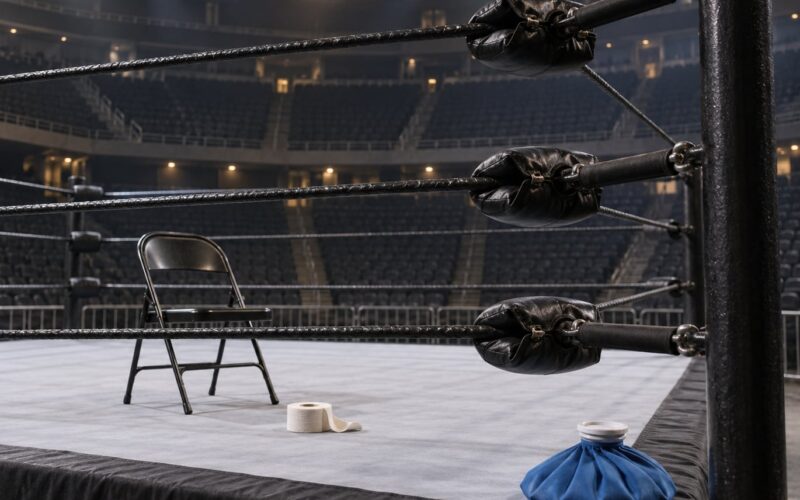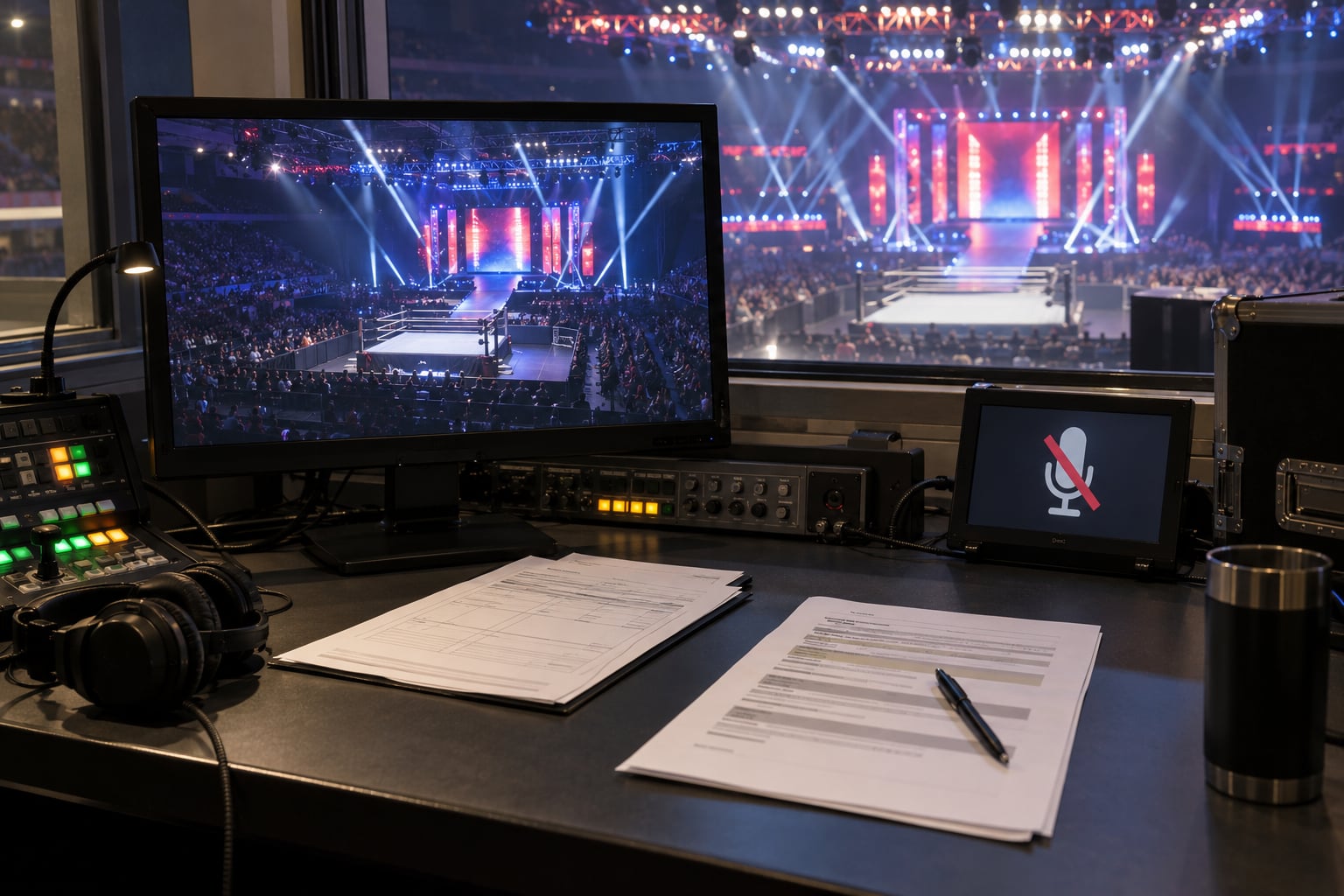
Wrestling television gets to bleed, throw people through tables and carry hard language on a TV-PG rated show because the rating system measures language, sexual content and graphic violence, not whether the physicality is real. Three parties enforce it: the promotion polices itself, the network’s standards department can demand cuts before air, and advertisers decide what it costs.
That is how blood and language rules work on wrestling TV in practice. The rules are not one tidy law. They are a negotiation between creative intent, network standards and ad revenue, and the same show can sit inside all three at once. I have watched enough weekly TV to know the oddest part is how rarely it feels consistent.
Table of Contents
- How Blood and Language Rules Work on Wrestling TV
- Why Do Wrestling Promotions Use Blood?
- Why Is Some Wrestling Language Edited or Bleeped?
- How Blood and Language Rules Work in a Match
- How Blood and Language Rules Affect Storylines
- Do WWE, AEW, and Other Promotions Follow the Same Rules?
- How Broadcast Standards and Streaming Delivery Differ
- What Viewers Should Notice About a Content Warning
- Frequently Asked Questions
- Why does WWE sometimes bleep wrestlers during interviews?
- Are blood rules the same for every wrestling promotion?
- Does a content warning mean the incident is not shown?
- Why can a match look different on television and on streaming?
- Can viewers find unedited versions of a wrestling segment?
- What to Take Away
How Blood and Language Rules Work on Wrestling TV

Three layers stack on top of each other, and confusing them is where most arguments about censorship go wrong.
The bottom layer is the TV Parental Guidelines system, a US ratings scheme that labels programmes based on language, sexual content and violence. It is not a legal regulation. Nothing in it says a show may not feature professional wrestling, and nothing in it distinguishes a real injury from a staged one.
The middle layer is the promotion’s own policy. This is the layer that actually bans things. WWE has long ruled out deliberate bleeding, called blading, as an in-ring practice, and writers are expected to plan promos around what can actually air. That restriction is self-imposed and has nothing to do with the network.
The top layer is the broadcast network. Its standards and practices staff review finished promos, sit with the writers’ room, and can require a specific word be swapped or cut. On a live show they act in real time through the production truck.
A fourth pressure sits beside all three: the ad sales floor. Advertisers pay more for inventory they can run beside family programming, so a network that keeps its shows broadly sellable keeps that money. In 2026, wrestling executives still describe the product that way in public.
Why Do Wrestling Promotions Use Blood?
Blood sells a story faster than dialogue can. A wrestler who is bleeding has visibly paid for what just happened, and the audience reads that instantly without needing the promo to explain it.
It also marks a feud as serious. When two wrestlers cut each other up on TV, the next few weeks of promos land differently because everyone saw the price of the fight.
There is a camera reason too. Close-ups of a cut looking at the hard camera hit very differently from a wide shot of the same spot. Blood gives a production something to cut to during a replay.
And it makes a payoff feel bigger. If a wrestler has bled for weeks in a program, the moment they finally lose, the visual carries more weight than a bell and a raised hand would.
The distinction that matters for the rules is where the blood comes from. Blood that results from a legitimate worked impact is generally fine. Blood produced on purpose before the bell is the version the promotion bans.
Why Is Some Wrestling Language Edited or Bleeped?
Not all censored language is treated the same. Four categories come up constantly, and only some of them are about profanity.
- Profanity. Usually handled with a bleep or a written substitution, and the decision is made per segment rather than by a fixed list.
- Threats. Threats aimed at a wrestler’s family are the fastest way to get a promo cut, because they read as genuine hostility rather than character work.
- Discriminatory language. Slurs and hate speech are treated as an unacceptable-conduct issue rather than a rating issue, and are handled far more seriously than swearing.
- Real names. A performer under contract can have their own name cut when it is used in a way the promotion has not cleared, which is why in-character and out-of-character moments can be bleeped differently.
The last one is the part that frustrates viewers most, because it feels backwards. An insult the character would say can survive while an innocent mention of a name does not.
| What gets cut | What you usually hear instead | Why |
|---|---|---|
| Strong profanity | A short bleep over the first syllable, or the audio is cut entirely | Rating requirement on the broadcast feed |
| Repeated swear words | Written-out substitution such as bull– or a– | Handled by the writers before the segment airs |
| Family threats | Camera cuts away to the crowd, or the segment is shortened | Reads as a real threat, not a character beat |
| Uncleared real names | Bleep over the surname | Contract and clearance issue, not a language issue |
| Discriminatory slurs | Removed from the broadcast entirely | Handled as unacceptable conduct |
Nobody publishes a banned-word list, because there isn’t one. Writers work with a sense of the tone that will clear, then the writers’ room finds out what the network actually wants after the fact.
How Blood and Language Rules Work in a Match
Before a match, a content advisory may run if a segment is expected to be violent or language-heavy. It tells you what is coming and then the show moves on.
During the match, the live bleep is the part everyone notices. A wrestler is mid-sentence and the audio cuts for half a second, then comes back. On a taped show the same effect is done in the edit bay before the file reaches the network.
After the bell, the replays get graded. Which angle is used, how long a shot of an injury runs, and whether the announcers describe what they are seeing all sit with the broadcast team. A wrestler can bleed heavily on hard camera and be shown in a wide shot on the replay.
Post-match interviews are the least predictable part, because nobody knows in advance which words will come out.
How Blood and Language Rules Affect Storylines
Restrictions do not only subtract. A cut line can protect a feud longer than the line would have, because the argument stays unresolved for another week.
They also change tone. A heel who is never allowed to finish a threat reads as cold and controlled rather than hot, which some characters use deliberately.
The reaction splits too. Long-time viewers tend to read a bleep as the network overruling the creative team, while newer viewers often never register it at all.
Do WWE, AEW, and Other Promotions Follow the Same Rules?
No, and the differences are real rather than cosmetic. Each promotion writes its own internal policy, and each broadcaster adds its own layer on top.
| WWE | AEW | |
|---|---|---|
| US linear TV rating | Raw has aired at TV-14, SmackDown in the lower bands | Nighttime shows have aired with a TV-14 listing on cable |
| Who enforces | Promotion writers plus network standards staff | Promotion writers plus the cable broadcaster |
| Deliberate bleeding | Banned by promotion policy | Also restricted, and the broadcaster has pushed back on tone publicly |
| Language leniency | Swearing is generally substituted or bleeped on main shows | Reportedly looser, with a Warner Bros. Discovery instruction to tone the language down |
| Streaming | Streaming uploads on its own service have run stricter than the broadcast cut | Same pattern, different platform |
Those lines move. A promotion will tighten language after a broadcaster complains and loosen it once the audience moves on, which is why the same show can feel stricter in one month than the next.
Outside the US the comparison breaks down further, because many countries regulate broadcast content through formal national bodies with their own classifications. Japan, Mexico and the UK each handle profanity and blood differently, and none of it maps neatly onto the US system.
How Broadcast Standards and Streaming Delivery Differ
On linear television, standards staff are attached to the production in real time. There is a delay buffer, a switch, and a person who can act on a word before it reaches millions of households.
Cable carriage rules add another layer. A channel operating under a family-friendly carriage commitment can face financial consequences for content it would otherwise allow, which is why a wrestling show can be rated more conservatively than its network sister channel.
Streaming is different because the edit happens after the fact. Nothing is censored live, so the decision is made by a reviewer watching a finished upload hours or days later, against that platform’s own guidelines rather than the network’s. The result is frequently stricter and always less predictable.
Re-air and syndication edits get cut a third time, and international feeds can differ again from the US broadcast. Four versions of one segment is normal, not a conspiracy.
What Viewers Should Notice About a Content Warning
A content warning is an advance notice. It says something violent, graphic or language-heavy is about to happen so an audience can decide whether to stay or look away.
The wording varies by outlet and by network, usually along the lines of a segment containing graphic content or strong language. Read it as a signal about what is coming, not as a description of what already happened.
It is also not an explanation. A warning rarely tells you which storyline or why a segment was pulled, and it never tells you whether the material was altered.
Where something was genuinely removed, you usually get a different kind of notice. It is worth keeping the two apart, because a warning tells you nothing about whether the footage is intact.
Frequently Asked Questions
Why does WWE sometimes bleep wrestlers during interviews?
Wrestlers are under contract to deliver lines their character would say, and the broadcast side can cut audio during a live segment within seconds. Writers try to write around the limit in advance, but improvised promos and post-match reactions happen in real time, so the decision belongs to whoever is on the switch. Cuts usually hit profanity, threats aimed at family, or an uncleared real name.
Are blood rules the same for every wrestling promotion?
No. Each promotion sets its own policy on deliberate bleeding, and the network or channel applies its own tolerance on top of that. WWE bans blading as a matter of promotion policy, while AEW has run heavier worked blood and has publicly been told by Warner Bros. Discovery to tone down its language. International promotions work under entirely different broadcast regulators.
Does a content warning mean the incident is not shown?
No. A content warning is advance notice, not a censor’s cut. It tells you something graphic, violent or language-heavy is coming so you can decide whether to keep watching. The footage still airs. When material is genuinely removed or muted, that is an edit, and the two are announced differently because they mean different things for the viewer.
Why can a match look different on television and on streaming?
Linear television is governed by network standards staff and the carriage rules attached to the channel. A streaming upload is reviewed after the fact against that platform’s own guidelines, which tend to be stricter. That is why the same episode can bleep a word live in the arena and mute it completely the next morning on the streaming service.
Can viewers find unedited versions of a wrestling segment?
Sometimes. Full-length segment uploads on a promotion’s own channel can carry weaker censoring than the network broadcast, particularly on second-brand shows and specials. International television feeds also often differ from the US cut. Nothing is guaranteed, and syndicated re-airs are usually edited again, so a version that looks sharper is not automatically the complete one.
What to Take Away
Check the rating where you actually watch, not on a poster or a trailer. Cable guides and streaming platforms list different values for the same episode.
Read a bleep as a fact about that segment rather than about the show. The words that got cut on Monday tell you what one writer and one network executive decided that afternoon.
And expect it to stay inconsistent. There is no published banned-word list and no written blood threshold to appeal to, so these rules get applied case by case, week by week.