Wrestlers protect their necks during bumps by keeping the chin tucked to the chest so the neck stays in flexion, landing on the shoulder girdle and upper back rather than the back of the head, and letting the arms arrive at the same instant as the head to spread the shock. That is the core cue, but it is only one piece of a much larger habit built around communication, pacing and knowing where you will land.
The rest of this guide breaks that habit down move by move, including the parts online advice usually skips: what happens biomechanically when the chin goes down, why the person throwing a move carries half the responsibility for your neck, and what protective gear can and cannot do. It is general information, not medical advice. Anyone with pain, dizziness, numbness or weakness after a fall should stop and get assessed by a qualified healthcare professional.
Table of Contents
- Why Neck Protection Matters in Professional Wrestling
- How Wrestlers Protect Their Necks During Bumps
- What Does a Good Wrestling Bump Look Like?
- How Do Wrestlers Keep Their Heads Safe on Impact?
- Why just tucking your chin is not enough
- How Is the Head and Neck Positioned During a Fall?
- How Do Wrestlers Control Their Heads on Throws and Takedowns?
- Do Mouthguards, Neck Rings, and Cushioning Help?
- How Do Wrestlers Train Bumps Safely?
- Which Bumps Put the Most Strain on the Neck?
- When Should a Wrestler Stop or Change a Bump?
- Frequently Asked Questions
- Do neck braces or protective gear prevent wrestling injuries?
- What should a wrestler do after landing awkwardly on their head or neck?
- Can beginners safely learn wrestling bumps at home?
- Does a stronger neck guarantee safer wrestling bumps?
- How do wrestlers protect their heads on backward falls and throws?
- What warning signs mean a bump should be stopped?
- Conclusion: Put Control Before Impact
Why Neck Protection Matters in Professional Wrestling
The neck is the least protected part of a body that is otherwise built to take punishment. It carries the full axial load of the torso, it sits directly beneath a heavy skull, and it has less surrounding muscle than the shoulders, back or thighs do.
That combination makes the cervical spine unusually vulnerable to a specific motion. When the head continues travelling backward after the body has already stopped, the neck is forced into rapid extension while the head keeps its momentum, and the base of the skull gets driven forward against the top of the spine. In a fall from any height, that whip-lash motion can produce neck strain, a stinger, a disc injury or a concussion.
A landing done well does the opposite. Force gets distributed across the shoulder girdle, the upper back and the mat surface over a wider area and a slightly longer window, and the head is kept from snapping past the point of no return.
Wrestling is not risk-free, and no article can make it so. What good technique does is remove the avoidable parts of the equation, which is where most of the room for improvement sits.
How Wrestlers Protect Their Necks During Bumps
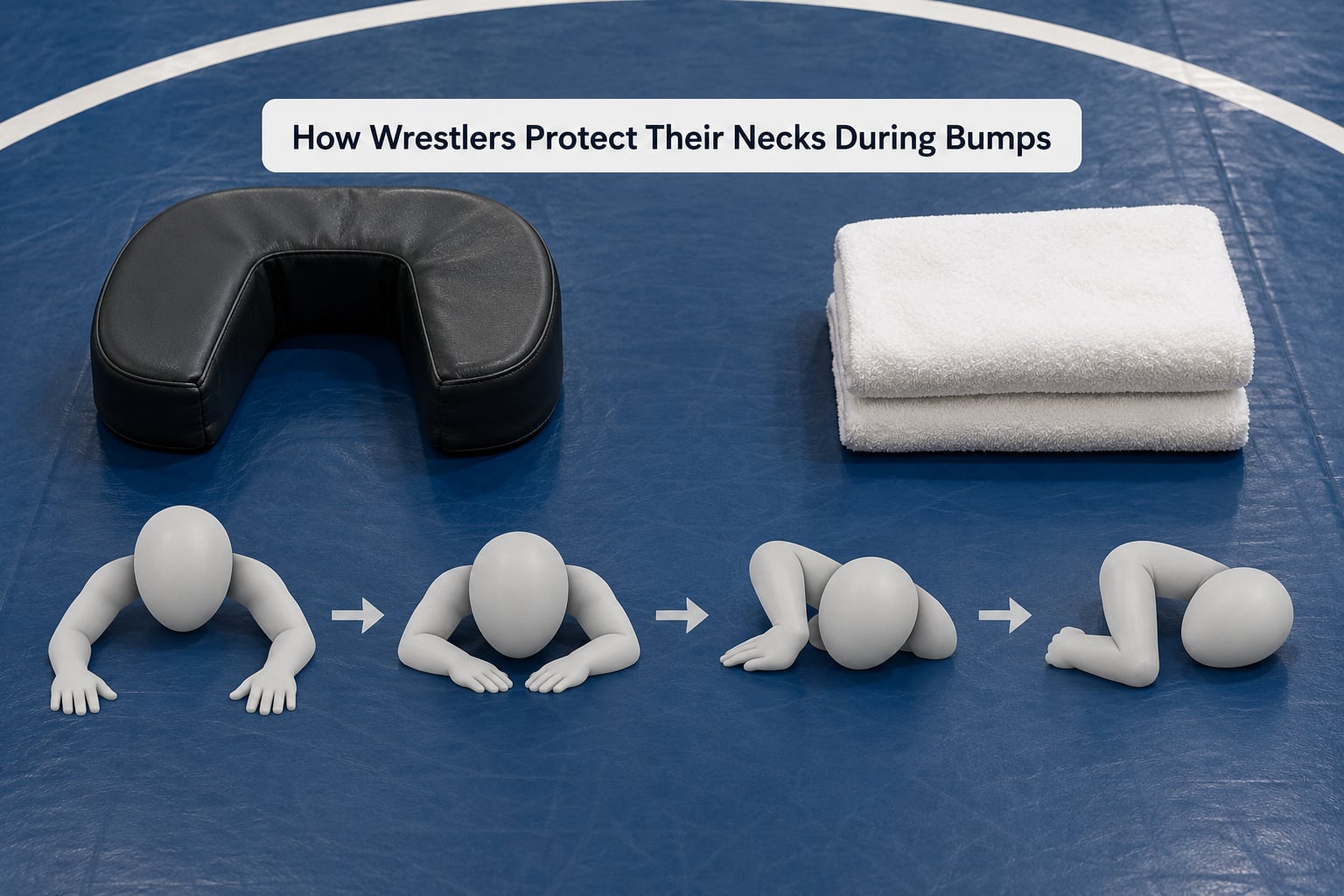
The short answer is an eight-part routine: say the move out loud before it happens, control the acceleration, tuck the chin so the forehead and chest move toward each other, keep the arms active, land across the back and shoulder blades instead of flat on the neck, and roll with any leftover momentum.
A wrestler who takes hundreds of bumps a year usually runs the same sequence every time without thinking about it.
- Call the move before it happens. The thrower names the spot and the receiver confirms it out loud. If either side cannot finish a sentence before the move starts, the move does not happen.
- Slow the entry. Falling from a controlled arc is a completely different impact from falling at the speed the other person happens to be moving. Energy added at the top is energy the neck has to absorb at the bottom.
- Tuck the chin. The forehead moves toward the chest so the neck sits in flexion. This is the single most repeated piece of advice in the sport, and a later section explains what it actually changes.
- Keep the neck long, not stiff. There is a difference between bracing and locking. A locked neck takes the shock as a rigid column and passes it straight to the vertebrae.
- Arms in, elbows working. The forearms land at the same time as the shoulders so the impact is shared across the arms instead of concentrating in the neck.
- Land on the shoulders and upper back. Flat on the back with the head moving is fine as long as the head is not the first thing to arrive and the chin is down.
- Roll rather than stop dead. When a fall has more travel than expected, the receiver rolls through it so momentum leaves the body gradually.
- Reset before the next move. A wrestler who is still moving from the previous impact is landing the next one badly, usually without noticing.
None of this prevents every injury. It is a set of habits that reduces the avoidable error in the landing, and at training level it becomes automatic within weeks rather than years.
What Does a Good Wrestling Bump Look Like?
A good bump is visible from the crowd. The path is predictable, the acceleration is gradual, the first contact is the shoulder rather than the skull, the arms move with the body, and the finish is a controlled settle rather than a flat slap. Communication happens before the move, not after it.
The table below contrasts the landing geometry that keeps the head moving with the body against the geometry that invites a neck problem. Neck strain here describes the demand on the cervical spine, not a prediction about injury.
| Bump type | Landing geometry | Neck strain | Protective cue |
|---|---|---|---|
| Backward fall from standing height | Feet fold, back and shoulder blades arrive together | Moderate | Chin down, roll to one side at the finish |
| Seated drop | Seated first, chin tucked, back rolls to shoulders | Moderate | Wrap arms behind the head rather than arching the neck |
| Vertical suplex landing | Upper back and shoulders take the drop straight down | Moderate to high | Eyes up the whole way, chin tucked before the shoulders touch |
| Forward fall onto the knees and forearms | Forwards and down, weight over the hands | Low | Forearms land before the face |
| Forward roll | Continuous rotation, no pause at the shoulders | Low | Chin stays off the mat through the rotation |
| Fall off the second rope | Unpredictable rotation, harder to control entry speed | High | Know the ropes beforehand, keep the arms out to slow rotation |
| Head-first landing onto the crown | Axial load straight down the spine | Very high | Only landed with a rehearsed, trained partner in a controlled gym |
| Landing onto a stacked wrestler or ringside surface | Unpredictable give and angle | Very high | Avoid; change the spot rather than the cushioning |
Two entries deserve emphasis. Anything landing on the crown of the head sends the load straight down the spine, and that is not something to practice without a trained coach. Anything landing on a moving or stacked surface loses the controlled geometry entirely, which is why the answer there is to change the spot rather than to add padding.
How Do Wrestlers Keep Their Heads Safe on Impact?
The mechanism is the interesting part, and it is the reason experienced coaches teach the chin tuck so relentlessly. When a head lands backward with the neck extended, the neck is being pulled into a position it was not built to hold, and the movement continues after the body has stopped.
Tucking the chin converts that motion into a different one. The neck moves into flexion, the chin stays ahead of the shoulders, and the head keeps travelling in the same direction as the torso rather than away from it. The neck muscles brace isometrically before contact, so the load is shared by soft tissue instead of being concentrated on the vertebrae.
Why just tucking your chin is not enough
This is the most common frustration in wrestling forums. Trainees report tucking perfectly and still ending up with neck pain, and the explanation is usually the same: the tuck protects the head, but it says nothing about the arms, the shoulders, the speed of the fall or the size of the person landing on you.
A chin tuck handled alone is a small part of a landing. The forearm arriving on time, the shoulders rolling instead of squaring flat, and the fall being slowed at the top of the arc are what actually reduce peak force. Most wrestlers who tuck correctly and still feel it the next day are absorbing a partner noticeably heavier than themselves, or locking the neck on contact, and neither of those is fixed by the chin position.
The other reason a hard bump defeats sound technique is simple. A stiff bump is one where the performer reacts at the last moment instead of planning the fall in advance, and a body cannot absorb cleanly when the head, arms and torso arrive at three different times.
How Is the Head and Neck Positioned During a Fall?
Head placement changes with the direction of the fall. For a backward fall the chin tucks and the eyes stay on the ceiling or on the far corner, which keeps the neck from following the head into extension. For a forward fall the chin also tucks, but the arms extend first so the forearms arrive ahead of the face.
Looking at the surface you are about to hit is a habit worth building on purpose. It keeps the head from turning mid-fall, and a twisted neck under load is the position most amateur wrestlers get wrong.
The arms have a defined job in each case. On a back fall they draw in and the forearms cross near the chest or the hands go behind the head, so the shoulders take the arrival. On a front fall the palms and forearms hit first and the elbows bend to soften the contact. In both, the point is shock absorption through a large surface moving together with the body.
Rolling matters more than most people expect. A fall with more energy than planned needs somewhere to put it, and the shoulder roll, the side roll and the tuck-and-roll are three ways to bleed that energy instead of absorbing it in one instant.
How Do Wrestlers Control Their Heads on Throws and Takedowns?
On a throw, three people share the responsibility and the receiver usually has the least of it. The thrower controls height, rotation speed and the landing location. The spotter, if there is one, watches the head and the surface. The receiver controls only their own head and arms, which is why the quality of a throw depends heavily on the person doing the throwing.
The receiver’s job is to pick a position before the throw starts: chin down, eyes on the thrower’s chest or hip, arms ready, body shaped to accept the fall where it is coming. Then the whole job is not to resist and not to brace with a rigid neck, but to stay connected through the rotation and arrive on the shoulder girdle.
The release matters as much as the catch. A thrower who lets go cleanly and slightly early gives the receiver time to organize; a thrower who holds on through the landing adds rotation the receiver cannot cancel, which is where a lot of avoidable neck problems originate.
With a partner you have never worked with, the highest-value habit is to ask them to explain the move before it happens, and to ask what they need from you rather than assuming. Bodies differ, and two people who have drilled the same spot a hundred times can still be surprised by each other’s height, weight and timing.
Do Mouthguards, Neck Rings, and Cushioning Help?
Protective gear helps, but not in the way people usually hope. Nothing on this list makes a bad landing safe.
| Item | What it is claimed to do | What it realistically changes |
|---|---|---|
| Mouthguard | Prevent concussion and dental injury | Dental protection and jaw comfort; not shown to prevent concussion |
| Headgear or padded mask | Shield the skull from surface impact | Reduces discomfort on the forehead and ears; changes little on a mat fall |
| Neck brace or collar | Hold the neck in a safe position | Limits motion and can restrict the landing reflex; not standard in professional wrestling |
| Extra mat padding or a crash mat | Soften hard landings | Softens a surface; does not change a head-first landing geometry |
| Padding under clothing | Cushion ribs, shoulders and tailbone | Comfort on repeated impacts; minimal effect on the cervical spine |
| Cheek pads on a headrest | Prevent the head slipping during sit-ups and lifts | Useful for neck loading work, irrelevant to a bump |
The practical read is fairly consistent across the sport: a mouthpiece is worth wearing for the teeth and the jaw, and unproven for preventing concussion. Neck strengthening is the item with real support behind it.
Anyone with dental work, a history of jaw problems or a specific worry about mouth protection should raise it with a dentist or a qualified medical professional rather than relying on general advice.
How Do Wrestlers Train Bumps Safely?
Falling properly is learned before wrestling is. Wrestlers with a judo or grappling background usually arrive with an instinct for how to hit a mat that takes years to build otherwise, and that instinct is the single biggest protective asset a trainee can have.
Progression is the rest of it. Start with a low-energy version from a low height, get it clean, then add speed, then height, then complexity, and only ever one variable at a time. Every bump is rehearsed verbally first, and a spot that has not been spoken out loud on the same day is a spot worth skipping.
Coaching matters because a trained eye catches a bad landing shape while it is still small. Working only with partners of a similar size and weight to you removes one of the most common aggravating factors, at least until you get booked with someone heavier than expected.
Surface checks are routine and unglamorous. A mat that has shifted, a slick ring, a rope at the wrong height or an audience member close to the fall point can turn a well-rehearsed spot into an uncontrolled one in a fraction of a second.
Fatigue is the most underrated variable. A wrestler who has worked fifteen minutes is landing differently from the same wrestler at minute one, usually without noticing, and the schedule is what makes fatigue unavoidable in most independent shows.
Impact practice without supervision is where most avoidable injuries happen. Learn to fall with a coach, on a proper surface, with someone who will stop the drill if the shape goes wrong.
Which Bumps Put the Most Strain on the Neck?
The common factor behind the roughest landings is not height, it is unpredictability. The ones worth being most cautious about are the ones where the receiver cannot see the angle coming or cannot control the entry speed.
Head-first impacts sit at the top of that list because the force travels straight down the spine rather than across the shoulder girdle. So do elevated rope falls, where rotation starts before the wrestler knows it has started, and any landing on a stacked opponent or on the apron rather than the mat.
Uncontrolled rotation is the other category. When the head keeps turning through the landing, the neck is loaded sideways and the muscles have nothing to brace against. Stacked impacts, where one landing follows immediately after another without a reset, leave the neck bracing with nowhere left to go.
Late decisions matter too. A rehearsed spot that is attempted when tired, at the wrong distance, or at a pace nobody agreed on is a different move from the one that was drilled.
That is a list of things to be careful with, not a ranking of injury probability, and none of it applies the same way to every body or every gym. A spot that is routine at one training room may be completely unfamiliar at the next one.
When Should a Wrestler Stop or Change a Bump?
The stop signals are easier to recognise than people expect. Communication broke down or was never finished. Timing was missed. The surface moved. The wrestler feels heavy, slow or light-headed, or simply is not tracking the spot.
Physical signals matter just as much. Neck pain that does not settle within a short time, upper-back pain near the base of the neck, tingling or numbness into the arms, weakness in an arm or grip, dizziness, headache, nausea, confusion, blurred vision, sensitivity to light or noise, or any sense that something is off that a training partner notices before you do.
For neck pain specifically, the sensible response is to stop taking bumps, not to work through it. A wrestler with neck pain who keeps wrestling is the case that shows up in clinics, not in highlight reels.
Persistent or worsening symptoms, weakness, numbness or loss of coordination need assessment from a qualified healthcare professional, and urgent symptoms need urgent care. This article cannot tell anyone what is wrong with their neck, and nobody reading it should use it to decide whether a symptom is serious.
There is a second reason to stop that has nothing to do with the body. If a promoter, coach or partner pushes a wrestler to work through symptoms, that is worth declining. Nobody can feel their own concussion accurately, and the person who has to say no is usually the only person in the room who can.
Frequently Asked Questions
Do neck braces or protective gear prevent wrestling injuries?
No. A neck brace mostly limits motion, and a limited neck can make a landing less coordinated rather than safer. A mouthpiece is worth wearing to protect the teeth and jaw, and headgear can reduce discomfort from repeated surface contact, but neither has been shown to prevent concussion. What genuinely reduces neck strain is technique: a tucked chin, active arms, controlled speed and a good landing surface.
What should a wrestler do after landing awkwardly on their head or neck?
Stop taking bumps for the day, even if you feel mostly fine. Note when the pain started and how it behaves over the next day, and watch for dizziness, nausea, headache, confusion, blurred vision, numbness or arm weakness. Do not drive yourself home if any of those appear. Neck pain that persists or worsens needs assessment from a qualified healthcare professional rather than another training session.
Can beginners safely learn wrestling bumps at home?
Not alone. Falling properly needs a mat, a coach and a partner who will stop the drill when your shape goes wrong, and floors in a living room are exactly the wrong surface. Start with supervised drills on proper mats: low height, low energy, one variable at a time. Many gyms and clubs run beginner fall-and-breakdown sessions, and those are the cheapest injury prevention available.
Does a stronger neck guarantee safer wrestling bumps?
No. Neck strength and endurance help a wrestler brace under load, which is genuinely useful, but strength cannot control a fall you did not see coming or a head-first landing. Technique, communication, pacing and choosing the right spot do more than conditioning does. Conditioning is the supporting habit, not the protection itself.
How do wrestlers protect their heads on backward falls and throws?
On a backward fall, the chin tucks so the forehead moves toward the chest, the arms draw in to protect the head, and the shoulders and upper back arrive before the back of the skull does. On a throw, the receiver picks the position before the throw starts, keeps the chin down and the eyes on the thrower, and rolls through any leftover momentum rather than trying to stop it dead.
What warning signs mean a bump should be stopped?
Stop when communication breaks down, the timing is missed, the surface shifts, or you feel heavy, foggy or uncoordinated. Physical reasons include neck pain that will not settle, upper-back pain near the base of the neck, tingling or weakness in an arm, dizziness, nausea, headache, confusion or sensitivity to light and noise. Any of those means no more bumps and a call to a qualified healthcare professional.
Conclusion: Put Control Before Impact
How wrestlers protect their necks during bumps comes down to control, and control starts before anybody is airborne. Communicate the move, rehearse it, control the path and the speed, land on the shoulders with the chin tucked and the arms active, and let your partner know the shape you are expecting.
Then stop when the conditions change. A tired wrestler, an unfamiliar opponent or a surface that moved are all good reasons to change the spot, and neck pain is a reason to stop for the day. For persistent or urgent symptoms, the answer is a qualified healthcare professional, not another round of bumps.