Yes, a small number of indie wrestlers do it, but not the way most people picture it. How indie wrestlers make a living on the road comes down to three pillars: a booking fee for the show, a cut of the merch table, and side income from subscriptions, coaching or content. Only a handful reach a full-time wage from those three, so most keep a day job and treat wrestling as the thing they build toward.
The rest of the industry looks very different from the highlight reels. A wrestler can pull a decent fee, drive four hours home, and end up with less than the driving cost. Understanding that arithmetic is the whole ballgame, so here is where the money enters the picture, where it goes, and what changes between a Saturday gym show and a two-week overseas tour.
Table of Contents
- How Indie Wrestlers Make a Living on the Road
- Why gross earnings and take-home pay are two different numbers
- What Does an Indie Wrestling Career Pay Like?
- How the road changes what independent wrestlers actually take home
- Why a tour in Japan or the UK pays differently from a Saturday gym show
- Where Does the Money Come From?
- How Ticket Sales and Merchandise Affect Take-Home Pay
- The gap between the gate and your cut
- How the merch split actually works
- What It Costs to Stay on the Road
- A sample month on the road, annotated
- How Indie Wrestlers Build a More Stable Income
- Work more than one promotion
- Cluster your dates
- Get travel covered before you accept a small fee
- Build the subscription and book the recurring appearances
- Separate wrestling money from household money
- How to get booked and negotiate a better deal
- How the Road Affects Wrestlers Outside Wrestling
- Frequently Asked Questions
- Do indie wrestlers make enough money from wrestling alone?
- How much do independent wrestlers usually make per show?
- Do most indie wrestlers have a day job?
- How do ticket bonuses and merchandise help a wrestler’s income?
- Why do indie wrestlers sometimes earn more on one tour than another?
- What expenses should a new indie wrestler budget for?
- What to Do First
How Indie Wrestlers Make a Living on the Road
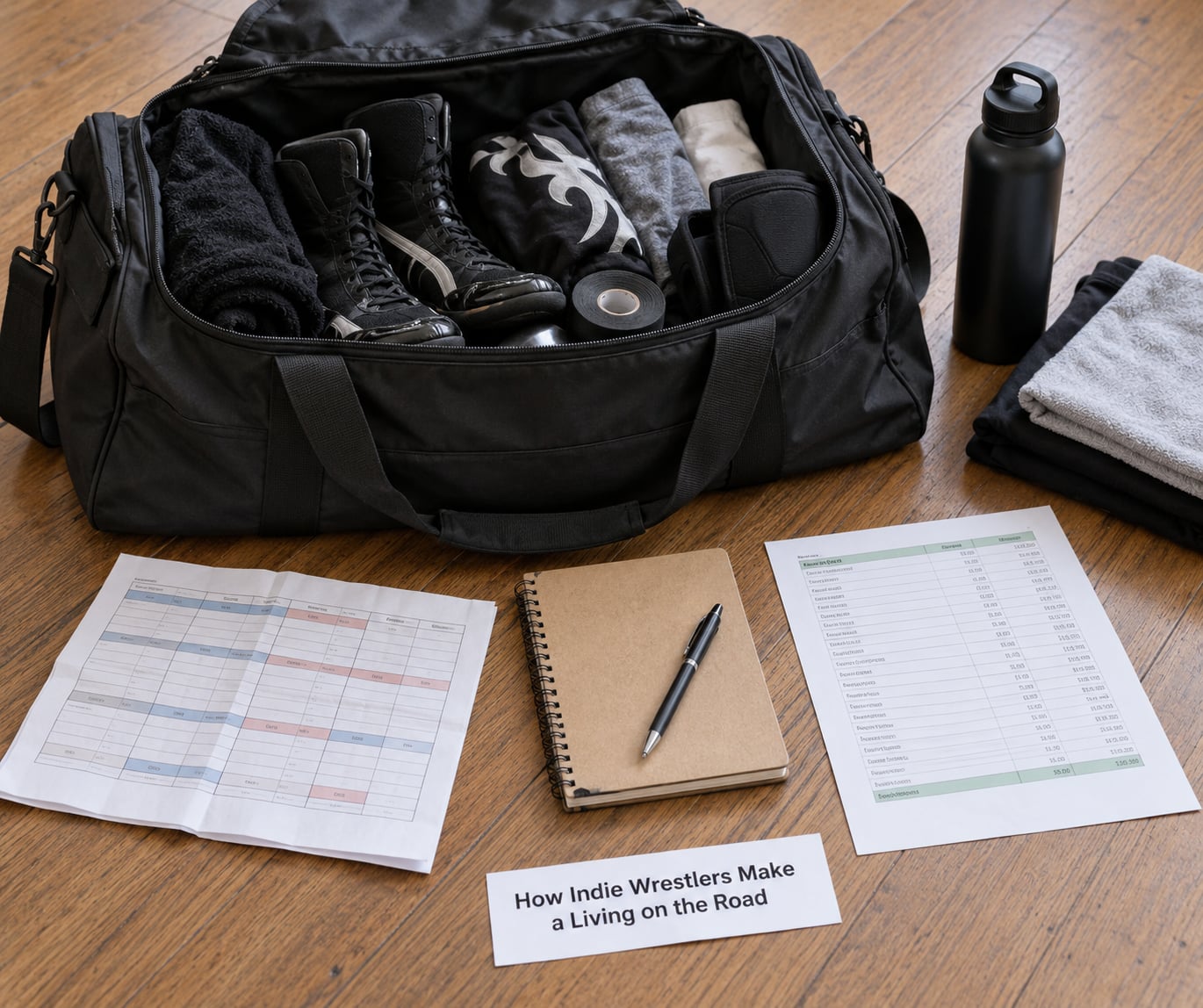
Indie wrestling runs on small businesses. A promoter rents a hall, sets a ticket price, sells beer, and takes a slice of everything before a single wrestler gets paid. Whatever remains is the wrestling budget, and each name on the card negotiates a slice of it. That is the entire game.
Three income streams carry most working indies. Booking fees are the flat or percentage payment for appearing on a card. Merchandise sales come off the promotion’s table, sometimes split 50/50, sometimes 70/30 in the wrestler’s favour. Side income means subscriptions, coaching, seminars, YouTube ad revenue, autograph money, sponsorships and the occasional film or voice job.
That last category is doing more work than it used to. A wrestler with a real audience can sell a membership at 10 USD a month to 200 people and out-earn several gym-show bookings in a year without leaving the house.
Why gross earnings and take-home pay are two different numbers
Gross is what the night looks like on paper. Take-home is what survives fuel, lodging, food, restock fees and the self-employment tax nobody withholds for you. Wrestlers in the r/SquaredCircle community keep repeating the same line about surviving off bookings and merch: it is possible, but it comes with a lot of hustle.
Nothing is withheld. There is no payroll department taking tax out of your show fee and no benefits package arriving in the mail. Set aside a portion of every payment for taxes from day one, because the bill lands months later and does not care how rough the month was.
What Does an Indie Wrestling Career Pay Like?
Independent pay comes in three shapes: a flat fee agreed in advance, a percentage of the gate, or a flat fee plus a percentage on a night that outperforms expectations. New wrestlers mostly get flat fees. Names with a drawing crowd get to ask for percentage.
The Billfold’s amateur wrestler Seth put the early career version of this plainly in 2013: in this industry, you gotta pay to get paid. His documented figures were around USD 50 to USD 100 for a first show, training tuition of about USD 400 a month, and roughly USD 800 to USD 1,200 collected by the school before he ever took a paid match. Those numbers are a decade old, and everything has inflated since, but the shape of the gap has not changed.
One widely quoted freelance range puts per-show rates anywhere from USD 1,000 to USD 10,000 depending on the promotion’s budget and the wrestler’s drawing power. Treat that as the ceiling side of a professional tier that includes well-known independents working well-run regional shows, not as what a Saturday night in a community centre looks like.
How the road changes what independent wrestlers actually take home
Travel distance is the single biggest swing factor. A show 40 minutes from home with a hotel covered by the promoter is worth more than a twice-as-large fee 400 miles away where you are funding the van, the fuel and the motel from your own pocket before you get home.
Other levers: booking status inside a promotion, whether you are a headliner or an opener, how much of the card you can sell, and your reputation for showing up and being worth the draw. Promoters openly admit an indie show is a low-margin business, which is exactly why a name that fills seats has real negotiating power and everyone else takes what is offered.
Why a tour in Japan or the UK pays differently from a Saturday gym show
Overseas tours carry higher day rates because a promoter has flown talent in, filled a foreign market, and carries currency and visa costs. The downside is that the higher fee partly compensates you for the risk and the expense, so the take-home improvement is smaller than the headline suggests.
Regional touring shows sit in between. A US or UK tour with ten dates in two weeks amortizes the drive once, which is why a wrestler touring generally does better per night than the same wrestler working scattered single dates.
Where Does the Money Come From?
Here is the full list of streams a working indie wrestler will realistically touch, ordered by how dependable they tend to be.
- Booking fees. Flat or percentage pay for the night. Dependable in the sense that it is predictable once the date is booked, which is rare in this business.
- Merchandise sales. Shirts, hoodies, hats, posters and photos off the show table. Many wrestlers now say this is as reliable as the cheque, though it scales with crowd size and how many tables you are allowed to set up.
- Subscriptions and memberships. A monthly charge for backstage access, membership content, early ticket access or a monthly match. Predictable income, slow to build.
- Coaching, seminars and clinics. Run a session at a wrestling school, a weekend camp or a seminar in your region. Excellent money per hour of actual work.
- Streaming and social revenue. Ad revenue and channel memberships from highlight content and backstage access. Small for most, meaningful for a name with a real audience.
- Sponsorships. Local supplement brands, gear companies, gyms, tattoo shops and car dealers. Usually gear or product rather than cash.
- Autograph signings and appearances. Store signings, grand openings, wrestling conventions and birthday parties. Cash in hand, small amounts, irregular hours.
- Film, television and voice work. Extra work, indy film projects, animated voice roles and reality television appearances. The most volatile stream on this list.
- Crowdfunding for tours and projects. Fans funding travel, a documentary, a second title run or a tour where pay does not cover costs.
- In-kind deals. Free hotels, free meals, discounted tires, free flights. Not income, but it removes an expense from the budget.
| Income stream | Typical range | Reliability | Who can access it |
|---|---|---|---|
| Flat booking fee | Tens to low thousands of USD per show, by card position and draw | High once the date is booked | Anyone the promoter books |
| Percentage of gate | A small slice of ticket revenue above a threshold | Medium | Names that sell tickets |
| Merch table cut | Split of table sales, often 50/50 or 70/30 | Medium | Anyone with product and table access |
| Subscriptions | A few hundred to a few thousand USD a month | High once built | Names with an audience |
| Coaching and seminars | Session-priced, often the best rate per hour | Medium | Anyone with a reputation |
| Sponsorships | Product, gear or small cash amounts | Low | Names with reach or a region |
| Signings and appearances | Small flat amounts per appearance | Low | Anyone with a name |
| Film and voice work | Union or non-union scale plus a buyout | Low | Names casting agencies know |
One useful reality check on the gate itself. A Scott Hall indie show in Fall River, Massachusetts sold about 480 paid tickets at USD 10 each, a gate of roughly USD 4,800. Subtract the ring crew, the venue, the production, the staffing and the promotion overhead, and the pool for the entire card can be a low four-figure number before anybody gets paid. That is why per-show percentages feel safer than flat fees for a headliner and worse for everyone else.
How Ticket Sales and Merchandise Affect Take-Home Pay
A strong crowd helps a wrestler twice: it can trigger a gate bonus, and it multiplies the merch table. A weak crowd does the opposite, and the promotion’s deductions start eating the payout. That is the practical reason wrestlers care about ticket numbers even when their pay is flat.
The gap between the gate and your cut
The gate is total ticket revenue. Your cut comes out of whatever remains after production, venue rental, sound and lights, ring crew, cleaning, insurance and staffing. Some promotions also take a housekeeping percentage before the wrestler’s split is calculated. That is the number that determines whether a percentage deal was a good deal for you on that specific night.
Percentage deals protect the wrestler from a bad room and pay well in a good one. If a promoter offers a flat fee plus 10 percent above 250 sold, you are now sharing their risk instead of theirs. Negotiating from a position of a real draw is far easier than negotiating from a beginner’s card.
How the merch split actually works
Typically you get a table in the venue, you staff it yourself or with a friend, and the split is 50/50 or 70/30. The wrestler covers production costs for shirts and prints up front, which is real cash out before anyone sells anything.
Restocking is the quiet expense. Every show sells out your best-selling design, so the next stop needs the same sizes in the box. Wrestlers who order in bulk or keep a second table of staples tend to protect more of the revenue than those who sell out and have nothing on hand the following weekend.
What It Costs to Stay on the Road
Here is where most indie wrestling income quietly disappears. These are the recurring costs that turn a good gross night into a thin bank balance.
- Fuel and mileage. The most common complaint in the community, and the one that most often exceeds the booking fee itself.
- Hotels. Standard out-of-town cost when the promoter does not cover a room.
- Food on the road. Cheap and constant, and it adds up across a month of dates.
- Van maintenance. Tyres, brakes, oil changes and the ability to fix a breakdown yourself before a show.
- Flights for overseas tours. Usually arranged or reimbursed by the promoter, but frequently only for the outbound leg.
- Gear and boots. Ring boots, kneepads, wrist tape, mouthguards and entrance gear, all of which wear out fast.
- Training. School tuition and seminar fees, on top of gym time you still have to pay for.
- Hype production. Graphics, highlight videos, promo editing and the software to make them. Community posters describe this spend as never coming back.
- Merch inventory. Upfront production before a single sale.
- Health and injury. Therapy, chiropractic work, physio and, if you are lucky, insurance.
- Agent or manager fees. A percentage of bookings, if you use one.
- Taxes. Self-employment tax, plus business registration and bookkeeping costs where your state requires them.
A sample month on the road, annotated
Here is a realistic monthly picture for a mid-tier working indie with a base of regional dates, a subscription running, and no day job. The structure is representative rather than a specific person’s books.
- Income, 8 shows at flat fees: 1,600 USD.
- Merch, net of 50/50 table splits: 900 USD.
- Subscriptions, 150 members at 8 USD: 1,200 USD.
- Two coaching sessions: 500 USD.
- Signing and sponsorship: 250 USD.
- Gross for the month: about 4,450 USD.
- Fuel and maintenance across 8 dates: 700 USD.
- Hotels, 4 nights: 480 USD.
- Food: 300 USD.
- Merch restock and printing: 350 USD.
- Training and gym: 180 USD.
- Graphics, editing and software: 120 USD.
- Tax set-aside: 600 USD.
- Expenses before tax: about 2,130 USD.
The result is roughly 1,720 USD of money in hand before tax, on eight nights of work plus travel, training, admin and the merch table. Now move the same person to ten scattered out-of-town dates with no hotel covered and the balance narrows fast. That is the pattern wrestlers describe when they say the lifestyle works, but the margin is thin and a bad month can go negative.
For context on the scale of the business as a whole, Research and Markets valued professional wrestling at USD 5.69B in 2026 with a projection of USD 7.36B by 2030. Independent shows are a small slice of that, and the streaming growth behind it is the reason more names are building audiences outside their own promotion’s room.
How Indie Wrestlers Build a More Stable Income
Nobody in this business has a salary. What you can do is reduce how often the number goes to zero.
Work more than one promotion
One promoter means one schedule, one budget and one bad month. Working three means a slow month at one is covered by another. Promotions are also more likely to book a name with options, which raises the rate.
Cluster your dates
Five shows within a two-hour radius costs one drive. The same five dates spread over two months costs five drives plus five nights away. Clubbed runs and regional tours are the single most effective cost reduction available to a working indie.
Get travel covered before you accept a small fee
Three things are worth negotiating separately from the booking fee: the hotel, mileage or travel cost, and the merch table split. A promoter who cannot pay USD 400 for a match can often pay USD 60 for a room. Splitting the conversation like this gets you yes more often than arguing about the headline number.
Build the subscription and book the recurring appearances
A monthly membership turns fans into predictable revenue. A monthly sign-in at a supplement shop, a quarterly seminar, or a standing coaching slot produces the same thing. Recurring pay is the opposite of an indie card, where every night is a new negotiation.
Separate wrestling money from household money
Open a separate account for wrestling income, pay the taxes and the production costs out of it first, and pay yourself a fixed amount from what remains. Most indies who last are the ones who treat the operation like a small business rather than a stream of unpredictable deposits.
How to get booked and negotiate a better deal
- Work your own show first. Most promoters book talent who already proved they can fill a room somewhere.
- Sell tickets before you sell yourself. Demonstrated drawing power is the cleanest argument for a percentage deal.
- Send a reel, not a CV. Ninety seconds of match footage says more than a resume line.
- Build relationships with promoters, not just audiences. Show up early, help load in, and be easy to work with. Reliable people get booked.
- Ask what the card pays before you say yes. Rates are far more negotiable before the date is on the schedule.
- Handle unpaid offers carefully. The hotdog and a handshake is the term for a promoter who shakes your hand and hands you a free hotdog from the concession stand. Community mockery of gym-show pay is not a joke to anyone actually standing in that gym.
- Keep records. Every date, fee, expense and mile. Some wrestlers fold an LLC for tax separation and credibility with venues.
How the Road Affects Wrestlers Outside Wrestling
The money is only half of it. Constant travel, unfamiliar rooms, and a schedule that sends a wrestler home Sunday night and out again Wednesday is genuinely hard on a body and on everything around the wrestler.
Recovery. Multi-match nights are common on indies. A wrestler may work three or four matches in one show, then drive four hours. Repeated show-eat-drive-sleep cycles leave no room for the training that keeps a wrestler safe.
Home time. Promoters book mainly on weekends, which is when family and friends are available. Road life means missing a lot of both.
The day job. Most indies still hold employment, and weekend dates make that workable in a way a Thursday-to-Saturday route would not. When the day job asks for overtime, wrestling is what gets dropped.
Self-employment exposure. Independent status means no paid sick days, no injury cover from a promotion and no retirement contributions. A neck injury can end an income stream with no safety net behind it, which is a much sharper risk than most people outside the industry assume.
The exit ramp. Plenty of people leave wrestling and stay in it. Refereeing, announcing, writing, training, promoting and production work all pay more predictably and cost less physically. The community mentions those fallbacks constantly, and treating them as failure rather than continuity changes how the whole thing feels.
There is also a saturation problem nobody discusses enough. In a healthy regional scene, a small group of names appears in every promotion, and everyone else is building a card for the same small pool of dates. That is part of why so many capable wrestlers hold a day job.
Frequently Asked Questions
Do indie wrestlers make enough money from wrestling alone?
A small number do, usually once a name has a subscription, a merch line and enough dates to smooth out slow months. Most do not. The typical working indie has a day job, and wrestling income covers travel, gear and production costs while contributing part of a household budget. Anyone claiming a comfortable full-time wage from a standard regional indie schedule should be asked where the rest of the income comes from.
How much do independent wrestlers usually make per show?
At the entry level, documented figures put first shows in the tens to low hundreds of USD, which routinely fails to cover travel. Established independents drawing real crowds negotiate far more, and one widely quoted freelance range runs from USD 1,000 to USD 10,000 per show depending on draw and budget. Percentage-of-gate deals let a popular wrestler earn more in a strong room without asking for a bigger guarantee.
Do most indie wrestlers have a day job?
Most of them do, at least early on. Because promoters book weekends, a regular weekday schedule is one of the few arrangements that leaves a wrestler available for shows. The balance shifts once memberships, coaching and merch produce dependable monthly income. Until that happens, the day job absorbs the cost of a car payment, rent and insurance that wrestling pay alone will not cover.
How do ticket bonuses and merchandise help a wrestler’s income?
Ticket bonuses add a share of revenue above an agreed threshold, so selling the room pays twice through gate bonuses and a bigger merch table. Merchandise usually splits 50/50 or 70/30 with the promotion, which makes a strong night worth considerably more than a flat fee suggests. The wrestler still fronts production costs and restocks the designs that sold out, so the profit on paper is never the profit in the bank.
Why do indie wrestlers sometimes earn more on one tour than another?
Because a tour amortizes travel. Ten dates in two weeks across one region costs a single drive out and back, while the same ten fees spread across five months mean ten round trips plus hotels. Booked position changes the fee too, and a percentage deal pays out when the room is big. Touring on top of a strong booking position is the easiest way to raise income without renegotiating from scratch.
What expenses should a new indie wrestler budget for?
Start with fuel and mileage, a hotel for every out-of-town date, food, and vehicle maintenance you are responsible for yourself. Then add training tuition, ring boots and gear, graphic design and video editing for promos, and merch inventory you have to pay for before selling anything. Set aside tax from every payment as it arrives, because nothing is withheld and the bill arrives months later.
What to Do First
If you are weighing this career, the first move is not a gym membership. It is working a real show in your area for free, selling a few tickets to someone who already draws, and finding out whether you enjoy the actual road before you spend money on the road.
If you are already working, pick one stream and build it this quarter. A subscription at 8 USD a month or a standing coaching slot will do more for stability than one more flat-fee booking, because it is the only kind of income that arrives whether the room is full or not.
And write everything down. Every fee, every mile, every merch restock. The wrestlers who last are the ones running a small business on the side of a wrestling career, not the other way around.