Weather affects outdoor wrestling events in two very different ways. Lightning is the one hazard that reliably stops a show, while rain, heat, wind, cold and poor air quality usually change how the card runs rather than whether it runs at all.
That distinction is the whole answer, and it is the one thing promoters rarely write down publicly. Fans spend months planning travel around a show and get almost no guidance on what a forecast actually means, so the guesswork falls on them. Understanding how weather affects outdoor wrestling events means knowing which conditions get a card delayed, which get it modified, and which get it stopped.
The same rules apply whether the show is a stadium main event or a community card on a fairground with no roof, no concourse and no formal shelter plan.
Table of Contents
- What Weather Conditions Can Disrupt an Outdoor Wrestling Event?
- How Weather Affects Outdoor Wrestling Events
- How Rain and Thunderstorms Change Event Operations
- How Heat and Humidity Affect Wrestlers and Crowds
- How Wind, Cold, Snow, and Ice Create Different Risks
- Why Ring Surfaces and Equipment Need Special Attention
- When Should an Outdoor Wrestling Event Be Delayed or Canceled?
- How Promoters Should Communicate Weather Changes
- A Pre-Event Weather Contingency Checklist
- Frequently Asked Questions
- Can outdoor wrestling continue in light rain?
- How far away does lightning need to be before an outdoor wrestling event stops?
- Does heat make wrestling more dangerous?
- Can promoters cancel or reschedule an event because of weather?
- How should wrestlers prepare for cold or wet outdoor events?
- Conclusion
What Weather Conditions Can Disrupt an Outdoor Wrestling Event?
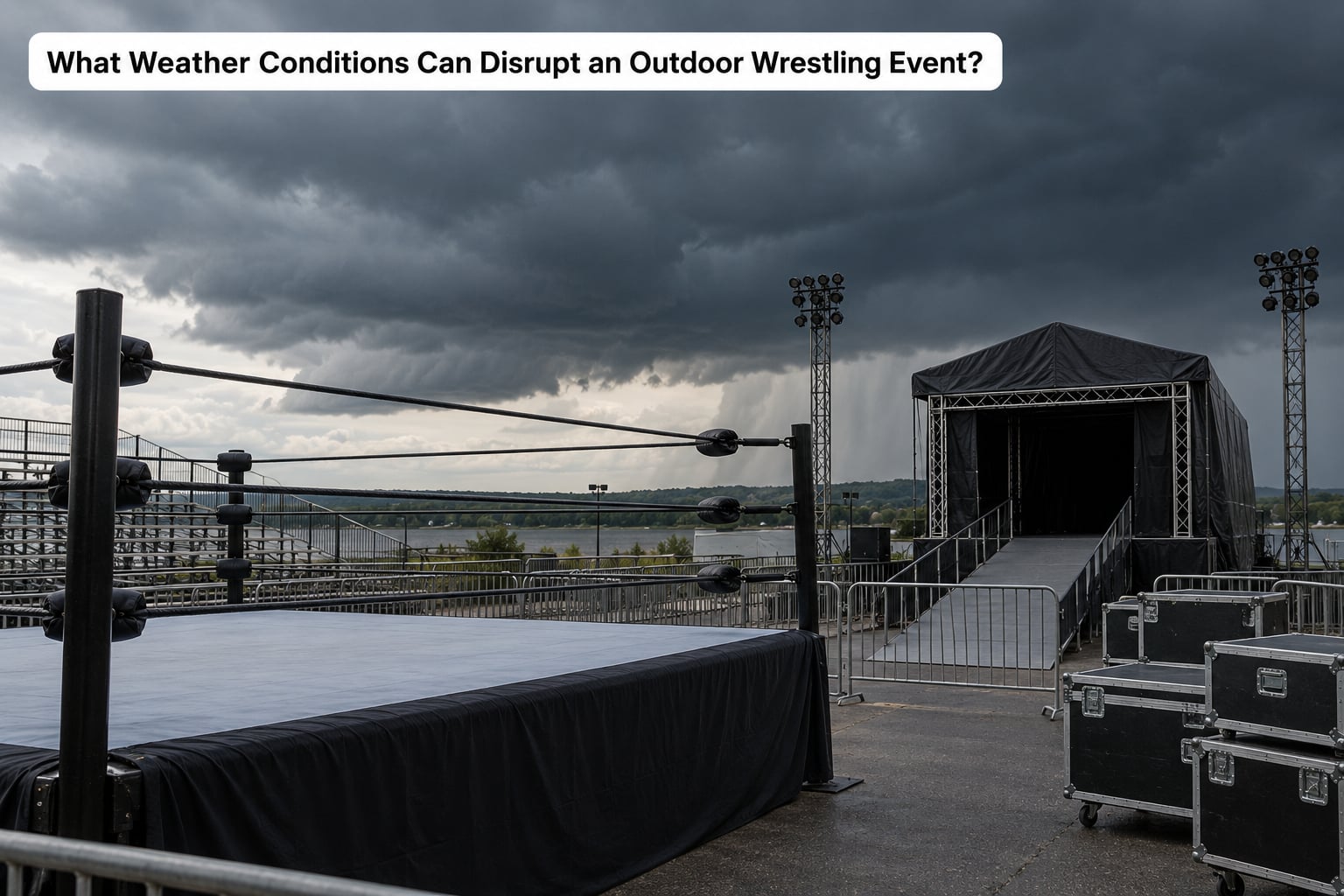
Seven conditions come up on nearly every outdoor wrestling risk assessment, and each one behaves differently. The table below groups them by what you will notice first, what it does to the event, and how promoters usually respond.
| Condition | Warning signs | Risks to the event | Usual response |
|---|---|---|---|
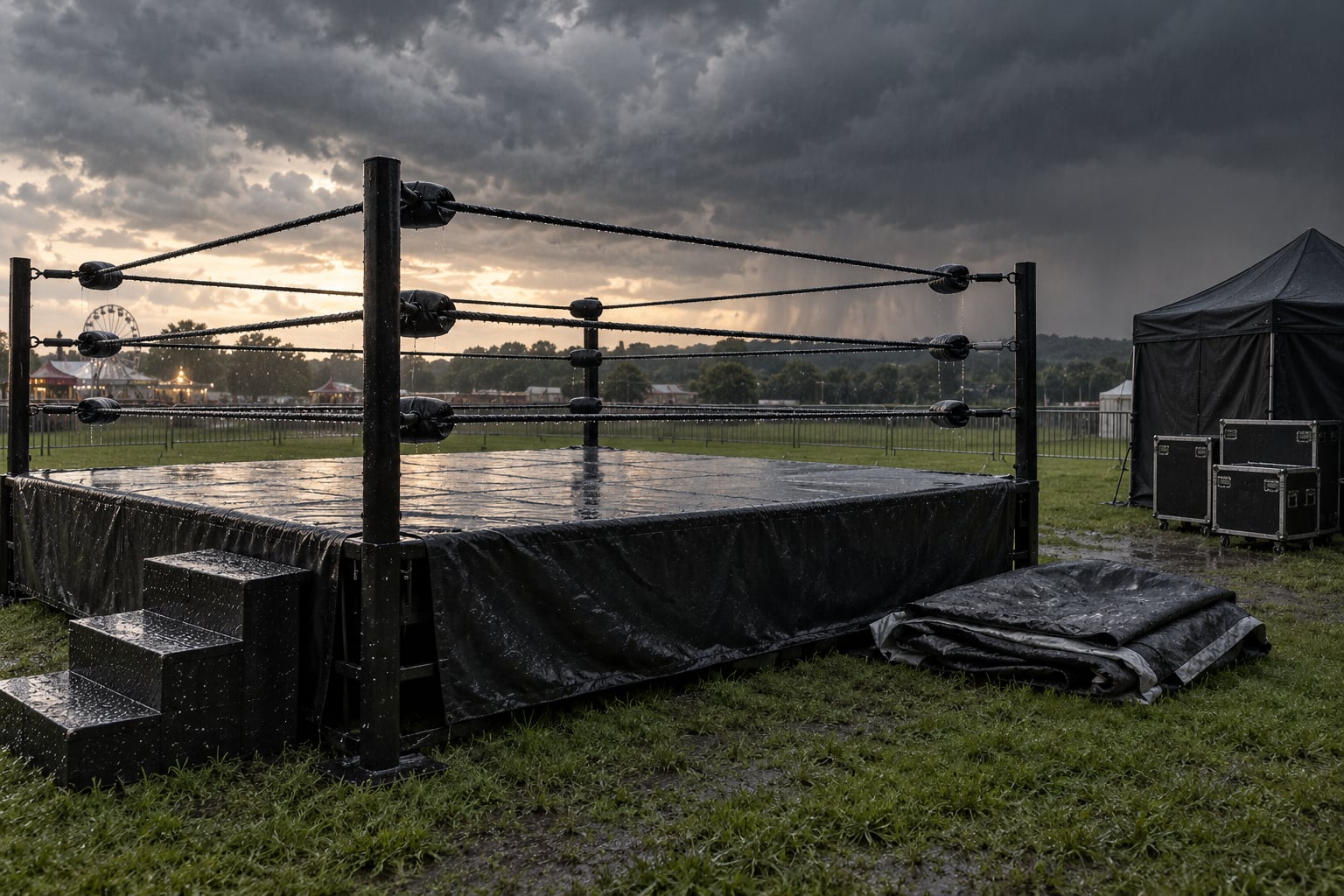
| Rain | Steady precipitation, darkening sky, rising humidity | Slick ropes, canvas and apron; wet boots; electrical exposure; audio issues | Continue, cover and dry the ring between segments, delay the start |
| Lightning and thunderstorms | Thunder heard, lightning visible, alerts on radar | Unsheltered crowds, exposed ring, staff on open structures | Move spectators to shelter and suspend until 30 minutes after the last strike |
| Extreme heat and humidity | Heat index climbing above 90F, visible heat haze, little overnight cooling | Dehydration, heat exhaustion, burns from hot gear, fatigue in the crowd | Shorten matches, add hydration breaks, push start times later |
| High wind | Wind advisory, gusts, tents and banners moving | Canopy blow-down, unstable barricades, flying signage and debris | Lower or remove inflatables and covers, secure or drop tall structures |
| Cold | Low temperatures, wind chill, early stadium starts | Stiff ropes, reduced grip, low turnout, long exposure for fans | Go on as scheduled, warm-up routines, shorter fan exposure |
| Snow and ice | Accumulation, freezing rain, slick walkways | Fall risk on ramps and stairs, frozen equipment, travel disruption | Postpone, or relocate and clear all walkways first |
| Poor air quality | Smoke or wildfire haze, air quality alerts | Asthma and respiratory distress, especially for workers and children | Shorten the event, move stages indoors, cancel if the alert level is severe |
How Weather Affects Outdoor Wrestling Events
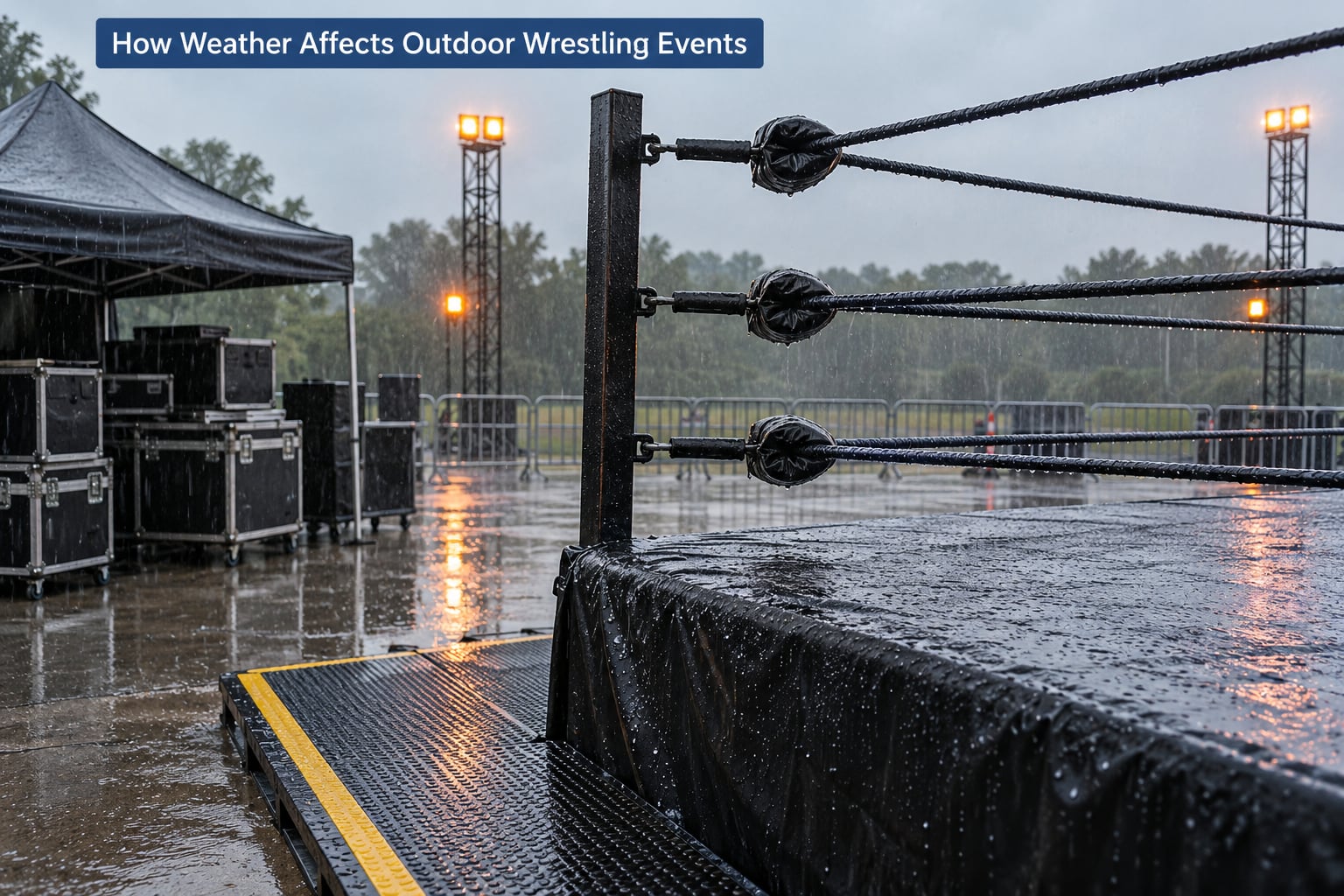
Weather touches every part of an outdoor card, and only one part of it is really about whether the show happens.
Venue safety comes first. An open-air venue has more exposed surface, more electrical infrastructure and fewer options for getting a seated crowd under cover than an arena. Rings set on grass or temporary flooring are more vulnerable to drainage problems than a permanent arena bowl.
The wrestling surface is where conditions become dangerous. A dry ring canvas grips; a wet one does not. So do the ropes. Wrestlers who cannot get a hand on the top rope cannot break a hold safely, which turns a routine rope-assisted maneuver into a fall onto the ring post or the floor.
Performers absorb the physical cost. Heat drains them, cold stiffens them, and rain makes every step on the apron a question. Spectators have their own exposure problem, and it is regularly ignored. Uncovered seating in direct sun is genuinely dangerous for older fans, small children and anyone with heart or respiratory conditions.
Equipment, staff duties, the running order and revenue all shift too. Wet weather delays a start, which compresses the schedule, which changes the card, which changes the merch and food walk-past traffic. A delay is never only a delay.
How Rain and Thunderstorms Change Event Operations
Rain is the condition most often mistaken for a cancellation trigger, and that myth does a lot of damage to fan planning. A drizzle changes grip and footing. A thunderstorm changes everything, because lightning forces people to move and there is no negotiating with it.
Wet ropes hide injuries. A rope that is soaked feels fine at first and then gives way mid-swing, and the rope burn that follows is easy to dismiss until it blisters. Wet canvas and a wet apron mean boots slide during running spots, and the landing that usually absorbs the impact becomes a shin caught on the edge.
Water and electricity do not mix. Cable runs, distribution boxes and generators near an open ring are a genuine exposure problem in a downpour, and sound systems suffer as well. PA crackles, entrance music cuts out, and a delayed entrance audio can leave a wrestler standing in the ring waiting for something that is not coming.
Tents and canopies are a separate issue. Ballasted canopies can shift in a squall, and barricade lines near a slope can shift if water undermines the footing. Barricade instability is what turns a weather problem into a crowd crush risk.
WrestleMania 37 at Raymond James Stadium in Tampa is the cleanest documented example of the difference. Fans were moved out of the seating bowl into the concourse, roughly 45 minutes passed before the first match, and the advertised 8 p.m. ET start was still held. The delay was not about rain. It was about thunderstorms in the area and lightning near the venue.
How Heat and Humidity Affect Wrestlers and Crowds
Heat is the hazard that most often gets ignored, and it harms workers and spectators at the same time.
Humidity is the part that matters. A 95F day with dry air is a different event from a 95F day at 70 percent humidity, because the body cannot evaporate sweat efficiently and the heat index climbs well past the air temperature. Promoters who only watch the temperature reading are working with half the picture.
Dehydration shows up before collapse. Concentration drops, reaction time slows, and a wrestler who normally works a ten-minute match starts losing pace in six. Fatigue raises heat-illness risk, and heat exhaustion signs in a wrestler in full gear on the apron are easy for a busy crowd to overlook because they look like someone catching their breath.
Equipment gets hot enough to matter. Metal steps, ringside tables, barricade panels and any exposed metal in direct sun can be uncomfortable to touch, which changes how wrestlers interact with the ringside area all night.
The practical adjustments are unglamorous and effective. Water stations the workers can reach without asking. Shade and cooling space for both performers and fans. More frequent breaks and shorter matches in the middle of the card. Later start times in the hottest months. Local health authorities publish activity guidance by heat index, and those thresholds are the ones worth borrowing.
How Wind, Cold, Snow, and Ice Create Different Risks
Treating all bad weather as one bucket is how promoters end up prepared for the wrong problem.
Wind is a structural event before it is a comfort event. Tall banners, inflatable entryways, ring skirts and canopy frames move or fail under gusts, and a wind advisory is the trigger to take them down rather than watch. Flying debris is the other half. Anything loose on the floor becomes a projectile in a gust, and paper is a surprisingly common culprit in an open venue.
Cold is a performance problem, not a safety emergency for the crowd. Ropes stiffen, hands grip worse, and a wrestler who has spent time in a cold entrance has noticeably weaker hold strength in the first minutes of a match. Fans in uncovered seats at an early outdoor show get uncomfortable fast, which shows up as empty seats rather than complaints.
Snow and ice are the hardest to work around, because they affect the building rather than the show. Ice on ramps, stairs and walkways creates a fall risk that no amount of crowd management fixes, and travel disruption tends to decide the outcome before the venue even opens. If conditions freeze, postponement is usually the honest call.
Why Ring Surfaces and Equipment Need Special Attention
Weather does not only change how an event feels. It changes how the ring behaves, and a ring that behaves differently is an injury mechanism.
Moisture reduces friction on the canvas, the mat and the apron at once. So does dust, a dry ring floor, or any covering that was laid down unevenly and now has a lip under a wrestler’s boot. Temperature does the opposite work in reverse: a canvas that has gone cold in the early morning stays stiff and fast for the first block of the card, and grips differently after the building warms up.
A pre-event inspection should cover the ring frame and posts, every rope and turnbuckle, the apron and the steel steps, all barricade lines and their ballast, the lighting towers and their rigging, the sound system and speaker stacks, and every power distribution point. The inspection has to happen after the weather arrives, not the night before.
For specialty rules and weapon matches, add ladders, tables, glass and any other props to the list. Slick ladders in rain are a fall from height, and a wet table breaks unpredictably. Those props often get staged to save time, which means they sit outside absorbing moisture until someone carries them in.
When Should an Outdoor Wrestling Event Be Delayed or Canceled?
Delay the show when a published threshold is hit and the safe alternative is available. Cancel it when there is no safe alternative, and relocate it when the venue itself has become unsafe.
The framework has six inputs. Official weather alerts and warnings from the national weather service. Venue policy, which sets the contractual and legal baseline. Lightning proximity, judged by detection radar or by the flash-to-bang rule where no radar is available. Wind limits against the rating of every tall or ballasted structure on site. Surface conditions at the ring, ramps, stairs and walkways. And visibility, which matters when you need to move a crowd you cannot see.
Then there is the question that is not a number: can spectators, staff and performers all be protected right now? A stadium with a concourse can shelter a crowd. An outdoor fairground with one canopy cannot, which is why the answer changes completely at an independent show.
Two precedents sit at opposite ends. A major stadium promotion can clear tens of thousands of fans into a concourse within minutes because the building was designed for it, while independent promotions, as fan forums describe them, often have no roof and no published rule at all, and the promoter is the one making the call on the night.
Local authorities and established venue safety procedures govern. Where a venue publishes a policy, that policy is the floor, not a suggestion to be improved on.
How Promoters Should Communicate Weather Changes
Communication is where most of the damage happens. Fans learn about a delay from someone else’s video before they hear it from the promoter.
A workable sequence runs like this. Publish the weather thresholds with the ticket announcement, so the rule exists before anyone is affected. Send ticket-holder notifications for any forecast change, with a specific time, not a vague one. Give venue staff a written instruction sheet covering shelter routes and who makes the call. Contact performers directly and early, since travel is the constraint they cannot solve on the day. Post transport and travel updates for people who drove or took public transport, including road conditions. State refund and transfer options in writing, in advance, so nobody has to guess whether a postponed show is a postponement or a cancellation. Then announce at the venue when doors open, when the show resumes, and again when the card order changes.
Announcements should be short and repeated. A single announcement at the start of the card is a missed opportunity for the people who arrived late or who were in the concourse when it happened.
A Pre-Event Weather Contingency Checklist
Run through this before doors open, and again when the first crew arrives on site.
- Check the forecast, including heat index, wind advisories and any thunderstorm or severe weather alerts.
- Confirm the emergency contacts for the venue, local emergency services and any medical provider on site.
- Identify real shelter, and be explicit with staff about which structures are not shelter. Open-sided tents and canopies do not qualify.
- Walk the evacuation routes and check that ramps, stairs and walkways are clear, drained and non-slip.
- Protect equipment: cover cases, seal cables, raise power distribution, stage props under cover.
- Assign one named weather monitor with the authority to call the delay, and brief everyone on who that person is.
- Confirm medical readiness, including heat illness supplies in summer and a warm space for cold weather.
- Prepare the announcement text in advance for each scenario: delay, shelter, card change, postponement.
- Set the postponement deadline before the event, so the decision gets made on a schedule instead of under pressure.
- Inspect the venue after the weather passes and before anyone uses it again.
Frequently Asked Questions
Can outdoor wrestling continue in light rain?
Yes, and it usually does. Rain alone is rarely a stop condition at any level of wrestling. Promoters manage it with ring covers, shorter segments between matches, towels for the ropes and apron, and a later start if the ground is waterlogged. What stops a show is lightning, not rain. Light steady rain mostly changes grip and footing, so matches continue with wet surfaces and everyone gets a slightly harder time on the ropes.
How far away does lightning need to be before an outdoor wrestling event stops?
Official guidance from the CDC and the National Weather Service is to suspend activity when thunder is heard or lightning is seen nearby, then wait 30 minutes after the last thunder before resuming. Where detection radar is available, venues commonly use a radius around the site as the trigger. Count the seconds between a flash and the thunder that follows it: roughly three seconds per mile. Close enough to hear it means close enough to stop.
Does heat make wrestling more dangerous?
It does. Heat raises the risk of dehydration, heat exhaustion and reduced concentration, and humidity makes it worse because sweat stops evaporating efficiently. Exhausted wrestlers land badly, react slowly and make mistakes they would not make at a normal temperature. The adjustments that work are shorter matches, more frequent rest intervals, water within reach, shade and cooling areas, and monitoring by heat index rather than air temperature alone.
Can promoters cancel or reschedule an event because of weather?
Yes, and it is usually a postponement first rather than a cancellation. Refunds and transfer terms belong in the ticket terms before the event happens, not in a social media post the afternoon of. Independent promotions with no roof and no published policy often make the call on the day, which is exactly why the thresholds should be written down and shared in advance. Venue policy and local authority guidance set the floor for that decision.
How should wrestlers prepare for cold or wet outdoor events?
Bring layers for the entrance and warm up in them, because cold hands and stiff ropes reduce grip before the match even starts. Bring grippy boot soles and replace a wet pair rather than wrestling in slick footwear. Bring tape and a towel for rope burns, and change out of wet gear between segments instead of sitting in it. Long entrances are the real exposure on a cold card, so use the covered space whenever one exists.
Conclusion
The first thing an organizer should do is stop treating weather as a judgment call made on the day. Write down the thresholds that trigger a delay, a relocation and a cancellation, publish them with the ticket announcement, and name the one person who can call it.
Lightning stops outdoor wrestling. Rain changes the surface. Heat drains the people working. Wind takes down structures. Everything else is a scheduling problem with a plan attached. Promoters who separate those categories in advance get a shorter delay, a safer crew and far fewer confused people in the car park wondering whether to drive home.