A submission-only match is a singles stipulation match where the one legal way to finish is for a wrestler to submit, usually by tapping the mat. Pinfalls, count-outs, disqualification and time limits are all removed, which leaves the match to be carried entirely by limb work, escapes and psychology. Booking one is a completely different craft problem from booking a normal match, because you remove every safety net before a single spot is agreed.
That is the part most fans never see. The hold you remember on television was chosen weeks earlier, the near-taps were agreed in advance, and the person who taps was picked for reasons of character rather than athletic ability. Here is how that process actually works.
Table of Contents
- What Makes a Submission-Only Wrestling Match Different?
- How Submission Only Wrestling Matches Are Booked
- How Do Bookers Choose the Match Winner and Stakes?
- How Are Submission Holds and Near Falls Built?
- Why Do Submission Matches Need a Finishing Move?
- How Do Bookers Keep Repeated Submissions From Feeling Predictable?
- What Makes a Submission-Only Match Feel Believable?
- Frequently Asked Questions
- What is the submission rule in a submission-only wrestling match?
- How does a wrestler escape a submission hold?
- How do wrestlers book a submission match without using a normal pinfall?
- Should the champion lose by submission in a submission-only match?
- Why do wrestlers kick out of finishers in submission matches?
- How long should a submission-only wrestling match last?
- Conclusion
What Makes a Submission-Only Wrestling Match Different?
The format strips a match down to one finish. There is no three-count, no rope break, no count-out, no disqualification loss, and usually no clock, so the only ways a submission-only match can end are a tap, a referee stoppage, a forfeit, or a draw.
That single constraint is what makes the stipulation interesting to book and hard to watch if it is booked badly. Every second of ring work has to lead somewhere, because there is no other way to close the contest.
| Match type | Legal finishes | Time limit | Possible outcomes |
|---|---|---|---|
| Submission-only | Tap, referee stoppage, forfeit | None | Decisive finish or draw |
| Standard singles | Pinfall, submission, count-out, disqualification | None | Decisive finish |
| Ultimate Submission | Submission only, but scored | Yes | Most falls win, tie means draw |
| I Quit | Referee stoppage only, after a verbal surrender | None | Decisive finish |
It is worth separating this from an ordinary match that happens to feature submission holds. A normal match can go to a pinfall at any moment, so a submission is one option among several. In a submission-only match, remove the pinfall and the hold stops being a spot and becomes the entire story.
One more distinction, because search results constantly blur it. Pro wrestling submission matches are not submission grappling competitions. Amateur freestyle wrestling forbids submissions entirely, while Brazilian jiu-jitsu and catch-as-catch-can events run their own points or submission-only rulesets for a completely different audience. A kayfabe stipulation is a story device, not a rulebook.
How Submission Only Wrestling Matches Are Booked
Bookers work out the whole match in advance, then agree it with both wrestlers before anyone steps in the ring. The finished plan is essentially a seven-beat sequence.
- Establish the first hold early. The match usually opens with a collar-and-elbow tie-up that turns into a headlock or arm control, so the audience knows within a minute that the body is the target. Opening with a signature finisher burns the payoff before the crowd has anything to lose.
- Target one limb and stay there. Bookers pick a working limb early, usually a leg or an arm, and stack variations on it. A match that jumps between neck, both legs and an arm has no through-line.
- Agree the escape pattern in advance. The defender needs a rehearsed way out of every hold, and the attacker needs a counter to that escape. Unrehearsed mat work in a one-finish match produces a stalled or flat-looking contest.
- Build a comeback, not a counterattack. The escalation is only convincing if the defence has a real comeback. Bookers give the losing wrestler one clean reversal that puts them in control, because an opponent who never escapes makes the hold look weak.
- Layer near-taps in rising order. Early near-taps are quick and loose. Later ones are held longer, sold with more desperation, and usually happen right near the rope so the kickout has an obvious visual explanation.
- Protect the finisher until the finish. Once the signature submission is used early and kicked out of, the crowd knows the trick. The hold that ends the match should be the first time the crowd sees it applied at full intent.
- Finish with a callback. The cleanest endings reference something from earlier in the match, a hold used at the start, a limb that was worked throughout, or a spot the crowd already saw once.
The whole plan is agreed before the match, but the timing is worked live. Wrestlers adjust the length of a near-tap, the position of a hold and the number of escapes in the ring based on how the crowd is reacting that night.
How Do Bookers Choose the Match Winner and Stakes?
The winner is decided by story logic long before anyone thinks about who would win a real fight. Five things usually get weighed, and they frequently point in the same direction.
Character comes first. A heel who has never shown submission ability does not suddenly tap out for a beat in the middle of a main event. If a loss is being planned, the person losing is usually someone whose character can absorb it without looking weak.
Crowd reaction is the second test. A stipulation only means something if the audience believes both wrestlers could legitimately finish each other. A dominant heel against a weaker opponent removes the tension, because everyone knows the result before the bell.
Championship value matters as well. A title being defended in a submission-only match is a strong story beat, but it can also be dangerous, because losing a championship by tapping is a very specific kind of defeat and it needs payoff later. Bret Hart versus Steve Austin at WrestleMania XIII is the reference point every booker has in mind for that kind of match, because the finish defined both men for years.
Payoff is the fourth factor. The match has to deliver something the feud has been promising. Chris Benoit and Chris Jericho trading submission attempts in their 2000s rivalry is the example that comes up most often with fans, because the holds were the point rather than an interruption to a pinfall contest.
Planned duration is the practical constraint. A one-finish stipulation with no clock can fill twenty minutes, but it is genuinely hard to book past about fifteen without the crowd noticing the seams. Most bookers solve this by adding a time limit, which turns the contest into an Ultimate Submission, or by pairing it with a second stipulation.
How Are Submission Holds and Near Falls Built?
A hold is only convincing if the audience believes the joint is in danger. That belief comes from small details, not from squeezing harder.
Isolation comes first. Wrestlers work the same limb repeatedly so the audience builds a mental note that this arm or knee is compromised. Once a spot has been established, it can be referred back to later without explanation, which is why callback finishes land.
Position tells the story. A hold applied from a dominant position reads as dangerous. The same hold applied while the attacker is scrambling reads as desperate, and desperation is a legitimate creative choice late in a match. Bookers use that shift on purpose, moving from control to chaos as the finish approaches.
Near-taps are built in layers. The first one should be a loose two-count that the crowd barely registers, so the later ones have room to grow. A strong near-tap is sold with the face, the breathing and the reach for the rope, not with exaggerated yelling.
Interruption is the other escalation tool. A second wrestler appearing at the ropes, the referee stepping in to check a hold, or a corner man shouting a warning can all restart the tension without ending anything, which is a rare luxury in a match with only one finish available.
Practitioners are specific about what works. Forum consensus on training boards is that a submission used in pro wrestling must look legitimate and must be applicable to a variety of body types, which is a real booking constraint when two wrestlers are built very differently.
Why Do Submission Matches Need a Finishing Move?
A signature submission gives the match an identity and a finish the crowd can recognise. Without one, escapes lose meaning, because the audience has no way to tell a serious finish from a spot.
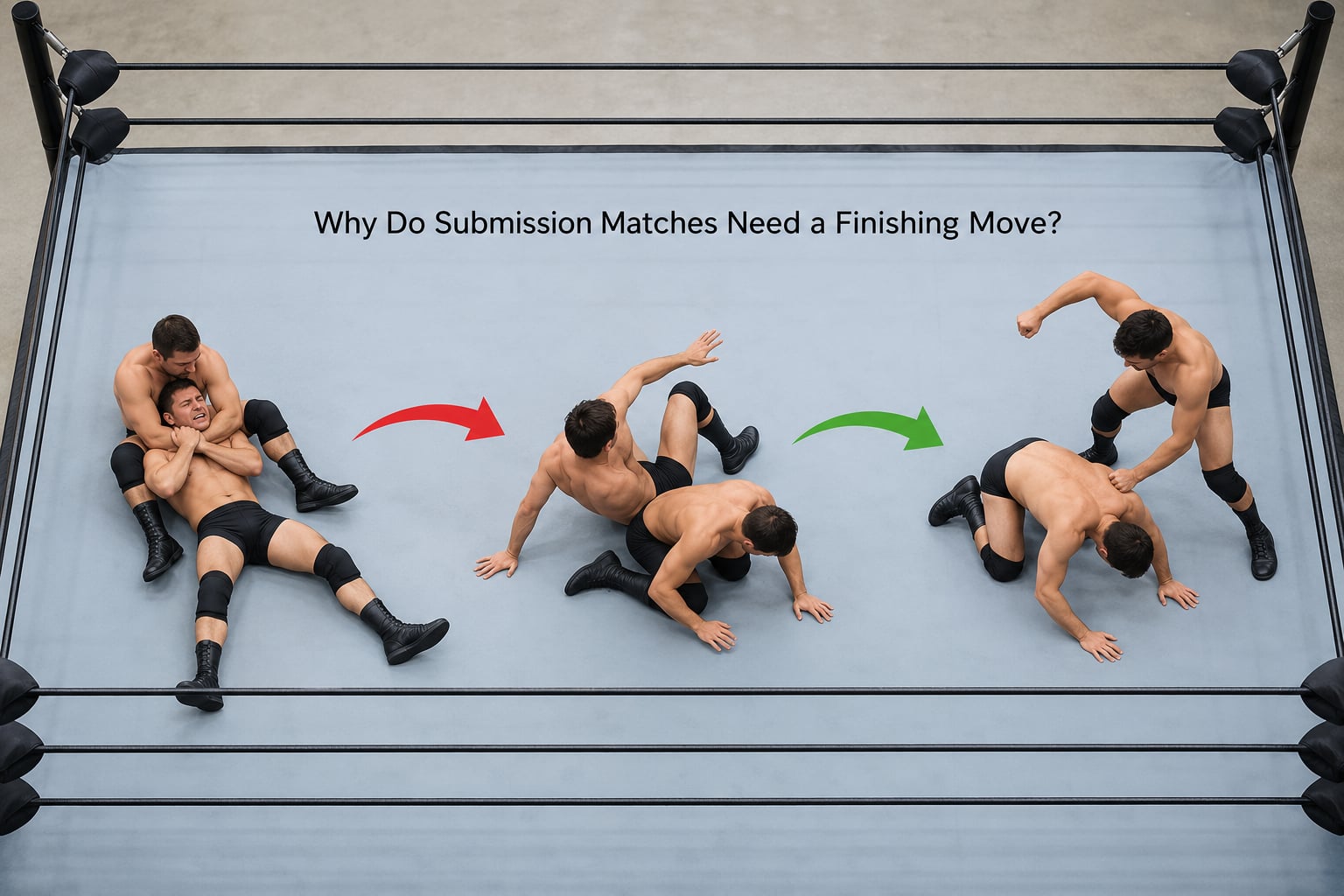
The finisher also solves the credibility problem. Once a wrestler has a named submission, every escape in the match can be sold as survival against that specific move, and every near-tap has an obvious destination. Shawn Michaels and Bret Hart built their whole careers on the idea that the signature hold is the moment the match belongs to one man.
Signatures are also tailored, not copied. A hold has to work on the specific opponent, and a good booker will adapt the finish rather than force a move that does not fit the body it is being applied to. Brock Lesnar’s Hell’s Gate, a kimura variant, is the example usually given for a finish built around one athlete’s specific strength rather than a generic hold.
How Do Bookers Keep Repeated Submissions From Feeling Predictable?
Repetition is the main complaint fans bring up, and it is a fair one. When a match is built from a single finish, the audience can feel the ending coming from minute three. Bookers fight that in five ways.
They change the pace. A submission match that is a long, grinding mat war feels completely different from one that moves at a fast, chaotic pace, and the same two wrestlers can have a very different match on a fast card than on a long one.
They vary the holds. Alternating between a head control, a leg lock and a choke gives the match a texture, and it also lets a comeback happen inside a hold the crowd did not expect.
They use counter-wrestling as the comeback engine. When the defender escapes and immediately catches a limb, the match resets without stopping, and the attacker has to solve a new problem mid-sequence.
They adjust the rules. An Ultimate Submission, an I Quit match or a no-disqualification version changes the pressure entirely, because the value of escaping a hold changes when a pinfall is also available.
They mix win conditions. Adding a title, a feud consequence or a time limit gives the crowd a second thing to watch, and a second thing to worry about losing.
What Makes a Submission-Only Match Feel Believable?
Five principles do most of the work, and they apply whether the match is on television or on an independent show.
Motivation has to be clear. Both wrestlers need a reason to keep fighting after a near-tap, and that reason comes from the story rather than from the hold.
Physical continuity has to hold. If one arm was worked for ten minutes, the finish should not ignore it. Continuity is what makes callbacks feel earned instead of random.
The two wrestlers need distinct tactics. One wrestler working a leg game and the other working a choke reads as a contest. Two wrestlers using identical holds reads as a rehearsal.
Escapes have to be logical. Reaching a rope, getting a hand on the mat, or using momentum to roll out of position are all explanations an audience accepts. A wrestler simply shrugging off a hold does not.
The payoff has to be setup. If the finish is the first time the crowd sees the hold applied with intent, it lands. If it was used and kicked out of twice already, the ending is a formality.
For independent wrestlers and promoters, the practical version of all this is simpler than it sounds. Pitch two specific wrestlers, name the finish both of them have already used on television, and give the promoter a reason the crowd has to believe either man can submit the other. A stipulation with no believable threat in it is the one thing that gets turned down.
Frequently Asked Questions
What is the submission rule in a submission-only wrestling match?
A submission-only match can end only when one wrestler submits, usually by tapping the mat, or when the referee stops the match. Pinfalls, count-outs, disqualification and outside interference cannot decide it. There is normally no time limit, which means a draw is technically possible, so most promotions add a clock or a second stipulation to guarantee a finish.
How does a wrestler escape a submission hold?
Escapes are worked and rehearsed in advance. Common methods include reaching the ropes, getting a hand to the mat, creating space with hip movement, or countering the finishing position with a reversal. The escape itself is never improvised in a one-finish match, because a botched escape kills the credibility of every hold that comes after it.
How do wrestlers book a submission match without using a normal pinfall?
They replace the pin attempt with a different kind of beat. A pinfall attempt becomes a hold that almost finishes, a two-count becomes a near-tap, and a rope break becomes an escape that only buys seconds. The match also needs a clear escalation ladder so the audience feels the situation worsening even though the finish never changes.
Should the champion lose by submission in a submission-only match?
It is a strong choice when the story pays it off later, because a title lost by tapping creates a specific kind of humiliation that can carry a feud for months. It is risky when the champion has never lost that way before, since the audience may reject it. Bookers usually have a reason prepared for how the champion regains the title.
Why do wrestlers kick out of finishers in submission matches?
A kickout from the finisher is the main source of suspense in a match that has no other finish available. It buys time, reverses the momentum, and forces the attacker to find a new solution. The kickout only works once, though. If the crowd has already seen the finisher escaped, the second attempt loses all its impact.
How long should a submission-only wrestling match last?
Most booked submission-only matches run between eight and fifteen minutes, with main event length pushing toward twenty. The ceiling is lower than a normal match because there is only one finish, so past a certain point the crowd starts watching the clock instead of the story. Adding a time limit or a second stipulation is the usual fix.
Conclusion
Start at the end. Decide who taps, with what hold, and why that person can afford to lose, then work backward through the limb you target, the escape you allow, and the near-tap that sets the finish up. Every question about how submission-only wrestling matches are booked comes back to that one decision, and a booker who has made it honestly can fill fifteen minutes without borrowing a single beat from a pinfall match.