A wrestling pay-per-view buy rate is the estimated share of a promotion’s potential pay-per-view audience that ordered an event, compiled from out-of-home ordering data and cable, satellite and telecom provider reporting. Orders open weeks ahead, get tallied against a cut-off date, and turn into a first-week estimate that a company publishes and later revises. That is how wrestling pay per view buy rates were counted, and why the numbers you read online are almost always estimates rather than audits.
The distinction matters because buy rates get quoted everywhere as if they were settled facts. They are not. Nobody outside the promotion and its distribution partners can see the raw order data, and no independent body audits the final figure. Once you understand the pipeline, you can read a headline number and immediately tell whether it is a company announcement, a reporter’s estimate, or forum guesswork.
This piece walks through the terminology, the step-by-step counting process, where the uncertainty creeps in, and how buy rates get confused with attendance, gate and viewership. It is the answer to a question most wrestling business threads never address: everyone quotes the number, nobody explains where it came from.
Table of Contents
- What Is a Wrestling Pay-Per-View Buy Rate?
- What Data Goes Into a Buy-Rate Estimate?
- How Wrestling Pay Per View Buy Rates Were Counted, Step by Step
- How to Tell Orders From Attendance and Revenue
- Why Reported Buy Rates Are Often Estimates
- Definitions are not standardized
- The window is never fully published
- International numbers are softer than domestic ones
- The reporting chain dilutes certainty
- The streaming era broke the old counting model
- Promotions without a distribution chain report differently
- Why Buy Rates Do Not Show What a Promotion Earned
- Frequently Asked Questions
- Does a wrestling pay-per-view buy rate mean the same thing as attendance?
- What does a reported 10,000 or 165,000 wrestling buy rate actually mean?
- Are wrestling buy rates independently audited?
- What is the difference between a buy rate and a buys figure?
- Can a buy-rate figure show how many unique people bought the event?
- Which wrestling pay-per-view has the highest buy rate?
- Conclusion
What Is a Wrestling Pay-Per-View Buy Rate?
A buy rate is a percentage, not a raw count, and confusing the two is the single most common error in wrestling discussion. A promotion might report 165,000 buys and a buy rate of 12 percent. Those are different numbers describing the same event, and only the first is a count.
The percentage works because the promotion divides its order total by a denominator it does not fully control: the estimated universe of people who could have bought that event. That universe shifts with distribution, pricing, cable penetration, streaming availability and how many markets carry the show. A 12 percent buy rate in one era and a 12 percent buy rate in another can represent wildly different crowds of actual buyers.
The term also carries a second, quieter meaning. Historically in wrestling, “buy rate” was used loosely for the raw number of orders itself, so a headline could say an event did a buy rate of 825,000 when it really meant 825,000 buys. Both usages still appear today. Reading which one a source means is half the work of reading the number.
One more thing to hold onto: a buy rate is a measure of paid orders for a home viewing product. It says nothing about who watched, where they watched, or whether they enjoyed it.
What Data Goes Into a Buy-Rate Estimate?
Historically, the input everybody forgets about is out-of-home ordering. Before streaming, most pay-per-views were ordered through a cable, satellite or telecom provider rather than from the promotion directly. Those providers collected the orders, counted them, and reported them back on a schedule set by the promotion. The promotion’s own internal order records were reconciled against those provider tallies, which is why the eventual number is a compilation rather than a single measurement.
On top of that sit several adjustment layers: international partner orders, which arrive through different systems and often on different timelines; refunds, chargebacks and billing disputes processed after the fact; and orders placed for events that were later moved, bundled or re-priced.
The vocabulary around those inputs is where most arguments online go wrong. Here is what each term actually means.
| Term | What it means | How firm is it |
|---|---|---|
| Buys | A raw count of paid orders for one event | A count, but only as firm as the window that produced it |
| Buy rate | Buys divided by an estimated potential audience, shown as a percentage | Only as reliable as the denominator, which is never published in detail |
| First-week estimate | The preliminary figure issued shortly after the ordering cut-off | Official when a company issues it, and explicitly labelled an estimate |
| Advanced buys | An interim tally reported before the cut-off date closes | Preliminary by definition; the cut-off can move the number either way |
| Final or settled figure | The count after the window closes and adjustments clear | The most stable number, but still company-produced rather than audited |
Notably absent from that table is television audience. Viewership is a Nielsen-style measurement of viewers, and it travels with the event rather than being counted by it. The two numbers are quoted in the same sentence constantly and they mean completely different things.
How Wrestling Pay Per View Buy Rates Were Counted, Step by Step
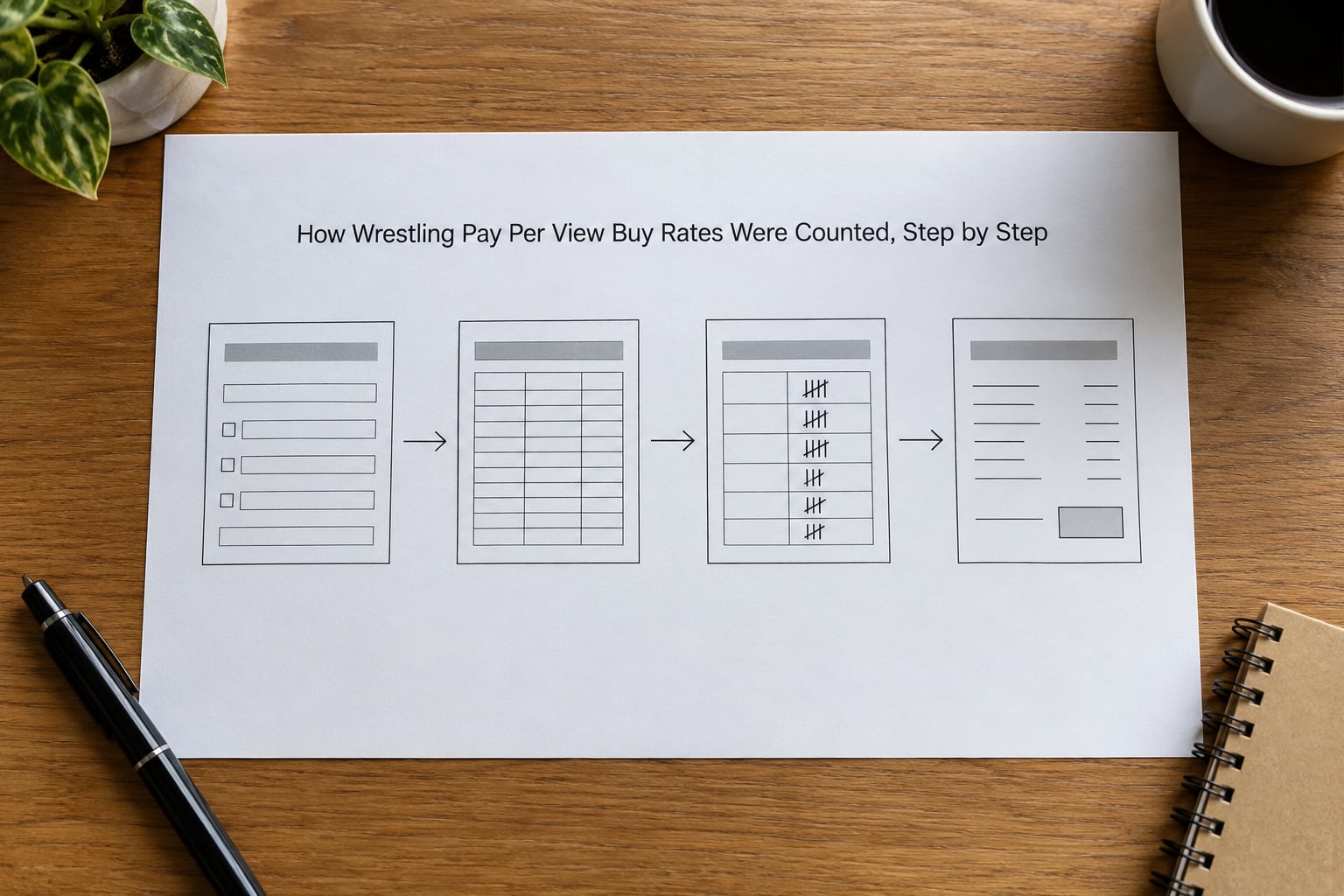
The process is the same shape across promotions, even when the details are never published. Here is how it runs.
- The event and price go on sale. Ordering opens through providers, usually several weeks out for a big show and closer to the date for a smaller one. Price is set by the promotion and varies by market and by provider.
- Interim tallies circulate as orders accumulate. These are the figures described as advanced buys. They are real counts of orders received so far, but the window is still open, so they can only rise or fall by whatever happens after they are taken.
- The orders cut off. A published or reported deadline closes the ordering window. This is the hinge of the entire process. Before it, the number is provisional. After it, the number is treated as settled subject to adjustments.
- Providers report their counts back. Each cable, satellite and telecom operator sends in its own tally. International partners report through separate arrangements, sometimes later and sometimes with less precision.
- The promotion compiles a first-week estimate. This is the number most people have seen. The clearest surviving example of the official language is WWE’s own wording for WrestleMania XX, which said the first-week estimate of pay-per-view buys was 825,000, exceeding pay-per-view buys for WrestleMania XIX by 25 percent. The words first-week estimate did the honest work in that sentence.
- Adjustments clear and the figure can move. Refunds, billing failures and cancellations are processed after the cut-off, which is why a final number sometimes lands below the first-week estimate that was announced with fanfare.
- The figure travels through the reporting chain. A company press release is one destination. A specialist newsletter report is another. A social post from an individual reporter is a third, and each carries a different level of certainty.
Steps one through four are where the count happens. Steps five through seven are where interpretation happens, and they are the steps most readers never notice.
How to Tell Orders From Attendance and Revenue
A buy rate figure counts orders placed through distribution channels. It is not a headcount in a building and it is not a money total. Working through a hypothetical makes the gap obvious.
Say an event reports 165,000 buys and a 12 percent buy rate. That could mean 165,000 separate households ordered the event, or it could mean fewer households with several orders between them. In some markets it can also mean one buyer ordering on behalf of a group. Nothing in the published figure resolves it.
Now compare that to the arena. If the venue seated 18,000, the 165,000 orders did not translate into 165,000 people in the seats. Many of those orders went to cable subscribers watching at home. Others went to international viewers whose orders were counted separately or estimated later. And an event can sell well at the gate while recording modest buys, or the reverse, because ticket buyers and pay-per-view buyers are largely different populations with different reasons for spending.
The same applies to revenue. Multiply 165,000 orders by a price and you get a gross consumer spend figure, not a profit and not even a net take for the promotion. Providers keep a share of every transaction, taxes apply, international markets have different pricing, and production, venue and talent costs sit entirely outside that calculation. The buy rate number itself does not disclose any of this.
Practical consequence: comparing a buy rate against an attendance figure or a gate number is a category error. It tells you nothing except that the writer picked two incompatible measurements.
Why Reported Buy Rates Are Often Estimates
Even a first-week estimate is an estimate, and the uncertainty compounds at several points in the pipeline.
Definitions are not standardized
There is no industry rulebook defining which orders count. One promotion might count a reorder as a new buy while another consolidates repeat orders to the same customer. Nobody outside the company can verify which convention was used for a given event.
The window is never fully published
The orders cut off determines everything, and the exact date is rarely given with the figure. When you only know an event did a certain number by a certain rough point, you cannot reason about what came after.
International numbers are softer than domestic ones
International orders flow through a different set of partners with different reporting rhythms and less granular data, which is why nearly every major comparison quoted online is US-centric. When a figure includes international orders, it usually includes an estimate of the estimate.
The reporting chain dilutes certainty
Not every number comes from the same place, and treating them as equal is the core problem in forum threads. A rough reliability ladder helps.
| Tier | Source | What it means |
|---|---|---|
| Announced | Company press release | Official, usually labelled a first-week estimate, and the company had a reason to publish it |
| Reported | Specialist newsletter reporting | Reliable enough to be the working reference, but still a report rather than a filing |
| Single-source | An individual reporter’s post | Useful as an early signal, especially for interim counts, but one source and no audit trail |
| Speculation | Forum and social guessing | No provenance; frequently extrapolated from a smaller event or a percentage claim |
That fourth tier is not hypothetical. It is the tier that quietly gets promoted into the third: an unsourced guess gets repeated until enough people have said it that it reads like a report, and by then the origin has long since disappeared. Nothing in the markup distinguishes it from a number that came off a company ledger. If you cannot name where a figure came from, you cannot check it, and that is the whole problem in one sentence.
The streaming era broke the old counting model
Wrestling pay per view buy rates were counted against an out-of-home ordering framework that assumed a cable or satellite order for a scheduled broadcast. That framework changed shape when WWE launched its own network and later moved events to Peacock, and when AEW sold events through its own streaming tiers. In those arrangements the purchase is a subscription state change rather than a single discrete order, which is a much harder thing to count and a much harder thing to compare against a legacy buy rate.
The result is a discontinuity. Comparing a pre-network figure to a streaming-era figure without acknowledging the change in counting mechanism is like comparing a mile walked to a mile driven. Both are distance, and the comparison still misleads.
Promotions without a distribution chain report differently
An independent promotion running a pay-per-view out of a small arena has no provider reporting chain at all. Its figures, when they surface, come from internal sales or from a partner, and they carry almost none of the verifiability of a major promotion’s estimate.
Why Buy Rates Do Not Show What a Promotion Earned
The gap between consumer spend and net revenue is wide, and a buy rate figure sits nowhere near the bottom of it. A simplified version of the chain looks like this.
| Layer | What happens | Effect on the promotion |
|---|---|---|
| Gross consumer spend | Orders multiplied by the price each buyer paid | The largest number, and the one furthest from profit |
| Provider and retailer share | Distributors take a cut of each transaction for billing and delivery | The single biggest reduction, and never disclosed per event |
| Taxes and duties | Sales tax in some markets, duties and fees elsewhere | Varies by market, which is why a global total is not directly comparable |
| Refunds and billing failures | Orders reversed after the cut-off | Can push a final figure below its first-week estimate |
| Production and travel | Staging, crew, production, and moving the show between cities | Scales with the size of the card and the number of stops |
| Venue and talent | Rental, staffing, and the performers’ compensation | Fixed and largely private, so no outside check is possible |
Two events with identical buy rates can sit on completely different margins. One may have toured three cities with a full production crew; the other happened in a single arena with a leaner setup. The published number does not capture any of that, and it is not designed to.
It also does not capture how many people watched for free, shared a signal, or subscribed to a service rather than buying the individual event. Those behaviours affect the value of the show enormously and appear nowhere in a buy rate.
Frequently Asked Questions
Does a wrestling pay-per-view buy rate mean the same thing as attendance?
No. A buy rate counts paid orders placed through distribution providers, while attendance counts bodies in seats at the venue. The two populations barely overlap, because most pay-per-view orders go to households watching at home and many ticket buyers never order the event. Quoting one figure as proof of the other is a category error, and the two numbers are usually never published in a way that lets you reconcile them.
What does a reported 10,000 or 165,000 wrestling buy rate actually mean?
It means roughly that many paid orders were counted for the event, out of an estimated potential audience, by the promotion’s own compilation of provider tallies and its internal records. It does not mean that many distinct individuals watched, that many people attended, or that the promotion kept that amount as revenue. If the figure came with a percentage, that percentage was calculated against an estimated audience the promotion never fully publishes.
Are wrestling buy rates independently audited?
No. Every widely circulated wrestling buy rate is produced by the promotion that sold the event, or reported second-hand by a newsletter or individual reporter who received it from a source. No accounting firm, regulatory body or industry association verifies these figures. That is why responsible coverage labels a number as an estimate, names where it came from, and avoids pretending to more precision than the source supports.
What is the difference between a buy rate and a buys figure?
A buys figure is a raw count of paid orders. A buy rate is that count divided by an estimated potential audience and expressed as a percentage. Wrestling media often uses the terms interchangeably, which is why a headline can appear to contradict a table. Always check which one a source means before comparing two numbers, because the percentage depends on a denominator that changes between eras and markets.
Can a buy-rate figure show how many unique people bought the event?
Not reliably. Depending on the promotion’s conventions, repeat orders from one household may be counted once or counted separately, and in some markets a single buyer can order on behalf of a group. Published figures rarely disclose the convention used, so a count of orders and a count of people are not interchangeable, and the gap between them is invisible from the outside.
Which wrestling pay-per-view has the highest buy rate?
By raw buys, the widely cited peak is WrestleMania XX, which WWE reported a first-week estimate of 825,000 buys, and which it described as exceeding WrestleMania XIX by 25 percent. Older lists often lead with WrestleMania XVII. Any figure needs its label attached: first-week estimate, reported figure or later revision, because those are not the same number.
Conclusion
The next time a buy rate number appears in your feed, ask three questions before you repeat it: who compiled it, what did they count, and when was the window closed. If the answer is a company announcement, treat it as an official estimate. If it came from a newsletter, treat it as a report. If it came from a forum post with no attribution, leave it alone.
Wrestling pay per view buy rates were counted through an ordering window, a cut-off date and a provider reporting chain, and that chain still runs even as the products underneath it changed. Understanding the mechanics does not make the numbers verifiable, but it does make you much harder to fool by the next one.