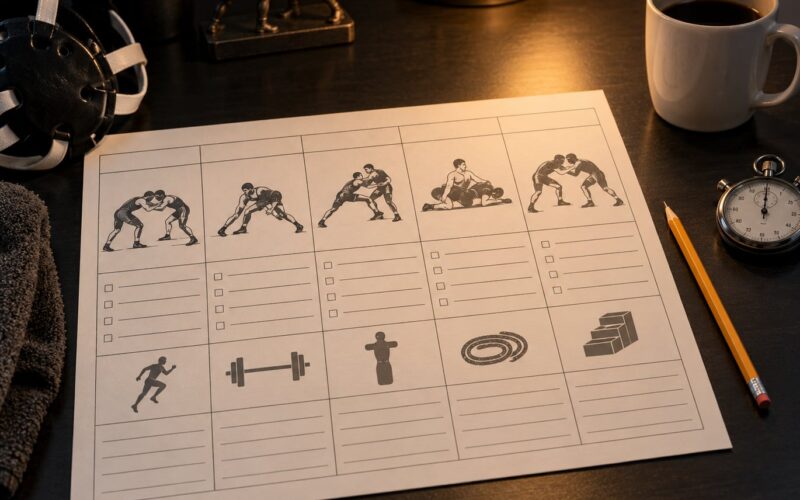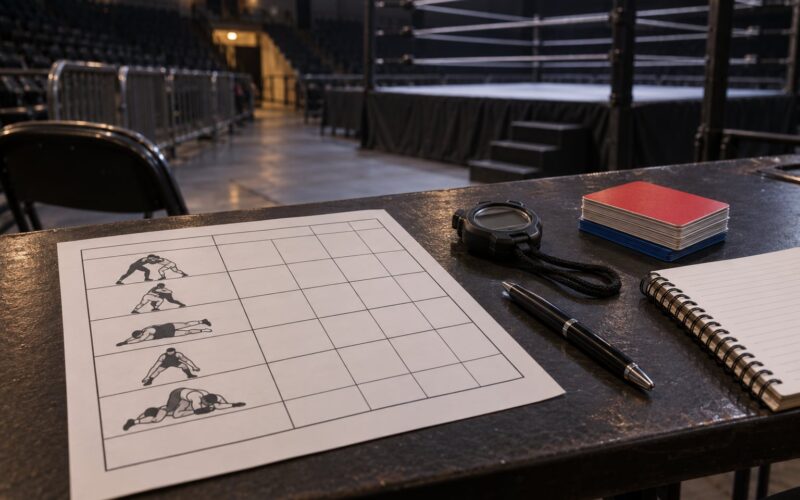
A wrestling match review is a written critique of one match, and writing one is mostly an exercise in process: watch with a question in mind, take notes while the moments are fresh, then judge structure, psychology, story and the finish against a standard you picked before the bell rang. Most beginner reviews fail not because the writer dislikes the right things, but because they were written from memory with no framework. Here is how to write a wrestling match review that a reader takes seriously, whether you are filing a post-show piece for a blog or writing your first reaction after a Saturday night show.
Set aside twenty minutes of prep before you ever open a video file, and the whole job gets easier. The rest of this guide walks through that prep, the seven steps of the review, and the mistakes that trip up new writers.
Table of Contents
- What You Need
- Step-by-Step: How to Write a Wrestling Match Review
- 1. Watch the Match With a Purpose
- 2. Take Notes During Key Moments
- 3. Summarize the Match Structure
- 4. Evaluate the Wrestling and Psychology
- 5. Explain the Story and Character Work
- 6. Describe the Finish and Its Impact
- 7. Write a Balanced Opinion and Verdict
- A Quick Note on Ratings
- Common Mistakes
- Frequently Asked Questions
- How long should a wrestling match review be?
- Should I give a wrestling match a star rating?
- Is the star rating system valid if wrestling is subjective?
- How do I write a wrestling review without spoilers?
- How do I review a match objectively when I did not enjoy it?
- What is pro wrestling psychology?
- Conclusion
What You Need
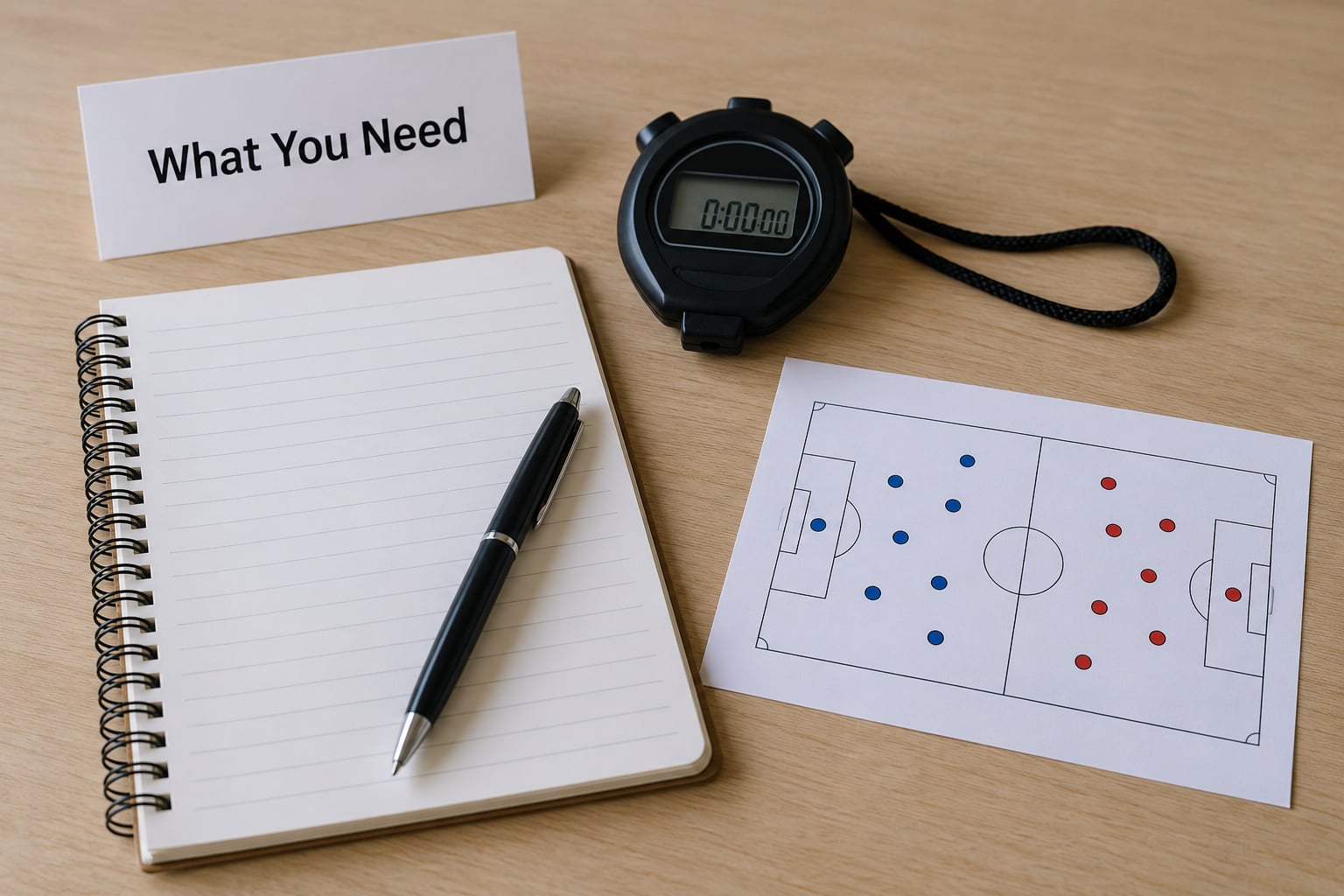
You do not need credentials, an insider contact or a wrestling background. You need a match, a way to keep track of what happened, enough vocabulary to describe it, and a rating standard you choose before you are emotionally invested in the result.
- The match and its run-up. Promotion, date, position on the card, the stipulation, and the two or three weeks of story leading into it. A match review that ignores context reads as a recap.
- A note method that does not interrupt watching. Timestamps in a plain text file, voice memos, or a two-column sheet with minutes down the side. If taking notes means pausing eleven times, you will stop doing it by the third match.
- The announced basics. Participants, stipulations, and any manager or second involved. You cannot assess a decision without knowing what a wrestler was being asked to protect.
- Core vocabulary. The terms below. Using the right word for what happened is most of what separates a review that reads like wrestling from one that reads like a summary.
- A rating standard, chosen in advance. Stars out of five, a five-category scorecard, or plain words such as lousy, fine, good and great. Pick one and reuse it, so readers can learn what your numbers mean.
The vocabulary list is the piece beginners most often skip, and it is the fastest credibility win available.
| Term | What it means | How it shows up in a review |
|---|---|---|
| Sell | Making a move look and feel like it matters, whether or not it really hurts. | The drop that made him wince was sold better than the one that actually landed. |
| Pop | A genuine burst of crowd approval for something unexpected or well executed. | The first superkick got a pop; the second one to the same man got silence. |
| Heat | Crowd hostility aimed at a wrestler, and the reaction an action draws from people who dislike him. | He was on the receiving end of heat for a full minute, and used it. |
| Botch | A mistake in execution, whether a botched spot, a missed cue, or a rope break that should not have happened. | One botch at the turnbuckle, recovered within two seconds and never referenced again. |
| Workrate | The ability to make a sequence of moves read clearly and build momentum through it. | Workrate carried that segment; the fight never slowed down long enough to breathe. |
| Near fall | A pin or submission that touches the count to two or three before the escape. | Three near falls in the last four minutes, each built a little differently. |
| Callback | A deliberate return to an earlier moment, promo, or move as part of the payoff. | The finish was a callback to the armbar he had never escaped on the road. |
| Chain wrestling | A sequence of holds and reversals linked together without a break, often on the mat. | Six minutes of chain wrestling that never let the crowd check its phone. |
| Shoot style | A style built around realism, grounded striking, limb targeting, and believable-looking holds. | It was booked shoot style, so the arm work mattered more than the flying. |
| Lucha libre | A Mexican style emphasizing fast, flowing exchanges, mask work, and aerial offense. | Lucha libre pacing, where the rest is as important as the moves. |
| Spot | A single planned or called moment within a match. | The best spot of the night came out of a fifteen-second exchange. |
| Spot calling | Wrestlers deciding in the ring, in real time, what happens next. | Nothing was called in advance; the last two minutes were built live. |
| Kayfabe | The pretend story world of the promotion, where injuries and defeats have narrative causes. | Nothing in that finish respected kayfabe, and the crowd noticed. |
One clarification that trips up searchers: a suplex is legal in professional wrestling. Questions about it being unsafe come from Olympic-style freestyle, which bans the move because of the spine. In-ring, you will hear it in every promotion worth watching.
Step-by-Step: How to Write a Wrestling Match Review
1. Watch the Match With a Purpose
Before pressing play, write down the announced facts: who is wrestling, under what stipulation, at what stakes, and what question the match is meant to answer. Most matches exist to settle something announced weeks earlier, and if you cannot state that question in one sentence you will not be able to say whether the match answered it.
Then watch without judging. Do not decide during the match that it is going to be a three and a half before the finish, because the second half of a wrestling match is where the structure either holds together or falls apart.
2. Take Notes During Key Moments
Record entrances, the opening pacing, every major spot, near falls, callbacks, notable crowd reactions, anything the commentary pointed out that you missed, and the finish. A timestamps-only list is enough: the goal is twenty lines, not a transcript.
Write down your reaction while it is still honest. A single phrase like “nothing happening after minute eight” is worth more than three paragraphs written from a hazy memory an hour later.
3. Summarize the Match Structure
Organize what you wrote into an opening, a middle, and a finish, and note how pacing shaped each part. Time limit matches have a built-in clock that forces a specific shape, while no-disqualification and submission matches let a match breathe and punish a slow start with an unearned distraction.
In your summary, say what the match was about in two or three sentences. Readers who skipped the show should get the shape of it without reading the whole piece.
4. Evaluate the Wrestling and Psychology
This is the core of how to write a wrestling match review that holds up. Look at ring work, the choices each wrestler made, how well moves were sold, whether momentum shifted for a reason, and how the two performers worked off each other rather than just taking turns.
Score the match against a fixed rubric so your verdict comes from the elements instead of a mood. Seven rows, five points each, takes about four minutes and makes your rating defensible.
| Element | What to look for | Score out of 5 |
|---|---|---|
| Structure and pacing | Does the match have a shape, and does each phase earn the time it takes? | ___ |
| Psychology | Do the moves mean something, and do reversals and transitions follow logically? | ___ |
| Selling | Does the work make impacts and injuries look as heavy as they should be? | ___ |
| Spots and execution | Are the sequences varied, clean, and placed where they build rather than interrupt? | ___ |
| The finish | Does it deliver the payoff the match set up, and close the segment cleanly? | ___ |
| Crowd reaction | Did the audience respond, and did the wrestlers adjust to the room? | ___ |
| Story and character | Do entrances and in-ring decisions connect to who these people are and why they are here? | ___ |
Judge a botch by its impact, not its count. A slip early in a long match that nobody noticed costs almost nothing. A mistake during the finish, in front of a crowd that had just gone quiet, can flatten a payoff no amount of crowd noise recovers.
5. Explain the Story and Character Work
Connect entrances, promos, callbacks, in-ring decisions and the finish to each wrestler’s character and to the larger feud. The question to answer is whether the people in the ring behaved like the people they are supposed to be.
Keep that separate from whether you like them. Disliking a heel and thinking he was badly written are two different claims, and a review that mixes them reads as a fan complaint instead of analysis.
6. Describe the Finish and Its Impact
Write the finish accurately: what was attempted, what happened, and how long it took. Plenty of readers have not seen the match, so get the mechanics right and keep speculation labeled as speculation.
Then assess it. Did it deliver the expected payoff, leave an angle open on purpose, create a new complication, or fail to close the match at all? A finish that turns out to be a deliberate setup is a good finish. A finish that was clearly improvised usually reads as one.
7. Write a Balanced Opinion and Verdict
State a specific verdict and support it with examples from the match itself. A useful formula is: the strongest thing that worked, the clearest thing that did not, and what the match did with the story it was given.
Finish by answering the question you set in step one. If the match was supposed to turn a heel, did it? If it was supposed to introduce a new contender, did the crowd believe it? A review without a verdict is a recap with extra steps.
A Quick Note on Ratings
Star ratings are the most recognized convention in wrestling writing, and the complaints about them are old and fair: the scale is widely understood to be inconsistent, and favorites routinely score higher than the same style from a less popular wrestler. That argument is not going to be settled here.
What does help is transparency. Score the rubric, publish the numbers, and use the same standard across every match you cover. Some writers skip stars entirely and use words like meh, bad, good, excellent or awesome, which is honest and portable to any era of wrestling. Pick a system, apply it consistently, and stop defending the number in the comments.
Common Mistakes
- Writing a move-by-move recap. Readers who wanted a play-by-play already watched it. Fix: describe four or five moments that mattered and analyze why they worked, not who threw what.
- Counting botches instead of measuring them. A match with two slips and a strong structure is often better than a clean match with nothing to say. Fix: name each mistake, then say whether it was visible and whether it was recovered.
- Confusing popularity with quality. Fix: score the seven elements first, then compare your score to your expectation and be honest when the better match is not the one you wanted.
- Writing a vague opinion. “It was fine, nothing special” gives a reader nothing to argue with. Fix: name the specific moment that decided your rating.
- Ignoring context. Judging a twenty-minute match the same as a six-minute sprint misses how stipulations and card position shape what a match can be. Fix: one paragraph on what the match had to accomplish.
- Reviewing the show instead of the match. A bad crowd or a thin announcement does not make a good match bad. Fix: keep the review on the match and put card-level complaints in the post-show piece.
Two more habits worth building early. Write about what you watched rather than what you know about the people making it, because unverified backstage claims are the fastest way to lose a wrestling audience. And be respectful toward performers even when the criticism is sharp; readers dismiss harshness about a wrestler no matter how sharp the analysis around it is.
Frequently Asked Questions
How long should a wrestling match review be?
For a single match, 400 to 700 words is the working range: enough room for context, structure, the strongest and weakest moments, and a verdict. A main event or a match with a long story run-up can justify 800. Post-show reviews covering a full card need more, but the matches that stood out still deserve their own paragraphs rather than a line each.
Should I give a wrestling match a star rating?
Use one if it fits your site, and apply it consistently. The scale works best as a summary of reasoning you have already written, not as the verdict itself. Many writers prefer words such as meh, bad, good or excellent, which travel across eras and styles without claiming a precision the stars imply. Either way, tell readers what each level means in your writing.
Is the star rating system valid if wrestling is subjective?
No system is objective, and the star scale is known to be inconsistent across promotions and promotions’ favorites. That does not make it useless, because a rating is a summary of a written argument rather than a measurement. Readers can argue with your reasoning more productively than with a number, so publish the reasoning and treat the score as shorthand.
How do I write a wrestling review without spoilers?
Describe the finish only in terms the story has already established, and say plainly that the review covers the ending. If you need to argue about whether a payoff landed, you cannot avoid naming it, so choose a format that makes that clear: put the verdict after a spoiler warning, or restrict the review to the portion of the show before the finish and link the rest.
How do I review a match objectively when I did not enjoy it?
Score the seven elements before you write a single sentence of opinion, then compare the score to your reaction. If the rubric says four and your gut says two, the interesting review explains the gap, usually because the match was technically sound but emotionally flat. Enjoyment is legitimate data; it just is not the only column.
What is pro wrestling psychology?
Psychology is the system that makes each move mean something: a wrestler targets a limb because it was worked earlier, gives up a hold to bait an escape, and loses a sequence on purpose so the comeback matters. A match built on psychology tells you what to feel and when, so when you review one, ask whether each beat set up the next rather than whether the moves were exciting on their own.
Conclusion
Start with the clearest strength and the clearest weakness, support both with a specific moment, and let the verdict follow from them. Readers who taste that match differently will still read your review as honest work, which is the standard worth writing to.
Pick your next match, set a twenty-minute timer, and draft it with the rubric beside you. The first one will be rough. The tenth will not be.