
If you promote professional wrestling in the United States, the short answer is that licensing is handled by state athletic commissions, and they do not all treat wrestling the same way. Some states issue promoter, wrestler, referee, and manager licenses, post surety bonds, and approve every event permit individually. Other states regulate wrestling only through local authorities and have no commission process to file with at all. Understanding how athletic commissions license wrestling events starts with finding out which of those two systems applies where your show is held.
The frustrating part for independent promoters is that there is no national standard to fall back on. A license in one state carries no weight in the next, and a show that sails through in one jurisdiction can be shut down in another. This guide walks through the licensing process step by step, the four license classes commissions commonly use, the paperwork a promoter files, the medical and insurance conditions that attach, and the mistakes that get events delayed or denied.
Everything here describes general regulatory practice in the U.S. Rules change, they differ by state, and some of the details below come from community reports rather than published commission documents. Confirm your own state’s requirements directly with the commission before you advertise, sell tickets, or sign a venue contract.
Table of Contents
- What Is an Athletic Commission?
- Do All U.S. States License Professional Wrestling?
- How the Wrestling Event Licensing Process Works
- How Athletic Commissions Classify Wrestling
- What a Promoter Files Before an Event
- Licensing Fees, Insurance, and Financial Requirements
- Medical Rules for Wrestlers
- Venue Inspections and Event-Day Enforcement
- How to Verify Requirements for Your State
- Common Reasons a Wrestling Event Is Delayed or Denied
- Frequently Asked Questions
- Does every U.S. state require an athletic commission license for professional wrestling?
- Who applies for a wrestling event license, the promoter or the wrestlers?
- Does an athletic commission license an entire wrestling card or only individual matches?
- How early should a promoter apply for approval of a wrestling event?
- Can the same wrestling event have different rules under state and local law?
- Why might a commission treat a professional wrestling match like a regulated combat sport?
- Conclusion
What Is an Athletic Commission?
A state athletic commission is the government agency that licenses and regulates combat sports and related events within a state. Its job is to decide who may promote, who may participate, what safety standards an event must meet, and what happens when someone is injured or defrauded.
The authority comes from a statute in the state code and a set of administrative rules. Those rules are written in language like conduct or hold a wrestling contest without first procuring a license, and they are the reason a promoter cannot simply decide to run a show. An Arizona auditor general performance audit put it plainly: the underlying statute prohibits any person from conducting, holding, or giving boxing or wrestling contests, or participating in any such contest, without first procuring a license.
Two things to keep separate. The commission governs the sporting event itself, licensing the promoter and participants and setting the medical and safety conditions. Local authorities, usually the city or county, govern the ordinary business side of a show: assembly permits, occupancy, fire inspection, noise, alcohol service, and street closures. Promoters routinely trip over the second list while focused on the first.
Most commissions exist primarily for boxing and mixed martial arts. Wrestling is often folded into their authority by statute, attached as an unregulated activity they still license, or left out entirely.
Do All U.S. States License Professional Wrestling?
No. There is no state that licenses every professional wrestling event in the country. Licensing authority sits with individual state commissions, and a substantial number of states do not include professional wrestling in it, leaving promoters to local permit processes only.
The differences come down to how each legislature chose to define the commission’s jurisdiction. Some statutes name wrestling contests and wrestling exhibitions explicitly. Others grant the commission authority over combat sports and boxing, and never mention wrestling, so the commission either regulates it under general rulemaking authority or declines to.
You will run into three broad outcomes as a promoter:
- Wrestling is a regulated professional sport. You need a promoter’s license, participants need licenses, and every event needs a permit.
- Only parts of the card are regulated. The commission treats specific matches as regulated combat and licenses those, while the rest of the show is ordinary entertainment.
- Wrestling is not regulated by the commission. Your only obligation is the local permit, and your insurance, contracts, and building rules are the real governing documents.
Independent promoters working on Facebook groups and wrestling subreddits repeatedly describe the same problem: they learn which states license wrestling from each other, not from a reliable national list. Names like Missouri and South Carolina come up often because those states are known to be enforcement-active. Anything beyond that has to be verified state by state.
A Washington attorney general opinion on who must be licensed to conduct wrestling and sparring contests reached a conclusion worth knowing, because it reflects how a commission reads its own statute: all groups and organizations should be licensed in order to conduct wrestling contests, with an exception carved out for scholastic contests. That scholastic carve-out is a common feature of these statutes, and understanding where your event falls on that line determines which code section you are actually subject to.
How the Wrestling Event Licensing Process Works
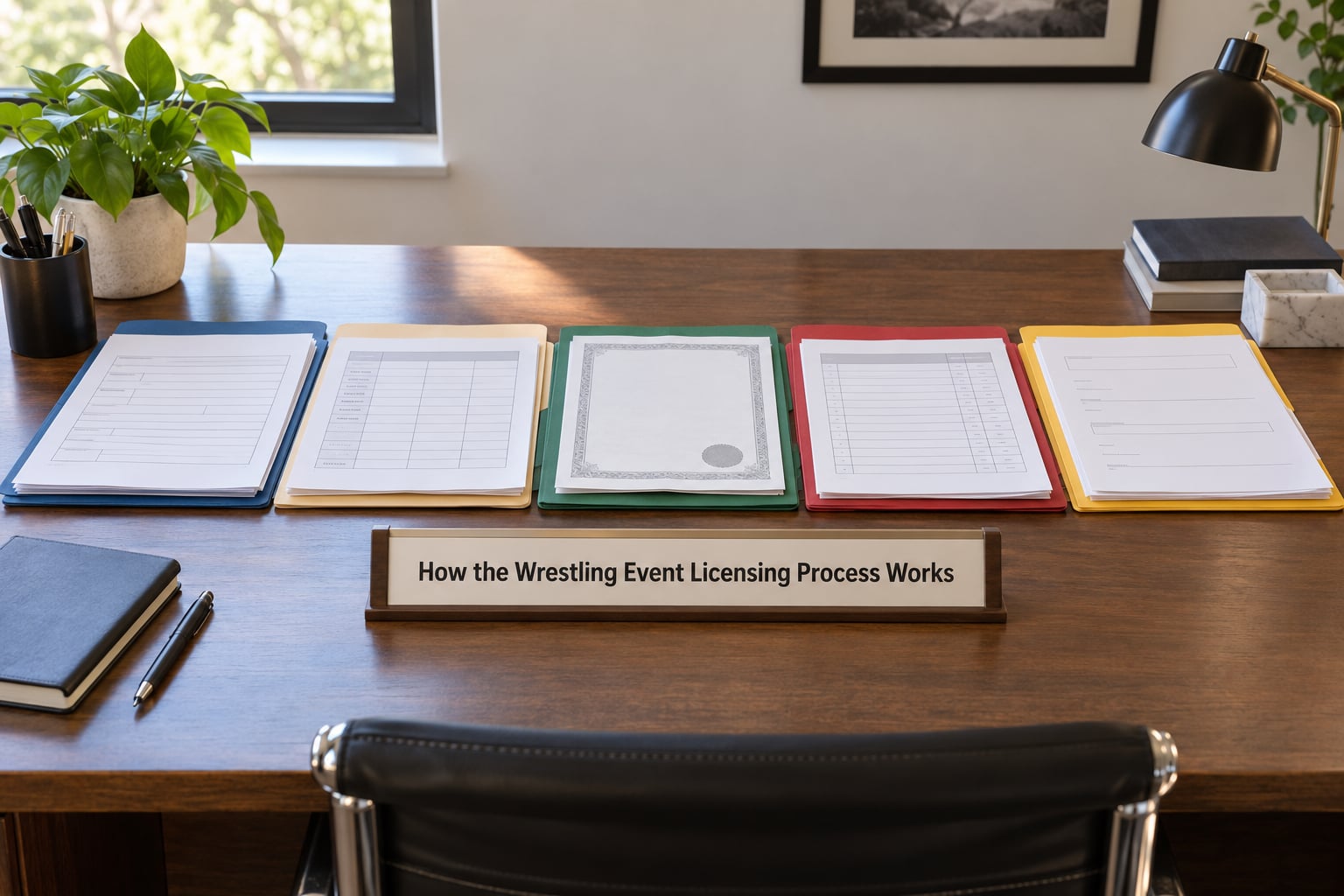
The process runs in a predictable order, and the failures promoters hit almost always come from doing these steps out of sequence or too late. The first step is identifying the correct authority, which means checking whether your state commission regulates professional wrestling at all before you contact it.
Once you have confirmed the jurisdiction, you identify which license classes apply to you and to your roster, then gather the supporting documents those classes require. The financial step follows, since the surety bond and insurance certificate often need to arrive alongside the application rather than after it. You file the event application for each individual show, since a promoter license generally does not approve a specific date and venue. After approval you handle event-day obligations, and after the show you reconcile the ticket accounting that the per-ticket levies depend on.
Several steps run in parallel rather than strictly in sequence, and promoters who treat them as one long chain lose weeks. Insurance certificates take time to issue, and background checks take time to clear, so both should start on the same day the application is filed. Waiting until the event is three weeks out to begin is the single most common cause of a delayed or denied event.
Timing is set by the commission, not by you. Most states publish a filing deadline in their rules, and permits are granted on a defined basis once the file is complete. The Kansas Athletic Commission, for example, requires the promoter’s event application be filed with the commission through its own portal and issues permits based on that filing. Your show’s date, not your mailing date, is what the deadline counts back from.
How Athletic Commissions Classify Wrestling
Commissions sort wrestling into a handful of categories, and the category determines what you file. Getting this wrong means filing the wrong application, or none at all.
In a regulated professional wrestling framework, wrestling contests and wrestling exhibitions are both named in the commission’s statute or rules. A contest carries rules for scoring and outcome, an exhibition does not. This is the clearest category for promoters, because the statute tells you what it covers.
Under a combat-sport overlay, the commission treats individual matches as regulated combat while the surrounding event stays entertainment. This happens where a statute grants authority over combative sports broadly and does not carve wrestling out. California is the example people argue about most: a legal answer on a question forum stated that the California State Athletic Commission regulates professional wrestling including large promotion shows, then acknowledged that the statutes it cited govern combative sports and do not specifically name professional wrestling. That contradiction is itself the lesson. Where the statutory basis is unclear, ask the commission directly rather than relying on a summary.
A scheduled or exhibition exception applies to many amateur, scholastic, charity, and private showcase events. These carve-outs are written into the statutes and administrative codes and are the fastest way to remove the licensing burden from a benefit show.
Finally, some events sit entirely outside the commission’s reach and are treated as unregulated entertainment, governed by contracts, insurance, and local permits instead.
Whether predetermined outcomes change the answer varies by state, and this is the question promoters ask most often. In some states the statute names wrestling contests regardless of scripting. In others the commission’s authority over combative sports is what supplies jurisdiction, and predetermined outcomes are irrelevant to that analysis.
What a Promoter Files Before an Event
Application packets vary by commission, but the recurring contents fall into a predictable set. Most state applications begin with identity information for the promoter and any business entity, then event details covering date, venue, capacity, start time, and the full proposed card.
A venue agreement or letter of intent is standard, because commissions want to know where the event will be held before approving it. Participant information follows, covering every wrestler, referee, and manager on the card, with license numbers for anyone already licensed elsewhere.
Medical documentation is usually required at the filing stage rather than event day. Expect to submit proof of a current pre-participation physical for each participant, and evidence of a ringside physician or medical coverage plan.
Financial paperwork comes with the application: a surety bond in the form the commission specifies, and a certificate of insurance naming the commission as an additional interested party where required. Fees and any deposit are paid at filing.
Four license classes recur across the states that regulate wrestling, and they carry different obligations:
| License class | Who needs it | What it obligates you to |
|---|---|---|
| Promoter’s license | The business or person staging the event | Follow commission rules, post bond, file a permit for each event, remit ticket levies |
| Wrestler or participant license | Anyone performing in a regulated match | Provide a current physical, disclose medical history, observe conduct rules |
| Referee license | Anyone officiating | Meet the commission’s rule knowledge requirement and conduct standards |
| Manager or valet license | Managers, valets, seconds, and cutmen where covered | Abide by conduct rules and remain credentialed at ringside |
That last row varies most. Some commissions credential managers only when they also corner manage. Others do not license ringside personnel at all. Ask for the roster requirements in writing.
A useful check on how granular a state is: an open letter campaign in New Mexico argued that the commission’s minimal wrestler license implied no real testing of training or competency. Whatever you think of that argument, it shows the shape of the requirement, an application with a fee and a basic standard behind it.
Licensing Fees, Insurance, and Financial Requirements
No single dollar figure is right for this article, and any promoter who quotes you one universal number is wrong. Fees vary by state, by license class, and by how often you file, and they change without notice. Below is what the categories are and how each one behaves. Treat it as a framework, then get current figures from your commission.
| Requirement | How it usually works | What varies |
|---|---|---|
| Promoter application fee | Paid when the promoter license is issued, often on a renewal cycle | Annual versus multi-year term; whether corporations and individuals pay the same |
| Participant license fee | Paid by each wrestler, referee, or manager, or covered by the promoter | Flat amount versus sliding scale; renewals and out-of-state additions |
| Event permit fee | Paid per event, filed a set number of days before the show | Flat fee versus fee per bout on the card |
| Surety bond | An instrument naming the state as beneficiary, securing promoter obligations | Required bond amount; annual premium paid to the surety |
| Per-ticket levy or tax | A percentage of face value, a flat per-ticket charge, or both | Rate, whether it stacks with a commission fee, ticket destruction rules |
| Insurance | General liability, participant accident, and sometimes event cancellation | Coverage limits, whether the commission must be named, waiver subrogation |
| Deposits | Held against ticket levies and remitted after the event | Amount, whether partial refunds apply to postponed events |
The surety bond deserves its own explanation because it is the requirement most promoters encounter first and misunderstand. A bond is not an insurance policy for you and not a fee to the commission. It is a promise, backed by an insurer, that you will perform your promoter obligations. The obligations it secures vary by state and commonly include remitting the state tax on the face value of tickets sold, having a physician in attendance, providing an ambulance on site, maintaining adequate crowd-control security, and not destroying unsold tickets. Pennsylvania’s rules under Section 2102 are a commonly cited example of that structure.
One practical note from bond mechanics: a surety can cancel with advance notice, so treat the bond as something you renew annually rather than a one-time expense you file and forget.
Community discussion about licensing costs is a reasonable sanity check on your own budget, though community-reported figures are not official. Promoters have posted figures for a promoter fee around the low hundreds per term in South Carolina, bond requirements in the five-figure range in several states, a percentage-of-face-value ticket tax plus a flat per-ticket fee in Missouri, and a percentage-of-face-value ticket tax in Pennsylvania. Treat every one of those as a starting point for a conversation with your commission, not as a current published rate.
Medical Rules for Wrestlers
Medical standards are where commission regulation touches participant safety most directly, and they are also the area where promoters get into trouble by improvising. Typical requirements include a current pre-participation physical for every licensed participant, a ringside physician at regulated events, and an emergency medical action plan filed in advance.
Most states also require ambulance access, with the route from the venue to a hospital and the plan for calling it documented rather than improvised. Concussion protocols have become standard in combat regulation and increasingly appear in wrestling rules as well, covering both pre-event clearance and removal from a match.
Participants are usually suspended following a knockout, a hospitalization, or a diagnosed concussion, and a medical suspension can delay a wrestler’s own booking schedule. Some states handle weight classes where applicable, and background checks on participants appear with varying thoroughness across commissions.
To be clear about scope: this is regulatory description, not medical advice. Individual clearance questions belong to a physician and, where a commission requires it, to the commission’s own medical director. Performers should also carry their own coverage, since a promoter’s policy is not a substitute for accident insurance that protects the wrestler.
Questions about specific moves and legality come up constantly in wrestling communities, including whether a chokeslam is illegal. The useful distinction is that commissions regulate the conduct of the event, the licensing of participants, and safety standards; they generally do not adjudicate individual performer decisions or performer safety. That is a contract and insurance matter between the wrestlers and the promotion.
Venue Inspections and Event-Day Enforcement
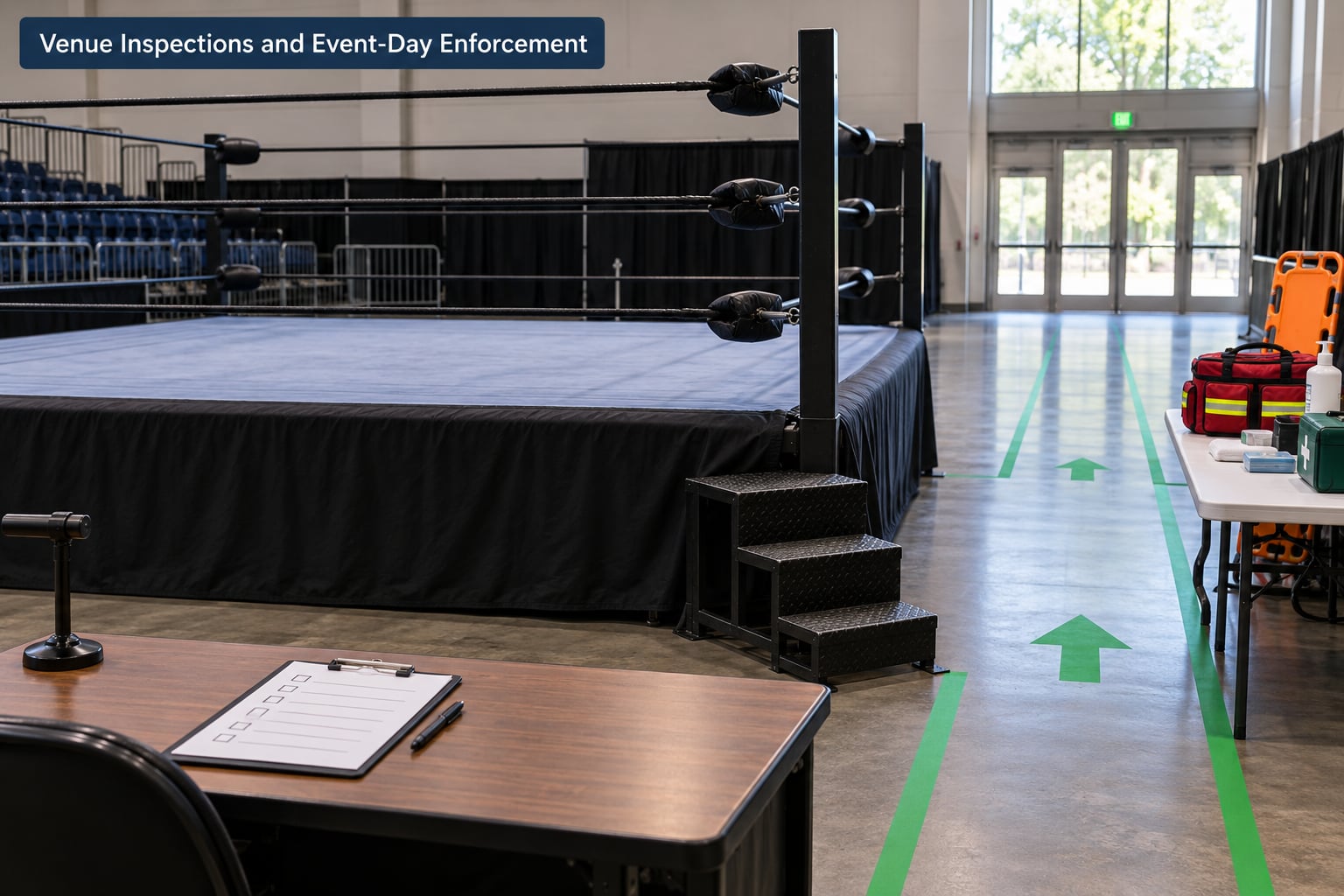
Approval of your paperwork does not end the commission’s involvement. Officials typically review the venue before the doors open, and a walkthrough covers the ring and its equipment, medical access and personnel, and fire safety.
What officials look at in practice includes ring condition and padding, rope tension and post condition, and whether the floor surrounding the ring is properly matted. They check that a physician or medical professional is present as the rules require, that emergency equipment is on site, and that ambulance access is unobstructed. They also look at crowd control and security staffing, exit routes, and whether the event is running under the rules that were approved on the permit.
On event day, enforcement is usually lighter-touch than promoters fear. The main risks are unapproved changes: adding a participant who was not on the submitted card, running a match format the commission approved differently, or starting the show without the medical coverage the permit assumed.
Two practical consequences. If the venue changes after approval, ask whether the commission must be notified, and assume it does until told otherwise. And if a physician orders a match stopped, that is not negotiable on the night; the permit’s medical condition exists precisely so that a promoter cannot overrule it in front of a crowd.
How to Verify Requirements for Your State
Verify before you book the venue, not after you announce the show. Start by finding your state commission’s official licensing portal through the state government site rather than a vendor’s page, since bond and insurance vendors often describe themselves as the authority and their pages can be years out of date.
Next, search your state code for the words wrestling contest and wrestling exhibition. Those two phrases locate the statute that gives the commission jurisdiction and tell you whether your event falls under it, plus where the scholastic and amateur exceptions live.
Then read the administrative code for the commission itself. Rules contain the filing deadlines, fee schedules, medical requirements, and bond amounts that the statute only gestures at.
Write to the commission before you commit to a date and ask directly: does the commission license professional wrestling in this state, which license classes apply, what is the filing deadline measured back from the event date, what bond and insurance limits are required, and does the promoter or the participant file. Getting that in email creates a record you can show a venue, an insurer, or a wrestler who asks.
Finally, contact your city or county separately about assembly, occupancy, and fire permits. Venue staff often know the local list by heart and can save you a week.
Common Reasons a Wrestling Event Is Delayed or Denied
Most problems trace back to a short list, and most are preventable at the application stage.
Incomplete applications. Missing signature lines, a missing license number for an out-of-state participant, or a venue letter that was never attached. Commissions reject incomplete files rather than holding them.
Late filing. The deadline runs backward from the event date and does not flex. Community posts about promoters scrambling after the cutoff are common, and the usual cause is waiting on a bond or a physical.
Inadequate insurance or the wrong bond form. A policy that does not name the commission, falls below the required limit, or lacks waiver of subrogation, and a bond issued on a private form instead of the commission’s. Underwriters know this and will fix it if you send them the rule.
Missing medical documentation. A physical that expired, or a roster submitted without the required physician attestation.
An unapproved rule set. Sanctioning under rules the commission has not approved, or under a sanctioning body’s rules that conflict with commission policy. Get written confirmation that the rules you intend to run are acceptable.
Venue safety deficiencies. Inadequate matted area, no ambulance access, exits blocked in the load-in. Venue fixes take days you may not have.
Confusing state and local authority. This one is almost free to avoid. Assuming a state license covers your city permit, or that a local permit satisfies the commission, wastes a cycle at exactly the wrong time.
Worth noting: running an unlicensed show where one is required can bring fines and expose the promoter to personal liability. Community concern about commissions being inconsistent or overreaching is real, and it is not a defense. Ask before you file, and keep the answer.
Frequently Asked Questions
Does every U.S. state require an athletic commission license for professional wrestling?
No. Licensing authority sits with individual state commissions, and many states do not include professional wrestling in it. Some states issue promoter, wrestler, referee, and manager licenses and approve each event. Others regulate only specific matches as combat sport. In a number of states, wrestling falls entirely outside commission oversight and promoters deal only with city or county permits. Check your state statute before assuming a requirement exists either way.
Who applies for a wrestling event license, the promoter or the wrestlers?
Usually both, in separate filings. The promoter files for a promoter’s license and then for a permit covering each event, including the card and venue. Wrestlers, referees, and sometimes managers or valets file their own participant licenses, which is why independent talent traveling across state lines often holds several. Some states let the promoter submit participant information as part of the event application, so ask whether individual licenses are still required for each person.
Does an athletic commission license an entire wrestling card or only individual matches?
It depends on the state. Where a statute names wrestling contests and exhibitions, the commission approves the event and its full card through a permit. Where authority comes from a broader combative sports statute, the commission may license only the matches it treats as regulated combat and leave the rest of the show as entertainment. That distinction changes what you file, so ask how the commission classifies your specific card before submitting anything.
How early should a promoter apply for approval of a wrestling event?
Far earlier than most promoters expect. Deadlines are set by each commission’s rules and count backward from the event date, and background checks, bond underwriting, and insurance certificates all take time. Start the promoter application, the bond, and the insurance on the same day, and treat the event date as fixed rather than movable. If a vendor tells you approval is quick, ask the commission for the actual filing window in writing before you advertise the date.
Can the same wrestling event have different rules under state and local law?
Yes, and routinely. State law governs licensing, participant eligibility, medical standards, and ticket levies. Local law governs assembly permits, occupancy, fire inspection, noise, and sometimes alcohol service. Both apply to the same show on the same night, and satisfying one tells you nothing about the other. Venue staff usually know the local requirements well, so ask them early while you are still choosing a date.
Why might a commission treat a professional wrestling match like a regulated combat sport?
Because its statutory authority may come from a combative sports provision rather than a wrestling-specific one. Where a statute names wrestling contests and exhibitions, the classification is clear. Where it grants the commission authority over boxing and combative sports generally, the commission applies combat rules to matches that fit, regardless of whether outcomes are predetermined. That is why a promoter cannot settle the question by arguing about scripting. Ask the commission how it classifies the match.
Conclusion
Start by confirming one thing: whether your state commission regulates professional wrestling at all. Everything after that follows from the answer. Find the statute, read the commission’s rules for filing deadlines, bond amounts, and insurance limits, then email the commission and get the response in writing.
Do that before you sign a venue, announce a date, or take a single ticket. The promoter who files early and in the right order treats licensing as paperwork; the one who files late treats it as a crisis.