Selling in pro wrestling is the deliberate performance of pain, exhaustion, fear and injury after a move, done well enough that the audience reacts as if it were real. That reaction is the whole point. Because a crowd already knows who is winning, what sells a match is not the outcome but the feeling of the outcome, and selling is the craft that produces it.
The word throws people off, so let me be plain: nobody in pro wrestling is trying to convince you the punches are real. They are trying to convince you the pain matters. If a wrestler takes a corner kick and just nods, the crowd sees two athletes moving around a ring. If the same wrestler grabs a leg and fights to stand, the crowd sees someone who might lose.
This guide covers the psychology underneath that reaction, the physical mechanics a wrestler uses, how selling changes across character types and eras, and what goes wrong when it does not land.
Table of Contents
- Key Takeaways
- What Does Selling Mean in Pro Wrestling?
- How Selling Works in Pro Wrestling Psychology
- Why Do Wrestling Audiences Need to Believe the Stakes?
- How Wrestlers Communicate Pain, Fear, and Excitement
- The face
- The breath
- The eyes
- The weight
- The sound
- How Offense, Defense, and Finishing Moves Create Believable Matches
- How Does Selling Change in Heels, Face Matches, and Different Eras?
- What Makes Selling Feel Bad?
- Repetition that becomes wallpaper
- Over-selling a minor move
- Reactions with no purpose
- Missed timing
- Inconsistent stamina
- Selling a major moment so hard the match stalls
- Selling when something is actually wrong
- Frequently Asked Questions
- Is pro wrestling selling just acting?
- Should wrestlers exaggerate every move?
- Why can silence be effective selling?
- How can viewers learn to recognize good selling?
- Can bad crowd reactions hurt a wrestling match?
- Conclusion
Key Takeaways
- Selling is performance, not deception. The audience knows the moves are choreographed and invests anyway.
- Selling works as a loop: believable situation, readable reaction, space to interpret it, then a payoff in the next move.
- Damage only matters if something later collects it. Limb work that does not feed a finisher is wasted selling.
- The face sells persistence and the heel sells credibility. They are performing opposite emotions from the same rules.
- Over-selling is the most common beginner failure. Repetition reads as theatre, not impact.
- A real injury usually looks like confusion. A sell usually looks like a clear, controlled collapse.
What Does Selling Mean in Pro Wrestling?
Selling is the act of making a fictional consequence look and sound real. A move lands, and the person receiving it reacts with a face, a breath, a posture and a sound that all agree with each other. When those signals line up, the crowd accepts the consequence without having to think about it.
Selling is not the same as acting realistically. A stage actor can play a doctor convincingly and nothing happens in the audience. A wrestler playing a doctor with a cast on his arm and a title on the line has a crowd of a few thousand people whose money and attention ride on the fiction. That pressure changes the work.
It is also not the same as working. Working is the whole agreed fiction of the promotion: the rivalries, the injuries, the championship, the insults in a promo. Selling sits inside that. You can work a match beautifully and still sell it flat if nobody reacts to anything.
How Selling Works in Pro Wrestling Psychology
The psychology runs on a four-beat loop that repeats for every exchange in a match.
- Believable situation. Something happens that would actually hurt in real life. A clothesline from a heavy opponent, a suplex onto the mat, a kick to a worked arm.
- Readable reaction. The receiving wrestler communicates it immediately through face, breath and body. If it is unclear, the crowd has nothing to react to.
- Space to interpret. A short pause where the crowd works out how bad it is. This is the beat most often rushed.
- Payoff. The next move collects the interest. The limping wrestler cannot kick, the arm cannot take the hold, the recovered wrestler finds a second wind.
Skip step three and the reaction gets swallowed. Skip step four and the pain was decoration. A match where nothing ever collects the damage is a highlight reel, and it leaves people cold.
Why Do Wrestling Audiences Need to Believe the Stakes?
Because the crowd has no stake except emotional. They have not invested money in the outcome, but they have invested attention, and attention behaves like money. Once they accept that a wrestler is hurt, they start wanting something for that wrestler, which is the entire mechanism behind crowd investment.
Identification is doing most of the work here. The audience is not watching two specific wrestlers so much as watching a scenario and quietly choosing a side. Selling is what makes the choice feel like theirs.
Suspense also needs a believable threat. A near fall only works if the two-and-three count feels earned rather than scripted, and it only feels earned if the hurt on the receiving end looked like it could end the match.
| Moment | What the selling has to show | What the crowd should feel |
|---|---|---|
| Ordinary contact | A small, short acknowledgment that the contact registered | Nothing much, so the crowd keeps watching |
| Major strike or throw | A visible, held reaction with breath and weight behind it | Concern, and a wish to see it answered |
| Near fall | Belief that the match is genuinely over | Dread or elation, depending on who is counting |
| Decisive finish | A collapse that closes the story the match has been telling | Closure, and a reason to talk about it later |
Notice that the table works as a budget. Every moment in the match is allowed a reaction, but the size of that reaction has to grow, or a big move lands with the same weight as a shove.
How Wrestlers Communicate Pain, Fear, and Excitement
Five mechanics do most of the work, and they are physical rather than emotional. You can rehearse all of them.
The face
The face is read in a fraction of a second from the cheap seats and instantly on a phone screen. A tight mouth and a hard stare reads as controlled pain. An open grimace reads as shock, which is a bigger and less sustainable reaction. Professionals use the smaller version more often than fans expect.
The breath
Breath is the most underrated signal. Short, sharp breaths after a sequence say the body is failing in a way a face cannot fake convincingly. A wrestler who never breathes hard for eight minutes has told the crowd the match is not costing anything.
The eyes
Eyes set the direction of the drama. A wrestler who looks at his own arm sells the damage. A wrestler who looks at the crowd sells the showmanship. A wrestler who looks at his opponent’s shoulder before the move is about to hit it tells you he planned it, which deepens the sense that this is a fight rather than a routine.
The weight
Body mechanics matter more than most fans expect. Grabbing the worked limb, rolling the shoulder, favoring a leg on every step, hesitating to load a running move. A wrestler who is genuinely protecting something stops protecting it the moment the crowd stops watching, and that is exactly when the next sequence begins.
The sound
Sound sells to the ear faster than anything else. A held grunt on impact, a sharp exhale on a hold, silence on a strike. Sound is also the easiest thing to overdo. The wrestler who screams at every contact has spent the currency that the finish needed.
Referees and cornermen are part of the same system. A referee checking an arm after a move is selling at one remove, and it is useful because it confirms to the audience that something worth checking happened.
How Offense, Defense, and Finishing Moves Create Believable Matches
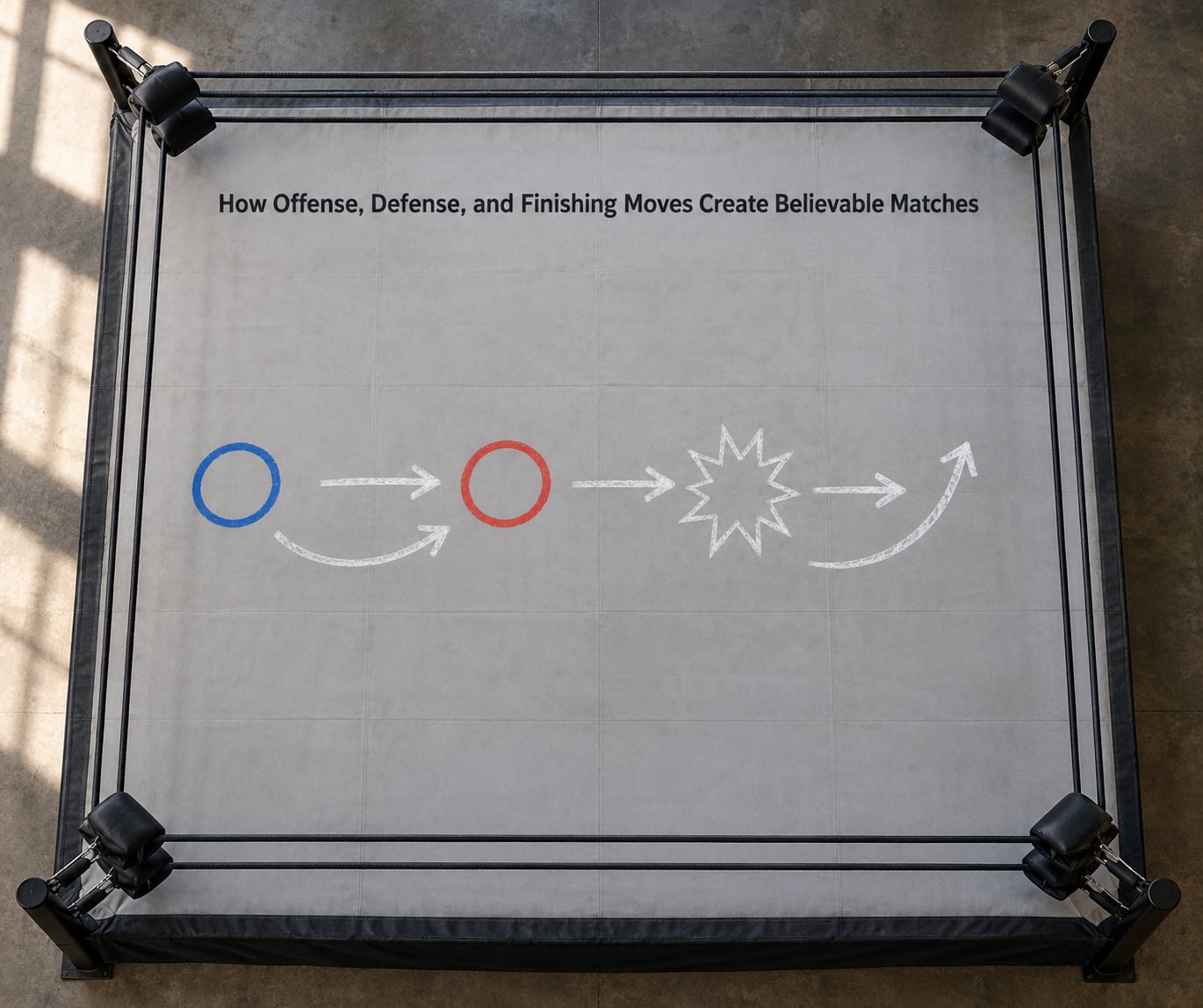
Selling has to run in both directions, and the two directions have different jobs. The offense sells the threat. The defense sells the cost.
When a wrestler attacks a limb, they are also selling their opponent’s future. Working an arm for ten minutes does nothing on its own, but it makes a submission hold later mean something concrete. The audience has watched the damage accumulate, so when the hold goes on they understand it before anyone tells them.
This is why working the wrong body part is one of the most common failures. Selling an arm when the finish is a leg-based move creates an expectation the match never collects. The crowd stops feeling the damage as relevant and starts watching it as repetition.
Counters are the same idea inverted. A reversal only feels earned when the previous selling told you the reversal was possible. A wrestler who has spent eight minutes limping cannot suddenly spring up to block a high-risk move without the audience reading it as convenient. Build the possibility first, cash it second.
Finishers carry the biggest obligation of all. A finisher should arrive after enough selling that it feels like the answer to something, not just a move with a big sound. The reaction to it should also be different from every other reaction in the match. If the knee strike hurt like every other knee strike, the finish lands as one more entry in a list.
How Does Selling Change in Heels, Face Matches, and Different Eras?
The mechanics stay the same, but the character changes what the selling is for.
A heel sells credibility. The audience has to believe this person is genuinely dangerous, which usually means the heel minimizes or conceals damage. Wiping their face, walking through a strike, laughing through a hold, all of it says the punishment is landing somewhere the villain does not admit. A heel who shows the same agony as everyone else reads as a face with a bad attitude.
A face sells persistence. The crowd wants to believe the effort is real even when the results are not going well. That means the selling leans into defiance and endurance rather than helplessness. A face who screams and gives up early has told the crowd the comeback will not be coming.
A technician uses selling differently. Precision sells for this style, so the emphasis sits on small, specific details: the exact spot that was targeted, the limb that now refuses to cooperate, the hesitation before a submission that usually comes clean.
Era changes the volume. Territory wrestling in small gyms leaned hard on visible damage because the crowd sat close enough to see a face. Television made camera angles and wide shots part of the problem, which pushed performers toward larger, more legible reactions. The modern style, built for short attention spans and highlight clips, often favors sharper and faster reactions that read instantly on a phone screen.
What Makes Selling Feel Bad?
Most bad selling is not bad intent. It is the same instinct applied too many times.
Repetition that becomes wallpaper
When one reaction is used for every move, it stops being information. A wrestler who gasps on contact every time has trained the crowd to ignore gasping. Vary the size and the type of the reaction, and save the loud version for two or three moments in the whole match.
Over-selling a minor move
Spending a big reaction on a headlock arm wrench means there is nothing left for the arm drop. Think of it as a budget and keep a reserve.
Reactions with no purpose
A reaction should either protect a body part, set up a later payoff, or shift the crowd’s expectation. A hit that is not connected to the arm you worked earlier is just noise. Ask what the reaction is doing before asking how big it should be.
Missed timing
Selling that arrives after the crowd has moved on feels like commentary. The reaction belongs in the same second as contact, and the pause that follows has to be long enough to land but short enough to keep the match moving.
Inconsistent stamina
If a wrestler was near death two minutes ago and is now running the ring, the accumulated damage stops being real. Fatigue has to accumulate in a way that is visible, or it should not be shown at all.
Selling a major moment so hard the match stalls
There is a version where the reaction goes on so long that the match stops. A referee count that stretches past the point of interest, a hold where the crowd has already made up its mind, a finisher followed by thirty seconds of writhing. Impact needs a fast version and a slow version, and the match usually needs the fast one.
Selling when something is actually wrong
For the audience, a real injury and a sell look different. A sell tends to be controlled, dramatic, and immediately followed by movement that makes sense. A real injury is usually messy and confusing, with the person who is hurt not knowing what to do next. If you are watching and cannot tell, that is what it is, and nobody in that building wants to guess.
Frequently Asked Questions
Is pro wrestling selling just acting?
Selling is performance work, but it is not acting in the dramatic sense. An actor plays a role and the audience forgets the performer exists. A wrestler plays a role and the audience cares specifically about that performer, because the same body carries damage from match to match. That continuity is what makes a reaction feel like history rather than a line reading.
Should wrestlers exaggerate every move?
No, and the exaggeration is not really about size. It is about readability. A real flinch is small and fast, so on a phone screen it disappears entirely, and the move reads as light. Trained wrestlers scale the response so the audience can register it in the time available. What gets punished is the same loud reaction used on everything, not a large reaction on an important moment.
Why can silence be effective selling?
Silence signals control, and control is what makes a character feel dangerous. A wrestler who takes a strike without reacting is telling the crowd the punishment is landing somewhere they cannot see. Silence also preserves the volume budget. When a wrestler has been quiet and controlled for several minutes, the one moment they finally break reads as much bigger than it would have otherwise.
How can viewers learn to recognize good selling?
Watch the sequence rather than the move. Ask what damage the wrestler is showing, whether the later finish actually collects it, and whether the reaction arrived at the moment of contact. Pick one wrestler and watch how they sell the same move against different opponents and in different matches. Single-move consistency is the clearest skill fans can judge on their own.
Can bad crowd reactions hurt a wrestling match?
They can. A crowd that rejects the story being sold them stops covering the intended reactions, and the performers then have to sell into silence. Some crowd work is designed for this, turning a hostile audience into part of the story. Constant unsolicited pops for an unmotivated heel, or silence through the big moments of a match, removes the information the wrestlers are relying on.
Conclusion
Selling runs on a simple loop: establish something believable, show a reaction the crowd can read, leave room for the crowd to interpret it, then collect the damage later. Every technique in this guide is a variation on making one of those four beats land harder.
So stop watching matches move by move. Pick your favorite one, find the first exchange, and follow the damage all the way to the finish. Once you can see where the payoff was set up, hearing the crowd change will make a lot more sense.