A wrestling show recap is a segment-by-segment written record of an episode: what happened, in what order, how the room reacted, and what you make of it. The good ones post within minutes of the final bell, score every match on a scale you have defined, and read like a person wrote them rather than a highlight reel.
That is the whole job. Learning how to recap a wrestling show for a blog is mostly about structure, not talent. Get the template right and the writing takes care of itself. This guide covers the full routine, from the pre-show prep through publishing, and it works the same whether you cover WWE Raw, AEW Dynamite, an independent promotion, or an old tape you’ve never seen before.
Budget roughly two to three hours for a full weekly show, most of it spent on the first twenty minutes while the notes are fresh. A tighter fifteen-minute turnaround is doable once you have written the show several times in a row with the same skeleton.
Table of Contents
- What You Need
- Step-by-Step
- Watch the show and capture the essential details
- Verify names, results, and championship changes
- Build an outline in match-card order
- Write the match summaries
- Connect the matches to the bigger storylines
- Add analysis, context, and a clear opinion
- Edit for accuracy, clarity, and search intent
- Common Mistakes
- Frequently Asked Questions
- How long should a weekly wrestling recap be?
- Should a wrestling recap include spoilers?
- What is the difference between a recap and a review?
- What is a good star rating system for wrestling matches?
- How fast should I post a recap?
- Is it okay to use AI to help write a wrestling recap?
- Conclusion
What You Need
The gear is ordinary. The prep is what separates a usable recap from a transcript nobody finishes.
- A way to watch. The broadcast, a legal streaming option, or a seat in the arena if you are covering indies live.
- A notes app plus a keyboard. Phone notes during the show, a laptop to expand them after. Typing on the phone during a match is where drafts go to die.
- A card template. A blank document with the show name, date, and a heading per match already in it. Build this once and reuse it every week.
- A rating scale written down. Pick one scale, define each level in a sentence, and never argue with yourself about it mid-show.
- A storyline crib sheet. One page of the feuds currently running, who is a face, who is a heel, and where each arc is supposed to go next.
- A results source to check against. The promotion’s own results page, so you can confirm finishes and title changes before you publish.
- An editing pass. Nothing goes up on the first draft. Wrestling readers catch a wrong finisher name faster than they catch a wrong sentence.
One more thing worth having: a running document of your own past verdict lines. Watching your own ratings drift over six months tells you more about your writing than any rubric will.
Step-by-Step
Watch the show and capture the essential details
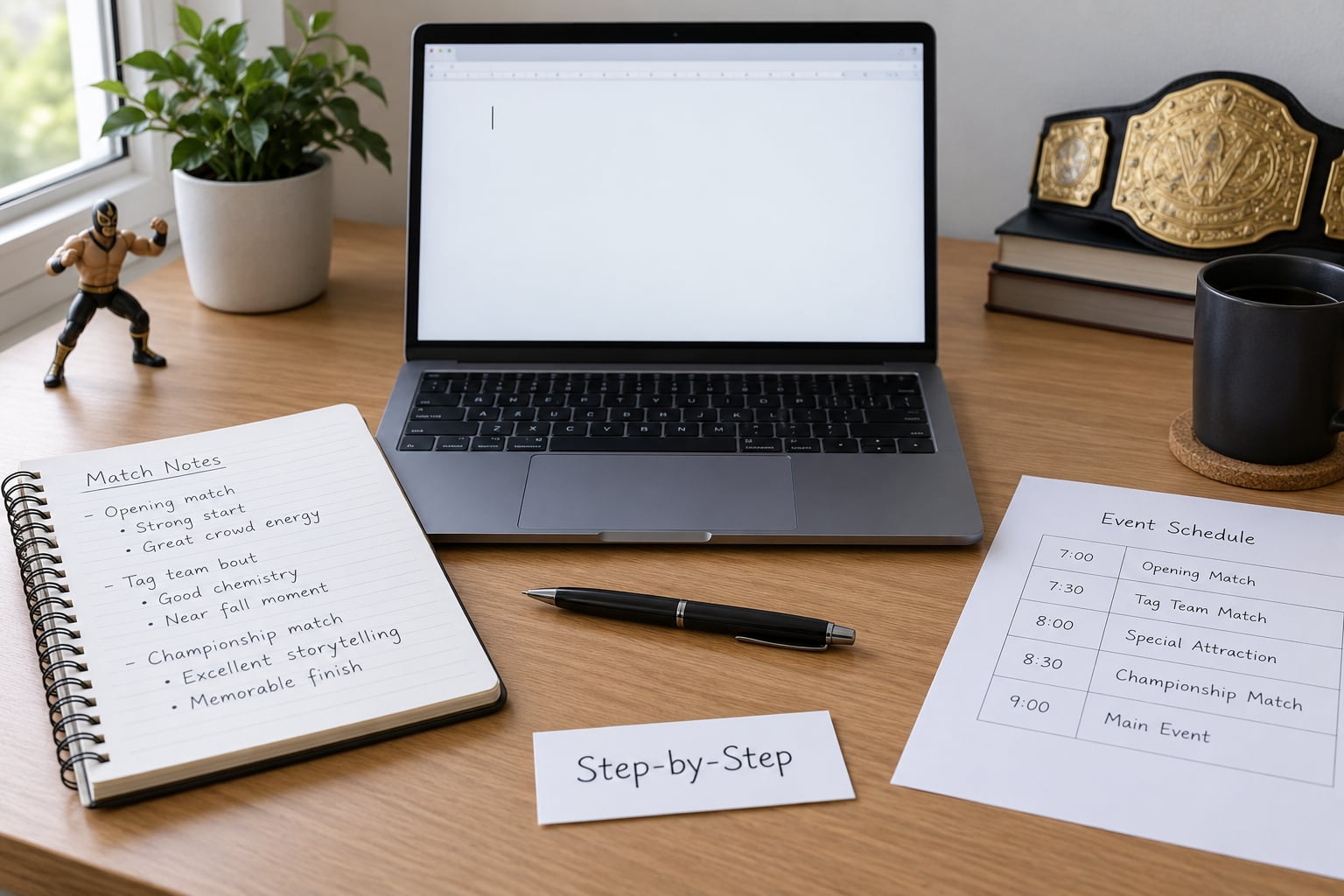
Take notes in card order as the show runs, and write down only the details you would be annoyed to lose. That means the announced names, the stipulation, the winner, the finish, and any storyline beat that happened between matches.
Miss the botched spot or the promo that fell flat and readers will hear about it for years, so those go in too. Ignore the middle of a twelve-minute match that nobody will remember. A useful shorthand line looks like this:
3:40 Cody vs. Penta singles, TV title, Penta wins clean with the crossface. Cody popped off after the bell and stared at the belt. Crowd popped big.
Capture atmosphere as you go, especially if you were in the building. Fightful’s guide to writing about wrestling makes the point that live crowds change the writing: the chants, the walkouts, the silence after a big spot are material no one else has.
Verify names, results, and championship changes
Confirm every name, team, and result against a reliable record before you draft. Wrestling readers spot errors instantly, and one wrong championship change costs you more credibility than a whole good recap earns.
Check the spellings of tag team members rather than the team name, since both members usually need crediting. If a title changed hands, note who carried it out and who carried it in. Where you are unsure, write around the uncertainty instead of guessing.
Build an outline in match-card order
Write the post in the order the audience experienced it. Match-card order is the only outline that never surprises the reader, and keeping segments in place is what makes a wrestling recap format feel professional instead of like a list of notes.
Five sections cover almost every show: the opening, the undercard matches, the angles and promos between them, the main event, and the closing beat. For a three-hour weekly show with eight matches, two to four sentences per match plus a verdict is plenty.
If you want a fixed skeleton, this one works. Copy it into a blank document and fill it in every week.
Show name, date, promotion. Where you watched it (broadcast, arena, delay).
Opening: one paragraph on the first five minutes and the crowd.
Match 1 — A vs. B (stipulation). Two to four sentences. Finish. Rating.
Angle: what was said backstage, who it involves, what it sets up.
Repeat for each match and angle in card order.
Main event — C vs. D. Same shape, more room for the finish.
Closing: the final segment and the hook for next week.
Overall grade: one line, naming the best match, the worst beat, and the story that moved.
Write the match summaries
Lead with the finish, then give the two or three spots that decided the match, then note why they mattered. That ordering keeps readers who only care about the result happy without abandoning anyone else.
Compress the action. Pro wrestling has its own shorthand, and using it is the difference between a recap and a wall of text.
- For two — shoulders both touch the mat, near fall.
- Makes the ropes — thrown into the corner to break a hold.
- Kickout at 2.9 — saved at the last instant.
- Hot tag — a legal wrestler enters illegally and takes over.
- Callback — a move or line from an earlier moment, usually a botched one.
Here is the same moment written two ways. Long version: “The first challenger nearly won when the champion’s move was reversed at the last second, and she kicked out just before the referee counted three.” Tight version: “Reverse hold for a near fall, she kicks out at 2.9.”
The short version is the one to publish. It assumes the reader watched, or will watch, and it leaves room for you to say something about the match instead of narrating it.
Connect the matches to the bigger storylines
Match results stop mattering the moment you stop explaining what they change. After each match, one sentence on where the arc goes next turns a list into coverage.
The test is simple: could a reader who missed the show understand what the wrestler is trying to accomplish? If a heel botched a promo and then cheated to win, the connection is right there. If two wrestlers traded holds for eight minutes with no stated grievance, say that plainly rather than inventing a motive.
Covering indies raises the bar here. When you did not watch the build, the reputable move is to say what you know and mark the rest: “This is the first time these two have been on a show together, and the crowd treated it as a throwaway bout.” Readers forgive a gap. They do not forgive a fabricated backstory.
Add analysis, context, and a clear opinion
Separate what happened from what you think. State the result in the past tense, then give your take in your own sentence, clearly marked as your read.
Score every match on a scale you published in advance. A simple ten-point version works:
| Score | What it means | When to award it |
|---|---|---|
| 7 or above | A match with a real story, a clear structure, and at least two moments people will talk about | Both wrestlers had a reason to be there and the finish earned the time |
| 5 to 6 | Competent, watchable, nothing special | Worked, had a finish, no real story attached |
| 3 to 4 | Forgettable, though the time was used | A squash or a rushed bout that served a bigger segment |
| Below 3 | Hard to sit through | Botched, pointless, or filler inserted for a commercial break |
Give the show a single overall grade too, using the same scale. Consistency is what makes the numbers mean something: readers on forums like ProWrestlingOnly talk about grading systems precisely because a 7 has to be a 7 every week.
Finish with a verdict that names specifics. “It was fine” tells a reader nothing. “The undercard ran long and the tag title changed hands for the second time this month without a payoff” gives them something to argue with, which is where a comment section comes from.
Edit for accuracy, clarity, and search intent
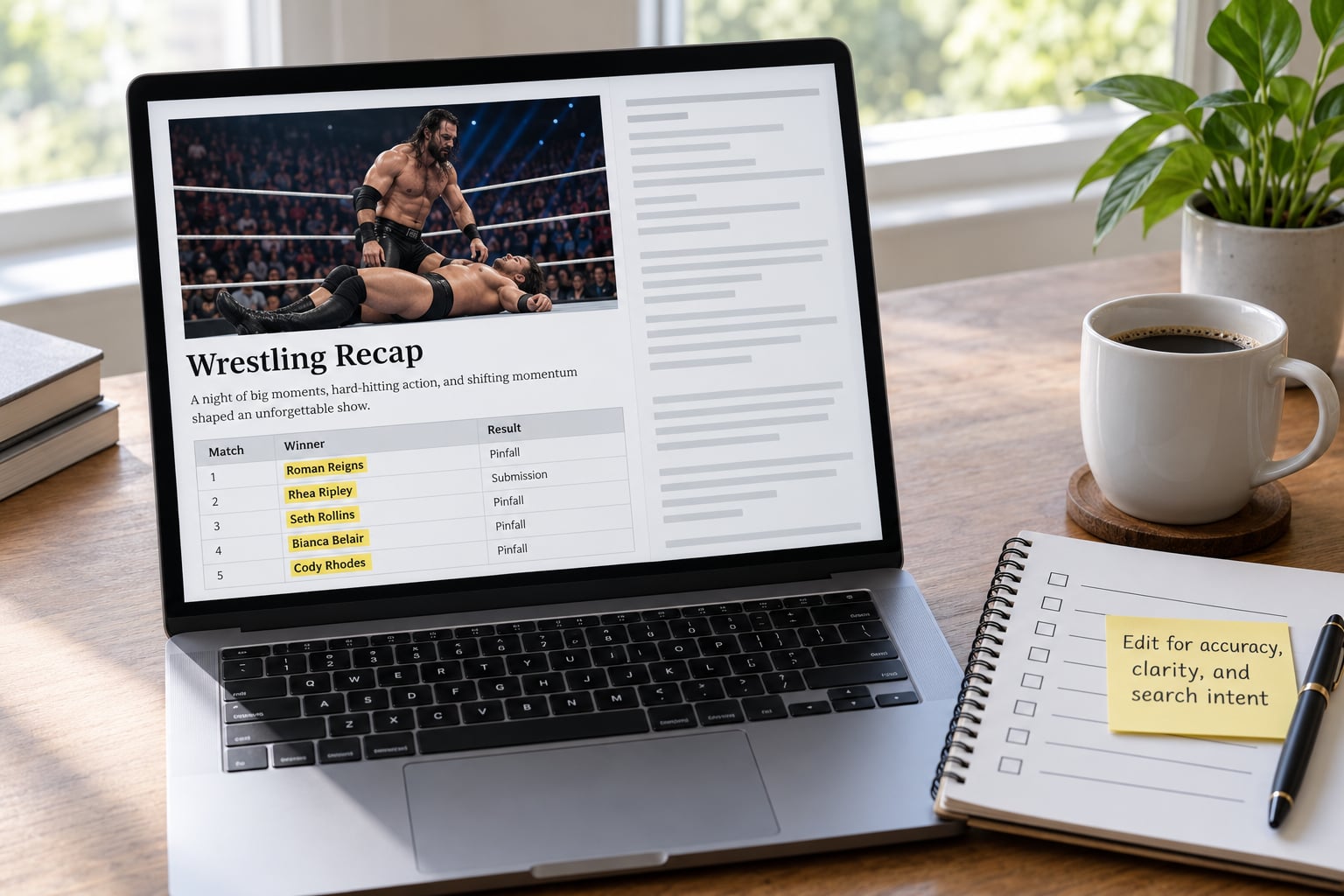
Read the draft once for facts and once for readability, separately. The fact pass covers names, finishes, title status, and dates. The readability pass covers paragraph length, whether any section runs past six sentences, and whether the opening states the show and the date within the first line.
Label spoilers clearly on anything covering a pay-per-view, then decide what the first sentence is. A reader who opens a post called “WrestleMania results” has consented to spoilers; a reader who opened your weekly column has not. Where you are unsure, put the spoiler note in the first line rather than the footer nobody reaches.
On the on-page side, keep the same headline formula every week so your archive stays searchable: show name, promotion, and date. Link out to your own wrestler profile pages rather than to social posts, and update the post once if a title change is corrected after you publish.
Finally, use the phrase your readers type. Somewhere natural, in a sentence, write how to recap a wrestling show for a blog and let it read like advice you would give a friend. It is the clearest description of the article you are reading right now.
Common Mistakes
Almost every bad wrestling recap I have read fails in one of the same six ways. All of them are fixable in a single editing pass.
| Mistake | Why it hurts | Quick fix |
|---|---|---|
| Copying an official results write-up | Reads like filler, and readers know the difference instantly | Use results pages only to check facts, then write the match in your own words |
| Transcribing every move | A wall of text nobody finishes | Keep the finish and the two or three spots that mattered |
| Getting names or team members wrong | Breaks trust with the most engaged readers | Check spellings and full team lineups before publishing |
| Ratings by vibe | Numbers you cannot explain read as noise | Publish the scale with its definitions and grade against it |
| Opinion blended into the results | Readers cannot tell what happened from what you feel | One sentence of result, then a clearly separate sentence of take |
| Unlabelled spoilers on specials | Drives casual readers off the post | Put a spoiler note in the opening line, not at the bottom |
Two smaller habits help more than expected. Write the opening sentence last, when you know what the show actually was. And keep your section headings identical week to week; readers navigate a recap by scanning for the match name, not by reading linearly.
One more, aimed at the fifteen-minute live report: draft the headings and your opening line before the show starts. Filling gaps is fast. Building a document from nothing at 11:55 p.m. is not.
Frequently Asked Questions
How long should a weekly wrestling recap be?
Around 800 to 1,200 words covers a standard weekly show with five or six matches. Give two to four sentences per match, a short paragraph for each promo or backstage segment, and a closing verdict. A pay-per-view can run 1,500 to 2,000 words because the stakes and the post-event reaction justify the length. Length is not the measure, though: a well-organised 900-word recap beats a 2,000-word wall every time.
Should a wrestling recap include spoilers?
Label them, and put the label in the first line rather than at the bottom of the post. A results post for a pay-per-view can name winners openly, because the reader arrived expecting them, but a weekly column often gets read by people who plan to watch on delay. A single line saying the post contains results keeps the casual reader and loses nobody who wanted the spoilers.
What is the difference between a recap and a review?
A recap reports what happened, in order, with a rating attached. A review judges the show as a piece of television, which means it can spend its opening on pacing, the announce team, and whether the show held your attention, without walking through every match. Instant analysis sits in between: it is a short opinion piece written within about fifteen minutes of the bell, focused on the one or two moments that mattered.
What is a good star rating system for wrestling matches?
A ten-point scale works well because it gives you enough room to be precise. Define each band in one sentence and publish those definitions on your site, then grade every match against them. Keep the scale stable for at least a year, or your numbers stop being comparable and readers stop trusting them.
How fast should I post a recap?
Within an hour is good, and within fifteen minutes is genuinely achievable once you have a template. The speed comes from structure, not from typing faster: capture the card order in notes as the show runs, expand each note into two or four sentences, then add ratings and the verdict. Sites that commission weekly recaps typically expect the post within about fifteen minutes of the show ending, and beginner writers who miss that deadline usually lose work for missing the format, not the speed.
Is it okay to use AI to help write a wrestling recap?
Use it for research and never for fabrication. Checking a name spelling or summarising a promo you recorded is fine. Inventing quotes, inventing results you did not verify, or pasting generated match-by-match text into your post is not, because the reader will spot the errors and the trust damage is permanent. Publish only what you watched and confirmed yourself.
Conclusion
Start with the boring part, because it does most of the work. Record the card while the show runs, verify the names and results before you write a word, then fill a fixed outline section by section. Ratings come from a scale you published in advance, the opinion goes in its own clearly marked sentence, and the verdict names something concrete.
Write the first three shows with the template above. By the fourth, you will have your own rhythm inside it, and that is when the post starts sounding like you rather than like a format.