Wrestling insurance for an independent show is an event liability policy a promoter buys before the doors open, usually as a single-show or short-term policy, that pays medical bills and defends third-party injury or property claims arising from the event up to a stated limit. The mechanism is short: disclose the event, list the wrestlers, hand every performer a signed waiver, confirm what the venue demands, then report any incident and file with the insurer’s claims department.
The rest of this guide is the detail underneath that paragraph — what each part of the policy actually pays for, what it throws out, and what happens in the two weeks after somebody gets hurt. Rules and rates differ by state and change from year to year, so treat everything here as a working understanding rather than legal or financial advice.
Last reviewed October 2026
Table of Contents
- What Is Wrestling Insurance for Independent Shows?
- What Does an Independent Wrestling Insurance Policy Cover?
- How Wrestling Insurance Works for Independent Shows
- How wrestling insurance works for independent shows, step by step
- Per-event policy or annual program policy?
- The certificate of insurance and the additional insured handshake
- What Injuries or Incidents May Not Be Covered?
- How Do Promoters File a Wrestling Insurance Claim?
- What Should an Independent Wrestling Promotion Do Before the Show?
- Frequently Asked Questions
- How much does event insurance typically cost for an independent wrestling show?
- Do independent wrestling promotions need event insurance?
- Who pays when a wrestler is injured at an independent show?
- Does event insurance replace workers’ compensation?
- Does the venue’s insurance cover my wrestling show?
- Is event insurance worth it for a small wrestling show?
- Conclusion
What Is Wrestling Insurance for Independent Shows?
An independent promotion’s policy is written around one event and one night. It names the promotion as the insured, covers claims made against the promotion or its staff, and pays eligible medical expenses for participants under an accident medical provision. Wrestlers themselves are usually not individually named. The promotion buys it; the roster is covered as a class.
That structure confuses people, because four different kinds of insurance get called “wrestling insurance” in conversation.
- General liability covers a spectator who trips in the aisle, a fan hurt by a thrown chair, or damage to the venue’s floor. It pays third parties, not your own roster.
- Accident medical covers the wrestlers, for a defined list of injuries, up to a fixed benefit limit.
- Workers’ compensation covers employees. Independent wrestlers are usually classified as independent contractors, so a workers’ comp policy generally does not reach them at all.
- Health insurance is what a wrestler carries personally and never touches the show’s policy.
USA Wrestling member coverage, sold through governing bodies and sanctioned tournaments, sits in a different category again. It applies to amateur competition under that body’s rules and does not extend to a professional indie card, a taping, or a nightclub show. Promoters frequently hear from talent that their sanctioning membership “covers it,” and it does not.
What Does an Independent Wrestling Insurance Policy Cover?
Most policies are a bundle rather than a single coverage. The table below is the usual shape of the bundle, and it is worth asking a broker to walk through each row for your specific show.
| Coverage type | What it pays for | Who it names as insured |
|---|---|---|
| General / event liability | Third-party bodily injury and property damage claims from the event | The promotion and named officers or staff |
| Accident medical | Medical expenses for a defined list of injuries sustained by participants | Wrestlers in the declared roster |
| Excess accident / catastrophic rider | Higher-limit medical, ambulance, rehabilitation and loss-of-limb benefits on top of the base accident medical | Same roster, separate benefit schedule |
| Workers’ compensation | Employee injury claims and medical costs | Anyone treated as an employee, not contractors |
| Entity or officers’ liability | Claims against the promotion’s officers or the LLC itself, such as a bad contract or a governance dispute | The company and its officers |
| Equipment and property | Damage to the ring, the trailer or the promo’s own gear | The promoter |
Limits are where most promoters get surprised. A policy carries a per-occurrence limit, which is the most any one claim can recover, and an aggregate limit, which is the most the insurer pays across the whole policy period. Accident medical usually runs far lower than general liability, with a sublimit per person for things like ambulance, fracture care or physical therapy.
A one-million-dollar general liability limit and a twenty-five-thousand-dollar medical sublimit can sit on the same certificate without anyone noticing at the time. They are bought separately, and the second one is the one that pays the wrestler in the ambulance.
Two more pieces are common. Event cancellation or non-appearance cover pays a fixed amount if the show cannot happen for a covered reason, though weather, a no-show wrestler and a pandemic are treated very differently and often excluded outright. And most policies extend only to activities that are in the declared scope, which is why declared weapons, pyro and alcohol matter so much to the price.
How Wrestling Insurance Works for Independent Shows
The purchase process is usually quick. A broker or an online underwriter asks for the date, the venue type, the expected attendance, the number of insured participants, the activities on the card, and whether weapons, pyro, ladders, tables or alcohol are involved. Answering that last question honestly matters more than any other line on the form.
Underwriting is not a formality. The carrier prices the exposure, may attach conditions, and may decline weapons entirely. Underwriters have seen what happens in independent rings, and a promotion that discloses a steel-cage steel step ladder match gets quoted accordingly. One that mentions it after the certificate is issued gets quoted after a claim.
How wrestling insurance works for independent shows, step by step
Number one, quote. Send the same facts to three carriers, because the appetite for independent wrestling varies and one of them will decline. Number two, bind. You receive a declarations page or a certificate naming the promotion, the date, the venue address and the limits. Number three, notify the venue. Send the certificate before load-in, not the night before. Number four, collect. Every participant signs a waiver and a release, and you file those with the policy records. Number five, run the show. Report any incident in writing within the deadline the policy sets, then follow the claim process.
Per-event policy or annual program policy?
Most one-night benefits and school-hall shows sit on a per-event policy. Recurring promotions usually move to an annual program policy once a year of dates is on the books, because the fixed costs stop dominating the price.
| Per-event policy | Annual program policy | |
|---|---|---|
| Best for | One-offs, benefits, tapings, first-time cards | Weekly or monthly shows with dates already booked |
| Dates covered | The single declared date | Every listed date inside the period |
| Adding a wrestler | Notify before the event | Update the roster mid-season |
| Adding a date | Buy a new policy | Endorsement, sometimes for a fee |
| Paperwork | One certificate per show | One certificate covering the season |
The certificate of insurance and the additional insured handshake
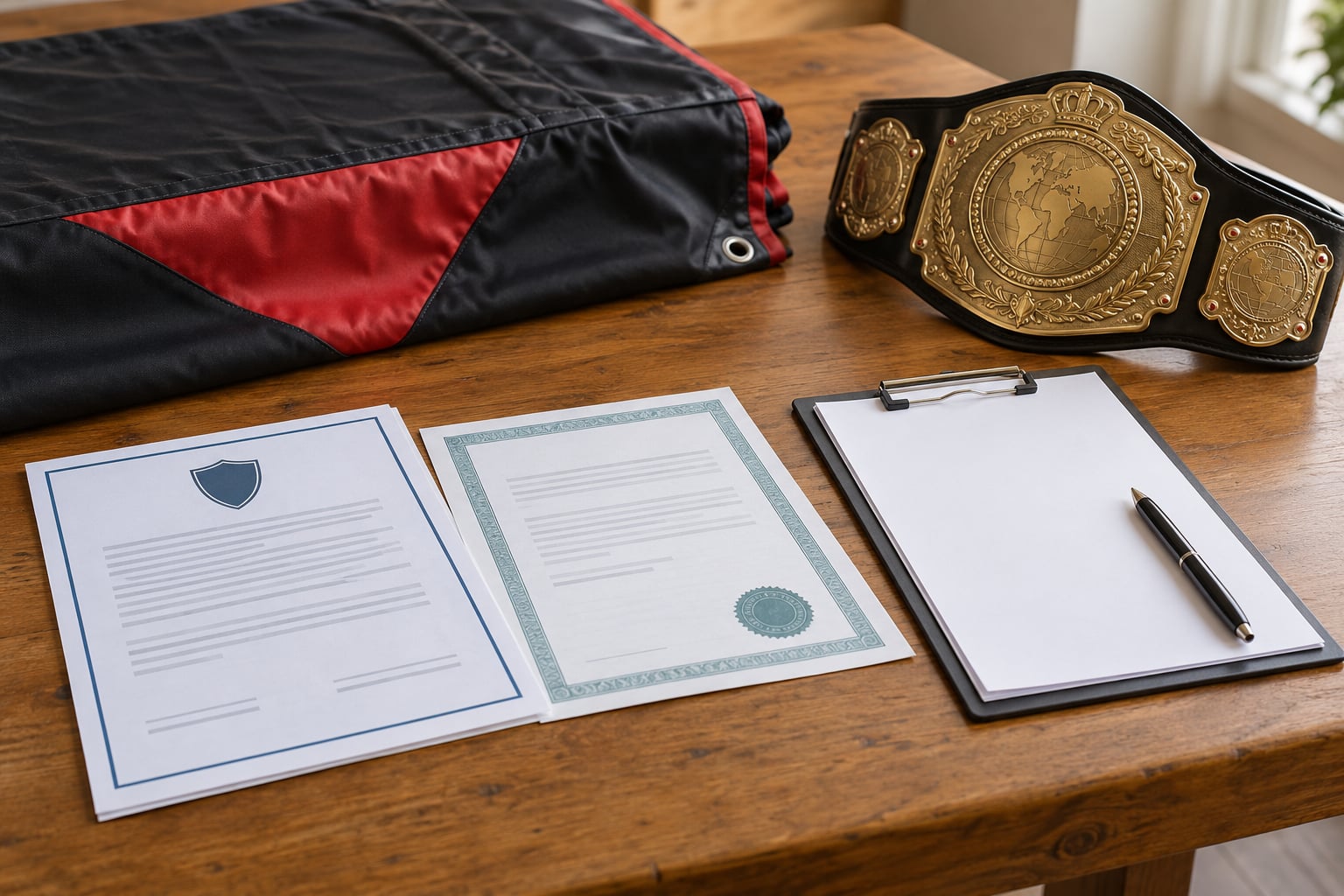
A certificate is a document, not a policy. It tells the venue what your promotion carries. What the venue actually wants is to be named as an additional insured on your policy, which extends the venue’s own liability coverage for your event. That status comes from an endorsement on the policy, not from anything printed on the certificate.
So read the certificate for three things: the limits, the named insured, and whether the additional-insured status is shown. If it is not, the venue can refuse the booking or ask for a limits bump, which costs more premium than the endorsement usually does.
Travel is where indie policies quietly stop. A standard event policy generally covers the event at the declared address on the declared date. Load a show in a neighbouring state for a tour and you are outside the policy period and often outside the territory, so you need either a separate authorisation or a travel extension.
What Injuries or Incidents May Not Be Covered?
Exclusions are normal and specific. Typical ones include an injury sustained while performing a stunt that was not declared, an injury during an activity the policy calls prohibited, anything outside the declared date or venue, and incidents that happened after the show ended. Most policies also exclude treatment you did not seek, or did not seek promptly.
Conduct exclusions are broader than promoters expect. Intentional injury, alcohol or drug impairment, criminal acts, and violating the terms of the sanctioning body or the carrier’s own rules can all turn a covered incident into an uncovered one. That last one catches out indies: a show booked under a body’s rules with insurance written on a different basis is a mismatch, and the mismatch surfaces at claim time.
Pre-existing conditions are the other big one. If a wrestler has a documented neck or knee history and reinjures the same area, the insurer will investigate whether the injury was aggravated by the event. Undisclosed prior injury reports are routinely treated as misrepresentation.
Which brings up waivers, because they are constantly mistaken for coverage. A waiver of liability built around assumption of risk and a hold-harmless clause is evidence that the signer accepted known dangers, and it helps a promoter defend a suit. It does not pay a single medical bill, it does not protect a promoter who acted recklessly, and its enforceability varies by state and by how the participant is classified. An unsigned waiver is worse than a good one, because the promoter cannot produce it when the adjuster asks.
How Do Promoters File a Wrestling Insurance Claim?
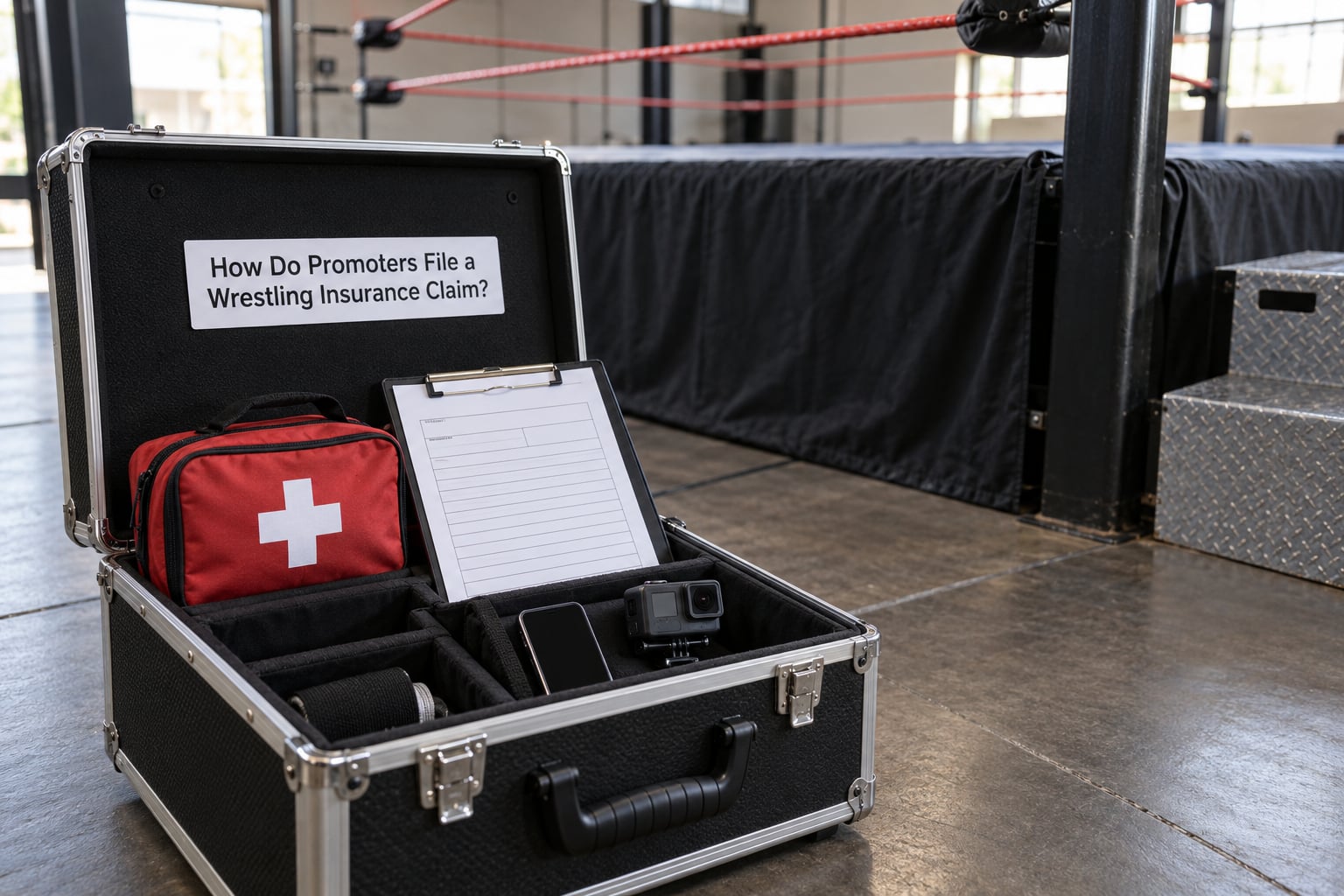
Most complaints in wrestling forums come down to the same gap: people get a claim number and then nothing. Here is the sequence that actually works.
Step 1: Get medical attention and stop the show. The wrestler gets assessed first, everything else waits. On a small card that may mean calling an ambulance instead of finishing the card. This part is not optional under almost any policy.
Step 2: Write it down while it is fresh. Who was involved, what happened, the date, the exact spot on the card, who witnessed it, and whether it was filmed. Photographs of the ring, the equipment and the scene go in the same file. Promoters who wait three days to reconstruct an incident lose the case on details alone.
Step 3: Tell the carrier and the venue. Notify the insurer within the policy’s stated window and tell the venue in writing the same day. Late notice is one of the most common reasons a claim is denied, and it is entirely preventable.
Step 4: Submit the medical documentation. Itemised bills, the treating provider’s notes, and proof of payment go to the adjuster. If the wrestler paid out of pocket, keep every receipt and ask the medical provider to bill with the injury details attached. Self-billing against your own health plan first and claiming the residual expense against the event policy is normal, but only if the policy says that in writing.
Step 5: Cooperate and track the file. Respond to the adjuster, provide the signed waivers, and keep a log of every call and email with dates. Ask for the claim number in writing and note who handled it. An adjuster is not an enemy; an untracked file is.
What happens then varies. A straightforward medical bill is usually paid quickly once documentation is complete. A disputed liability claim can take months, and the promoter needs to keep paying out of pocket in the meantime unless the policy guarantees an advance. If a wrestler is injured at a show with no policy at all, there is no claim process, and the bill simply stays with whoever incurred it.
What Should an Independent Wrestling Promotion Do Before the Show?
The checklist below is the part that pays off. Every item here costs an hour or less if you run a handful of shows a year.
- Verify the policy is real. Match the named insured, the date, the venue address and the limits against what you actually booked.
- Send the certificate early. Confirm the venue received it and check whether the additional-insured status is listed.
- Have a medical plan. Know where the nearest emergency department is, who calls it, and who on your roster holds a phone at every match.
- Collect a signed waiver from everyone. Wrestlers, managers, ring crew, guests and anyone working the door who handles a camera.
- Prepare incident paperwork. A one-page incident report form with date, match, description, witnesses and photos, kept with the medical log.
- Confirm what is declared. Weapons, pyro, ladders, tables, aerial work, appearances by guests. If it is not declared, take it out of the card.
- Brief the roster on concussion protocol. Anyone who takes a head strike or shows signs of impairment comes out and gets seen, and that rule is not negotiable on the night.
- Store everything in one folder. Policy, certificate, waivers, incident reports and medical correspondence together, available within the hour.
One habit worth adding: ask each wrestler, in writing before the booking is confirmed, whether they carry their own accident medical and whether they want to be covered by the show’s policy. It settles the argument before someone is lying on a gym floor.
Frequently Asked Questions
How much does event insurance typically cost for an independent wrestling show?
Figures vary by region and change over time, but small hall shows with no weapons and a short roster usually price in the low hundreds of dollars, while a card with pyro, weapons, hard tables, alcohol service or a large talent count can reach the low thousands. The insured participant count, attendance, activities and the limits you request move the premium more than anything else. Compare three quotes on exclusions, not just price.
Do independent wrestling promotions need event insurance?
If you take money at the door, sell tickets or charge talent, you are running a business and you carry liability exposure whether or not anyone gets hurt. Venues routinely require a certificate of insurance before load-in, and a promotion with no policy faces a catastrophic injury personally. If an approved facility policy already names your promotion for that date, that may be enough, but confirm it in writing first.
Who pays when a wrestler is injured at an independent show?
Usually the wrestler’s own health plan or personal accident policy first, with the event policy as a backstop where the booking agreement says so. Independent wrestlers are contractors rather than employees, so nobody is obliged to pay a bill by default. Talent raise this constantly in wrestling forums, where the same thread repeats: no union, no workers’ comp, no benefits. Carry your own accident medical and keep the receipts.
Does event insurance replace workers’ compensation?
No. Workers’ compensation covers employees, and independent wrestlers are normally classified as independent contractors, so a workers’ comp policy often does not reach a roster at all. Event accident medical is what covers the talent in an indie setting, and it pays a defined list of injuries up to a fixed benefit limit rather than covering ongoing disability. If anyone is genuinely treated as an employee, ask the carrier whether a workers’ comp endorsement is required alongside.
Does the venue’s insurance cover my wrestling show?
Rarely. A facility’s policy insures the facility and sometimes its authorised users. Unless your promotion is named or listed as an additional insured on that policy for the date of your event, its coverage does not follow the ring, the talent or the props onto the floor. Assuming otherwise is the most expensive misunderstanding in the independent scene. Ask for the certificate, check the additional-insured status and limits, and buy your own policy if it is missing.
Is event insurance worth it for a small wrestling show?
For most independent shows, yes, because one ring collapse or one bad ladder spot costs more than a year of premiums. The usual failure is not the injury itself, it is the argument afterwards about whose policy was supposed to respond. A single-show policy takes one phone call and a payment card, and the certificate gets you past the venue’s legal review. An uninsured promotion carries the entire exposure itself.
Conclusion
Start by getting three quotes from the same set of facts, then compare the exclusions and the medical sublimits rather than the premium alone. Disclose the whole card honestly, confirm what the venue requires before you sign the venue contract, and keep the policy, certificate, waivers and every incident report in one folder you can open within the hour.
Most independent shows operate uninsured, and the wrestlers absorb it because the independent-contractor classification puts the cost on the individual. That is the whole problem wrestling insurance solves, and it solves it for a single phone call before your next show.