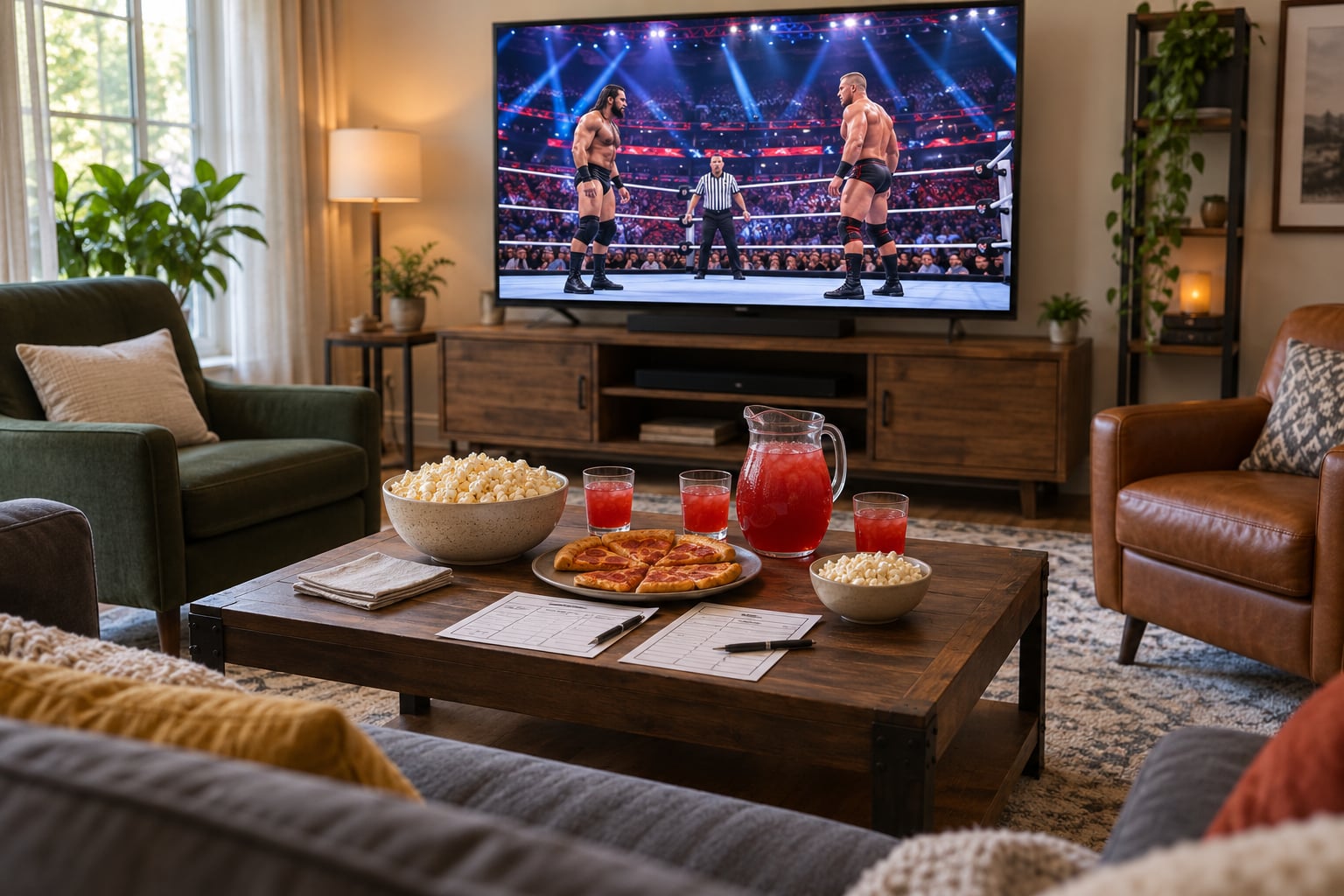
A wrestling watch party is a gathering where a group watches a show together, in a room or online, with food, drinks and activities timed around the card. Running one well comes down to four things: confirm where the show streams, test the setup before anyone arrives, serve food people can eat with one hand, and have something planned for entrances and promos. Budget two hours of prep on the day and the whole night takes care of itself.
Wrestling is a strange show to host for. There are no commercial breaks every few minutes to talk over, a single match can run twenty minutes with a long entrance before it, and half the crowd may have never seen the show before. That combination rewards a host who plans the pace rather than just the playlist.
The plan below follows the same order every time: pick the event, sort the screen, plan the food, add a game, then run the night. Skip a step and something goes wrong at 9:40pm with eight people in your living room.
Table of Contents
- What You Need to Run a Wrestling Watch Party
- Step-by-Step: How to Run a Wrestling Watch Party
- 1. Choose the Match or Event
- 2. Set the Viewing Area and Screen
- 3. Plan Food, Drinks, and Seating
- 4. Add a Prediction Game
- 5. Set the Tone Before the Matches
- 6. Keep the Energy Going
- 7. Close the Party Cleanly
- Common Mistakes at a Wrestling Watch Party
- Frequently Asked Questions
- How do I start a wrestling watch party?
- How do I host a watch party for people who don’t watch wrestling?
- How long does a wrestling show actually run?
- What size screen do I need for a wrestling watch party?
- Can I set up a watch party for friends who are watching remotely?
- What food works best at a wrestling watch party?
What You Need to Run a Wrestling Watch Party
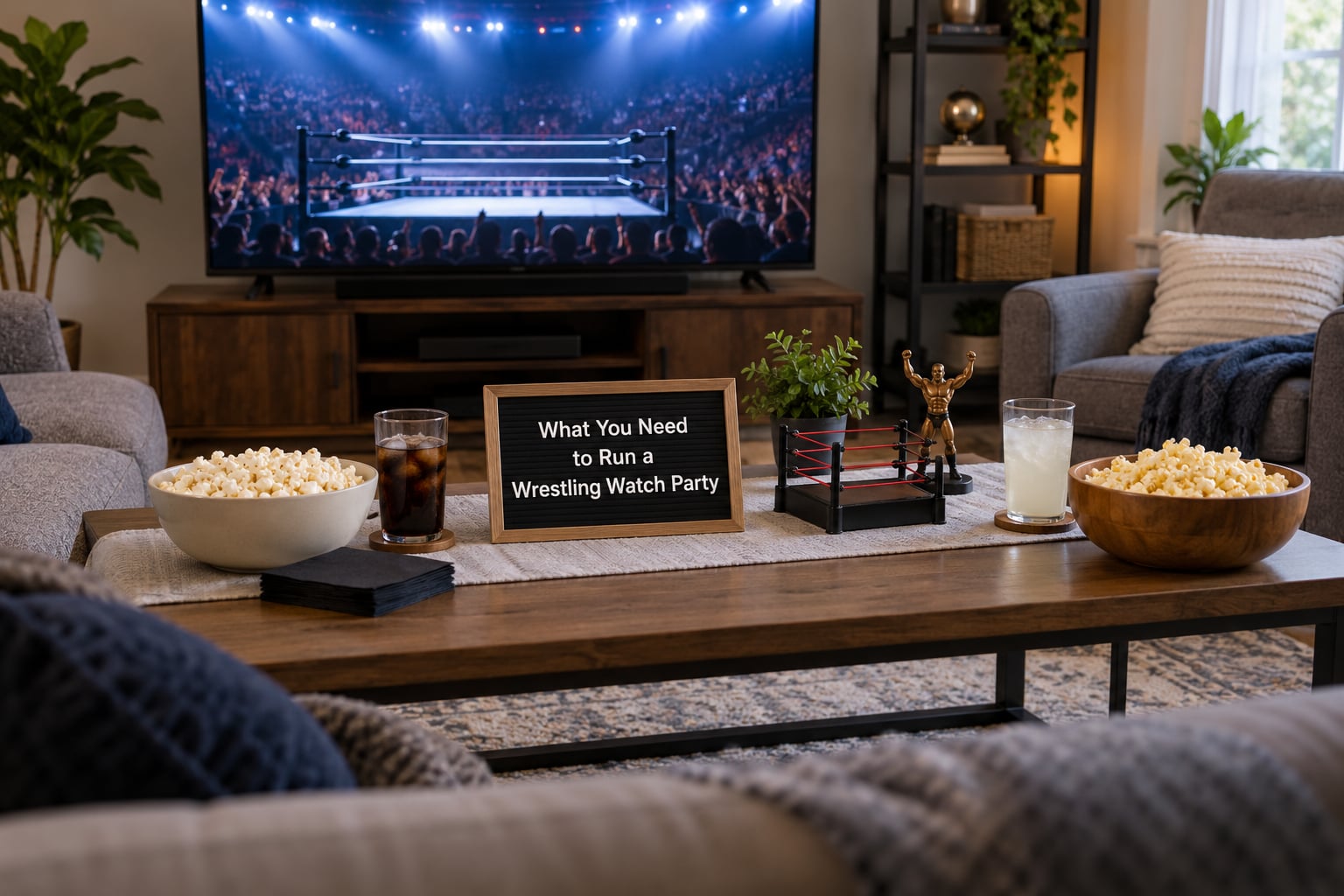
Most of what you need is already in your house. The only item that can sink the night is streaming access, so treat that as a task rather than an assumption.
- Access to the show. Confirm which service carries the event where you live before you invite anyone. WWE weekly shows and premium events sit on different platforms in different countries, and AEW runs on its own platform. If you plan to watch somewhere you don’t normally stream, log in and confirm the event page loads first.
- A screen everyone can see. A 55 inch television handles about six to ten people in a normal living room. Beyond that, sightlines break down and you need a bigger set or a different plan.
- Sound that carries. Television speakers are fine for a small group. Past about twelve people, a soundbar or a basic speaker setup keeps commentary and entrance music audible at the back.
- Seating that does not block the screen. Sofas, floor cushions and folding chairs arranged in a shallow arc beat rows of straight chairs facing forward.
- Finger food and drinks. Everything should be eatable with one hand, because nobody wants to put a wing down during a pinfall.
- A prediction sheet. One printed page per guest, or a group message thread.
- A backup login. A second account that is signed in, and a phone number for support. Streaming failures and paywall login problems are the most common reason a wrestling watch party dies ten minutes in.
Two optional upgrades earn their keep. A cheap projector on a sheet or blank wall turns a small apartment into a screening room, and a phone hotspot covers a dead Wi-Fi connection.
Step-by-Step: How to Run a Wrestling Watch Party
1. Choose the Match or Event
Pick the show your group actually wants to see, then confirm where it streams. A weekly episode of Raw or SmackDown is a very different hosting job from WrestleMania or a Royal Rumble, and mixing them up is the most common planning error.
Weekly shows run roughly an hour and a half to two hours, sometimes three with a long pre-show. Premium events commonly run three hours or more, with entrance music, promos and a pre-show that starts before the advertised start time. Choose your event knowing that number, because it decides when you serve food.
Nobody should be told to arrive at the advertised start time. Send the actual door time, which is usually 45 to 60 minutes earlier for a premium event and 20 to 30 minutes earlier for a weekly show.
Which show changes the tone of the room too. WWE shows are the widest-known thing most people recognise, AEW tends to draw smaller and more vocal rooms, NXT carries a younger crowd that talks over the matches, and independent promotions are usually watched by fans who will explain everything if you let them. Hosting for people who have never watched wrestling is easier on a weekly show than a stacked premium card, because there is more time to explain and less riding on a single result.
How do you know the step worked? Every guest can name the show, the service, and the door time without asking you a single question.
2. Set the Viewing Area and Screen
Your screen needs to be visible from every seat, with nobody craning. Here is a rough map of what works by group size.
| Guests | Screen | Sound | Seating |
|---|---|---|---|
| 6 to 10 | 55 inch television | Television speakers | Sofa plus four folding chairs in an arc |
| 10 to 20 | 65 inch television or short-throw projector on a blank wall | Soundbar or a basic speaker pair | Two seating zones, both angled toward the screen |
| 20 to 40 | Projector on a sheet or garage door, or a big screen in the main room | Speaker pair plus one outside the room | Folding chairs in rows, aisle in the middle |
| 40 and up | Rental outdoor screen or a bar private room | Room system plus a second conversation room | Split across two rooms with one on a delay-free feed |
Test the whole chain before the party, not the night of. Log into the streaming service, open the event, play ten minutes, and check the sound from the furthest seat in the room. Then run the failure drill: if the stream dies, what do you do? Know your answer, because somebody will hit it.
Cut the overhead lights and close the blinds before anyone arrives rather than during the opening entrance. A bright room makes a 55 inch screen feel small and kills the entrance music, which is half the atmosphere of a wrestling show.
Keep a second device signed in and ready with the same show loaded. If the main screen fails, you have something to switch to in seconds instead of a room full of people refreshing apps.
How do you know the step worked? Everyone can see the screen from wherever they are sitting, and you have watched it run from the worst seat in the room.
3. Plan Food, Drinks, and Seating
Everything on the menu should be one-handed. That single rule removes most of the friction in a wrestling watch party, because the show does not pause when someone drops a drumstick.
- Pizza slices, because nobody argues about pizza
- Chicken wings or sliders, eaten standing up
- Veggie trays, dips and a bowl of chips
- Popcorn in a big communal bowl, scooped into small paper cups if your crowd is messy
- Something sweet for the last hour, when people start drifting
Skip anything that needs a knife and plate, and skip anything that drips. The single most common food mistake is a beautiful dish that requires attention for six minutes.
Time the food around the card rather than the clock. Entrances and promos are the natural gaps. Put the main tray out just before the pre-show, refresh the sides between the first two matches, and bring out dessert during the long entrance before the main event. Hosts who serve everything at once run out of everything by the halfway point.
For drinks, make one signature drink and a pitcher of water or something non-alcoholic. A named drink gets talked about more than anything else you make. Keep it simple: a citrus punch with a name from the event, plus a mocktail version so nobody is left out.
On seating, watch one detail people miss constantly. A hard right angle at the side of the screen means half the picture is off-axis and that guest will spend three hours twisted around. Push chairs back rather than out to the sides, and put anyone who talks a lot near the back so they have space.
How do you know the step worked? Nobody needs to leave the room during a match to reach the food, and no guest is sitting with their back to the screen.
4. Add a Prediction Game
Wrestling gives you a perfect structure for a prediction pool because you can score things that happen between matches too. Print one sheet per guest, or run it in a group chat so remote friends can play along.
A simple sheet asks for the winner of each match on the card, the winner of the match of the night, and one bonus question such as which entrance theme plays first. Score winners with one point, the match of the night with two, and the bonus with three. Bonus questions keep the game alive during entrances and promos, which is exactly where a room of new fans starts drifting.
If your group prefers something louder, a fantasy booking draft works well: everyone writes down the card they would book if they ran the show that week, and you compare. It generates real argument, and argument is the point.
Keep the scoring visible. A sheet pinned to a wall or a running scoreboard in the chat does more for the energy than any game with complicated rules.
How do you know the step worked? Newcomers are arguing about a bonus question before the third match.
5. Set the Tone Before the Matches
The first ten minutes decide whether the room stays warm for the rest of the night. When guests arrive, give them three things: what is on, how the game works, and where the drinks are.
For guests who have never watched wrestling, explain the shape of a show rather than the history of it. Most wrestling cards follow the same pattern: an opening match to start the crowd, a talk segment or two to advance a storyline, matches that build toward bigger names, and a main event. Once people know that shape, the rest is easy to follow.
A few words of lingo go a long way. A heel is the villain the crowd boos, a babyface is the hero, a finisher is a wrestler’s signature move, no disqualification means there are no rules, and kayfabe is the whole pretend that what you see on screen is really happening. Twenty seconds on those five and a newcomer is no longer lost.
Then stop talking. Over-explaining is the single biggest way a host loses a room of new fans, because the explanation competes with the thing they actually came to see.
How do you know the step worked? Guests are introducing themselves to the card, not to each other, before the first bell.
6. Keep the Energy Going
Wrestling has more dead air than most shows you host for. Knowing where those gaps fall is what separates a room that stays awake from one that checks its phone.
Every match is followed by entrances, promos and replays, and that is where you run activities. Prediction results go up between matches. Trivia questions about wrestlers you know your fans follow well. A countdown to the match of the night. For long entrances, talk, tell stories, or start the next round of food.
Commercial breaks matter too. Big events break for commercials and the room will talk. Have something ready that does not depend on watching, and let the conversation run rather than talking over it.
If someone dominates the room, give them a job. Handing your loudest guest a stack of wings or the prediction scoring sheet is a polite way to make them useful.
For remote guests, keep them in the same loop. Send the predictions before the show, let them post reactions in the chat during entrances, and include them when you announce scores. A friend on another continent who knows the result before the bell rings feels present in a way a video call never does.
How do you know the step worked? The room is still talking when the stream goes to commercial.
7. Close the Party Cleanly
End the night on a high note. Announce the winner of your prediction pool, give out any prize you put on the sheet, and let the room react to the finish before anyone starts cleaning up. People remember the last five minutes, and a wrestling show usually ends with the best five minutes of the night.
Then close out. Tell guests when you will send the result or the replay if they missed the finish, and put on the best match of the night for anyone still standing around. Cleaning goes faster with a highlight playing than with a pile of cups.
For a weekly show, end the night by picking the next one. A regular watch party for Raw, SmackDown or Dynamite is far easier than starting from scratch every month, and a standing date turns casual guests into actual fans.
How do you know the step worked? Nobody leaves during the finish, and someone asks when the next one is.
Common Mistakes at a Wrestling Watch Party
Most ruined watch parties fail for the same handful of reasons, and every one has a simple fix.
Not testing the stream until showtime. Login problems, expired cards and app crashes are common and always land in the first ten minutes. Sign in, load the event and play ten minutes of footage the day before. Keep a second signed-in device as a backup.
Inviting people to the wrong time. Premium events start with a pre-show well before the advertised start, and weekly shows run long. Tell guests when the first match begins, not when the event listing says it does, and give yourself a buffer after that.
Explaining too much. Newcomers do not need a history lesson, they need a two-minute shape of the show and permission to react. If a new guest is asking questions during the match, the show is harder to follow than the explanation would have been.
Letting the commentary go quiet. Commentary explains who people are and why the match matters. If the volume is too low, a room of new fans loses the thread entirely. Check the sound from the furthest seat, not from the couch.
Serving food that needs attention. Anything requiring a knife, a plate or two hands turns into a break in watching. One-handed food, served in waves around the card rather than all at once.
Nothing planned between matches. Entrances and promos can run longer than some matches. A prediction pool, a trivia question or a fresh round of food keeps a room awake without any extra cost.
Two smaller habits help too. Clear unused rooms so people spread out instead of blocking the screen, and keep a conversation corner away from the screen for the guests who came for the company rather than the wrestling.
Frequently Asked Questions
How do I start a wrestling watch party?
Start by picking the show, confirming which streaming service carries it where you live, and sending invitations with a firm door time rather than the advertised start time. Then test the stream and sound the day before, plan one-handed food, and print a prediction sheet. Those five tasks cover most of what makes a wrestling watch party work.
How do I host a watch party for people who don’t watch wrestling?
Give newcomers the shape of the show before the first bell: an opening match, talk segments that build a storyline, and a main event at the end. Explain five words only, heel, babyface, finisher, no disqualification and kayfabe. Then stop talking and let them watch. Over-explaining loses new fans faster than anything else a host does.
How long does a wrestling show actually run?
Weekly shows usually run about ninety minutes to two hours, sometimes closer to three with a long pre-show and post-show talk. Premium events commonly run three hours or more, with a pre-show starting before the advertised time. Plan food in waves around the card rather than serving everything at once, and tell guests a door time at least 30 minutes early.
What size screen do I need for a wrestling watch party?
A 55 inch television works for about six to ten people. Ten to twenty guests needs a 65 inch set or a short-throw projector on a blank wall, plus a soundbar. Twenty to forty needs a projector or a big screen and a deliberate seating plan with a clear aisle. Past forty, renting a large screen or booking a private room is the easier option.
Can I set up a watch party for friends who are watching remotely?
Yes, and it works better when remote guests are treated as part of the room. Send predictions in advance, share the scoring sheet, and pick a platform that supports simultaneous playback plus chat. Keep a chat channel open for reactions during entrances and promos, and tell remote guests the door time in their own time zone so nobody joins late.
What food works best at a wrestling watch party?
One-handed food, served in waves. Pizza slices, sliders, wings, veggie trays with dips, and a big bowl of popcorn cover most crowds. Put the main tray out before the pre-show, refresh the sides between early matches, and bring dessert out during the long entrance before the main event. Avoid anything that needs a knife, a plate or two free hands.
If you only do one thing tonight, test the stream. Everything else on this list can be fixed in the room; a login that fails ten minutes in front of ten people cannot. Once that works, pick the door time, put the food out before the pre-show, and let a prediction sheet keep the room talking through the entrances.