Streaming did not shrink wrestling’s audience. It moved that audience out of the cable ratings system and into platforms that report numbers in different units, over different windows, across different parts of the world. That is why two credible-looking figures for the same show can sit side by side and contradict each other, and why understanding how streaming changed wrestling viewership numbers matters more than any single week’s report.
Take the example fans argue about most. WWE Raw’s Netflix debut in January 2025 was reported at 5.9 million global viewers, with roughly 2.6 million of that in the United States. A few weeks later the show was hovering nearer 3 million. Meanwhile the weekly cable shows were being written up as collapsing. Both stories came from real reporting. They were not measuring the same thing.
Below is a plain-language guide to what each platform counts, why the two systems stopped lining up, and which numbers are actually worth watching if you want to know whether wrestling got bigger or smaller than it used to be.
Table of Contents
- What Changed When Wrestling Moved to Streaming?
- How Streaming Changed Wrestling Viewership Numbers by Era
- How Wrestling Viewership Was Measured Before Streaming
- How Streaming Platforms Count an Audience
- Why Cable and Streaming Numbers Are Not Directly Comparable
- What Major Streaming Transitions Revealed About the Audience
- Did Streaming Increase or Decrease Wrestling Viewership?
- How the Business and Broadcast Strategy Changed
- What Numbers Still Indicate a Healthy Wrestling Audience?
- Frequently Asked Questions
- Did streaming actually increase professional wrestling viewership?
- Are Netflix subscribers the same as wrestling viewers?
- Why is WWE streaming viewership harder to compare with cable ratings?
- How did AEW’s television audience compare with traditional wrestling ratings?
- Did moving WWE content to Peacock reduce viewership?
- What is the most reliable way to measure wrestling’s streaming audience?
- Conclusion: Compare Trends, Not Isolated Totals
What Changed When Wrestling Moved to Streaming?
Streaming changed two things at once: where wrestling could be watched, and how anyone was allowed to count the people watching it.
On distribution, the gains were obvious. A service like Netflix reaches households in over 190 countries on the same day, with no cable package to buy and no regional affiliate to find. A pay-per-view used to require a satellite or cable box, a credit card, and often a phone call or a cable provider’s own ordering system. That friction silently excluded people. On-demand catch-up removed it.
On measurement, the change was less visible and arguably bigger. Cable ratings came from a fixed panel of households across the United States, counted live and inside a narrow window. Streaming platforms report their own numbers in whatever format suits the platform, usually globally, usually with a multi-day accumulation window, and rarely with a demographic breakdown at all.
So the honest answer to what changed is this: the way wrestling reaches people widened, while the way wrestling is counted narrowed. Nobody agreed on a single yardstick, so every party in the conversation started using their own.
How Streaming Changed Wrestling Viewership Numbers by Era
Reading the shift chronologically makes the trend easier to see than arguing about any one week.
The syndicated and cable era. Raw, SmackDown and NXT aired on USA Network, Syfy and later USA in prime or highlights-style slots. Audiences were measured by Nielsen, published weekly, and were directly comparable week to week and year to year because the method never changed.
The pay-per-view era. Buy rates were the metric. WWE published numbers after each major event, and the number functioned almost like a share price, quoted by outlets like a stock ticker. Nobody outside the company verified those figures.
The WWE Network era, from February 2014. The promotion moved its own service in-house and stopped relying on a third-party measurement panel entirely. Subscribers became the headline figure instead of viewers. That was the first real break in the data chain, and it is the reason WWE Network-era subscriber counts can never be compared to a cable rating.
The Peacock era, from March 2021. WWE Network content moved into Peacock as part of a business-to-business deal, with the pay-per-view events following in 2022. Wrestling events were promoted as a reason to keep a streaming subscription, which is a very different measurement goal from maximising weekly audience for an advertiser.
The Netflix era, from January 2025. Raw moved to Netflix in the United States with events and library content following, and Netflix began publishing weekly Top 10 figures built on hours viewed and runtime. These are the numbers fans now argue about, and they are the least comparable numbers in wrestling.
The ESPN era, from 2026. Raw’s US television and streaming rights moved to ESPN as part of a long-term deal, with international markets on Netflix under separate arrangements. That split is important, because it means the US and the rest of the world are now measured by two different organisations on the same show.
Notice what the pattern is. Every step forward in distribution produced a step backward in comparability.
How Wrestling Viewership Was Measured Before Streaming
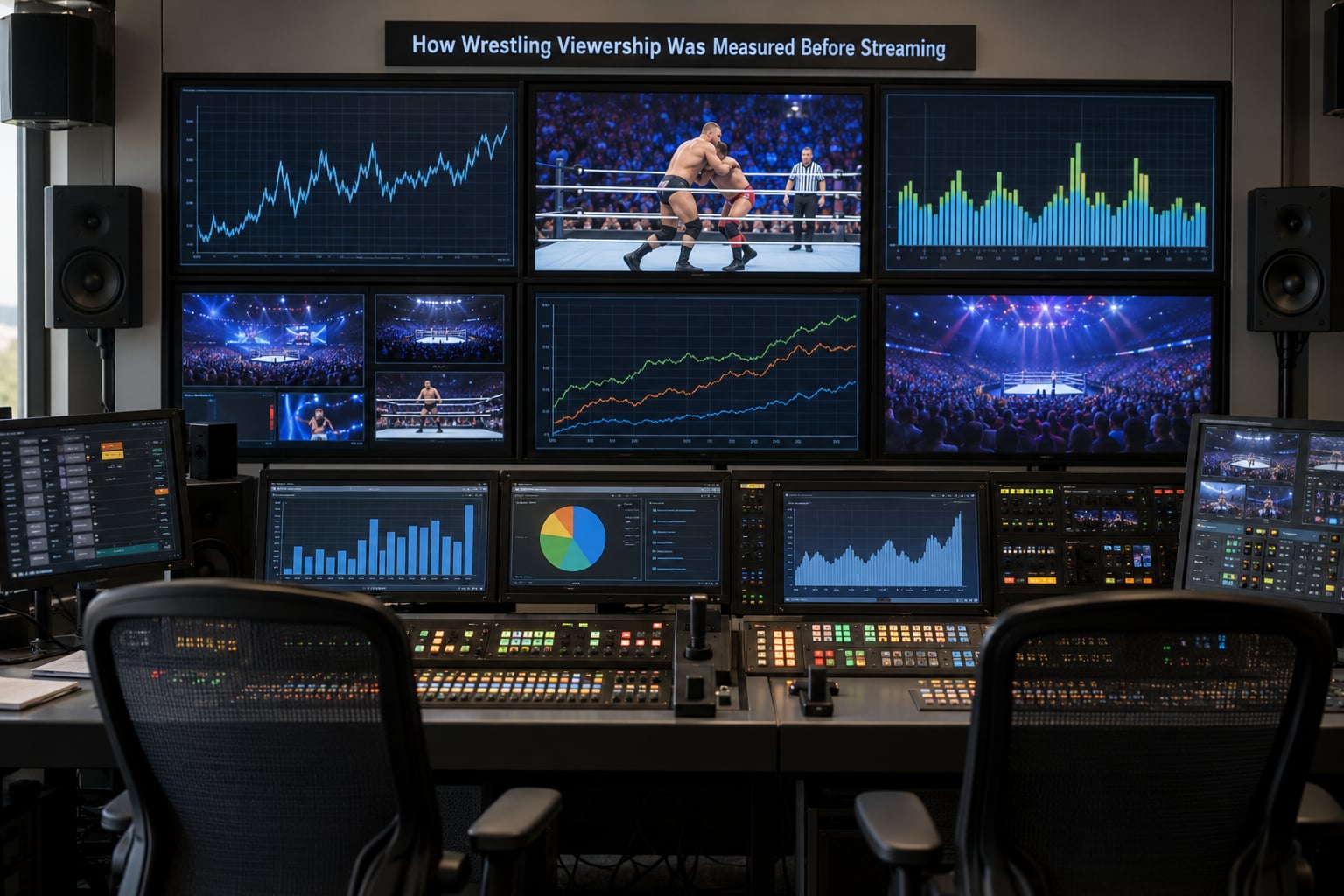
Before streaming, a wrestling ratings number meant one thing: how many people across a sample of American households watched the telecast, live, measured by Nielsen.
The mechanics are worth understanding because they explain why the old numbers felt solid. Nielsen operated a panel of households whose television sets were monitored. When a program aired on a monitored set, that household’s viewing was recorded. The households were weighted to represent the United States television population, and the result was published as a rating point and as a raw average audience count.
The key demo was P18-49, the percentage of adults aged 18 to 49 watching. Advertisers care about that group because they believe it maps onto purchasing power, so a rising P18-49 could justify higher ad rates even as total audience fell. Wrestling reports always paired the total number with the demo number, and arguments about whether WWE was “really” growing or shrinking usually turned on which of the two you chose.
There was also live plus same-day, which added DVR and time-shifted viewing to the live figure within a narrow window, and fast nationals, the preliminary estimate published a day or two before the final number. Fans regularly mistook fast nationals for official data, which is still one of the most common sources of confusion in ratings threads today.
What the old system could not do was count anyone watching outside the panel’s coverage, anyone watching in another country, or anyone watching a service that did not participate. That limitation is exactly why streaming platforms needed their own numbers.
How Streaming Platforms Count an Audience
Each streaming metric answers a different question, and platforms report different ones on purpose.
| Metric | What it actually measures | Typical reporting window | Common source |
|---|---|---|---|
| Subscribers | Accounts paying for the service, often bundled with cable or a mobile plan | Quarterly | Company press releases |
| Monthly active users | Accounts that used the service in a month, possibly a single visit | Monthly | Company earnings calls |
| Hours viewed | Total watch time accumulated by all viewers | Rolling week | Netflix weekly Top 10 |
| Views | Hours viewed divided by the program’s runtime | Rolling 7 days | Netflix weekly Top 10 |
| Live viewership | People watching at the moment of broadcast, via the platform’s own telemetry | At airtime | Platform announcements, occasionally |
| Simulcast audience | Cable numbers with streaming adds folded in where data exists | Live | Nielsen on selected services |
| Top 10 ranking | Position by views among all programs on the service that week | 7 days | Netflix public chart |
| Live attendance | People in the building | Per event | Promotion announcements |
Two of these need extra explanation because they cause most of the confusion.
Views are not viewers. Netflix calculates a view by dividing hours viewed by the runtime. An hour of a three-hour event counts as roughly a third of a view, so a long event can accumulate enormous hours and modest views. Netflix has also said it applies a blended approach because a live airing with commercials runs longer than the on-demand version, which means the same episode produces different view totals depending on when you measured it.
The 7-day window is not a night. A Tuesday morning Netflix chart reflects a full week of accumulated viewing, including rewatches and people catching up on Thursday or Friday. A cable number reflects what happened in three hours on Monday night. Those are different behaviours, not different levels of the same behaviour.
And subscribers are not viewers at all. A subscriber might never press play. A bundle can include a subscription nobody individually chose. Subscriber counts tell you how big the service is; they tell you almost nothing about one program.
Why Cable and Streaming Numbers Are Not Directly Comparable
There are six specific reasons the two systems stopped lining up, and each one is enough on its own to make a head-to-head comparison meaningless.
1. Different populations. Cable ratings cover the United States only. Netflix’s headline figures are global, covering more than 190 countries. Comparing a global streaming number to a US-only television number tells you about geography, not about audience strength.
2. Different time windows. Television counts a live window. Streaming accumulates over days. A show can lose a live audience and gain on-demand viewers at the same time, and both numbers will be reported accurately.
3. Different units. Television reports people. Streaming reports views, hours viewed, or rankings. A view is a unit of watch time, not a person, and one person can generate several.
4. Different denominators. Around 51% of US households had pay television as of the 2025 reporting cycle, down from a near-universal majority two decades earlier. Cable’s starting pool is shrinking while streaming’s is growing, so the same raw number now represents a larger share of the television market.
5. Different incentives. A broadcast network sells advertising and needs a demo number. A subscription service needs retention and growth, so it leads with subscriber growth and hours viewed. Both are rational; neither is designed to answer the same question.
6. Different disclosure. Netflix publishes weekly Top 10 data for every title on the service. Peacock and Max frequently publish nothing. When a platform stays silent, fans fill the gap with speculation, and speculation is where most false certainty comes from.
What Major Streaming Transitions Revealed About the Audience
Four transitions are worth looking at closely, because each one isolated a different variable.
The WWE Network launch in February 2014. This was the cleanest test of subscription demand in wrestling history, because subscribers could sign up without buying a cable package. The company reported subscriber milestones and buy-rate figures but stopped publishing weekly panel-measured television data for its own service, which permanently removed wrestling from one of the two systems readers had been using to judge it.
The move to Peacock in March 2021. WWE Network content landed on an existing streaming service, and the events followed in 2022. WrestleMania in 2022 was widely reported as improving on its predecessor by roughly 15% on the platform’s own reporting. Treat that as a platform-side claim rather than an independent measurement, but it is a reasonable one: an event moved to a service with a large existing subscriber base and still grew.
The Netflix move in January 2025. Raw’s debut was reported at 5.9 million global viewers with about 2.6 million in the US, then settled at an average near 3.7 million across the early run before hovering closer to 3 million in later weeks. The important part is not any single number. It is that a show nobody was tracking weekly on television showed up as a consistent presence on a global chart, which in 2025 happened for WWE content in 47 of 52 weeks.
AEW’s move to Max in January 2025. This one is the closest thing wrestling has to a controlled experiment, because AEW kept its television shows on cable and added a simulcast. Dynamite averaged about 602,000 viewers on Max in its early run. Collision delivered roughly 345,000 on January 4 against a December average near 262,000 on TNT. Max was reaching about 50 million US homes, and the platform did not disclose streaming viewership. The measured cable audience barely moved, which tells you the simulcast added reach without measurably cannibalising the broadcast product.
Read those four together and a pattern emerges. Distribution changes reliably increased access. Measurement changes reliably reduced visibility. The audience number you can see is not the audience that exists.
Did Streaming Increase or Decrease Wrestling Viewership?
Both happened, in different places, and the honest answer depends on which measure you are asking about.
Streaming clearly widened distribution. Content reached countries that a regional broadcast or a pay-per-view rollout could not reach in the same week. On-demand viewing let people catch up rather than lose a show entirely, which almost certainly keeps some fraction of the audience that the live, appointment-based model used to lose for good.
Streaming also fragmented the audience in ways that hurt the measured number. Weekly television puts everyone in the same room at the same time. On-demand does not, which removes the appointment, the lead-in, and the habit of watching something else first. Counters argue that the live appointment was never really about the show anyway, and that forcing a weekly schedule onto fans who want to binge is an artificial constraint.
The aggregate numbers argue against a collapse. Netflix reported that WWE content accounted for 525 million hours viewed in 2025, with Raw at 340 million views and premium live events at 185 million. Those are marketing numbers with a commercial interest behind them, and a subscription service has no reason to publish flattering data about its own shows. That makes them worth taking seriously, even when they are not comparable to anything a panel ever measured.
What can be said with confidence is that no verified evidence shows wrestling losing anything close to a third of its audience. The confident claims in both directions mostly come from people comparing figures that were never measuring the same thing.
How the Business and Broadcast Strategy Changed
The business decisions following the shift are easier to trace than the audience figures, because they show up in reported revenue and contract terms.
Rights fees escalated sharply. WWE’s agreement with Peacock, the Netflix deal, and the later ESPN arrangement together represented a step change in what streaming platforms were willing to pay for live sports entertainment, even as the published ratings for the same programming were falling or unclear. That combination is only possible if the value is no longer being measured in ratings alone.
Distribution went global and split by market. The same episode can now have different homes in the United States and internationally, on the same week. That complicates comparison, but it also means a single promotional push reaches far more people than a domestic broadcast buy ever could.
Weekly shows became hybrid. Live episodes remain important for events and pay-per-view equivalents, while library episodes and recaps live on demand. This is a scheduling model built for the platform rather than for the advertiser, and it changes how a “week” is even defined for a show like Raw.
Advertising became a different conversation again. Where a broadcaster needed an 18-to-49 demo, streaming platforms often price reach and hours instead. That removes the demo from the headline, which is one more reason wrestling fans lost the number they used to argue with.
Independent promotions got a similar squeeze. TNA, for instance, built much of its early television audience by outdrawing a competitor weekly, reportedly pulling 800,000 to a million viewers a week. When the cable system that carried shows like that shrank, those promotions lost reach without losing a single fan, which is why streaming-era numbers for regional wrestling look worse than the era deserves.
What Numbers Still Indicate a Healthy Wrestling Audience?
Here is the practical part. When you see a streaming viewership figure, check these things before you decide anything.
Is it a person or a unit? Hours viewed and views are units of time. Subscribers are accounts. Only live audience figures count people, and those come mainly from television panels.
What geography does it cover? Look for a US-only or global label. Most of the confusion comes from mixing the two.
What is the window? A 7-day accumulation and a three-hour live window are not comparable. When comparing weekly episodes against each other, the method at least stays constant.
Is it a trend or a spike? Debuts, post-match episodes and major events pull big numbers for reasons that have nothing to do with the baseline. Look for a season average rather than a headline episode.
Is the methodology changing underneath it? Nielsen’s move to a combined big-data and panel approach in late September 2025 changed reported figures across every show on cable, and wrestling was hit unusually hard because a smaller share of its audience watches live, and because it is programmed as entertainment rather than sport. An adjustment in late January 2026 was followed by published analysis showing much of the wrestling decline reversing across roughly 198 cable program titles.
Do other signals agree? Live attendance, Top 10 consistency week to week, social reach and continued rights-fee growth all move more slowly than a single ratings release. When several slow-moving signals point the same way, that is worth more attention than one fast number.
One more caution that saves a lot of confusion: a strong cable number during a streaming era is not proof of a comeback, because the cable audience pool itself has shrunk. And a weak one is not proof of collapse, because the same method change hit everything it measured at once.
Frequently Asked Questions
Did streaming actually increase professional wrestling viewership?
It widened distribution, and the aggregate numbers support that reading. Netflix reported 525 million hours of WWE content watched in 2025, with Raw at 340 million views and premium live events at 185 million, and WWE content held a Top 10 spot in 47 of 52 weeks. But no streaming figure is directly comparable to a cable rating, so a claim that streaming added or lost a specific number of viewers is not something the available data can prove.
Are Netflix subscribers the same as wrestling viewers?
No. A subscriber is an account paying for the service, often bundled with a cable package or a mobile plan, and may never press play. A viewer is someone who watched something. Netflix does not publish a subscriber count for wrestling, only per-title weekly views and hours viewed. Subscriber figures answer how big the service is, which is a different question from how many people watched Raw on a given week.
Why is WWE streaming viewership harder to compare with cable ratings?
For six reasons. Cable ratings count people in a US panel during a live window. Streaming figures are usually global, cover a multi-day window, report hours viewed or calculated views rather than people, include on-demand and ad-supported tiers, are published by a company with a commercial interest in the result, and are sometimes not published at all. Comparing the two tells you about methodology rather than about audience size.
How did AEW’s television audience compare with traditional wrestling ratings?
AEW moved to Max in January 2025 while keeping Dynamite and Collision on cable, which made it a useful test case. Dynamite averaged about 602,000 viewers on Max early on, and Collision drew roughly 345,000 on January 4 against a December average near 262,000 on TNT. The cable figures barely shifted, and Max did not disclose streaming viewership, so the measurable audience stayed largely the same while reach expanded.
Did moving WWE content to Peacock reduce viewership?
The available reporting points the other way. WWE Network content moved to Peacock in March 2021, with events following in 2022, and WrestleMania 2022 was widely reported as improving on its predecessor by roughly 15% on the platform’s own figures. That is a platform-reported claim rather than independent measurement, but it does not support the idea that the move cut the audience.
What is the most reliable way to measure wrestling’s streaming audience?
There is no single number. The best approach is to track several slow-moving signals together: weekly Top 10 views over a season rather than a debut, hours viewed alongside views, live attendance, and the same figures repeated from the same source in consecutive weeks. Also check whether the measurement method changed, since Nielsen’s late 2025 switch and its January 2026 adjustment moved reported figures for the same programs substantially.
Conclusion: Compare Trends, Not Isolated Totals
Streaming changed both where wrestling is watched and how it is counted, and the second change is the one that causes the arguments. When you see a cable number and a streaming number for the same promotion, check the geography, the window, the unit, and the source before you decide which one is real. They are usually both accurate and measuring different things.
The practical move is to stop reading isolated totals and start reading trends from a single source over time. Netflix’s weekly Top 10, the same Nielsen series week after week, arena attendance, and reported rights-fee movement are slow-moving signals. When several of them agree, that tells you something a single viral number never will.
Wrestling has survived more platform changes than almost any other form of entertainment, and the audience has followed every one. That is the real story behind how streaming changed wrestling viewership numbers: the measuring instrument changed more often than the audience did.