How a wrestling angle is built over months comes down to planning the ending first, then working backwards. A booker decides where the story finishes, lays out the beats that earn it, and drip-feeds those beats across weeks of television so every match raises the stakes above the last one. The long part is pacing, not plotting.
Most of that work happens in a writer’s room, weeks before anyone sees it on a show. What you watch on a Wednesday night is usually a small slice of an outline that already has months of story mapped out, with room left for the crowd to change it.
Last updated: October 2026
Table of Contents
- What Is a Wrestling Angle?
- How a Wrestling Angle Is Built Over Months
- Phase 1: Planting the Conflict
- Phase 2: Creating Stakes for Others
- Phase 3: Escalating the Story
- Phase 4: Delivering the Payoff
- How Long Should a Long-Term Wrestling Angle Run?
- What Makes a Long-Term Angle Feel Rewarding?
- How Do Writers Keep an Angle From Stalling?
- How Can You Recognize a Well-Built Angle?
- How a Wrestling Angle Differs From a Feud
- Frequently Asked Questions
- How long does a wrestling angle usually take to build?
- Can a wrestling angle last for several months?
- What is the difference between a wrestling angle and a feud?
- How do wrestling writers keep a long-term story interesting?
- How should a wrestling angle end?
- What to Work on First
What Is a Wrestling Angle?
An angle is a long-form storyline with a motive at its center, a reason two or more performers are pulling against each other, and an intended resolution. It is planned, not improvised, and it runs long enough that the audience forms an opinion about it before it ends.
A short program is different. It might cover three weeks and one pay-per-view, and it can be built week to week without much advance planning. A throwaway feud is shorter still: two people dislike each other, they have a match, they move on. Nobody is building toward anything.
The direct answer to the search question: a wrestling angle is built over months by deciding the payoff first, then seeding the conflict, escalating the stakes in every successive match, adding complications and reversals, and finishing with a resolution that the earlier weeks actually earned. The escalation in the middle is what separates an angle from a series of unrelated fights that happen to share two people.
How a Wrestling Angle Is Built Over Months
Four phases cover most long builds, whatever the promotion. The example that follows is a fictional independent promotion, because the mechanics are the same whether you are watching a company that tapes two shows a month or one that runs live television five nights a week.
Phase 1: Planting the Conflict
The first job is establishing a motive that already existed before the story started. The most credible conflicts are not invented on the spot. They grow out of something the character has shown for months: a former partner who was left behind, a wrestler who trained under someone and then got thrown out, a champion who protected the promotion until somebody else decided they had stopped needing the fans.
Then a threat appears, and it has to be one the audience believes. A masked wrestler who has never lost does not read as a threat, because nobody expects them to lose. A dangerous, established heel who has been quietly dismantling a faction for a few weeks does.
The first disagreement should cost something small but visible. A handshake refused in front of a crowd reads louder than a four-minute argument backstage. Writers avoid explaining the entire story here. If the audience knows every step on day one, they have nothing to look forward to for the next eight weeks.
Phase 2: Creating Stakes for Others
A personal dispute only holds attention while the two principals are on screen. To carry a story between weekly shows, the consequences have to spread outward, to a faction, a championship picture, or a group of wrestlers who depend on one of the principals.
There are three common ways to do it. Faction consequences put the antagonist’s allies in the ring, so now every member has a reason to show up. Title consequences put something on the line, which gives the audience a question with a shape: can they win it, and can the champion keep it. Moral consequences frame one side as right and the other as wrong, which is the cheapest way to keep an audience choosing sides, and also the easiest one to overplay.
Good stakes also survive a lost match. If the antagonist wins week three and nothing changes, the story has nowhere to go. A group feud keeps going because the losing side still has members, and a title feud keeps going because there is another date on the calendar.
Phase 3: Escalating the Story
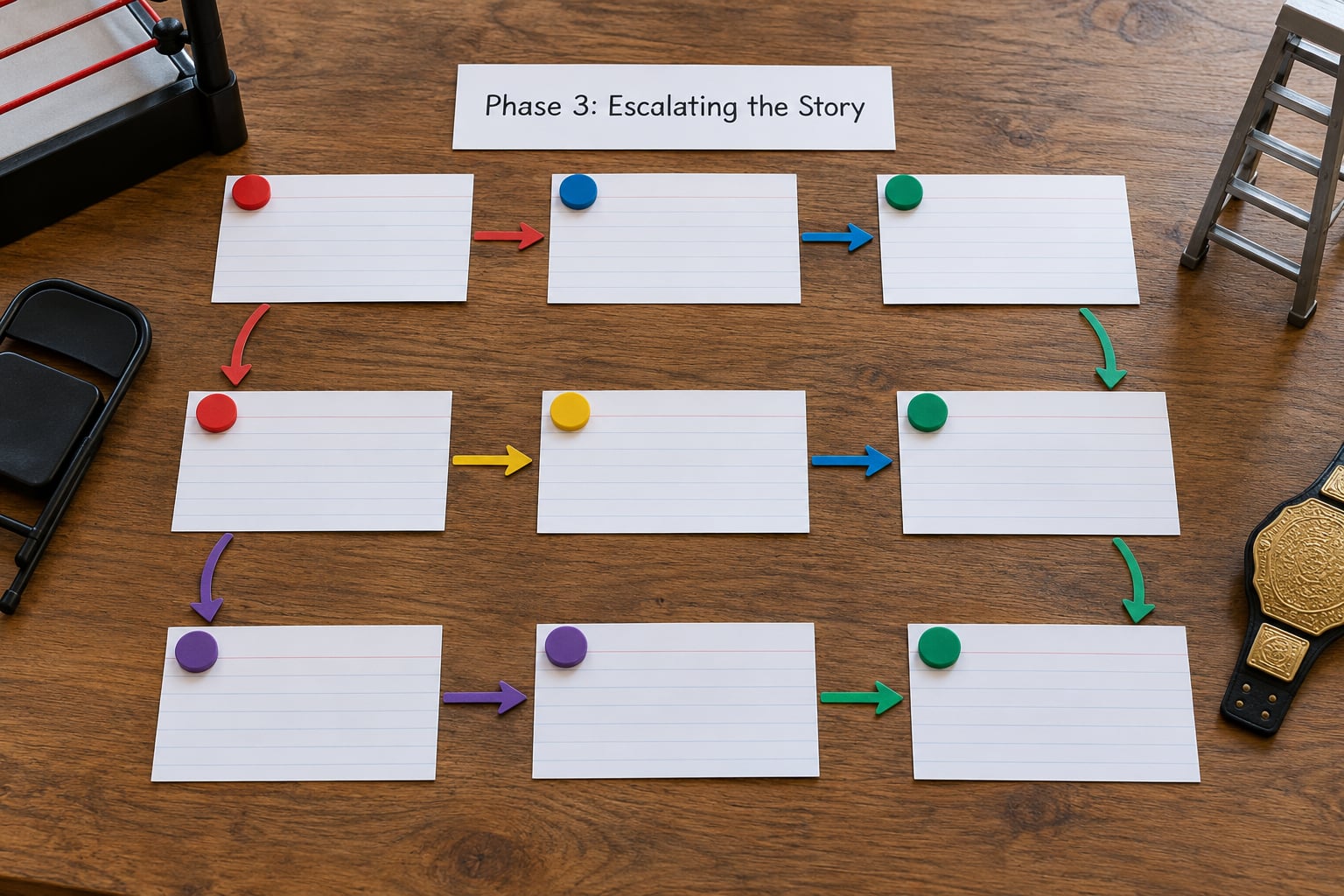
Escalation is the part everybody talks about and few pages actually explain. It is not a bigger match. It is a consequence that could not have happened in the previous match without looking fake.
It usually runs through four repeating mechanics. Interference adds a third party, so the fight stops being two-sided and starts involving other people’s motives. Reversals flip who holds the advantage, and the strongest version of a reversal is one where the winner gets the win but loses something doing it. Failed resolutions mean a match ends without a finish, or a finish gets overturned, or the handshake happens and something goes wrong during it. Temporary alliances put two former enemies on the same side, which forces both of them to explain themselves in promos, and that is where the best character work usually shows up.
None of these work if the principals start behaving like people they are not. A heel who suddenly refuses to cheat after a botched plan reads as a writer panicking, not as a character reconsidering. Escalation should raise the pressure, not remove the character.
The rule fans keep coming back to is simple: there has to be escalation between each successive match, and the better a storyline looks when it ends, the more momentum everyone involved carries into whatever comes next. The Shield against Evolution and Cena against the Wyatts get named as examples of builds that repeated the same structure without ever raising the cost. Austin against The Rock is the opposite case, credited not to the length of the run but to how often the situation changed underneath it.
Between tapings, the build continues off television. Vignettes, pre-taped packages, social posts, and a few lines dropped in a wrestler’s weekly interview give the audience something between shows. On an independent schedule, where a show might happen every three or four weeks, this matters even more, because the gap between events is longer than the weekly rhythm most arcs are written for.
Phase 4: Delivering the Payoff
The payoff answers the question the whole story has been asking. Not the wrestling question, which is who wins, but the character question: does the antagonist get away with it, does the protagonist prove themselves, does the betrayal mean what it seemed to mean.
A payoff is earned when the finish comes from something the story already set up. A heel loses because of a habit established months earlier, and the audience laughs because they saw it coming. That is a good feeling, not a bad one. The worst payoffs are the ones where the decisive moment has no precedent, because it reads as the booker needing a finish rather than the story needing one.
Announcers and commentary quietly destroy a lot of good payoff work by ignoring the build. When months of setup go unmentioned in the final match, the audience concludes the setup was filler, and they are not entirely wrong. A single line reminding them what is actually at stake costs fifteen seconds and recovers months of work.
Aftermath is not optional either. Somebody loses a title, somebody leaves a faction, somebody has to answer for what they did on screen. A resolution that closes every door leaves the performers with nothing, and the next angle starts from zero. The best payoffs open at least one new door, and they let the losers keep something: credibility, a new motivation, a grudge that pays off later.
How Long Should a Long-Term Wrestling Angle Run?
Length is not the goal. The complaint about long-term booking is almost never that stories run too long on their own, it is that the extra weeks do not add anything. A short build with a real ending beats a long build that stalls in month three.
| Build length | Typical duration | Common structure | Best used for | Main risk |
|---|---|---|---|---|
| Short build | 2 to 4 weeks | Setup, two matches, payoff | A squash match that needs a reason, or a short television cycle | No room for escalation, so the finish arrives out of nowhere |
| Standard build | 2 to 4 months | Seed, first confrontation, two or three escalations, major-event payoff | Most championship feuds and any rivalry that has to end at a specific show | The middle sags if the same match structure repeats |
| Long-form arc | 6 months to 2 years | Repeated cycles of conflict, temporary alliance, betrayal, reset, larger payoff | Character-defining arcs, faction wars, title lineages | Momentum leaks every time the story restarts from the same place |
What decides the length is the event calendar. A feud pointed at a major show has a natural deadline, which is helpful because the ending is already scheduled. A feud with no event attached to it will be stretched until somebody decides to end it, and that decision usually comes from a ratings conversation rather than a story one.
It also depends on the roster. A promotion with eight contracted wrestlers cannot run a twelve-month arc without those performers appearing in other stories in the meantime, and those appearances have to be written to feed something. Small-roster indies describe this cycle constantly: the same people fight the same people because there is nobody else to put in the match.
What Makes a Long-Term Angle Feel Rewarding?
Reward comes from continuity and consequence, not from length. Six ingredients do most of the work.
Continuity. The story remembers what it did eight weeks ago. An injury from month one shows up as a weakness in month three. A promise made in a promo gets broken on purpose. Losing continuity is the fastest way to lose an audience that committed to following something.
Clear incentives. Everyone in the story wants something specific, and the audience can name it. Vengeance, a title, money, a name being cleared, a group staying together. A motive nobody could state in one sentence will not survive five weeks of promos.
Partial answers. The story gives some of what the audience wants before the ending, so the wait is survivable. A single match where the protagonist does something the antagonist never expected buys a month of goodwill.
Changing obstacles. The obstacle between the two sides should not be the same shape in week four and week twelve. Different problem, same core conflict, is the pattern that keeps a long build from reading as one long match.
Character-consistent choices. The turn should be understandable in hindsight even if it is a surprise in the moment. Heel turns fail most often not because fans hate heels, but because nobody wants them. Fans can stay interested in a villain they understand, and an unexplained switch from popular to despicable reads as the writers needing an antagonist.
Meaningful consequences. The ending changes something. If every outcome leaves the roster exactly as it was, nobody has to watch the next show.
How Do Writers Keep an Angle From Stalling?
Stalling is the default failure, and it usually shows up as one of five things.
The same finish every month. When the antagonist wins the same way four weeks running, the audience learns that the outcome does not matter. Fix: change what the win costs. A dirty win that gets a title out of the challenger’s sight, then a legitimate win the next month, then a disqualification in the third, gives three matches three different shapes.
Turns nobody can explain. A betrayal usually works when the motive was on screen earlier, even quietly. If the closest thing to setup was a two-second look, the turn feels arbitrary. Fix: plant it two or three segments earlier and let the audience notice it on rewatch.
Characters that disappear. A wrestler booked for a match, then replaced, tells the audience they are not important to the story. Fix: if someone is central to the ending, they appear in the middle, and if they are not central, stop teasing them.
Vague motives. Words like respect and legacy do not generate conflict on their own. Fix: attach them to something physical. A handshake, a title, a match someone was promised and did not get.
Too much interference. When every match ends because of a run-in, the wrestlers stop mattering. Fix: make the interference the point of one match rather than the pattern of five.
The way to add a beat without abandoning the central conflict is to change the cost rather than the topic. The antagonist and the protagonist are still fighting over the same thing, but now the fight is in someone else’s ring, under someone else’s rules, with a third person’s title on the line. The conflict survives, the shape changes.
How Can You Recognize a Well-Built Angle?
You can tell from the audience side without knowing anything about booking. Six signs give it away.
Anticipation. People argue about who is going to win before the show, and the argument is about the story, not the record.
Foreshadowing you can find later. Go back and watch a promo from week two after a payoff in week twelve. A good build has something in it that reads differently in hindsight.
Reversals that make sense. A turn surprises you and does not feel cheap a week later. Both at once is the mark of a planned angle.
Dialogue that sounds like people. The heel says things a heel would say. Two people arguing about the same disagreement sound different from one person monologuing and the other nodding.
Consequences that stack. Every month costs somebody something, and the cost is still visible a month later.
A payoff that pays off setup. The final match contains moments that were set up earlier. If you can point at three of them, the angle was built.
The audience reaction gives the last clue away. A good payoff produces a physical release, an exhale in the arena, because the crowd is not only cheering a win. It is letting go of tension the story held for months, and that release is the clearest sign a long build actually landed.
How a Wrestling Angle Differs From a Feud
A feud is the period during which the two sides are actively in conflict. The angle is the reason for that conflict, the structure underneath it, and the ending it is heading toward. Feud is the fire; the angle is the reason the fire is lit and where it is pointed.
That distinction explains why one feud can contain several angles. A six-month title feud might have a main angle about the belt, a side angle about a betrayal inside a faction, and a third about whether one of the two can be trusted at all. Each has its own motive and its own resolution, and they trade off: while the belt angle stalls, the faction angle keeps the show watchable.
It also explains a common complaint. Audiences can tell when a feud is happening and there is no angle inside it. Two wrestlers work a program, split into two teams, and the reason for the conflict never gets past the word respect. The matches are fine and the story is missing.
Frequently Asked Questions
How long does a wrestling angle usually take to build?
Understanding how a wrestling angle is built over months starts with the calendar. A standard build runs two to four months, which gives a booker room for a setup, two or three escalations, and a payoff at a scheduled event. Short builds of two to four weeks work for quick television cycles.
Can a wrestling angle last for several months?
Yes, and that is the normal length for anything with a major event at the end of it. The community rule is escalation: each match has to raise the stakes above the last one, or the extra weeks feel like filler. Length itself is not the problem, repetition is.
What is the difference between a wrestling angle and a feud?
A feud is the stretch of time during which two sides are actively fighting. The angle is the motive, the structure, and the intended ending behind that fight. One feud can hold several angles at once, such as a championship storyline running alongside a faction betrayal.
How do wrestling writers keep a long-term story interesting?
By changing the cost rather than the topic. Each match alters what is at stake, who is involved, or what a win would cost, while the central conflict stays the same. Writers also fill the weeks between shows with vignettes, packages, and social posts, and they keep continuity so old injuries and old promises still matter.
How should a wrestling angle end?
With a resolution that answers the character question the story has been asking, using a device the earlier weeks already set up. After the finish, something should change: a title moves, a faction splits, or a loser leaves with a new motivation. An ending that closes every door leaves nothing for the next story to build on.
What to Work on First
If you are building an angle yourself, the order matters. Write the ending first, even in one sentence, because everything else is judged against it.
Then: name the central motive in a single sentence a fan could repeat back to you. List what each character wants, and check that the two lists collide. Plant the first clue in the first segment, small enough that most people will miss it. Map the escalation for every match before the first one airs, including what each one costs. Decide what the payoff changes for the roster afterwards.
That is the whole job. The months are not an obstacle to good writing, they are the space the writing lives in, and the only thing that fills that space badly is a story that stays in the same place.