How a battle royal is organized in the ring comes down to one visible setup and one hidden spreadsheet. Everyone starts in a fixed formation, gets eliminated by going over the top rope with both feet touching the floor, and the match is planned well in advance so the apparent chaos lands where it should. Most fans see the second half of that sentence only.
Here is the part worth slowing down for. Once you know what the starting formation is doing, why the entrances come in timed waves, and who maps out the elimination order, a match that looked random on TV starts reading like a sequence of decisions someone made in a hotel room in Connecticut.
Table of Contents
- What It Means to Learn How a Battle Royal Is Organized in the Ring
- How a Battle Royal Is Organized in the Ring: The Starting Formation
- How the Number of Wrestlers Changes the Layout
- Why Entrances, Warning Times and Elimination Rules Are Set
- How a Battle Royal Is Organized in the Ring, Step by Step
- Why a battle royal is organized long before the bell
- How Writers Keep the Action Clear and Fair-Looking
- What the Referee, Timekeeper and Broadcast Team Handle
- Why the Final Match Is Planned Before It Begins
- Frequently Asked Questions
- Are battle royal eliminations real or predetermined?
- How do wrestlers know when to leave the ring?
- Why are some battle royal rules not enforced consistently?
- How is the starting lineup decided?
- Can a battle royal be won without being officially eliminated?
- How do wrestlers avoid getting eliminated in a large field?
- Conclusion: Understand the Structure Beneath the Chaos
What It Means to Learn How a Battle Royal Is Organized in the Ring
To learn how a battle royal is organized in the ring, you need to separate two layers. The first is what you can see: where wrestlers stand at the bell, when new ones arrive, who goes over the top rope and who does not.
The second layer is the part nobody walks onto the ramp to see. Producers, writers and agents decide weeks ahead how many competitors there will be, what number each one enters at, who eliminates whom and in what order. A referee calls the eliminations live, and someone backstage keeps an eye on the floor and can change the plan mid-match when something goes sideways.
Knowing that split changes what you watch for. The first time you see a favorite thrown out four minutes after making a dramatic entrance, it reads as a mistake. The next time, you notice the number he was supposed to be gone by.
How a Battle Royal Is Organized in the Ring: The Starting Formation
The starting formation is the answer to the simplest question a fan asks: who is already standing in the ring when the bell rings?
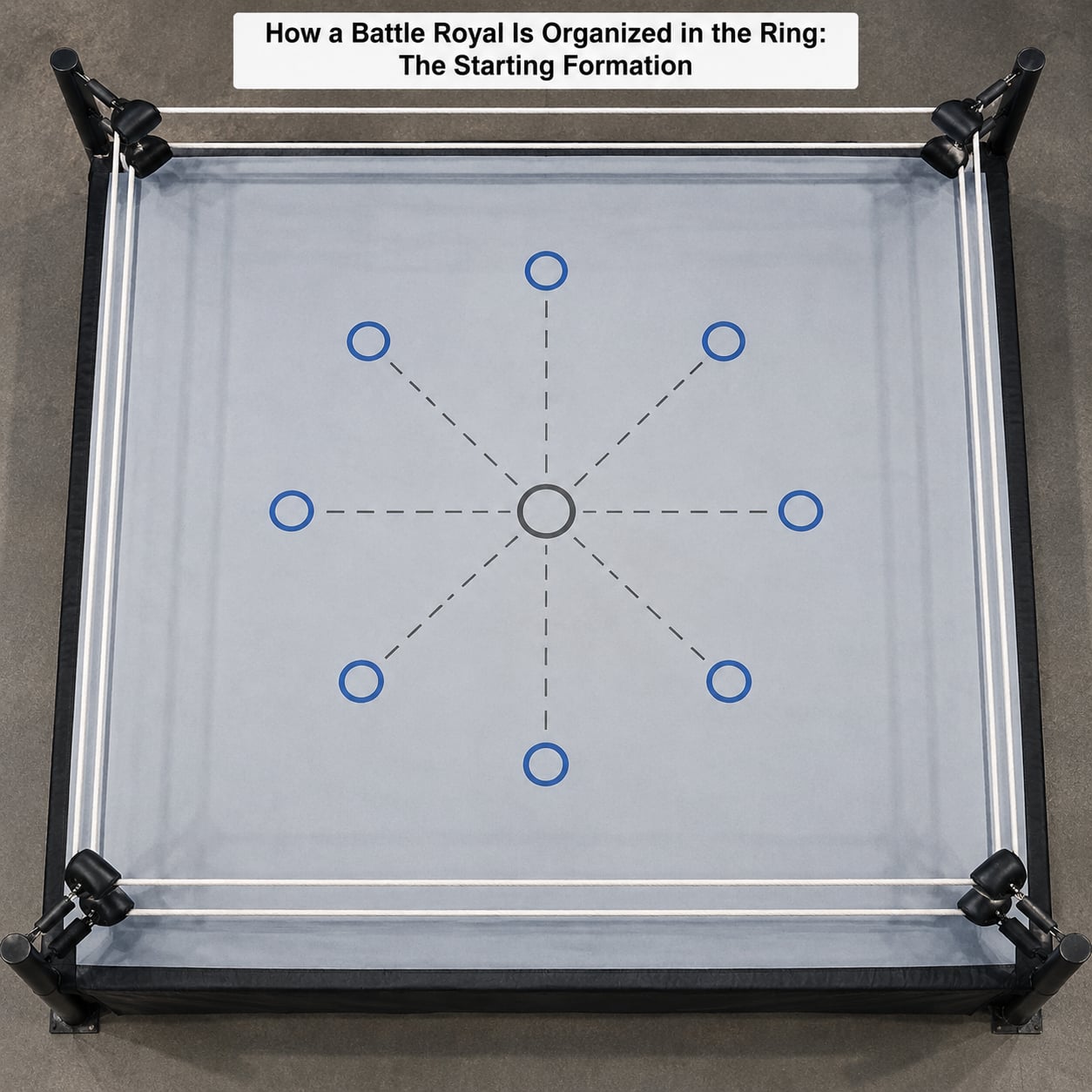
In a traditional battle royal, the whole field is in the ring at the bell. Twenty or thirty people spread across the canvas, spaced so nobody is standing on top of anybody before a single strike lands. The spread matters more than it sounds, because the opening exchanges are chosen, not thrown together.
In a Rumble-style match, the formation is tiny at the start and grows on a schedule. Two wrestlers begin in the ring, one on each side of it, and everybody else enters later at numbered intervals. Pat Patterson, credited with inventing that timed format, built it around a simple observation: a crowd will accept almost anything if the rhythm of the match is predictable, even when the outcome never is.
That rhythm is the whole trick. Every ninety seconds or two minutes, the lighting changes, music fires, and one more body enters. The two starters know the exact number of waves between them and the finish.
How the Number of Wrestlers Changes the Layout
Field size is the variable that reshapes everything else. A six-person scramble and a fifty-man Rumble are the same match type with completely different physics.
| Field size | Starting formation | Spacing challenge | Typical pacing |
|---|---|---|---|
| Small field, roughly 6 to 10 | Everyone in the ring at the bell | None. There is space to work and clear individual spots | Fast. Most eliminations come in under ten minutes |
| Standard field, roughly 20 to 30 | Full field at the bell, or two starters plus timed entries | Constant. The ring floor and apron fill up and blocks of bodies hide the action | Staged in waves, with a set number of eliminations per wave |
| Very large field, 40 and above | Two starters, timed entries throughout | Severe at ringside, where eliminated wrestlers must be moved along quickly | Slow build, long stretches of one-on-one with a final concentrated phase |
With twenty people the noise is physical. Bodies land on the apron, the floor fills with eliminated wrestlers waiting to leave, and the referee spends real time pointing at people who should already be gone. Push it to fifty and the production has to stagger entrances, spread the action and shorten individual segments so nothing important happens offscreen.
Why Entrances, Warning Times and Elimination Rules Are Set
All three exist to make the match readable. Entrances control who is in the ring and when. Warning times control how long a survivor sits on the apron before being expected in. Elimination rules control what counts as out.
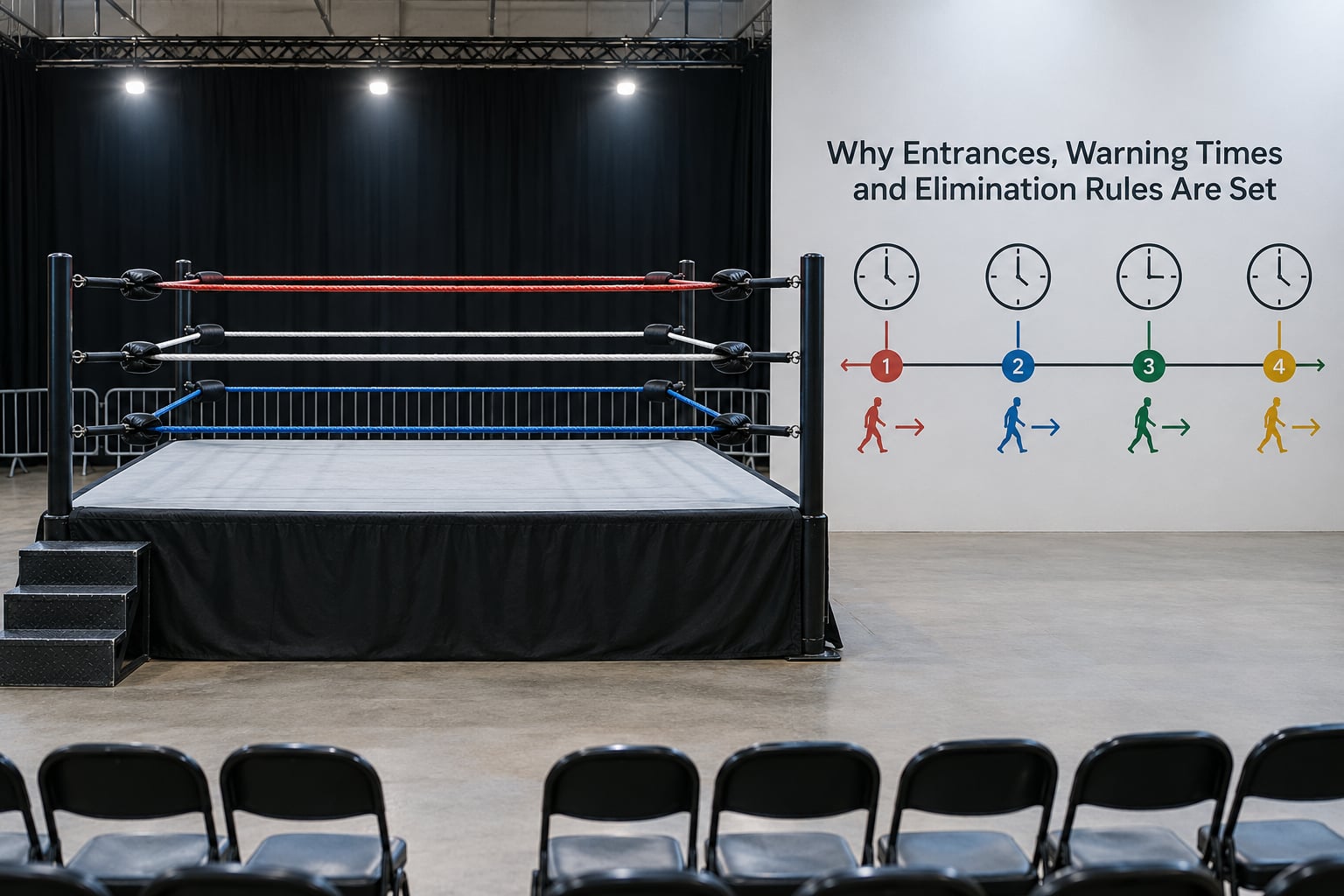
The standard elimination rule is short enough to say out loud: a wrestler is out when they are eliminated over the top rope and both feet touch the floor. Not one foot. Both. That wording gets tested constantly, because plenty of wrestlers get thrown to the apron and end up standing there with one leg still up on the ring, technically alive.
Warning times matter most in the tag team version. A team has a limited window to make a legal tag or one member leaves the match, so the match stays fast and nobody gets to camp on the apron indefinitely. In a single-wrestler Rumble there is no tag, and the equivalent pressure comes from the clock: you were told to be gone by number twenty-two, and the match is now waiting on you.
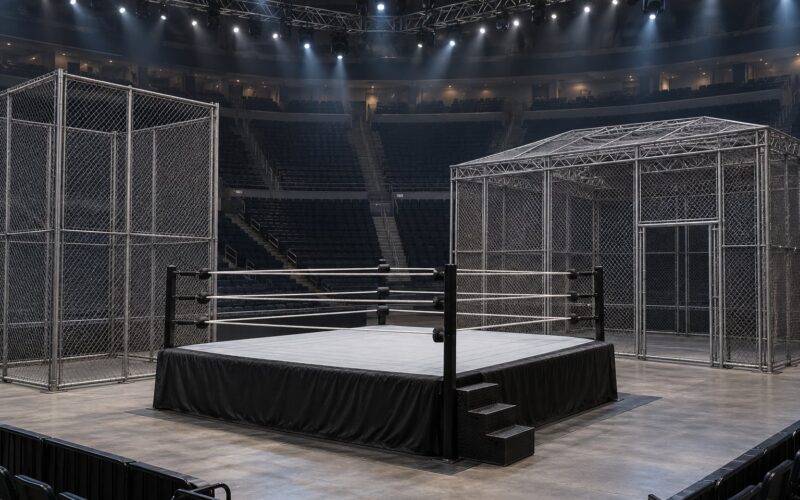
Elimination methods also get adjusted by promoter and by stipulation. Some versions add a steel cage so nobody can leave at all. Some let weapons count. Some reverse the logic entirely and keep the last person out of the ring instead of the last person in it.
How a Battle Royal Is Organized in the Ring, Step by Step
Run through a Rumble-style match in order and the organization becomes obvious. Here is the sequence, roughly as it plays out.
- The field is announced. Names, numbers and brand affiliations go out beforehand, so the audience knows the running order before anyone walks out.
- Two starters are placed. They are usually chosen so the opening minute has a shape, either two people with unfinished business or two who can look competent while the rest of the roster is still arriving.
- The clock starts. Every interval brings one entrant, and each one is briefed on who they are expected to eliminate and who is expected to eliminate them.
- Early eliminations set the tone. The first few names are usually paired with someone a few minutes earlier, so the crowd registers quickly that bodies leave in this match.
- Pairings get established. Feuds get touched on briefly. An incoming wrestler finds the storyline waiting for them, gets a short exchange, and moves on.
- Survivor blocks form. The wrestlers who are going to the end get separated in the running order and kept apart, so the final stretch has opponents who have not yet met.
- The field thins. From around number fifteen onward, eliminations come faster and the pace lifts, because the match needs to reach its finish.
- The bell ends the match when the last other competitor is eliminated, usually with the winner already positioned for what comes next.
Why a battle royal is organized long before the bell
The elimination order is written down before the show, not invented in the ring. Court Bauer, a former WWE writer, described planning Rumble entrances and eliminations in a rented hotel suite in Stamford, Connecticut, then pitching the result to the creative team. Duke Droese, who entered number thirty in 1996, recalled Pat Patterson sitting the roster in the catering area with a large dry erase board, handing out entry order and telling each person who would put them out.
So the entry number is not random, and neither is who goes over the rope first. If you see a wrestler leave almost immediately after a long entrance, that was the plan, not a mistake by the referee.
How Writers Keep the Action Clear and Fair-Looking
With twenty people moving at once, the writing exists to stop the match from becoming unreadable. A few habits do most of the work.
Some people are protected outright. A small number of wrestlers are told they will not be eliminated until a specific point, which is why a heavily pushed star can survive an alarming amount of punishment.
Repeating alliances are useful. Two wrestlers who have teamed before are easier to write into the same block, because the crowd already has an opinion about them together.
Near falls are the pacing tool. A two-count that breaks free buys time for the next scheduled elimination without actually removing anybody.
Survival near the ropes is written into the plan. The most common survival spot in these matches is a wrestler standing on the apron with one leg still inside the ring, technically uneliminated.
Rules get enforced selectively, too. Count-outs and disqualifications are usually not part of the format at all, so the arguments about who touched whose ropes in week three of your fantasy league do not apply here. The referee is there to call eliminations, not to police wrestling.
What the Referee, Timekeeper and Broadcast Team Handle
Three sets of eyes run the match, and they are not doing the same job.
The referee calls every elimination. In a large field that means watching the ropes and the floor simultaneously, counting out anything disputed, and telling eliminated wrestlers to clear the apron so the action stays visible. Authority is deliberately thinner here than in a standard match, because with this many competitors there is no time for warnings.
The timekeeper owns the entrance clock. Each interval is cued so a new entrant walks out on the beat rather than during a lull, and the cue has to survive a live crowd that is louder than the plan expects.
The broadcast team explains the beats you should be noticing, counts the field down as it shrinks, and keeps you oriented when six things are happening at once. They rarely tell you the finish is fixed, but they will tell you who just entered and how many are left.
Behind all of it sits a producer with live authority. Jamie Noble has described being the person to call during a Rumble with the question of what was supposed to be going on right now. That is the safety net for the whole structure.
Why the Final Match Is Planned Before It Begins
Nothing about the last five minutes is left to chance. The winner is decided long before the show, which survivors are being kept alive for it, and whether anyone interrupts are all settled in advance so the visible mess resolves into something coherent.
The structure usually works in three layers. Early eliminations feed the middle of the running order. The middle gets wrestlers out of the way so the advertised finalists stay untouched. The finish then assembles the remaining pieces in front of the crowd, with the bell ringing on the intended winner rather than on whoever happens to be standing.
That is why a battle royal can feel unpredictable for twenty minutes and still end exactly where it was always headed. The chaos is real in the moment and mapped out in advance.
Frequently Asked Questions
Are battle royal eliminations real or predetermined?
Elimination order is set in advance. Writers and producers decide who eliminates whom and in what sequence before the show, and wrestlers are told their window and who will put them out. The execution is live, so timings stretch or a spot gets missed, but nobody is randomly dumping someone over the rope. The finish is fixed before the bell.
How do wrestlers know when to leave the ring?
They are told two things in advance: the entry number that ends their run, and the wrestler who is supposed to eliminate them. Until then they are working the survival spots, staying near the ropes and avoiding the middle of the ring. If a match runs long, the person backstage tracking the running order can change a number on the fly.
Why are some battle royal rules not enforced consistently?
The referee has less authority in these matches than in a standard bout, because twenty or more competitors cannot be managed with warnings. Pinfalls, submissions, disqualifications and count-outs are usually not part of the format at all. When two wrestlers cross the rope at the same moment, the call is fast and sometimes feels loose, which is a complaint fans raise often.
How is the starting lineup decided?
Two things are happening at once. The promoter’s office decides the field size, the brand split and how the roster divides between the two starting positions. A numbered draw or a published list then assigns each competitor an entry slot. Slots are not random on the night, because the surviving block has to be spaced out so the announced finish can actually happen.
Can a battle royal be won without being officially eliminated?
Only in variant formats. The standard over-the-top-rope rule means the last wrestler remaining in the ring wins, and everyone else has been eliminated. Some versions flip it, keeping the last person outside, and others use a cage, weapons or no-disqualification conditions. In the standard format, no one can win while another competitor is still in the ring.
How do wrestlers avoid getting eliminated in a large field?
The reliable habits are all positional. Stay on the apron with one leg inside the ring, because both feet touching the floor means elimination. Avoid the middle brawl where bodies pile up. Use kicks and chops instead of signature moves early, since a big move often means going over the rope. Eliminated wrestlers are expected to clear the floor quickly so the next pair has room.
Conclusion: Understand the Structure Beneath the Chaos
Next time a battle royal comes on, watch four things. Where the wrestlers are standing when the bell rings, how the entry numbers are spaced, who gets eliminated right after each new arrival, and which survivors are being kept untouched at the end.
Once you track those four things, how a battle royal is organized in the ring stops being a question. The ring formation, the timed entrances and the elimination order are one plan executed in public, and the noise is what it looks like while that plan runs.