
If you are trying to work out how a cage match differs from a Hell in a Cell, the short answer is the win condition. In a steel cage match a wrestler can win by pinning or submitting, or by climbing out and escaping. In a Hell in a Cell match the only official ways to win are a pinfall or a submission, and climbing out changes nothing. Almost every other difference, from the roof to the size of the structure, follows from that one rule.
The confusion is easy to fall into because both objects look like a big fence on a television screen. But one is a generic match type any promotion can run on any show, and the other is a named stipulation with its own annual pay-per-view. Here is how the two actually differ, criterion by criterion.
Table of Contents
- How a Cage Match Differs from a Hell in a Cell at a Glance
- The Core Difference
- How a Cage Match Differs from a Hell in a Cell in Escape Rules
- How the Enclosures Are Different
- Cage Match or Hell in a Cell: What Counts as a Win?
- Rules, Refereeing, and Count-Outs
- Strategy and In-Ring Action
- Risk, Safety, and Working Conditions
- Which Should You Choose?
- Frequently Asked Questions
- Can you win a cage match by pinfall?
- Does escaping a Hell in a Cell have to be permanent?
- Are all cage matches no-disqualification matches?
- Why does a Hell in a Cell have a roof?
- How long does a twenty count last in a cage match?
- Is a steel cage match safer than Hell in a Cell?
- Conclusion
How a Cage Match Differs from a Hell in a Cell at a Glance
The table below sets the two side by side across the criteria fans argue about most, from what is enclosed to how a match ends.
| Criterion | Steel Cage Match | Hell in a Cell |
|---|---|---|
| Enclosure | Open-topped steel mesh cage wrapped around the ring | Roofed steel chain-link structure |
| Roof | None, by design | Yes, with a walkway around the top edge |
| Area enclosed | The ring and its immediate apron | The ring plus the ringside floor and the surrounding space |
| Win conditions | Pinfall, submission or escape | Pinfall or submission only, under standard rules |
| Count-out | Does not apply | Does not apply |
| Disqualification | No disqualifications | No disqualifications |
| Ropes and turnbuckles | Usually present | Removed, so wrestlers can fall freely |
| Typical length | Shorter, built around one escape attempt | Longer, with time for weapons and falls |
| First match | June 25, 1937, per The SmackDown Hotel | October 5, 1997, per ProwrestlingHistory |
The Core Difference
A steel cage match is a match type. Any promotion can book one, in a single, tag or multi-man format, on television or at a pay-per-view. Hell in a Cell is a specific named stipulation, trademarked by WWE and built around an annual event that shares its name.
That difference in scope matters because the two structures were designed to solve opposite problems. A cage is meant to create a ticking clock that pushes two wrestlers toward a solution. A Cell is meant to remove every exit so the beating can continue until someone physically cannot take it.
How a Cage Match Differs from a Hell in a Cell in Escape Rules
Escape is the single clearest dividing line. In a standard steel cage match, a wrestler who climbs the mesh and gets both feet onto the floor has won the match, full stop. The referee starts a count to give the trailing wrestler a chance to drag them back inside before it is called.
In a Hell in a Cell match, climbing out is not an official win condition. Wrestlers have climbed down, run through the door and even gone over the roof while the match carried on, because there is nothing in the rules that says the contest ends at the door. Fans often see this and assume the escape did not count, when in fact it never was going to.
How the Enclosures Are Different

The steel cage is a modest structure. It stands around the ring, roughly the height of a tall scaffold, with mesh walls, a couple of doors, and nothing overhead. Because it only encloses the ring, it can be wheeled in and out of most arenas without dismantling half the room.
The Cell is a different scale of object entirely. According to WWE’s own published figures it stands more than 20 feet tall and weighs about five tons of steel chain-link fence, and it encloses the ring along with the ringside floor around it. The original Cell that debuted in 1997 was smaller, around 16 feet and two tons, and it was made heavier and taller as the matches inside it got more punishing.
Ropes and turnbuckles come out for a Cell match, which is a quiet but important detail. Without ropes to catch a wrestler who is thrown across the ring, a fall onto the steel floor or the ring frame is a genuine risk rather than a staged bounce. The roof also carries a narrow walkway, which has been used for everything from a championship match to a metal crate being dropped onto the structure.
Cage Match or Hell in a Cell: What Counts as a Win?
Here are the permitted finishes for each format, kept separate so the difference is unambiguous.
In a steel cage match:
- Pinfall, with the referee counting to three.
- Submission, when a wrestler signals or the referee stops the match.
- Escape, when a wrestler climbs out and both feet touch the floor before the count runs out.
In a Hell in a Cell match:
- Pinfall.
- Submission.
- Disqualification does not apply, and neither does escaping. Under standard rules that is the complete list.
There is one famous wrinkle worth knowing about. At Judgment Day in May 2002, Triple H pinned Chris Jericho on top of the Cell roof after both men climbed up to use the height. It is the exception fans bring up when they argue that a Cell match can be won anywhere, and it remains an outlier rather than a repeatable tactic.
Count-outs are off the table in both. The referee will not count a wrestler out for leaving the ring, because in a cage match leaving the ring is the whole point, and in a Cell match there is nowhere to leave to.
Rules, Refereeing, and Count-Outs
Because disqualification is not a live rule in either stipulation, the referee has far less to police than in a normal match. Weapons brought in from under the ring, chairs, kendo sticks and even the cage itself are all fair game, and the standard illegal-move list effectively goes out the window. That is why a cage match can be as violent as a Cell match while still being booked as a wrestling match.
The referee’s job changes shape instead. In a cage match, the crucial routine is the count after an escape attempt, announced with a bell so the whole arena can hear how much time is left. In a Cell match the referee controls the door, which stays shut for the duration of the contest, and stands ready to restart the match after the action spills outside.
Wrestlers who leave the ring long enough can have the match restarted or declared a no contest, which is the one officiating tool that remains. A no contest is how a stipulation ends without a winner, and Cell matches have ended that way when a wrestler could not continue.
Strategy and In-Ring Action
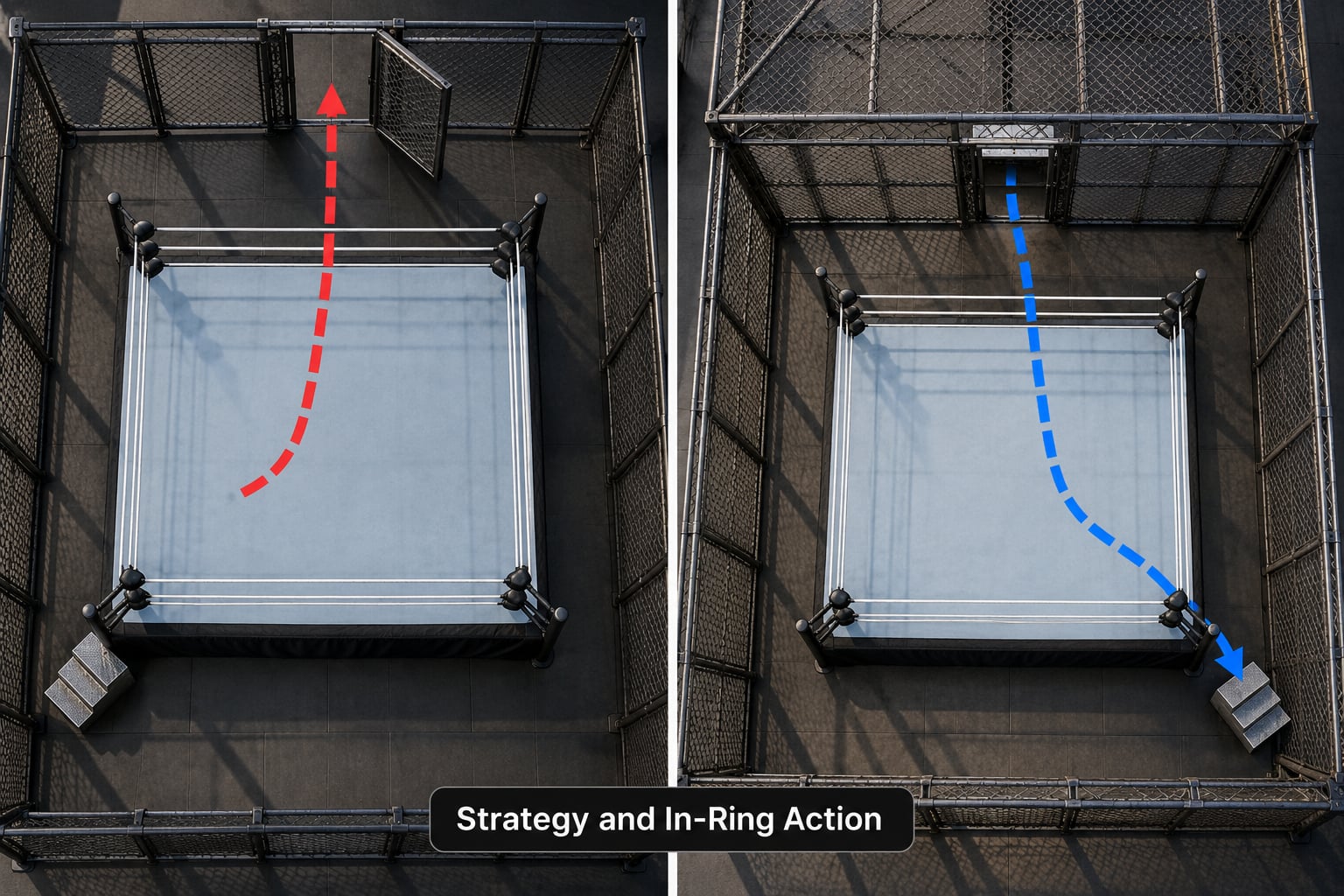
Escape being on the table changes everything a cage match is about. A wrestler on offence in a cage is often working toward the cage door rather than toward a pin, and a wrestler on defence has to decide whether to keep his opponent inside the ring or start blocking the door. Half the drama is a wrestler staring at a door his opponent is about to reach.
A Cell removes that entire layer. With nowhere to escape to, wrestlers commit to damage instead, which means longer matches, more weapons and more time spent on the floor and the roof. Fans who prefer the cage tend to talk about in-ring wrestling and structure, while fans who prefer the Cell tend to talk about how much punishment a match contained. Both are describing the same difference in objective.
That is also why a cage match is usually shorter. The clock is running on one escape, and once someone goes over the top, the match is over. A Cell match has no natural ending point except the point where one wrestler cannot continue, so those matches tend to run considerably longer.
Risk, Safety, and Working Conditions
A Cell is the more dangerous of the two, and the difference comes down to height and hard surfaces. There is no roof on a cage to fall from, and the mesh walls are roughly chest height. Inside a Cell, a wrestler can be thrown off the roof walkway, dropped from the top or sent through a table onto a frame that has no ropes to soften the landing.
The 1998 King of the Ring match between Mick Foley and The Undertaker is the reference point fans reach for when they want to explain why. Foley went over the top of a Cell several times that night, and the match is still the reason a casual viewer understands that a Cell is not just a larger cage.
Neither format belongs anywhere near a self-run event. These structures are engineered, loaded and rigged by trained crews, and both matches are worked and refereed with the safety of the wrestlers already accounted for. Attempting either outside a professional show puts the people involved at serious risk of crushing injuries.
Which Should You Choose?
If you want a compact contest with a clear finish and a lot of in-ring wrestling, the steel cage is the better fit. The escape objective gives the match a clock, keeps it tight, and lets two skilled wrestlers work with the cage itself as a tool without needing weapons or height.
If you want the major-event version, the Cell is where the danger and the scale live. You get more space, more surfaces to fall from, a longer runtime and a payoff that feels larger because the structure itself stays locked in view for the whole match. The trade-off is that the wrestling takes a back seat to the punishment more often.
They are not competing versions of the same thing, which is the wrong way to look at it. The cage is a match type, the Cell is an event, and the reason people cannot tell them apart is that both are called a cage match in conversation. Once you can spot the roof, the difference is obvious from across the arena.
Frequently Asked Questions
Can you win a cage match by pinfall?
Yes. A standard steel cage match can end three ways: pinfall, submission or escape. Escape is the extra option that separates a cage match from a Hell in a Cell, but a pinfall or a submission inside the cage ends the match exactly as it would on a normal show.
Does escaping a Hell in a Cell have to be permanent?
Under standard rules, escaping is not a win condition in a Hell in a Cell match at all, so permanence is not the issue. Wrestlers have climbed down and run through the door while the match continued, because pinfall or submission is what the contest is actually decided by. The roof exists largely to close off that option.
Are all cage matches no-disqualification matches?
Most are. Disqualification is not a live rule in a standard steel cage match, so weapons, illegal moves and outside interference are all allowed and the referee will not stop the contest over them. Variations such as the Escape Only match or matches with a restricted weapons list change that, so check the specific stipulation.
Why does a Hell in a Cell have a roof?
Because escape is not a win condition in a Cell match. A steel cage has to be open at the top, since climbing out is how a wrestler wins it. Put a roof on and that exit disappears, which frees WWE to build the structure far larger and taller without anyone simply leaving, and it removes the option of a cheap ending.
How long does a twenty count last in a cage match?
It is a matter of seconds, not a fixed clock. Once a wrestler escapes, the referee begins counting to give the trailing wrestler a chance to pull him back inside before the escape is confirmed. If the escaping wrestler makes it back over the fence before the count finishes, the match continues.
Is a steel cage match safer than Hell in a Cell?
Generally, yes. A cage is chest-high steel mesh with no roof to fall from, while a Cell stands more than 20 feet tall with a walkway on top and no ropes or turnbuckles to catch a fall. Neither should ever be attempted outside a professional event, where trained crews handle the loading and rigging.
Conclusion
The distinction comes down to one thing: a cage match adds escape to the list of ways to win, and a Hell in a Cell does not. That single rule explains the roof, the height, the extra space around the ringside floor and the longer runtime. If you can remember nothing else, check the roof next time you see one of these matches on television, and you will never confuse the two again.