
A wrestling title history page is a record of one championship’s lineage: every champion in order, the date and event of each title change, how long each reign lasted, and notes explaining vacancies, renames, unifications, and disputed changes. You read it top to bottom and follow the chain of who beat whom, using the reign numbers, day counts, and footnotes to fill in the gaps. Ten minutes with the column key is all it takes to stop guessing.
Most confusion comes from one thing: a title history page is not a results archive. It is a filtered, edited record where a company decides what counts. Once you know that, the columns stop looking like a wall of numbers.
Table of Contents
- What You Need
- Step-by-Step
- Start with the Championship Name and Scope
- Understand the Table’s Columns and Symbols
- Trace the Lineage in the Right Direction
- Read Each Reign as a Complete Record
- Read the Wrestling Title History Page’s Notes
- Verify the Records That Matter Most
- Common Mistakes
- Tips for Using a Wrestling Title History Page
- Frequently Asked Questions
- What is a wrestling title lineage?
- Should combined reigns count toward a championship’s longest-reign record?
- How do I handle a disputed championship change?
- Why do wrestling title history pages use different date formats?
- Which source should I trust when title records conflict?
- Conclusion
What You Need
You need four things before you read a single row, and none of them cost money or a membership.
- The exact championship. Not “the world title” but the named title, plus the promotion. WWE Championship, World Heavyweight Championship, and WCW Championship sound interchangeable and are three separate lineages.
- The brand. A title designated to Raw or SmackDown is a different designation of the same lineage, and the brand column tells you which era of the record book you are looking at.
- The time period. The NWA held the lineage from 1963 to 1983 before WWE left it, and those years are treated differently from everything after.
- A column key. Every serious page has one near the top. If you cannot find it, move to a source that publishes its rules, because a table without a key is a table you cannot verify.
Here is the reading order that works on almost any page: header, then statistics box, then the name-change table, then the reign table, then the notes, then the references. Six stops, about ten minutes.
Step-by-Step
Start with the Championship Name and Scope
Read the title name at the top of the page and expand every abbreviation before you go further. A page headed “List of WWE Champions” covers one championship, not every title WWE has ever run. That distinction is the single most common source of arguments online, and it is entirely avoidable.
Check the “other names” field next. A name change usually means the same belt and the same chain of champions, while a unification means two chains were merged into one. The WWE Championship, for instance, became the Undisputed WWE Championship in April 2024, and the record book treated that as a rename rather than a new title.
Two pages with similar names are not one lineage until someone shows you the chain connecting them. Treat an unconnected title as a separate record until a source documents the link.
Understand the Table’s Columns and Symbols
The largest table on the page carries the reign data, and each column answers a different question. Here is the layout used by the main WWE champion list, with what each field actually tells you.
| Column | What it means | What to look for |
|---|---|---|
| No. | Overall reign number in that lineage | Reigns 1 through 154 on the WWE Championship list. A jump or a repeated number signals a merged lineage. |
| Reign | How many times this champion has held the title, in order | The third Reign column value of 3 means the champion’s third time with the belt, not the third champion overall. |
| Champion | The person who held the title | Names listed with a marker beside them are usually footnotes, not decoration. |
| Date, Event, Location | When and where the change happened | Read it as one cell group. House shows and pay-per-view results both appear here, and tape-delayed segments often carry a different date than the on-air one. |
| Days | Actual time the champion held the belt | This is the physical count. It is the number that produces records like the 2,803-day single reign by Bruno Sammartino. |
| Days recog. | Days the promotion officially credits | Often shorter than the actual count when a company declines to recognize part of a reign. |
| Notes | Explanations, footnotes, and disputes | This is where vacancies, unifications, and handovers get explained. Never skip it. |
| Ref. | A citation linking to a source | A row with a citation is a claim you can check. A row without one is a claim you take on trust. |
A worked example row reads like this: No. 27, Reign 4, a champion name, a date, an event, a city, a day count, a shorter recognized count, a note about a stripped title, and a footnote marker. Every field is doing a job, and the two day counts are the one beginners misread most.
Then come the symbols. Three marks cover most of what you will see on a well-maintained page.
| Mark | Meaning | Why it changes your reading |
|---|---|---|
| Dagger | The title change is not recognized by the promotion | The champion physically held the belt and the promotion does not count the reign in its official history. |
| <1 | The reign lasted under one day | It counts in the lineage chain but almost never in a record category, which is why the shortest reign is listed separately. |
| Plus sign | The reign is still running | The day count increases every day, so any record involving the current champion changes under you. |
| Superscript number | A footnote | It points to a note explaining a disputed, unusual, or caveated entry. Treat it as required reading, not fine print. |
André the Giant’s reign of one minute and forty-eight seconds is the clearest example of why symbols matter. It sits in the lineage, and it does not disturb the longest-reign record at all.
Trace the Lineage in the Right Direction

Lineage is the unbroken chain of champions, and the simplest definition comes from a long-running lineage-rules discussion on r/SquaredCircle: a lineal title tracks the guy who beat the guy who beat the guy. No promotion invented the rule and no committee enforces it, which is exactly why the arguments never end.
Trace the chain in one direction only. Start at the bottom row, read upward to the current champion, and never jump to a related title because the names look similar. If a lineage diagram appears without stated rules, treat it as a claim rather than a source.
Watch for the three events that bend the chain:
- Vacancy. The title is vacated after a champion cannot defend, often on injury. A vacant stretch still belongs to the lineage. It is recorded as a vacancy, not as a reign, so a table showing 154 reigns and 11 vacancies on the WWE Championship list is counting two different things.
- Unification. Two lineages merge into one. The reigning holder of the primary title usually becomes champion of the merged title, and the other lineage’s records are retired rather than deleted.
- Handovers. A belt is handed to someone without a match. The Antonio Inoki and Jack Tunney case and the Ted DiBiase belt passed to André the Giant are the classic examples, and historians still read them differently.
Brand moves complicate this further. The WWE Draft moved champions between shows, and a brand extension shifted a title’s designation without changing a single champion. The designation tells you which era the record belongs to; it does not start a new lineage.
Read Each Reign as a Complete Record
One row is not just a name and a date. Read it as a full sentence: this champion won the title from this opponent, at this event, in this city, on this date, held it for this many days, and the promotion recognized this portion of it.
Check whether the change was official. A tournament final, a cash-in, an award after a match, and an on-screen handover are four different things, and pages label them inconsistently. The WWE Championship combined-reigns ranking separates actual days from days recognized by WWE precisely because the two lists disagree in several cases, and the disagreements are the interesting part.
Then check whether the champion is a repeat. The overall reign number and a champion’s personal reign number are separate columns, and conflating them is how arguments about John Cena’s 14 reigns or anyone’s combined total go wrong. Combined reigns sum separate stints, so a wrestler with several short runs can top that table without ever topping the single-reign record.
Read the Wrestling Title History Page’s Notes
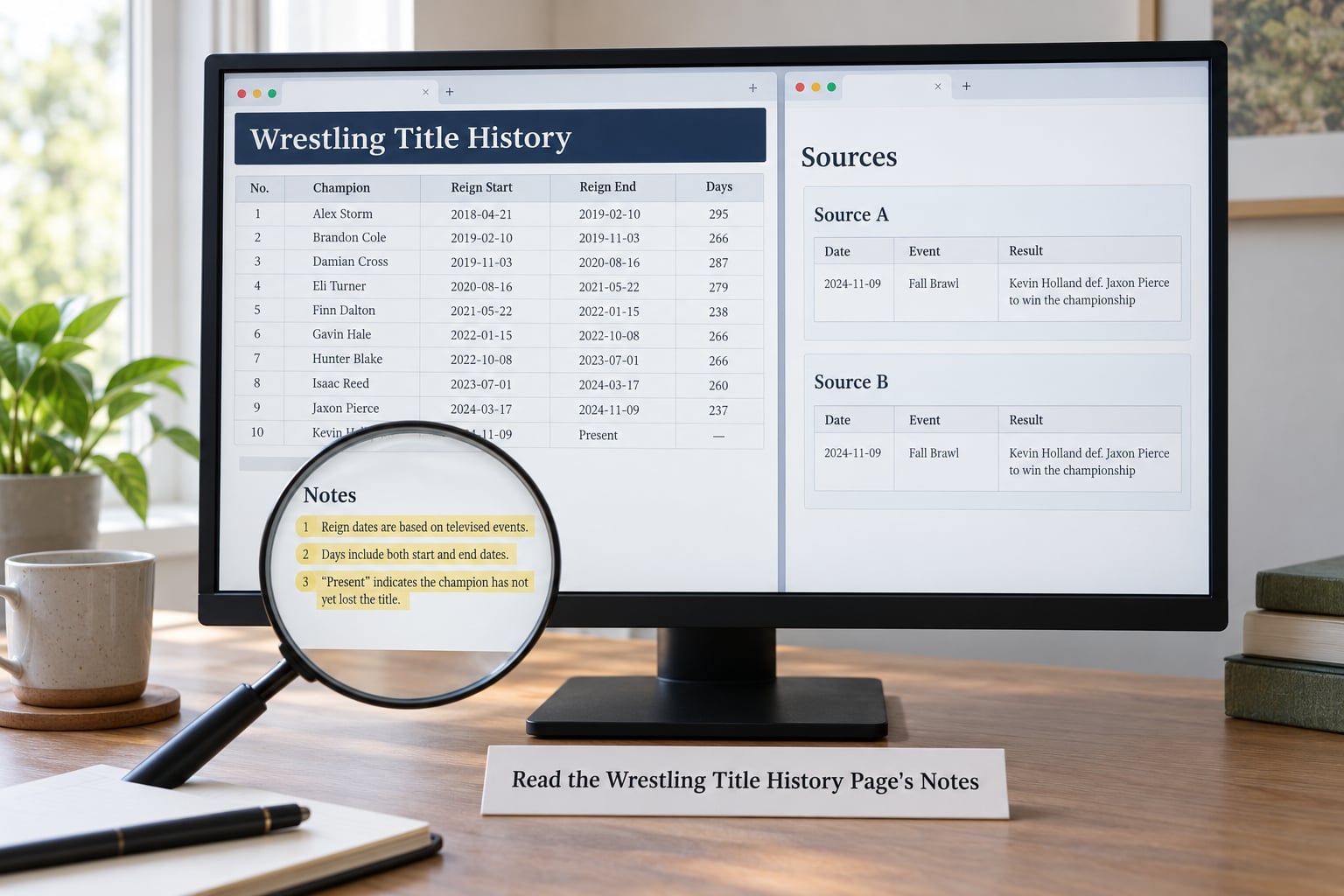
The notes section is where a wrestling title history page becomes honest or unreliable. Every legitimate page states its editorial conventions, and you should be able to read them before you read a single reign. Look specifically for how the editors handle vacated titles, unrecognized changes, empty reigns, disputed dates, and records that differ between databases.
Three things should be there. The NWA exit and the 1971 to 1983 period when the title was not recognized as a world championship outside WWE. The lineage amendment made to the Universal Championship after Cody Rhodes beat Roman Reigns, which changed official records retroactively. And a statement of what counts when a company and an outside database disagree.
If the notes are thin, the page is a fan project dressed up as a reference. That is not an insult, it is just a different thing, and worth knowing before you quote it.
Verify the Records That Matter Most
Four record categories get quoted more than everything else combined, and each deserves a cross-check. Verify the longest single reign, the most defenses, the first champion, and any lineage claim that sounds surprising. For the WWE Championship those records point to Bruno Sammartino’s 2,803-day run, Buddy Rogers as the inaugural champion in 1963, and the modern reign counts, and each one can be confirmed against promotion records, event results, contemporary coverage, and established reference works.
Work the check in this order:
- Find the claim’s cited source. A row with a reference is checkable in one click.
- Compare against a second, independent database. If two reputable sources agree, you are probably fine.
- Look for the footnote, because that is where the honest disagreement is written down.
- When sources still differ, say so. Fans trust a source that names the dispute over one that picks a side silently.
Never verify a title history claim against a social post, a video thumbnail, or an unsourced lineage graphic. Those are opinions with formatting.
Common Mistakes
Treating similar names as one lineage. Two titles that sound related are separate records until a source connects them. Fix: find the row where a champion held both, or the note that documents a unification.
Ignoring the second day count. The actual and recognized columns often differ, and picking the wrong one changes a record. Fix: quote both, and say which one you mean.
Counting combined reigns as a single reign. Combined totals add stints together, which is a ranking category rather than a reign. Fix: use the single-reign column for reign records and the combined column only for career comparisons.
Reading a vacancy as a reign. A gap where nobody held the belt is a vacancy, not an abbreviated reign. Fix: the table marks these separately, so count reigns and vacancies as two figures.
Skipping the footnotes. The footnote is where unrecognised changes, handovers, and retroactive amendments live. Fix: read the notes after the table, not before the conclusion.
Treating every source as equally authoritative. An official promotion history reflects what the promotion wants on the books. A reference database reflects what its editors could source. A fan wiki reflects a compiler’s judgment. Fix: know which kind you are reading before you cite it.
Believing a lineage diagram without rules. Two people can produce two different chains from the same title and both be internally consistent. Fix: read the stated rules first, then judge the chain.
Tips for Using a Wrestling Title History Page
Different sources are good at different things, and picking the right one saves you from reconciling numbers later.
| Source type | Strongest for | Weakest at |
|---|---|---|
| Official promotion history | The current brand designation, the current champion, and company policy on what is recognized | Anything disputed, vacated, or pre-NWA-exit; official records have been amended retroactively |
| Wikipedia list and championship articles | Full reign tables, statistics boxes, and footnotes that name the disagreement | Beginner readability; the tables carry footnotes that change meaning |
| Reference database such as Wrestling-Titles.com | Finding the right lineage page in the first place, and title hierarchies across promotions | It is an index first, so narrative context is thin |
| Independent or regional title pages | Short, self-contained lineages for independent promotions and women’s wrestling titles | Coverage stops when a promotion closes or a title is deactivated |
Keep notes as you read. A small column with the page URL, the date you checked it, and the exact number you found will save an argument later, because pages change as new reigns happen.
Learn each site’s own vocabulary. One page may say “days recog.” where another says “recognized,” and a third publishes only a single day count. The labels differ, the underlying facts often do not.
Follow the citation links. They take you to contemporary coverage or to an official announcement, which is the fastest way out of a dispute and the best source for a retrospective you are writing.
Then use the page for what it is good at: understanding how a wrestler’s career moved. A champion’s rows show when they were headliner, when the company put them on the shelf, and where a long gap sits between two stints.
Frequently Asked Questions
What is a wrestling title lineage?
A lineage is the unbroken chain of champions in a championship, where each holder won the title by beating the person who held it before. The framing used by wrestling historians is that a lineal title tracks the guy who beat the guy who beat the guy. A lineage is separate from the belt itself, which can be renamed, redesigned, or moved between brands while the chain of champions continues unbroken.
Should combined reigns count toward a championship’s longest-reign record?
No. Combined reign totals add several separate stints together, so a champion with many short runs can lead that ranking without ever holding the belt long in one stretch. Longest-reign records use the single-reign day count only. Reference pages usually publish both columns so you can see where a career total came from, and the WWE Championship list is a good example of that side-by-side format.
How do I handle a disputed championship change?
Treat it as a dispute and show your work. Note the date, the event, and the two competing accounts, then check whether the page marks the change with an unrecognised-change symbol and whether a footnote explains it. If a promotion and a reference database disagree, report both numbers and say which source you used. Readers trust a historian who names the disagreement over one who quietly picks a side.
Why do wrestling title history pages use different date formats?
Different publishers built their tables for different jobs. Some record the date the match happened, others the date the episode aired, and tape-delayed segments can push those apart. Independent and regional pages often use a single day and month format with the year in a note, while main reference pages use a full numeric date. When comparing two pages, check the format before assuming the dates actually disagree.
Which source should I trust when title records conflict?
Trust the source that cites its rules and shows its notes. An official promotion history tells you what the company recognizes, which is one legitimate position rather than the final word. A reference database with footnotes usually tells you what outside records found. When they conflict on a disputed change, say so in your own writing and give both figures, since the disagreement is itself the historical fact worth recording.
Conclusion
Start with the exact championship and its lineage, then read the statistics box, the column key, and the reign table in that order. Treat the day counts and the footnotes as the real content, because that is where recognized history and disputed history are separated. When a claim matters, follow the citation or check a second database rather than repeating the first number you saw.
In short: identify the title, establish its lineage, inspect the table and its notes, then verify the unusual claims. Anyone can learn to read a wrestling title history page that way, and the records you quote will hold up.