How wrestling entrance music is chosen and licensed comes down to two jobs that happen in sequence: a promoter’s music team picks the track because it fits a character, then a clearance person makes sure it can legally play on the arena PA, on television, and on a streaming service. Pick a song without clearing it and the whole entrance dies at the worst possible moment.
Short version: a wrestler, the promotion’s creative lead, and a music producer work together on taste, and a clearance person handles permission. Nothing plays on the ramp until both sides are done.
Below is the full chain, from first reference track to the moment a cue hits a speaker at a live show, plus what changes when the same theme has to work for broadcast, streaming, and a video game.
Table of Contents
- How Wrestling Entrance Music Is Chosen and Licensed
- Who Chooses Entrance Music for a Wrestler?
- How Do Wrestlers, Promoters, and Producers Divide the Work?
- How Is Entrance Music Cleared for Wrestling Use?
- What Types of Entrance Music Can Wrestlers Use?
- What Makes an Entrance Theme Work on a Wrestling Show?
- Frequently Asked Questions
- Can a wrestler use any song for an entrance theme?
- Who pays for a wrestler’s original entrance music?
- Is a song licensed for live use automatically licensed for entrance videos?
- Why does a promotion sometimes shorten or edit a wrestler’s entrance song?
- Can independent wrestlers use streaming-service music at live shows?
- Conclusion
How Wrestling Entrance Music Is Chosen and Licensed
Here is the process in plain terms. Someone on the creative side proposes a direction, usually a shortlist of reference tracks or a description of the character. A producer turns that into a demo, the demo gets approved, and the finished cue is then cleared for every place it will be used: arena PA, television broadcast, streaming library, and video game. Only after clearance does the theme get performed in front of an audience.
| Step | What happens | Who owns the decision |
|---|---|---|
| 1. Character concept | Wrestler’s role, entrance gear, and crowd reaction are defined | Promotion creative team |
| 2. Reference shortlist | Two to four existing tracks or a mood description are proposed | Wrestler and creative lead |
| 3. Route decision | Commission original, license an existing recording, or use production library music | Promotion, with cost input |
| 4. Composer brief | Length, tempo, instrumentation, vocal presence, and mix targets are specified | Music producer |
| 5. Demo pass | One or more rough cues delivered for reaction | Wrestler and promoter |
| 6. Mix and edit | Final cue trimmed to walkout length and leveled for a loud room | Producer and audio team |
| 7. Rights clearance | Master and composition rights cleared per channel | Clearance or business affairs |
| 8. Cue sheet and debut | Approved track filed for the show, wrestler, and platform | Production crew |
The step people skip is step three, the route decision. A promotion has three ways to source a cue, and they lead to very different long-term costs and legal positions.
The first route is commissioning an original theme from a composer, which takes weeks but leaves the promotion owning or controlling the finished recording. The second is licensing an existing commercial recording for a defined term, which is faster and instantly recognisable, and it usually carries both an upfront fee and ongoing royalties. The third is using production library music: a track written and recorded for licensing to productions, which is cheap, fast, and clear to broadcast but has no cultural weight behind it.
Selection and licensing being separate decisions is the whole trick. The track that would feel best on the ramp is rarely the easiest one to use for five years across a broadcaster, a streaming platform, and a game.
Who Chooses Entrance Music for a Wrestler?
The short answer is that wrestlers usually get real input into the direction, and the promotion makes the final call. Wrestlers talk about this often, and the pattern is consistent: they describe a taste, a reference track, a tempo, and sometimes an artist they wanted, and then the company’s creative team decides what actually plays.
Major promotions keep that control tighter than most people expect. A theme is part of a televised product, and a song attached to a wrestler carries brand and clearance consequences that an independent booking agent cannot evaluate. So the promotion holds the veto even when the wrestler is the one pushing for a specific track.
There is also a clear split between original themes and borrowed ones. An original commissioned theme is built for the character and usually sticks with them through a run. A borrowed mainstream song is often treated as temporary, which is exactly what it is: a licensed arrangement with an end date attached.
How Do Wrestlers, Promoters, and Producers Divide the Work?
The wrestler sets the emotional target. They know which songs make them feel like the character they are portraying, and they often arrive with a shortlist. What they rarely control is the final edit.
The promoter or creative lead approves the direction and pays for it. That person balances character fit against budget, audience recognition, and whether the track can survive a broadcast mix.
The music producer turns the approved direction into audio. That covers composing or sourcing, arranging, editing to length, and mixing for a room that is louder than any studio.
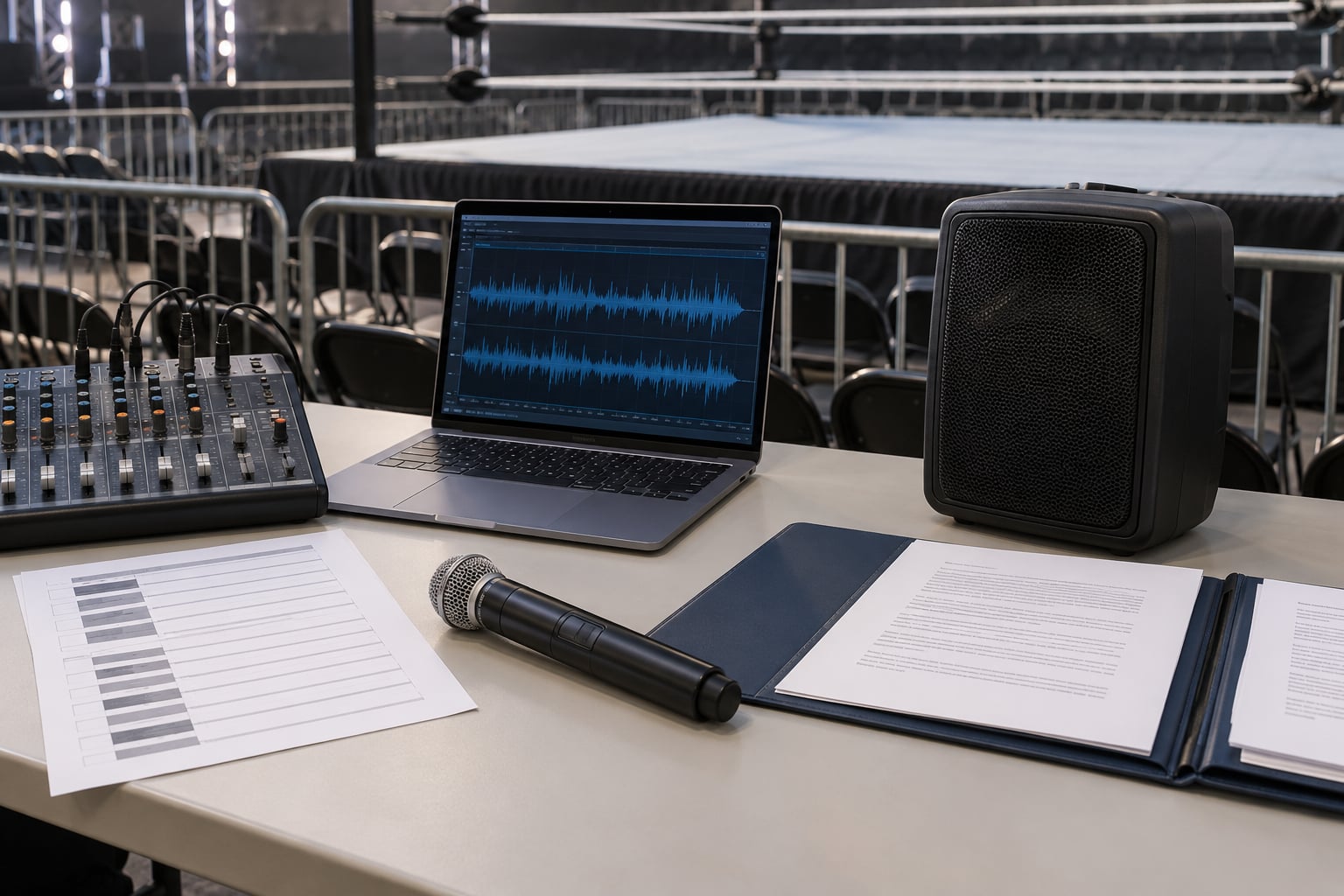
The production team confirms the cue is usable on the night. They check the file is on the playback system, the level is right, the entrance length matches, and the rights cover the show being performed in the venue being used.
How Is Entrance Music Cleared for Wrestling Use?
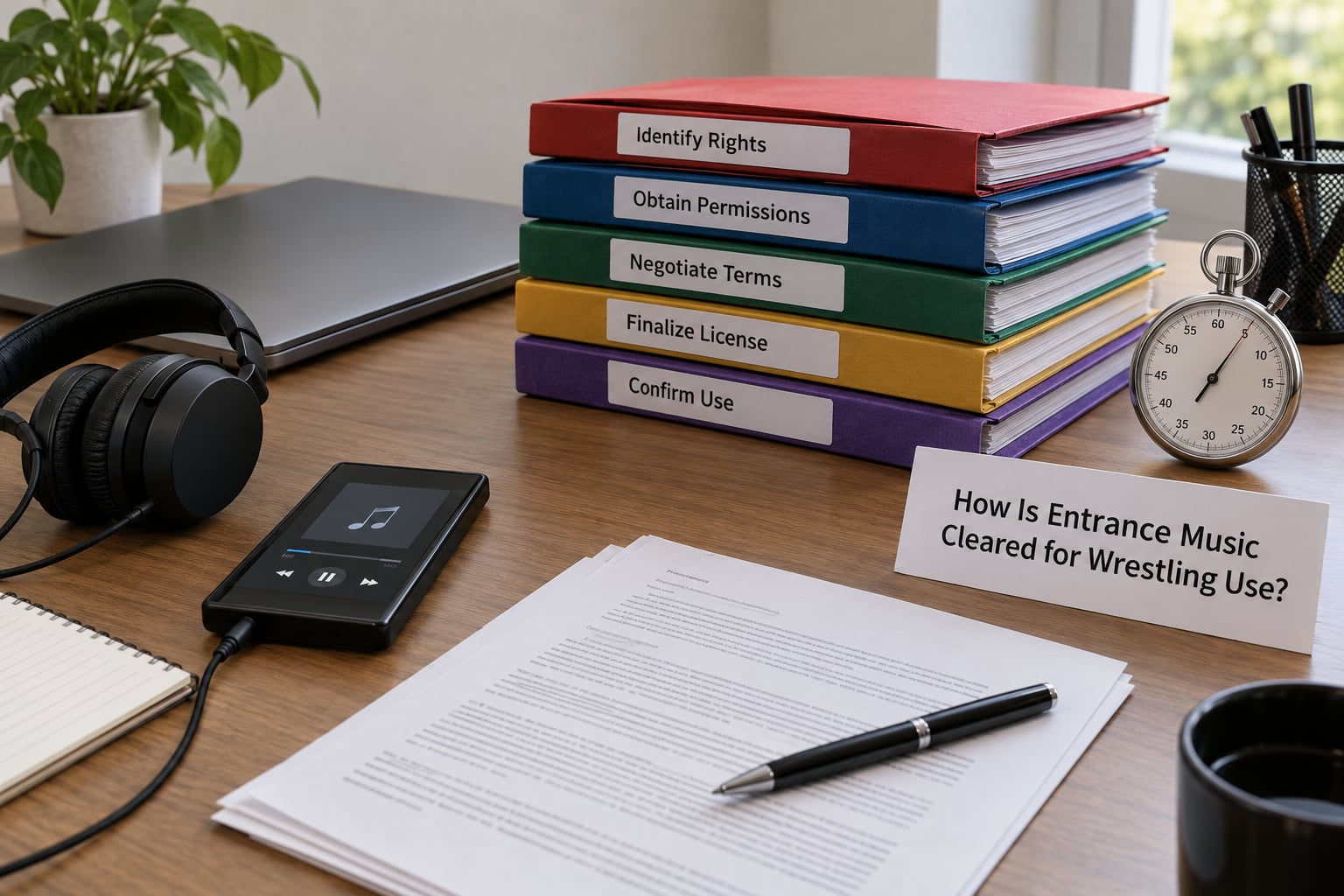
Every recorded song carries two separate copyrights, and a promotion needs permission for both. The composition copyright covers the song itself: melody, lyrics, chords, structure. The master or sound recording copyright covers the specific recorded version. Playing a famous song in an arena means clearing the recording through the label and the composition through the publisher, usually as two separate deals.
| Right | What it covers | Who is typically paid |
|---|---|---|
| Composition copyright | Melody, lyrics, chords, structure | Songwriter and publisher, via a performance rights organisation such as ASCAP or BMI |
| Master (sound recording) copyright | The particular recorded performance | Record label or artist who own that recording |
| Synchronisation and master use licence | Using the audio alongside a video package or broadcast visuals | Both parties, usually with an upfront fee plus backend royalties |
| Public performance licensing | Playing the song in a public space such as an arena | Covered for many venues by a blanket licence paid through PROs, but promotions often negotiate directly |
Beyond those, platform-specific restrictions matter more than most fans expect. A broadcast deal covers the channel it names. A streaming library deal covers on-demand playback and usually carries a term. A video game needs its own licence with its own term and its own territory language, and an entrance clip uploaded by a fan is a completely different use from an official video package the promotion publishes itself.
That last distinction matters. Covering a song live, playing a licensed recording at an event, streaming that entrance as part of an on-demand library, and using the audio inside an official video package are four different permissions. A deal that covers one rarely covers the others automatically.
Precise requirements vary by promotion, venue, broadcaster, platform, territory, and contract. A regional television deal in one country can carry a completely different restriction set from a global streaming library, and a promoter’s contract with a wrestler may assign or reserve rights in ways that are never public.
What Types of Entrance Music Can Wrestlers Use?
Original commissioned themes are the top of the list, and they are the cleanest option. Nobody can object to a cue written specifically for the wrestler, the promotion controls it, and it can be edited, extended, or re-mixed for a return without renegotiating anything.
Licensed commercial recordings come next. These give instant recognition, which is valuable when a wrestler is new and the crowd needs a cue to attach to. The catch is that recognition arrives with conditions: a term, a territory, an edit allowance, and a fee that scales with how long the track is used.
Cover versions sit in between. A live cover gives the wrestler or the promotion control over the master without paying a label for the recording, but the composition still needs a licence, and a cover that is recognisable enough to work can be recognisable enough to draw a claim.
Public domain or properly cleared compositions are the safest option for independent work. Older compositions may have compositions free for commercial use, though arrangements and modern recordings of them usually are not.
Temporary imported tracks are the last category, and they are common. A promotion will use a borrowed mainstream song for a debut, a return, or a rebranding, then replace it once clearance becomes expensive or complicated.
That replacement is often called dubbing, and the cost logic is the single most repeated fact in wrestling forums. Rather than keep paying licensing fees on a streaming library, a promotion can record a new production track that sounds close enough in mood to work. It is also the reason some tracks people assumed were cheap library music turn out to have been commissioned outright.
The reverse also happens. Independent promotions license tracks outright rather than inheriting them from a catalogue, and fans have noted that a track’s catalogue status does not block licensing: an old theme pulled from a defunct promotion’s library can still be cleared years later for a current game.
An original theme is not automatically cheaper or easier, by the way. It costs more up front in composer time and studio days, and it still needs mixing, cue sheet work, and a contract that says who owns the finished recording.
What Makes an Entrance Theme Work on a Wrestling Show?
Tempo is the first filter. A cue has to carry a walk from the curtain to the ring at a deliberate pace, and a slow intro that works in a car becomes dead air in front of a few thousand people.
Structure matters next. Most usable themes have a clear hit point: an opening sting, a rise, and a moment that lands. Vocal presence is a choice rather than a default, and plenty of strong cues use a vocal hook with no lyrics the audience can hear over commentary.
Edit length is where most borrowed tracks get cut down. A four-minute song rarely plays in full, so a shortened arrangement built around the strongest thirty seconds is what actually ships.
Volume and transitions decide whether the crowd hears anything at all. Pyro, lighting changes, ring bell hits, and commentary all compete for the same moments, and a cue with no clean transition point gets faded out early.
Walkout timing is the practical test. Production counts the entrance in seconds and cuts the cue to match, so the theme has to have a natural ending rather than just running out.
A worked example. Suppose three reference tracks are shortlisted, and how wrestling entrance music is chosen and licensed comes down to what happens next: two are licensed mainstream songs with strong recognition but awkward structures for a short ramp, and the third is a production library cue with a clean hit and a proper ending but no audience recognition. The usual resolution is a licensed or commissioned theme for television and headline shows, with the production library cue covering house shows, streaming libraries, and secondary appearances where per-playback costs bite. That split is common and it is why the same wrestler can have two different cues.
Frequently Asked Questions
Can a wrestler use any song for an entrance theme?
No. A wrestler can suggest any song, but playing a commercial recording publicly requires permission for the master and the composition. Covering it live still needs a composition licence. Promotions with broadcast and streaming deals also have to clear the audio for those platforms separately, which rules out a lot of songs that would otherwise work in a small room.
Who pays for a wrestler’s original entrance music?
Usually the promotion, sometimes the wrestler, sometimes a record label involved with the performer. A commissioned theme is typically a cost the company absorbs because the recording becomes part of the show’s property. Wrestlers who also release their own music sometimes retain publishing in a split sheet, so they can earn from the theme and their own releases at the same time.
Is a song licensed for live use automatically licensed for entrance videos?
No. Playing a song in a venue and using its audio inside a broadcast, a streaming library, or an official video package are separate permissions with separate fees and terms. A live performance licence covers the arena only. Publishing entrance clips yourself, or letting a fan upload one, can also trigger content ID claims, since that use is not covered by the deal at all.
Why does a promotion sometimes shorten or edit a wrestler’s entrance song?
Because the walkout is measured in seconds, not minutes, and the cue has to end cleanly for the ring bell and commentary. Editors also trim licensed tracks to what the licence allows and to what fits pyro, lighting changes, and the video package. A shortened version is often the version that survives clearance, streaming, and game use.
Can independent wrestlers use streaming-service music at live shows?
Not safely. A personal subscription does not grant public performance rights, and playing a track in a venue is a public use. Budget routes that work are production library music licensed for live events, commissions from local composers, and older compositions that are genuinely public domain. Checking the venue’s existing blanket licence first can also remove some of the burden.
Conclusion
Choosing a theme and licensing it are two jobs run by two groups. Taste comes from the wrestler and the creative team, timing and edit come from the producer, and permission comes from whoever handles business affairs at the promotion.
Start with the intended use. Decide whether the cue needs to work in an arena, on broadcast, on a streaming service, in a game, or in a promotional video, because each one changes the answer. Pick the strongest musical fit within that scope, then confirm performance, recording, streaming, and editing rights before anyone announces it or walks out to it. That is the practical answer to how wrestling entrance music is chosen and licensed: decide the use, pick the strongest fit, and clear it properly.