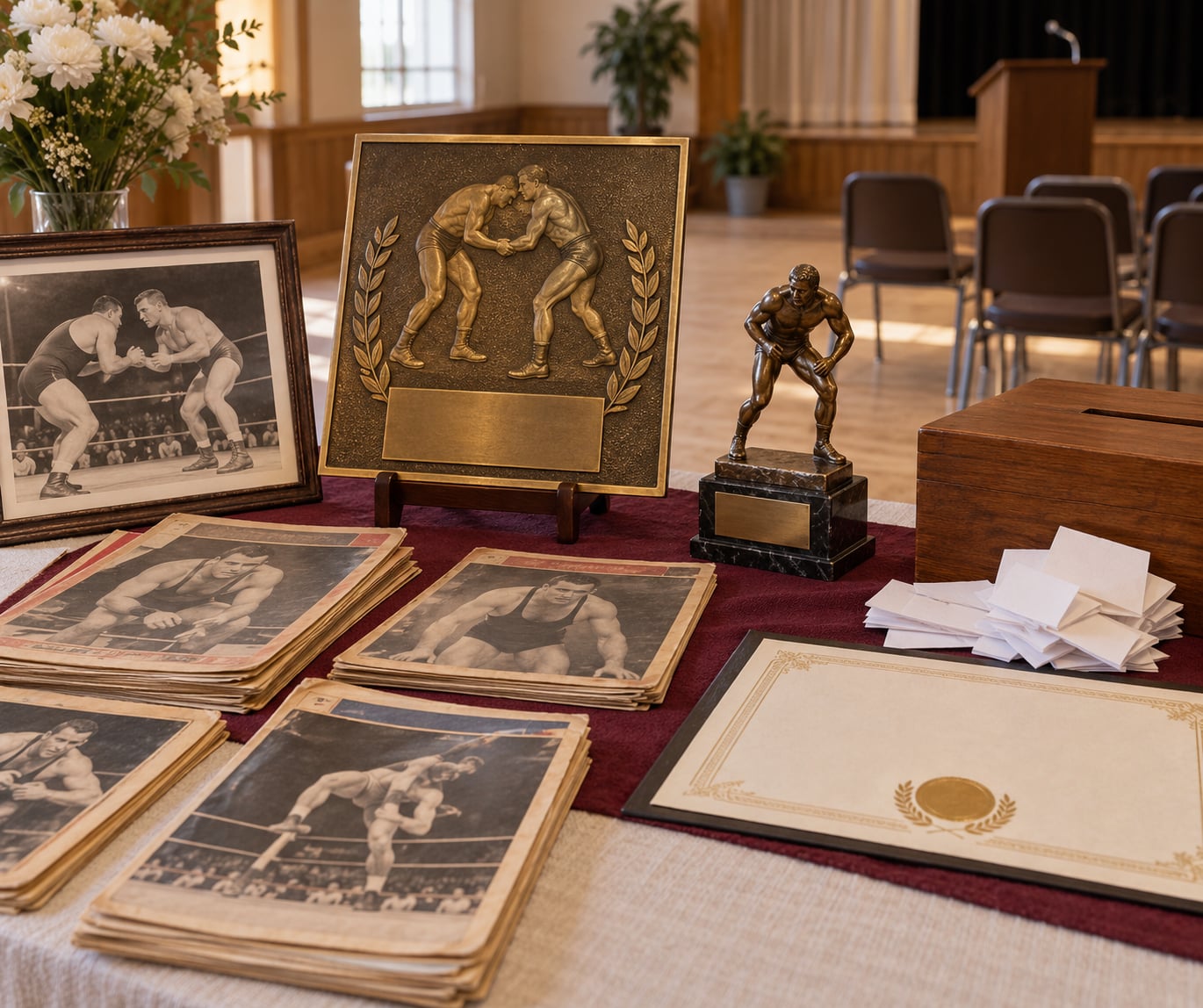
Wrestling halls of fame outside WWE operate as independent, usually volunteer-run nonprofits: a board nominates candidates, members or the board vote on an induction class, donations and reunion ticket sales pay for a yearly ceremony, and volunteers keep tape, programs and memorabilia from the territory era from disappearing. If you have ever wondered how wrestling halls of fame outside WWE operate day to day, there is no single authority, no official ranking and no central database of inductees. What follows is how that machine actually works, organization by organization.
The confusing part for most fans is that a “hall of fame” can mean a museum with glass cases, a charity that hands out money to broke retired wrestlers, or a list published in a newsletter with no event at all. Those are three different businesses with three different budgets. Once you know which type you are looking at, the rest is much easier to follow.
Table of Contents
- What Is a Wrestling Hall of Fame Outside WWE?
- How Are Outside WWE Halls of Fame Organized?
- Who the board members are
- How governance actually differs
- Who Decides Who Gets Inducted?
- How wrestling halls of fame outside WWE run a vote
- Is it pay to play?
- How Are Nominees Chosen and Honored?
- What Happens at a Wrestling Hall of Fame Induction Ceremony?
- How Do Outside Halls of Fame Fund Their Work?
- How Do They Preserve Wrestling History?
- Why Don’t WWE and Other Halls of Fame Work the Same Way?
- Frequently Asked Questions
- How are wrestling hall of fame inductees usually selected outside WWE?
- Can fans vote for inductees in independent wrestling halls of fame?
- Who pays to run a wrestling hall of fame ceremony?
- What is the oldest wrestling hall of fame outside WWE?
- Can wrestlers or promoters be inducted into more than one hall of fame?
- How can fans support a regional wrestling hall of fame?
- What Should Fans Look For First?
What Is a Wrestling Hall of Fame Outside WWE?

A wrestling hall of fame outside WWE is an independent organization, normally a 501(c)(3) nonprofit, that preserves professional wrestling history through annual induction events, physical collections, and sometimes financial help for retired wrestlers. Nobody owns it and nobody licenses it, which is exactly why the Cauliflower Alley Club in California, the International Pro Wrestling Hall of Fame in Albany, the National Wrestling Hall of Fame in Stillwater, and the Professional Wrestling Hall of Fame and Museum in Wichita Falls can all claim the same title at once.
Here is the short list worth knowing:
- Cauliflower Alley Club — founded 1965, the oldest of the group, a benevolence club that holds a reunion and hands out the Iron Mike Mazurki Award and the Ron Hutchison Trainers Award.
- International Pro Wrestling Hall of Fame — Albany, New York, a registered not-for-profit museum working toward a physical space with a New York State charter.
- National Wrestling Hall of Fame — founded 1976 in Stillwater, Oklahoma, a national body that also runs the George Tragos/Lou Thesz professional hall in Waterloo, Iowa.
- Professional Wrestling Hall of Fame and Museum — Wichita Falls, Texas, a walk-in museum with exhibits visitors can actually stand in front of.
- Wrestling Observer Newsletter Hall of Fame — a published, biography-driven list with no ceremony attached.
Do not confuse the National Wrestling Hall of Fame with the pro halls. Its main body is built around amateur wrestling, and its professional wing exists because of the Tragos/Lou Thesz legacy. Fans routinely trip over that line.
How Are Outside WWE Halls of Fame Organized?
Every one of these organizations is a board first and an event second. The board is usually a mix of retired wrestlers, promoters, collectors, historians and a small number of spouses and archivists who keep the paperwork moving.
Who the board members are
A wrestling organization’s governing body is a mix of people with a personal stake in the sport’s memory and a few who simply know how to run a nonprofit. The National Wrestling Hall of Fame publishes a named board of governors and officers, which is unusual transparency for a hobby that runs on handshake deals. The International Pro Wrestling Hall of Fame lists a president, Seth Turner, who has talked openly about the museum’s chartering problems and its finances.
How governance actually differs
There is no model hall of fame. One organization may give its entire board the final say; another may send every nominee to a wider membership ballot; a third may do both, with a screening committee narrowing a long list before anybody votes. Committees handle the screening so a dozen retirees do not have to argue in front of everyone. Volunteers run the reunion weekend, staff any booth at an independent show, and do the cataloguing.
Sponsors turn up in unexpected places too. A regional show buys tables, a hobby company underwrites the printing, and a fan with a printer saves the organization thousands. Nobody lists sponsors on the induction ballot.
Who Decides Who Gets Inducted?

Selection authority sits with the board or the members, never with the fans, the promoter, or a public vote in the way some major sports run theirs. In practice you will run into four methods, sometimes blended: a public ballot open to anyone, a membership ballot limited to dues-paying members, a straight board vote, and a committee decision when the class is small enough that all hands would be unwieldy.
How wrestling halls of fame outside WWE run a vote
Here is what a nomination usually travels through, and it is worth remembering that the order changes from one organization to the next.
- Eligibility review. The organization checks the basics, and the rules are not identical everywhere. The Cauliflower Alley Club’s benevolence mission is built around wrestlers who worked a minimum stretch in the business, and it also honors trainers with its own named award.
- Nomination submission. A nomination comes from the board, a chapter, a member or sometimes the candidate’s family, supported with dates, territory names and a reason.
- Committee screening. A small group reads the files and cuts the list down, checking for duplicated honors and for people already inducted elsewhere.
- Ballot or board decision. The survivors go to the full membership, or to the board, or to a joint session. Class size is the practical constraint and it changes year to year.
- Class announcement and ceremony planning. Names go public, plaques get ordered, and the logistics of a room full of wrestlers get solved.
Is it pay to play?
The short answer is no, not formally, and the reason is structural: a nonprofit that sells seats is destroyed if the public believes the guest list is for sale. That said, the suspicion is permanent, and the arguments on r/Wrasslin and r/SquaredCircle make the same three points every year — that long industry service correlates with who has good stories, that busy schedules keep some candidates from the room when the vote is taken, and that nobody publishes the raw vote totals. You will never see an audited ballot from a wrestling hall, and treating silence as proof of corruption is no more fair than assuming it away. The honest read is that these are small volunteer bodies making judgment calls in public, where the main currency is reputation.
How Are Nominees Chosen and Honored?
The selection process and the honor are two different halves of the operation. Selection is where the politics live; honoring is where the money and the time go.
A granite plaque in Stillwater, a bronze plaque in Iowa, a mounted certificate at a banquet in California, or an entry in a printed Observer booklet each cost a different amount to produce. Organizations with a permanent building keep the object forever. Organizations that rent a hall for a Saturday hand the plaque to the inductee and keep a photograph. Ceremony planning is genuinely unglamorous work: room rental, a microphone that works, a photographer, a table for the plaques, and a running order that does not put two feuding names in the same segment.
Announcements usually trail the event by weeks rather than days, which surprises people who expect a season-long rollout like a league sport. These groups are small, and the schedule follows when a hall is free and who can travel.
What Happens at a Wrestling Hall of Fame Induction Ceremony?
A typical non-WWE ceremony runs one evening, sometimes bundled into a reunion weekend, and it is closer to a benefits dinner than to a network broadcast. A video package plays, the presentation is made, the honoree talks, and the room applauds. There is no red carpet and no four-hour runtime.
Three formats cover most of the field. The museum model means a permanent building with exhibits and a smaller annual ceremony, like the Wichita Falls museum, whose visitor reviews rate it around 4.4 out of 5 across 34 mentions. The reunion model means a banquet where the honor is the entire event, which is the Cauliflower Alley Club’s format. The publication model has no event at all, and the Wrestling Observer Newsletter Hall of Fame is the clean example: the recognition is the written record of a career, and the audience is the readers.
Family members often accept plaques for wrestlers who are gone or simply unable to travel, and promoters routinely use the podium to announce one last tour date. Retired wrestlers who rarely give interviews are noticeably more talkative at these events, since nobody is asking them to answer for a current storyline.
How Do Outside Halls of Fame Fund Their Work?
Money comes from the audience, the members and occasionally a wealthy patron. Almost none of these organizations carry a large endowment, so a bad year shows up quickly. The pandemic showed it: the International Pro Wrestling Hall of Fame reported cash reserves hitting zero, with refund processing eating a meaningful slice of every transaction it handled, and the physical museum plan went from active to aspirational.
| Income source | Typical use |
|---|---|
| Membership dues | Operating costs, mailings, and a member vote on induction |
| Reunion and ceremony tickets | Rental, food, plaques, AV, and travel for the honoree |
| Individual donations | Benevolence grants, archive shipping, emergency shortfalls |
| Memorabilia auctions and signings | Cash for grants and exhibit cases |
| Local show sponsors | Printing, tables, transport, volunteer costs |
| Artifact sales and estate donations | Capital projects, sometimes a rare belt or trophy changing hands |
Figures you find online for any of these organizations are usually a mix of filed nonprofit records and a reporter’s estimate, so treat any number without a source as an estimate. The Cauliflower Alley Club is the clearest case of a hall whose budget line is not the ceremony at all but direct financial assistance to wrestlers who fell on hard times, and it also maintains a Ring of Friendship network for members in need. Knowing how wrestling halls of fame outside WWE operate financially matters because it explains why the ceremony is small: the money has to go somewhere else.
How Do They Preserve Wrestling History?
Preservation is the quietest part of the job and the reason any of these groups still exist. Territory-era material is not durable: programs were printed in small runs, tapes were recorded on formats nobody plays, and memorabilia sat in storage lockers until the building closed.
The core work breaks into a few buckets. The International Pro Wrestling Hall of Fame has released classic match footage with a video partner from the Savoldi collection, which is what archival material looks like once it survives. Artifact acquisition is the other half, and the Bruno Sammartino title belt the organization acquired is the kind of object that carries a provenance story, not just a value. Elsewhere you have oral history interviews, recorded match listings, program collections, ribbon cutting material, and loans where a collector keeps the item but signs over photo and scan rights.
Museum status is not a formality. A group that wants to call itself a museum has to work through a state education department for a charter, submit a collection and educational plan, and meet curatorial and access standards. That process costs money and years, which is why some organizations stay collectors and call themselves something else. Even where a building is not in play, donation agreements carry restrictions: a family can require that a robe stay together, that a name not be displayed, or that an item never be sold.
Why Don’t WWE and Other Halls of Fame Work the Same Way?
WWE’s hall is a corporate ceremony attached to a company that owns its own library, footage and brand, while the independent halls are separate nonprofits with no rights to the programming they preserve. Neither model is wrong, and the practical result is that wrestling’s physical history sits almost entirely outside the company that dominates it.
| Factor | WWE Hall of Fame | Independent halls |
|---|---|---|
| Who selects | The company | A volunteer board or the membership |
| Mission | Brand extension and live event | Preservation, benevolence, community |
| Physical space | No public museum | Ranging from a banquet hall to a walk-in museum |
| Funding | Corporate budget | Dues, tickets, donations, auctions |
| Ceremony | Televised, multi-segment | One evening, or no ceremony at all |
| Archive | Company-controlled tape library | Fragmented across a dozen unaffiliated nonprofits |
That fragmentation is the honest answer to why fans argue about which hall is legitimate. There is no supreme body, so each one is the authority on its own turf. Fans who want to see relics of the territorial years drive to Wichita Falls, and the reviews make clear that trip tends to be worth it.
Frequently Asked Questions
How are wrestling hall of fame inductees usually selected outside WWE?
Selection sits with a volunteer board or a dues-paying membership, not with fans. A nomination is submitted, a small committee screens it for eligibility and duplicates, and the survivors go to a board vote or a member ballot. Class size is limited by the organization’s budget and how many people will actually show up to accept a plaque.
Can fans vote for inductees in independent wrestling halls of fame?
Sometimes, and it depends entirely on the organization. Some halls open a ballot to the public, some restrict voting to members in good standing, and some leave the decision to the board alone. No major non-WWE hall runs a mass fan vote like a major league sport does, and the organizations are generally tight-lipped about raw vote totals.
Who pays to run a wrestling hall of fame ceremony?
The members and the audience. Ceremony money usually comes from membership dues, reunion and banquet tickets, donations, memorabilia auctions, signings and local sponsors. Some groups also earn from selling or lending collections. A few wealthy patrons cover big capital items such as a museum space, an artifact purchase or a building renovation.
What is the oldest wrestling hall of fame outside WWE?
The Cauliflower Alley Club, founded in 1965, has the longest continuous run of any wrestling hall of fame outside WWE. It was built around financial assistance for wrestlers who had worked a minimum stretch in the business rather than around exhibits, and its annual reunion is its main public event. The National Wrestling Hall of Fame followed in 1976.
Can wrestlers or promoters be inducted into more than one hall of fame?
Yes, and it is common. There is no central registry, no shared rulebook and no shared membership, so the same career can be honored in two or three organizations. Screening committees do check for existing honors, but a wrestler remembered for a territory in one state may be far outside another organization’s frame of reference.
How can fans support a regional wrestling hall of fame?
Join the membership, buy reunion tickets, attend the ceremony in person, and donate memorabilia or funds directly. Buying from their store, bidding in an auction and volunteering at a table at an independent show all help. For someone planning a visit, pairing a museum trip with a regional show gets more attention and more money than the museum stop alone.
What Should Fans Look For First?
Start with the organization’s own paperwork: its mission statement, its bylaws, its nomination rules and the name of its board. If a hall publishes a list of governors and a stated voting method, you can judge it on something. If it publishes nothing, that tells you something too.
After that, judge the record rather than the reputation. How many induction classes has it run, does it publish dates before the reunion, does its archive actually hold material, and can a fan walk in and see anything? That is how wrestling halls of fame outside WWE have always worked, and it is why the ones that survive are the ones that keep showing up.