Most wrestlers never negotiate a merchandise split by itself. It sits inside a broader licensing arrangement, attached to a television deal, and gets settled alongside term length, guarantees and ownership of the ring name. The percentage is one line in a much longer clause, and it is usually not the line that decides the money.
What follows is the process as it actually runs: who sits at the table, what gets agreed, how the arithmetic works, and which parts a wrestler can realistically push on. Reported rate figures get flagged as reported, because the contracts themselves stay private.
Table of Contents
- How Wrestlers Negotiate Merchandise Splits from the Start
- Who Is Usually at the Negotiation Table?
- What Merchandise Split Terms Are Typically Negotiated?
- How Does the Merchandise Revenue Split Work?
- What Rights Do Wrestlers Negotiate Beyond the Percentage?
- How Are Approvals, Deductions, and Payment Deadlines Handled?
- How Wrestlers Prepare for the Negotiation
- What Gives a Wrestler More Bargaining Power?
- What Can Make a Merchandise Split Unfair or Risky?
- How Do Independent Wrestling Merchandise Deals Differ?
- Frequently Asked Questions
- Can a wrestler’s merchandise percentage change during a contract?
- Who owns the design and images used on a wrestler’s merchandise?
- Are manufacturing, shipping, and platform fees deducted before the wrestler is paid?
- How do independent wrestlers make money from their own merchandise?
- Can fans find the actual merchandise splits in wrestlers’ contracts?
- What to Focus on First
How Wrestlers Negotiate Merchandise Splits from the Start
A merchandise split is the contractual percentage of sales from licensed products bearing a wrestler’s name, likeness or character that the promotion agrees to pay that performer. It is rarely negotiated as a standalone deal. It is one paragraph inside a larger agreement covering television appearances, live-event compensation and licensing rights, and it is usually agreed last, once everything else is settled.
The reason it comes late is that the percentage depends on a set of definitions that have to be locked down first. Which revenue counts. Which costs come off before the percentage applies. Who owns the artwork. How long the arrangement runs and what happens to sales afterward. Get those wrong and a headline number means very little.
Negotiation timing matters too. Talks typically open well before a contract expires, and the useful window is narrow. A wrestler negotiating three months from expiry with no alternative has far less room than the same wrestler negotiating six months out with a competing offer on the table.
Who Is Usually at the Negotiation Table?
The wrestler rarely handles it alone, and the people at the table do very different jobs.
- The wrestler decides what matters most: rate, guarantees, categories, or ownership after the deal ends. Those priorities get set before anyone else speaks.
- A manager or agent handles day-to-day communication, deadlines and paperwork. Managers often carry the relationship with the promotion long before money is discussed.
- A business manager or accountant models the payout. This person is the one who cares whether the split applies to gross or net, because that single word can halve the check.
- An attorney reads the definitions, the audit rights, the term and the survival clauses. On smaller deals this role is sometimes played by the business manager directly.
- The promotion’s business affairs team owns the template. They set the standard clause, collect approvals and keep the same language across the roster.
Small independents run a compressed version of the same thing. A promoter may be the licensing party, the manufacturer and the distributor at once, so the wrestler is effectively negotiating with all three functions without a table.
What Merchandise Split Terms Are Typically Negotiated?
These examples show typical structures rather than confirmed private-contract terms. No wrestler contract is published, so what follows is how the clauses are commonly built, not a transcript of anyone’s deal.
| Term | What it decides | Why it matters |
|---|---|---|
| Gross or net basis | Whether costs are deducted before the percentage applies | The single biggest driver of the actual payout |
| Percentage rate | The wrestler’s share and any tier it steps up to | Often escalates as sales cross agreed thresholds |
| Ownership of designs and likeness | Who owns the artwork and the image after the term ends | Determines whether the wrestler can sell independently later |
| Advances and minimum guarantees | A floor paid regardless of sales | Converts variable income into something predictable |
| Permitted deductions | Which costs may be taken off the top | An open-ended list removes most of the value of a high rate |
| Reporting and payment schedule | How sales data is shared and when money is due | Without reporting there is nothing to verify |
| Term and renewals | How long the deal runs and how it extends | Auto-renewals can lock in outdated rates |
| Post-term sales | Royalty on products sold after the deal ends | Legacy designs often outlast the contract |
Two structures show up repeatedly. A royalty-only arrangement pays a percentage of sales with no floor. A minimum guarantee pays a set amount first, then a smaller percentage above it. Promotions prefer the first because the risk sits with the performer; wrestlers with reliable demand push for the second.
How Does the Merchandise Revenue Split Work?
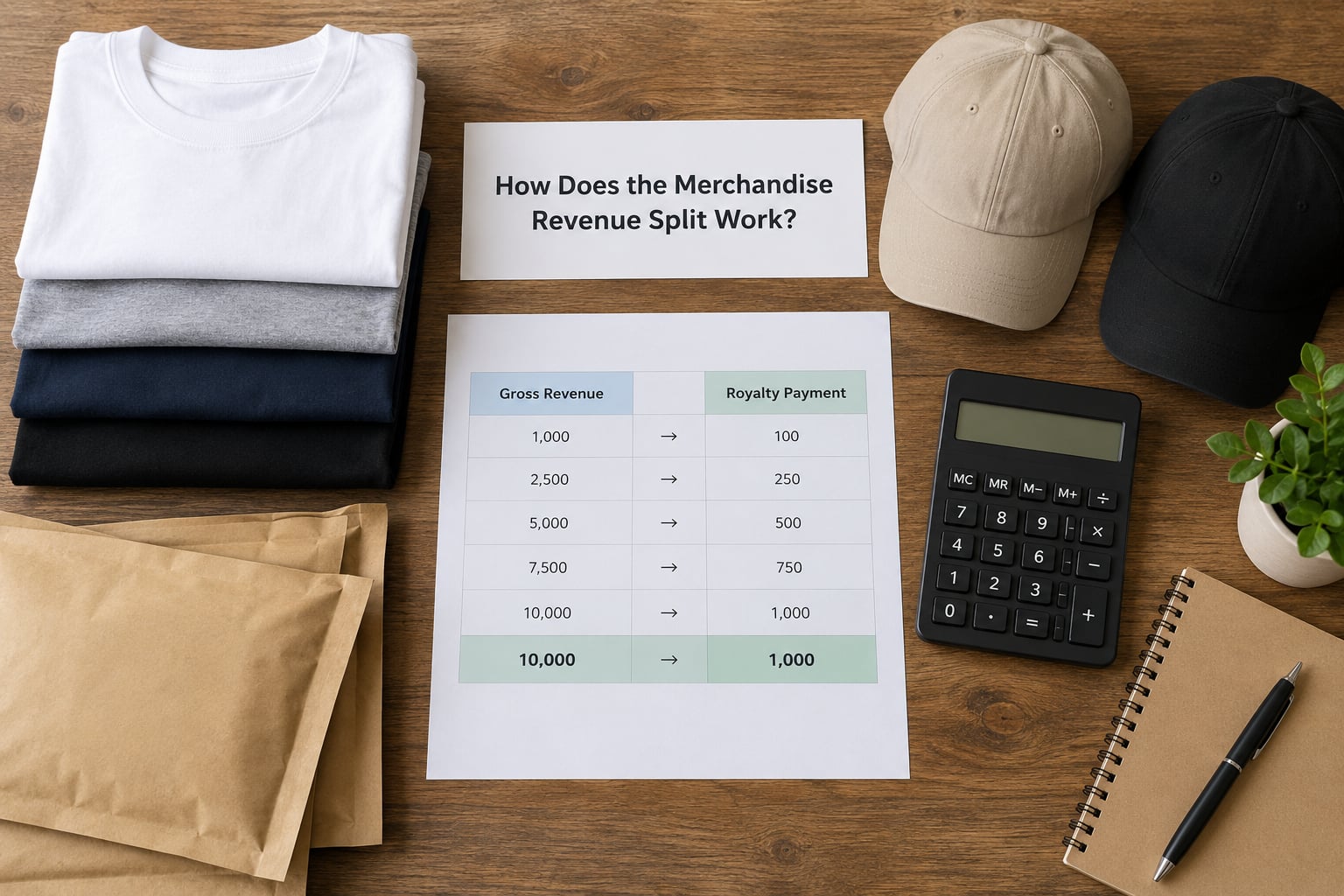
The math is where the interest in a reported percentage quietly disappears. Take a year where a wrestler’s licensed products generate 1,000,000 in reported sales. That figure is a gross number, and gross is not what gets split.
Assume 8 percent comes back as returns and exchanges. Then the marketplace or retailer where the product sold takes a cut. Then production: blanks, printing, embroidery, quality checks. Then packaging, freight, fulfillment and the warehousing fee. What remains after those agreed deductions is net sales, and the percentage applies to net sales.
On those assumptions, net sales land somewhere in the region of 600,000. A rate of 5 percent on net pays about 30,000. The same 5 percent applied to gross would pay 50,000. Nobody’s rate changed; the definition did.
The gap widens further when product cost is folded in. If the licensee’s total cost of goods runs close to the wholesale price, net sales compress hard and a headline rate of 5 or even 10 percent becomes a modest payment.
With a minimum guarantee the shape changes. Suppose a deal guarantees 25,000 a year and pays 4 percent above a 700,000 sales threshold. Below the threshold the wrestler takes the guarantee. Above it, the wrestler takes the guarantee plus 4 percent of the excess. Both structures are common, and which one is better depends entirely on whether sales are predictable.
That is the calculation to run before anyone argues about the rate. Fix the deductions first, then the percentage becomes a comparable number rather than a slogan.
What Rights Do Wrestlers Negotiate Beyond the Percentage?
The percentage is one line. The rest of the clause decides whether the merchandise business is worth anything after the contract ends.
- Design ownership. Whether artwork stays with the license, the promotion or the wrestler, and what happens to it when the deal expires.
- Name and likeness. How far a wrestler’s name, image and character can be licensed, and to which product categories.
- Photography. Whether existing photos and video can be used for merchandise, or whether new shoots at the wrestler’s expense are required.
- Category carve-outs. Apparel, toys and games, trading cards, footwear and home goods rarely carry the same rate. A wrestler may hold apparel while a partner handles the rest.
- Territory and format. Worldwide versus single-country, physical product versus on-demand printing, and whether new digital formats get folded in automatically.
- Live-event merchandise. A separate question from licensed retail. Table sales at a show are often governed by a different clause with different accounting.
- Group merchandise. Pooled designs that feature several performers, including how a name is ranked on the shirt and how revenue is divided.
- Selling rights after the term. Whether the wrestler can keep selling their own designs once the agreement ends, and for how long.
A r/SquaredCircle thread raised the point that a pooled, association-wide merchandise split would cut any single star’s individual rate, because revenue from a design featuring five people has to be divided five ways. A wrestler with a genuine personal brand has a reason to protect category exclusivity, and that is usually the ask that carries more value than another two points on the rate.
How Are Approvals, Deductions, and Payment Deadlines Handled?
Most arguments about a merchandise split are not about the rate at all. They come back to deductions and timing.
On approvals, wrestlers typically ask for a review right over artwork, product category and pricing, with a defined response window. A clause that lets one side approve designs with no time limit for reply is worth negotiating over, because a silent approval block stalls an entire product run.
On deductions, the useful distinction is between costs everyone expects and costs that need evidence. Manufacturing, freight, platform commission and returns are ordinary. A per-order handling fee, a warehouse allocation charge or a corporate overhead allocation are the kind of line that can quietly consume a margin. The wrestler’s side typically asks that unusual deductions be itemised and capped as a share of sales.
On reporting, the clause should specify how often sales statements arrive, what categories they break out by design and by product, and whether the wrestler can audit. Auditing usually means examining the licensee’s books for the covered period, often with the cost of a failed audit falling on whoever called it. Absent that right, a wrestler is trusting a number they cannot check.
On payment, quarterly statements with payment due within a set number of days after the statement is the common pattern. Disputes usually need a notice window, so a reported error has to be raised in time to stop the clock before the money clears.
How Wrestlers Prepare for the Negotiation
The work happens months before anyone sits down. A six-step preparation process covers most of it.
- Gather the sales data. Per design, per product, per quarter. A r/Accounting poster put it plainly: nobody outside the company sees which products actually sell, so ask for the breakdown before renewal, not during it.
- Rank priorities. Rate, guarantee, category control, term length and post-term rights are five different arguments. Deciding which two are non-negotiable prevents the negotiation from trading away the important thing for something cheap.
- Separate the floor from the upside. Model what the guarantee pays in a weak year and what the escalator pays in a strong one. A high rate on low guaranteed volume often loses to a lower rate with a solid floor.
- Model the worst case. Test the net-sales definition against a realistic set of deductions. If the result looks wrong at any stage, the definition is where the problem sits.
- Find out what the alternative is. A competing offer, a deadline, or simply the quiet fact that a promotion does not want to lose a top seller all change how the conversation goes.
- Have an attorney read the definitions. Net sales, permitted deductions, audit rights, term and survival. Those five sentences decide more than the rate line.
Keeping the written record matters just as much. Emails that approve a design, confirm a category or reference a rate become the reference point when the statement arrives.
What Gives a Wrestler More Bargaining Power?
Position on the card matters less than measurable demand. What actually changes the conversation:
- Demand that survives scrutiny. Units moved across several quarters, not one viral week.
- A distinct identity. Designs that sell because they are recognisably that wrestler’s, not because of the logo on top.
- Control of name and likeness. The more of the identity that stays with the performer, the more the other side has to buy rather than assume.
- Reach outside the promotion. A large audience that follows the person rather than the brand makes the promotion dependent on the promotion being involved.
- An existing licensing relationship. Prior deals elsewhere set a reference point the promotion has to argue with.
- Timing. Conversations that start early, before the promotion has decided its budget, carry more room than ones that start after a renewal deadline.
Wrestlingforum users tend to judge drawing power with four factors together: pay-per-view buys, merchandise sales, television ratings and live-event attendance. Any one of those alone is easy to argue with. All four pointing the same way is not.
What Can Make a Merchandise Split Unfair or Risky?
A handful of clause patterns cause most of the trouble. Each has a recognisable fix.
- An undefined net. If net sales is not defined line by line, the deduction list can grow after signing. Fix: enumerate permitted deductions in the contract.
- Uncapped deductions. Fees applied per order rather than as a share of sales can eat a thin rate entirely. Fix: cap total deductions as a percentage of gross.
- One-sided approval rights. No reply deadline means a launch can stall indefinitely. Fix: written approval within a stated number of business days, silence counting as approval.
- Short reporting windows. A wrestler needs time to review a statement before payment. Fix: at least thirty days between statement and due date, plus a defined dispute window.
- Weak audit rights. No access to underlying records means no way to confirm the figure. Fix: a defined audit period, usually covering the term plus a limited tail.
- Broad exclusivity with no term limit. An exclusive licence that never ends removes any chance of earning from designs after the contract. Fix: a fixed term with defined survival periods by category.
- Automatic renewals. A deal renewing at the old rate without renegotiation locks in stale terms. Fix: require a fresh negotiation window before renewal.
- Ownership disputes. Unclear rights to artwork and images create friction years later, when the merchandise is still moving. Fix: state ownership in three sentences, plainly.
None of this is exotic. Every item is a place where two reasonable people could read the same sentence differently, which is exactly why it matters before signing rather than after.
How Do Independent Wrestling Merchandise Deals Differ?
Independents are not negotiating against a template with a business affairs department. The wrestler is often handling manufacturing, fulfillment and sales directly, which changes the economics more than the percentage does.
On a print-on-demand setup, a third party prints on demand and takes a commission per order. The wrestler’s cost is per unit sold, with no upfront inventory. That means no risk on unsold stock and a materially smaller share per unit than a bulk production run would produce.
On bulk production, independent wrestlers have described paying 300 to 400 per box up front and carrying all the risk themselves. Orders then need to clear that cost before any split happens. With a promotion involved, the promotion may absorb production and simply pay a rate, or it may take a cut of what the wrestler clears after the box cost.
Merch table sales at independent shows are usually simpler. The wrestler or a seller staffs the table, cash is collected on the night, and a split with the promotion is agreed in advance as a flat share or a fixed fee per show. Cash timing differs completely from a quarterly royalty statement.
Large promotion agreements invert all of this. The company owns production, distribution and the intellectual property, which is exactly why reported rates for main roster talent start low. Figures of 1 to 3 percent are repeated constantly across the web, and figures of 10 to 15 percent for top-tier talent appear just as often. A widely circulated claim credits a figure near 10 percent to one major star with manufacturing covered by the promotion. Treat all of them as reported, not published. The contract terms are private, and the two ranges differ mostly by which side of the negotiation is doing the describing.
Frequently Asked Questions
Can a wrestler’s merchandise percentage change during a contract?
Yes, if the deal includes an escalation clause. Rates commonly step up when sales cross agreed thresholds, or at fixed anniversaries during a multi-year term. Some contracts cap the increase, and some set a rate for the first period and a higher one after. Whether the rate moves on a date or on a sales threshold is worth checking, because a threshold-based clause only pays out if the line keeps growing.
Who owns the design and images used on a wrestler’s merchandise?
It depends on the agreement and on employment status. Work created by a performer under a work-for-hire arrangement generally belongs to the company that hired them, which is the usual basis for promotion-owned merchandise. A wrestler operating as an independent contractor or running their own apparel line usually retains ownership, unless the licence assigns it. This is the clause to check first, because a better rate means little without ownership after the term ends.
Are manufacturing, shipping, and platform fees deducted before the wrestler is paid?
On a net-sales agreement, yes. Returns, production, packaging, freight, fulfillment and platform commission are typically deducted first, and the wrestler’s percentage applies to what remains. On a gross-sales agreement, fewer deductions apply. The difference between the two can be substantial, so the worked example matters more than the headline percentage. Ask for the definition of net sales in writing, including which specific costs are permitted.
How do independent wrestlers make money from their own merchandise?
Most commonly through self-produced apparel sold online, at shows and through print-on-demand partners. Print-on-demand takes a commission per order and carries no upfront inventory risk. Bulk production costs more per unit but earns more, at the price of paying for boxes up front and covering unsold stock. Some independents split table revenue with the promoter at shows, usually as a flat share or a fixed fee per event rather than a percentage of total sales.
Can fans find the actual merchandise splits in wrestlers’ contracts?
Almost never. Wrestler contracts are private documents, and no major promotion has published one in full. What circulates online is a mix of reported figures, lawsuit filings, industry newsletter reporting and fan estimates, often with no source attached. Anyone claiming a specific rate as confirmed fact is guessing. The figures worth remembering are the ranges and the mechanics behind them, not any single number circulating this week.
What to Focus on First
Start with the definition of net sales and the list of permitted deductions. Until those are pinned down, no percentage on the page is comparable to any other, and the loudest number in the negotiation is usually the least reliable one.
After that, read the ownership clause, the guarantee, the reporting and audit rights, and the term with its survival periods. The rate matters, but it is the line most easily matched by whoever is willing to define the terms around it.