Dirt sheets exist because professional wrestling is performed under kayfabe, where the official story is fictional on purpose. Why dirt sheets exist and how they get information comes down to one habit: reporters spend years building contacts inside promotions, then publish what those contacts tell them, usually second-hand and usually anonymously.
Table of Contents
- What Are Dirt Sheets and Why Do They Exist?
- Why Dirt Sheets Exist and How They Get Information
- Where Do Wrestling Reports Come From?
- How Do Dirt Sheets Verify a Rumor?
- What Makes a Wrestling Rumor Credible?
- How Can You Tell a Dirt Sheet From a Reliable News Site?
- Why Do False Wrestling Rumors Spread?
- Frequently Asked Questions
- Are all wrestling dirt sheets the same?
- How reliable are anonymous wrestling insiders?
- Why do wrestling sites remove reports after publishing them?
- What is the difference between a rumor and a confirmed wrestling change?
- Should readers trust a wrestling report with no named source?
- Conclusion
What Are Dirt Sheets and Why Do They Exist?
A dirt sheet is a newsletter or website that reports unconfirmed professional wrestling news: injuries, departures, contract status, and planned matches. Reporters gather it from people with access to wrestlers, agents, and production staff rather than from company announcements.
That access is the whole reason they exist. Official channels are built to protect storylines, so a fan watching television is told what the promotion wants them told. A dirt sheet is the corrective, and it fills a genuine gap that nobody else in wrestling media is positioned to fill.
Not every site calling itself a dirt sheet does that work, though. Some report with sources attached, and some just republish whatever was posted hardest that morning. That difference matters more than anything else on this page.
Why Dirt Sheets Exist and How They Get Information
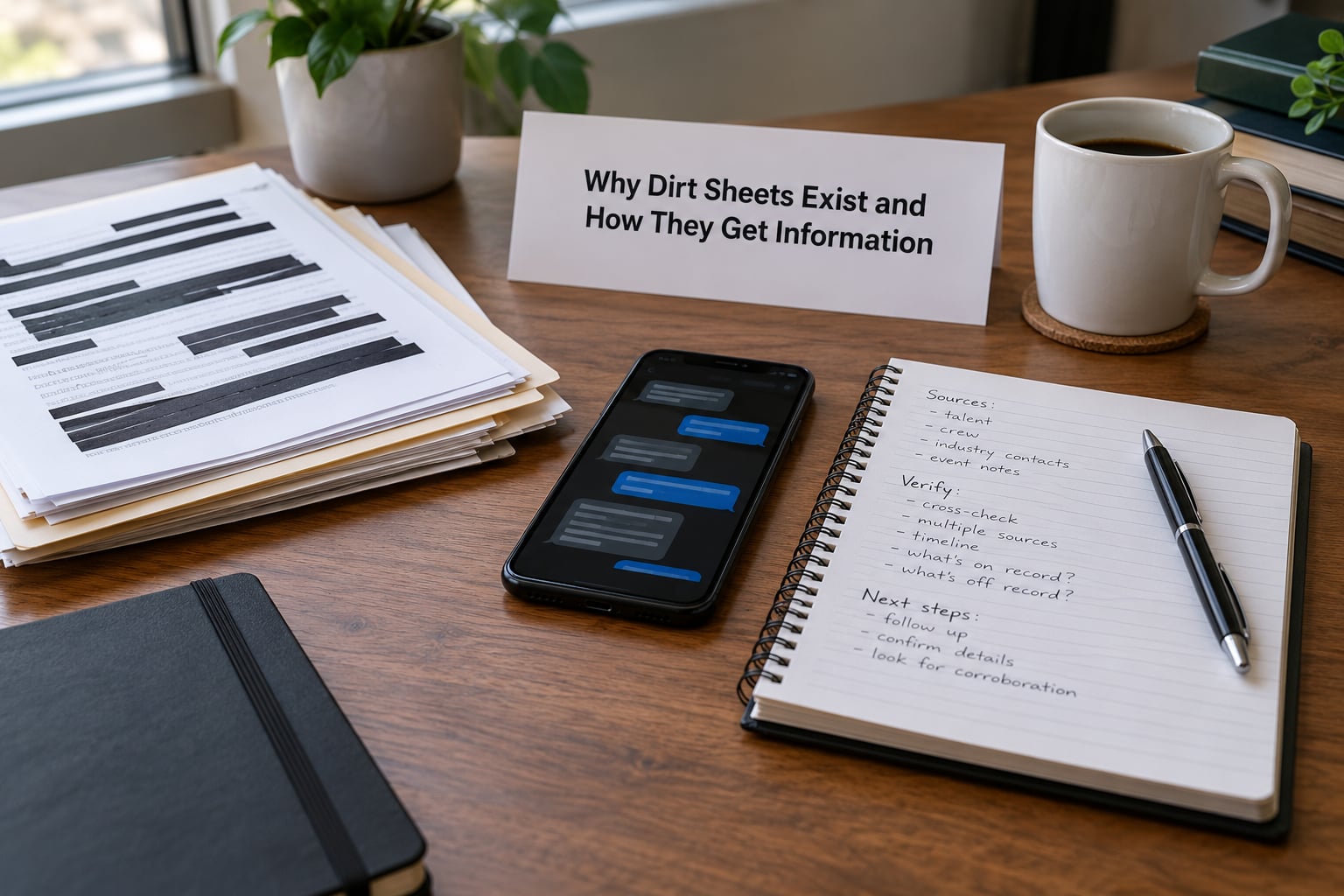
Reporters get information through a cycle, not a tap. They monitor public statements first, log tips as they arrive, then chase corroboration before writing anything. Most of the actual material sits in six recurring places.
- Developmental and territory contacts. Reporters cover NXT-style and regional shows, sit in the crowd, and talk to wrestlers who have not made a name yet. These relationships last years and produce the steady drip of small notes that nobody else sees.
- Wrestlers and their personal networks. Phone calls, group chats, and friends from home. A wrestler who trusts a reporter may pass along what he heard in a locker room, often with no idea how accurate the original version was.
- Agents and managers. This is where contract and departure information surfaces, because contract talks sit with representation. It is usually discussed in general terms and never confirmed on the record.
- Former employees and production crew. Writers, video producers, ring crew, and contractors move between companies. They know schedules, travel, and budgets from the inside and lose nothing by talking once their job is done.
- Public records and public statements. A surprising amount is not secret at all. Parent-company filings, announced cards, roster pages, and a wrestler’s own social posts are all checkable by anyone willing to look.
- Other journalists. Reporters swap what they have. One outlet’s developmental scoop becomes another outlet’s sourced line within an hour, which is how a single unverified claim acquires the appearance of confirmation.
Most reporters will not name the person who gave them a story, and that is normal practice rather than a red flag. What matters is whether the sourcing describes a relationship, whether two independent people said it, and whether the details line up with what is publicly checkable.
Where Do Wrestling Reports Come From?
Sources fall into tiers. Public interviews, televised segments, and official social posts are the top tier: verifiable, but often incomplete. Event observation and independent show coverage sit next, giving a reporter firsthand material without needing anyone to talk.
Below that are insiders, agents, production staff, and other wrestlers, which is where most real dirt sheet reporting lives. At the bottom sit anonymous user accounts and screenshots. Those occasionally turn out to be true, but they carry no verification at all, so treat them as a starting point rather than a report.
How Do Dirt Sheets Verify a Rumor?
A responsible report separates the initial claim from the corroboration. If a writer says he was told something by one person and heard it again from another, that is two sources. If he heard it once and phrased it as certainty, it is one source with a confident sentence around it.
The rest of the process is unglamorous. Compare the details against the schedule, check whether an announced card already contradicts it, ask the promotion for a response and note whether they declined, and watch whether other independent reporters describe the same thing.
Then the language matters. Wording like we have heard, we were told, or it is expected hedges a claim honestly. When new evidence arrives, a good outlet edits the item, adds a correction, or deletes it outright. Silence after a wrong report is the one behaviour that should end your trust.
What Makes a Wrestling Rumor Credible?
Credibility is assessed claim by claim, not site by site. A publication with a strong record can still carry a wrong item, and a low-traffic blog can occasionally be right. These are the signals worth checking before you repost anything.
| Signal | What good looks like | Warning sign |
|---|---|---|
| Specificity | Named roles, dates, and locations | Vague claims with no detail attached |
| Sourcing | A relationship described, such as someone in the company | Sourcing that stops at a close to the situation |
| Track record | Years of coverage with misses owned publicly | A brand new site with no history |
| Internal consistency | Details match what is publicly known | Details that contradict the announced card |
| Public confirmation | Later confirmed by an official channel | Nothing confirmable at all |
| Plausibility | Fits schedules, budgets, and travel | Contradicts known business reality |
| Corrections | Wrong items are updated or removed openly | Wrong items quietly vanish |
One practical habit: when a story breaks, check whether two independent reporters wrote it from their own sources. One outlet’s version repeated by five accounts is still one source.
How Can You Tell a Dirt Sheet From a Reliable News Site?
Official announcements carry real information and are the only fully confirmed channel, but they arrive late and sanitized. Established journalism sites are verifiable by a named byline and a history of published work, so you can hold them accountable even when the story is uncomfortable.
Fan forums and message boards are useful and unfiltered, which cuts both ways. Good historical research happens there, and so does confident invention. Social aggregators mostly republish, so a rumor reaches huge numbers without ever being reported.
Anonymous blogs with no byline, no sources, and a fresh domain deserve the least weight. A label, a disclaimer, or an updated timestamp can all be faked in a minute, so none of them prove anything on their own.
For new readers, the simplest starting set is a long-running newsletter or site with a visible archive, a professional outlet that publishes corrections, and one forum community you actually read rather than search once a rumor appears.
Why Do False Wrestling Rumors Spread?
Most false rumors fail for ordinary reasons. Confirmation bias means fans share what they already wanted to be true, and novelty means the surprising version travels while the boring truth does not. Both are predictable, which is why the loudest rumor is rarely the best sourced one.
Story structure makes it worse. An unfinished angle invites fans to fill the gap themselves, and their guess gets reposted as if it were reporting. A deleted post or cropped screenshot then does the heavy lifting, because a missing original is treated as a cover-up.
The publishing side contributes too. Sites that chase clicks will run an unconfirmed report as a headline, collect the traffic, and quietly drop it once it fails. Readers assume a loud report reflects a well-sourced one, and the whole chain never gets checked.
None of this is new. The mechanism is old; the delivery method just got faster.
Frequently Asked Questions
Are all wrestling dirt sheets the same?
No. They range from long-running subscription newsletters with years of documented accuracy to anonymous blogs that republish whatever appeared on social media that morning. The useful ones share a few habits: they describe their sourcing by relationship, they update items when evidence changes, and they delete wrong reports openly. Judge the individual item rather than the site.
How reliable are anonymous wrestling insiders?
Anonymity is normal in wrestling reporting and says very little on its own. What matters is corroboration: whether two independent sources said the same thing, whether the details match publicly checkable records, and whether the outlet asked the promotion and reported the response or the refusal. A confident claim from one anonymous account is weak. The same claim from three accounts is a pattern.
Why do wrestling sites remove reports after publishing them?
Usually because the report turned out to be wrong, or because a promotion asked for a takedown on legal grounds. Removing an item quietly is the problem, not removing it. Outlets that correct or retract openly are telling you how much weight the story deserved. If a story disappears and the site never mentions it again, treat the original claim as unproven.
What is the difference between a rumor and a confirmed wrestling change?
A confirmed change has been announced by the promotion, shown on an official roster or card, or documented in a public filing. A rumor is any report that has not reached that stage, even when it comes from a well-known reporter with a good track record. Promotions announce departures and returns deliberately and late, so the gap between rumor and confirmation can last weeks.
Should readers trust a wrestling report with no named source?
Treat it as a lead, not a fact. Reports without a named source are not automatically false, since protecting a source is legitimate and often necessary. Read the sourcing line carefully: a report describing someone as working in the relevant department carries more weight than one that just says a source close to the situation told them. Then check for a second independent outlet before you pass it along.
Conclusion
Dirt sheets exist because a scripted product needs a corrective, and how they get information is straightforward once you see it: years of relationships with developmental talent, agents, crew, and other reporters, filtered through corroboration and hedging language.
The useful habit to take away is small. Before you share a wrestling report, check whether a second independent outlet is reporting it from its own source, and whether the details match something publicly checkable. If a story only exists on one anonymous account, let someone else be first.