Wrestling games add legends every year to refresh the roster, pull lapsed players back in, and give match cards names people already care about. It is also a production shortcut and a revenue stream. Once you understand those four overlapping motives, the yearly legend drop stops looking like nostalgia and starts looking like a business decision with a fan service wrapper.
I have played through enough of these releases to know the pattern. The base roster leans current, the DLC and season-pass tracks lean heavily toward the past, and the fans who complain loudest about roster bloat are usually the same ones booking an Attitude Era Universe save the second those legends unlock.

Table of Contents
- What Does It Mean When Wrestling Games Add Legends?
- Why Wrestling Games Add Legends Every Year?
- How Do Legends Make a Wrestling Roster Feel Bigger?
- How Does Nostalgia Bring Older Fans Back?
- Why Do Publishers Use Legends to Sell New Games?
- Why Wrestling Games Add Legends Every Year: The Short List
- How Do Legends Change Gameplay and Storytelling?
- What Are the Limits and Risks of Adding Too Many Legends?
- Frequently Asked Questions
- Does adding legends take spots from current superstars?
- Why is Owen Hart not in WWE 2K games?
- Why are some legends only available as paid DLC?
- How does a wrestling game decide which legends to add?
- Why are former stars from other promotions missing from the roster?
- Do legends change how the game plays?
- Conclusion
What Does It Mean When Wrestling Games Add Legends?
In game terms, a legend is a wrestler from a past era who is no longer on the active roster but returns as a playable character. Think Attitude Era throwbacks, Ruthless Aggression main events, Golden Era pioneers and anyone who held a championship in another promotion before WWE signed them.
That is different from a create-a-wrestler original. Legends have a real name, a documented history and archived match footage, which is exactly why they are harder to license and easier to sell. Legends can arrive on the base roster, inside a DLC pack, as a season-pass track, or as part of a Showcase story mode built around a specific rivalry.
The category label matters less than people think. A former champion returning for a legend run and a long-retired name added for a Hall of Fame scene both count as legend content to the publisher.
Why Wrestling Games Add Legends Every Year?
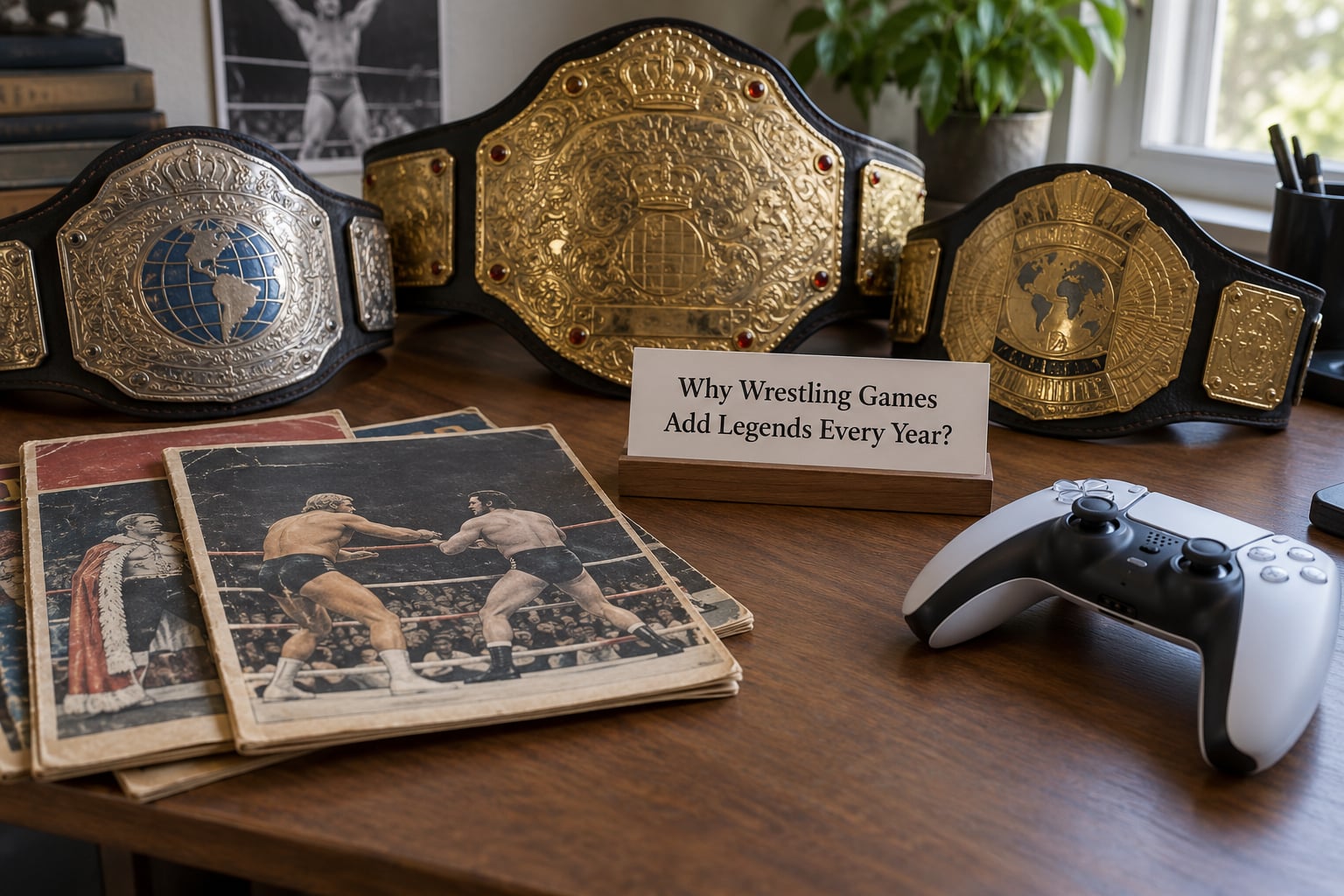
The short answer is that legends refresh the roster, win back lapsed players, sell as downloadable content, and are cheaper to build than brand-new superstars. Here are the reasons that come up again and again in community discussions.
- The roster needs new blood. Even the strongest card runs out of fresh matchups. Adding a retired name creates a match that fans could not have last year, which keeps an annual release from feeling identical to the previous one.
- Archive footage is cheaper than a fresh scan. A legend has decades of match tape, clear silhouette reference and an established look. Developers say the real constraint is studio time for scanning, modelling and motion capture, not the number of empty slots on the list.
- Wrestlers who never worked for WWE cannot be used. Rights sit with the promotion or the individual. That narrows the pool to names WWE controlled or owns outright, which is why certain popular former wrestlers have stayed out of every release.
- Lapsed players come back for a name they love. A player who stopped buying annual releases in their twenties will happily pick one up again if their favourite wrestler is unlockable, even if the core game is unchanged.
- Dream matches are the reason people talk. Putting Bret Hart against a modern heavyweight generates more discussion than any brand-new prospect. That chatter carries into preorders and social posts.
- Legends fill the DLC calendar. Season passes, Ringside Pass tracks and standalone packs need content every few weeks. Legends are an obvious source because fans already want them.
- Universes and Showcase modes need story material. A World Wrestling Federation Universe save or a Hall of Fame Showcase needs history to reference, and legends supply it.
- It widens the audience. Older fans grew up on a specific era. Newer talent pulls in a younger crowd. A roster that keeps a foot in both keeps more of them subscribed.
How Do Legends Make a Wrestling Roster Feel Bigger?
Depth is not just headcount. A legend changes what you can build with the roster you already have. A technical veteran gives you a slower, limb-target style that nothing on the current card replicates. A larger legend opens up tag formats and throwback teams. A heel from fifteen years ago supplies an antagonist whose motives players already understand.
That variety changes championship bookings. A player running a fantasy promotion can book a match that makes sense because both names exist, then use Universe mode to generate a rivalry without micromanaging every segment.
There is a ceiling, of course. Ten added legends do not produce ten new play styles if they all fight the same way. But for a fan planning an Attitude Era throwback card, the roster does feel bigger in practice.
How Does Nostalgia Bring Older Fans Back?
Nostalgia works here because wrestling history is something fans watched happen, not something they read about later. An entrance theme lands harder than a stat boost. People who stopped playing during the early 2000s recognise a face from a pay-per-view main event and pick the controller back up.
Forum threads show the pattern clearly, along with its limits. The most repeated line of criticism is that legend DLC is fine as long as it is not the same familiar faces every single year. Just as common is the opposite reaction: players who use no legends at all and would rather see the current roster developed properly.
That counter-faction is worth taking seriously. Some players want a roster built around the current product, and a legend drop reads as padding to them. Both reactions come from the same annual negotiation, and publishers have learned to split the difference by putting the biggest nostalgia names in paid content instead of the base game.
Why Do Publishers Use Legends to Sell New Games?
Legends are marketing that happens to be playable. A trailer built around a returning icon gives a studio something to announce before preorders open, and the reveal itself is free publicity on every wrestling forum and video channel.
Recent editions have leaned harder into the free-track approach. When a season-pass structure hands out a legend on a free track early on, players who would never have bought an upgrade get a taste and a reason to look at the paid tracks. That converts an emotional want into a purchase without a separate marketing campaign.
There is a longer-term calculation too. A yearly release needs a reason to exist for people who bought the last one. Legends are the most visible difference between editions, so they end up carrying an outsized share of the argument for upgrading.
Why Wrestling Games Add Legends Every Year: The Short List
- Roster renewal, because a card that repeats last year sells worse.
- Lower production effort, since archive footage speeds up scanning and animation.
- Audience expansion across two or three generations of fans.
- Dream-match appeal that generates talk before release day.
- Gameplay variety, since older styles differ from current move sets.
- Sales support through packs, season tracks and Showcase content.
How Do Legends Change Gameplay and Storytelling?
Play a legend next to a current superstar and the difference shows up in the first minute. Legends tend to have a distinct rhythm: slower setups, a signature finisher fans will recognise, and a style that rewards a specific match approach rather than button mashing. Current talent is usually built for fast exchanges and longer combos.
Storytelling changes too. Rivalries carry real history, so Showcase mode can hand you a feud with stakes and a payoff already written. Universe mode benefits even more, because feuds between two familiar names generate believable storylines without the player having to write them.
The catch is age. A move set designed in the era of closed-eye submissions can feel clunky next to a modern grappling system. Studios rewrite some animations, and others keep them faithful to how the wrestler actually worked, which is a choice fans argue about every year.
What Are the Limits and Risks of Adding Too Many Legends?
- Roster crowding. When the list carries many entries for the same era, newer talent can feel like an afterthought even when the developer has stated the two are budgeted separately.
- Nostalgia fatigue. Repeat additions of familiar faces push the request list toward names the publisher has skipped for years.
- Licensing cost and risk. Rights for talent who worked elsewhere can be unavailable, unaffordable, or tied to disputes that never resolve. That is the single biggest reason a requested legend never appears.
- Aging animation. Faithful recreations of old moves and entrances can clash with a modern control and presentation layer.
- Repetitive dream matches. Once everyone has seen the same fantasy bouts, the novelty fades and the entry can feel like a roster update dressed up.
The fairest way to judge a legend drop is to ask whether it adds something new to play, not whether it adds another name you already know.
Frequently Asked Questions
Does adding legends take spots from current superstars?
2K has stated publicly more than once that adding a legend does not remove a potential spot for a current superstar. Fans on wrestling forums tend to treat that as the settled answer and point instead to studio time for scanning, modelling and motion capture as the genuine limit. Crowding the roster is a fair complaint, but it is not the same thing as a fixed number of slots.
Why is Owen Hart not in WWE 2K games?
Owen Hart’s absence is usually attributed to likeness rights rather than a creative decision. His family controls his image and has not licensed it to the publisher, so no edition has included him. He is the most famous example of a legend who stays out of the games entirely, and fans mention the name every year when the roster is revealed.
Why are some legends only available as paid DLC?
Larger legends generally arrive in packs, season-pass tracks or paid editions rather than on the base roster. That split gives the publisher extra revenue from players who would not have bought the game at all. Fans who dislike the paywall tend to wait for the free season-pass tracks instead of planning a purchase around release day.
How does a wrestling game decide which legends to add?
The decision mixes demand, rights availability and production capacity. Publishers track which legends fans request and which ones sell, then check whether the likeness can be licensed and whether there is studio time to build the character. The roster reveal is usually the first public sign of what made the cut that year.
Why are former stars from other promotions missing from the roster?
Rights for wrestlers who spent their post-WWE years in another promotion are complicated, and some names have stayed out of the games entirely as a result. This is why requests for certain popular former champions persist for years without an answer. The absence is about licensing, not about how the game was built.
Do legends change how the game plays?
They do. Older wrestlers usually come with slower, more deliberate styles, signature finishers and specific match rhythms that current superstars do not offer. They also give Universe and Showcase modes familiar rivalries to reference. Some move sets and entrances from older eras feel dated in a modern engine, which is part of why fans argue about them.
Conclusion
Wrestling games add legends every year because the decision pays off in four places at once: a fresher roster, a cheaper production pipeline, a steady supply of DLC material, and a reason for lapsed fans to come back. Nostalgia is the emotional engine, but the mechanics behind it are licensing and studio capacity.
When a new roster drops, look past the name count. Check whether the legends bring styles and storylines your current card cannot already produce, and whether the new talent got room to work alongside them.