Wrestling documentaries are researched by building a dated timeline, then attaching one primary source to every claim on it: tape library footage, network and promoter archives, digitized newspapers and public records, and recorded interviews with wrestlers and contemporaries who were there. A researcher cross-checks accounts that contradict each other, verifies shoot and worked claims against the record, and hands production a sourced research packet before a single camera turns on. It is slow, mostly unglamorous work, and it happens long before anyone says action.
I spent a while chasing this question myself, because most wrestling docs look effortless on screen and nobody explains the machinery behind them. Fans ask the same two things in every thread: how did they get that interview, and how did they find that footage. There are real answers, and the people giving them are usually named in the credits of a film most of us never bothered to read.
This is the workflow those answers come from, plus what a researcher does when the person telling the story is the only person who can tell it.
Table of Contents
- How Are Wrestling Documentaries Researched?
- What You Need Before Research Starts
- A working timeline, not a pile of links
- Access to footage and archive contacts
- A contact list built from credits, not fan databases
- Legal groundwork handled early
- The Step-by-Step Wrestling Documentary Research Workflow
- 1. Write the question the film has to answer
- 2. Build the dated timeline before anything else
- 3. Attach one source to every claim
- 4. Hunt the archival footage and tape libraries
- 5. File newspaper and public records requests
- 6. Build and vet the interviewee list
- 7. Record, archive and transcribe every interview
- 8. Cross-check accounts that contradict each other
- 9. Test shoot and worked claims against the record
- 10. Hand over a sourced research packet
- Where Researchers Find Sources, and What Each One Can Prove
- Research method comparison
- How Interview Sourcing Actually Works
- Who talks, and why those people
- Insider access beats outside credentials
- Vet the story before you book the interview
- Scheduling interviews between people who cannot stand each other
- The questions that get past the wrestling answer
- Verifying Shoot and Worked Claims
- Ethics and Legal Vetting on Scandal-Heavy Episodes
- What Real Wrestling Documentaries Did With the Research
- Dark Side of the Ring and the long interview chase
- When Giants Walked Here and the insider researcher
- Junkyard Dogs and detail as credibility
- The lucha libre film corpus and academic research
- Common Research Mistakes That End Up on Screen
- How Long Wrestling Documentary Research Takes
- What research costs
- A One-Page Research Checklist
- Frequently Asked Questions
- What is the best documentary about wrestling?
- How much of wrestling is staged?
- Was wrestling ever unscripted?
- Is there a Netflix documentary about wrestling?
- Who is considered the greatest shoot wrestler of all time?
- How do wrestling documentaries clear old footage they do not own?
- Conclusion: What To Do First
How Are Wrestling Documentaries Researched?
Wrestling documentaries are researched the way any serious historical documentary is researched, with one wrestling-specific twist. The researcher builds a dated timeline first, then attaches primary evidence to every entry: archival broadcast footage from tape libraries, network and promoter archives, digitized newspaper coverage, court and public records, and recorded interviews with wrestlers, promoters and contemporaries. Conflicting accounts get cross-checked before anything reaches the edit. The twist is that the central subject is a business built on planned illusion, so every claim has to survive being treated as a possible angle.
That last part is what separates a credible wrestling documentary from a fan compilation with interviews in it.
What You Need Before Research Starts
You can start without all of this, but you will waste months if you do. Four things need to be in place before the first real research day.
A working timeline, not a pile of links
Open a document and start with dates, not links. Every wrestler, match, injury, departure and legal event gets a line. A researcher who cannot say what happened on a Tuesday in 1997 has no idea which archive to open next, and that is where projects stall.
Dates are also how you spot the holes. Wrestling history has famous matches and long silences, and the silences are usually where the interesting material sits.
Access to footage and archive contacts
You need a working relationship with at least one tape library and a sense of who holds what. Rights sit with different people depending on the era and the region, and the same match can involve a promoter, a television station and a tape library with separate claims. Knowing who to write to is half the job.
Tape dealers matter here in a way they do not in most documentaries. They are often the only people who know which master tapes still exist.
A contact list built from credits, not fan databases
Read the end credits of every wrestling program, special and documentary in your subject’s era. Names of production assistants, commentators, photographers, ring announcers and publicists are all people who remember things and who can name other people. That is a far better list than a mailing list of enthusiasts.
One reliable name is worth fifty enthusiastic strangers. Enthusiasts cannot verify anything on camera.
Legal groundwork handled early
Get the legal side moving before the first interview is booked, not after the first edit is locked. Interviews need releases, archival footage needs clearance, and allegation-heavy material needs a plan for what happens if a subject sues. Discovering the cost of clearance in month nine is how projects die.
The Step-by-Step Wrestling Documentary Research Workflow
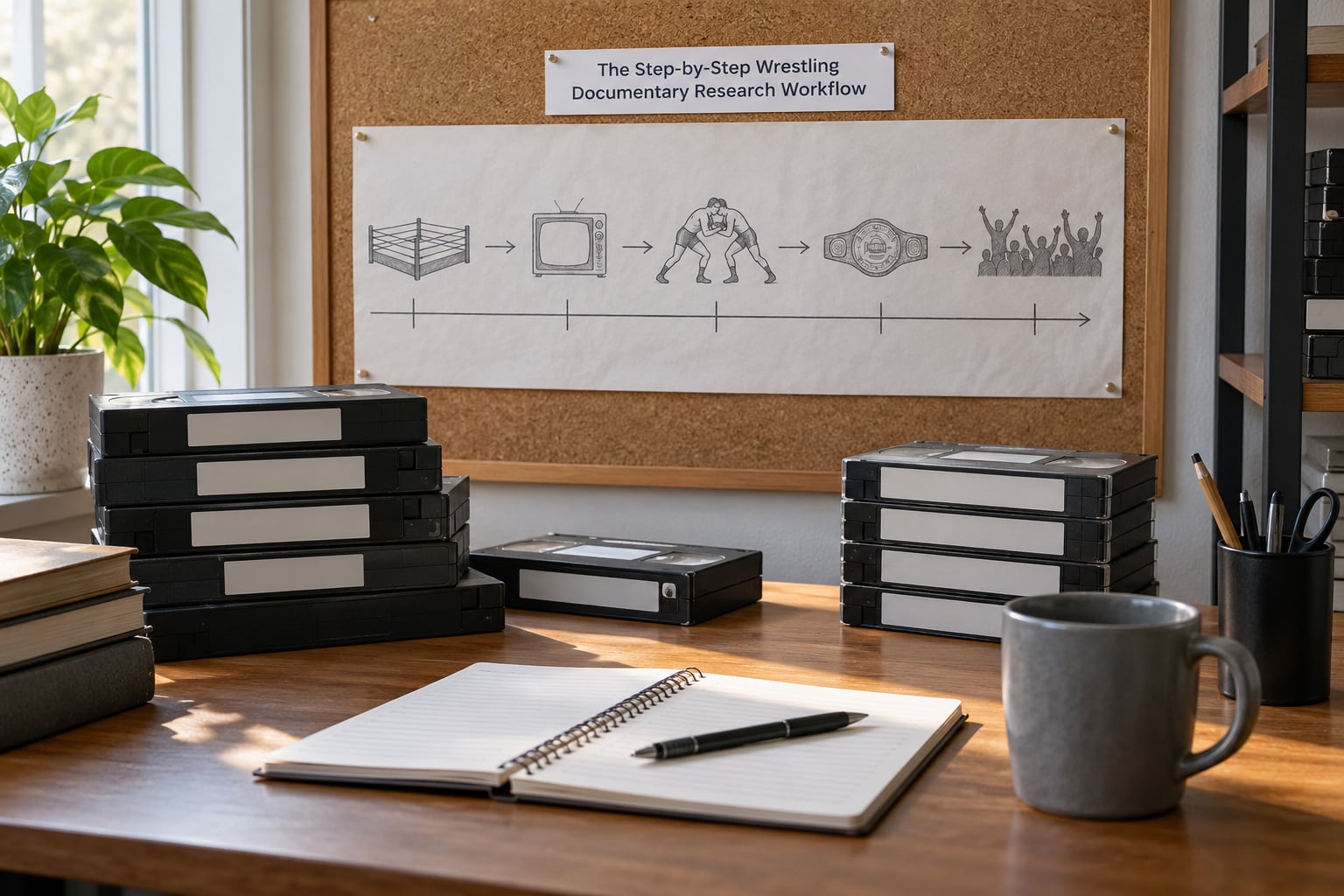
Ten steps, in the order a researcher actually works them.
1. Write the question the film has to answer
Not the topic. The question. Why did this promotion die, why did this injury end this career, why did that particular alliance fall apart. A documentary that cannot phrase its central question will collect endless footage and still not know what it is making.
2. Build the dated timeline before anything else
Everything downstream hangs off this. Start with newspaper dates, event listings and match records, then add footage availability notes next to each date. A match you cannot source is a match you probably cannot show.
3. Attach one source to every claim
One. If a claim has no source attached, it is not a fact yet, it is a story someone told you. This single rule kills more bad wrestling documentary material than any other, and it is the rule most often skipped.
4. Hunt the archival footage and tape libraries
Contact tape libraries directly, ask what exists rather than what is for sale, and request a viewing list with dates and source notes. Record what you find on a log sheet with format, running time, quality and any visible network bug or date stamp. Every log line should have an identifier that your fact-checker can find again six months later.
The most valuable thing on that log is often a note about what is missing. Knowing a reel was destroyed, or that a hard drive failed years ago, tells you a great deal about a promoter’s operation.
5. File newspaper and public records requests
Digitized newspaper archives give you dates, attendance figures and local politics. Public records requests and court records give you lawsuits, incorporations and police reports. Wrestling is a business with paper trails, and most of that paper never made it into the documentary world.
Court filings matter most on scandal subjects, where a single filing can confirm or kill a timeline entry.
6. Build and vet the interviewee list
Work outward from the timeline. For each claim, list everyone who would know it: the wrestler, the opponent, the promoter, the commentator, the photographer, the booker, the widow. Then rank by proximity to the event and by whether they had a reason to lie.
Vetting comes before booking. Do not spend a camera day on someone who cannot corroborate anything.
7. Record, archive and transcribe every interview
Back up every recording twice, on two different drives, the same day. Name files by date and subject, not by sequence. Then transcribe. Transcripts are what let you search a claim, find the moment a subject contradicted themselves, and quote accurately in narration instead of paraphrasing into drama.
Paraphrase is where documentary accuracy usually dies.
8. Cross-check accounts that contradict each other
Two people telling the same story differently is normal, not evidence of a lie. Look for the thing both accounts agree on, then identify what each person had a reason to shade. A former promoter’s memory of a quiet draw has a different reliability profile than that promoter’s memory of a riot.
9. Test shoot and worked claims against the record
A shoot claim is a claim about intent, and intent is the hardest thing in wrestling history to source. Test it against independent evidence: does the tape show something scripted outcomes do not? Do court records or contemporaneous reporting back the story up? Does a second unrelated witness describe the same thing? A single retrospective account with nothing behind it is an anecdote, whatever its tone.
10. Hand over a sourced research packet
The researcher’s deliverable is a packet, not a feeling. Annotated timeline, source list with identifiers, footage log, interview transcripts, a conflicts file listing every contradiction and how it was handled, and a clear note on what could not be verified at all.
That last file is the one that separates good wrestling research from promotional copy. Fans reward documentaries that tell them what they could not confirm.
Where Researchers Find Sources, and What Each One Can Prove
Every source type has a limit. Misusing one is the fastest way to get a claim onto screen that cannot be defended.
| Source type | What it can prove | What it cannot prove |
|---|---|---|
| Tape library broadcast footage | What happened on camera, on what date, in front of how large a crowd | Why it happened, whether it was planned, what happened off camera |
| Promoter archive and corporate library | What the promoter’s own office preserved and considered worth keeping | Anything the promoter chose not to record or destroy |
| Digitized newspapers | Dates, towns, attendance claims, local politics, business filings | Anything the paper never covered, which is most in-ring work |
| Court and public records | Lawsuits, police reports, corporate registrations, injuries claimed in documents | Private conversations and anything sealed |
| On-camera interview | One person’s account, on the record, in their own words | That the account is true; a wrestler may be working a narrative |
| Shoot claim | Almost nothing on its own; it is a claim about intent | Intent itself, unless independent evidence supports it |
| Tape dealer or private collector | That specific footage exists and where it can be viewed | Provenance, unless the collector can document where it came from |
The useful discipline is to ask, of every asset, what question it is allowed to answer. Footage proves an event. An interview explains an event from one angle. A lawsuit proves somebody complained.
Research method comparison
| Method | Strength | Weakness |
|---|---|---|
| Insider researcher, former wrestler or booker | Gets access, understands how the business actually ran, reads a promo correctly | Part of the story; may be carrying an angle of their own |
| Outside historian or journalist | Clean record, no promoter debt, strong with documents | Slower to build trust, often lacks the vernacular |
| Academic corpus study | Catalogue-scale coverage, dates and provenance for hundreds of items | No access to private tapes or living participants |
| Fan historian or archivist | Deep local knowledge, often holds unique material | Varies wildly in source discipline |
Most serious wrestling documentaries use more than one of these at once, and say so in the credits.
How Interview Sourcing Actually Works
Getting a wrestler on camera is the part everyone asks about. It is not charisma and it is not begging. It is preparation plus a reason.
Who talks, and why those people
The people who talk fall into overlapping groups: wrestlers from the era, the people who booked them, the people who built the promotion, and the people who worked the building. The last group is chronically underused and often the most talkative, because they had no stake in the outcome.
Supporters, valets, photographers and local promotional staff will describe the atmosphere of a promotion more honestly than anyone who was being paid by it.
Insider access beats outside credentials
The clearest example of this is When Giants Walked Here, about Jim Crockett Promotions and wrestling at Dorton Arena. Its co-producer Chris Lea spent roughly twenty years as a journalist and as an independent wrestler before making it. That combination is not incidental. It decides who returns your call and what gets said on the record.
A former wrestler as researcher also knows which questions are insults and which are routine, which saves months.
Vet the story before you book the interview
Before you schedule, establish what the person can actually add to the timeline. If they were not present, did not book the match, and were not in the room, they are a texture interview, and you should treat them as one. Booking on a reputation alone is how a season gets wasted on a story the subject was not part of.
Scheduling interviews between people who cannot stand each other
Two subjects who publicly hated each other is a scheduling problem before it is a legal one. Keep sessions on different days, in different rooms if you can manage it, and never promise either one what the other will say. Crews often record a neutral framing session for both so neither can claim they were ambushed.
On feud narratives specifically, remember that both men were under contract. Their public hostility was part of the booking.
The questions that get past the wrestling answer
Ask about a specific Tuesday, a specific building, a specific match. Ask what the room smelled like, who drove, who paid, who was broke that week. Prompt for process rather than verdicts: what were you told, by whom, and what did you say you would do? Wrestlers train answers. They are far less fluent on logistics.
Verifying Shoot and Worked Claims
Wrestling was never fully unscripted, and it was never fully fake either. Territory wrestling ran on negotiated finishes, agreed angles and a mixture of both, with the balance shifting by promotion, by era and by crowd. A researcher who says otherwise is either simplifying or selling.
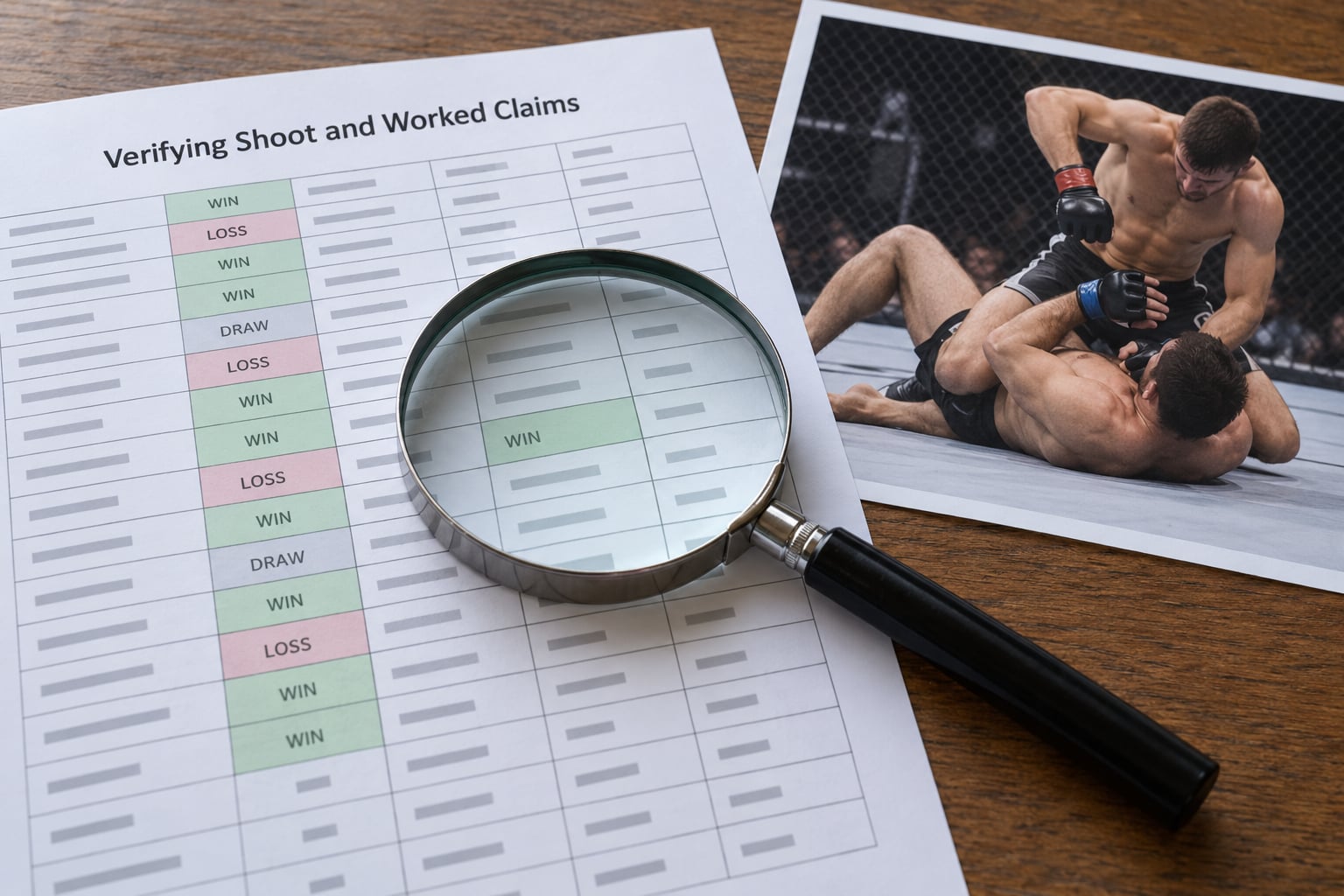
So how does anyone verify a shoot claim? In practice, four tests get applied.
- Independent corroboration. Is there a second witness who was not in that person’s storyline telling the same thing? One retirement-gate story told by one person is a story.
- Documentary support. Court filings, medical records, police reports, contracts, contemporaneous newspaper coverage. Paper does not have a persona.
- Footage consistency. Does the tape show a finish that does not read as a planned one? Wrestlers can work believable outcomes, and a convincing match is not evidence of a shoot.
- Consistency over time. Does the account hold up across separate interviews, months apart, without shifting?
When those tests fail, the honest move is to say so on screen. Fans notice, and they are kinder about an acknowledged gap than about a confident claim that collapses later.
The inverse problem shows up too. Promotional framing repeated without challenge is the complaint that follows every wrestling documentary made by a company that still employs half the people in the film. When a subject’s own employer controls the archive and the release process, corroboration has to come from outside that structure.
Ethics and Legal Vetting on Scandal-Heavy Episodes
Tragedy episodes carry the highest legal and ethical load in the genre. A film about a death, a death inside the industry or an allegation of a crime is not just a research problem; it is a reporting problem with living families attached.
The working rules that serious productions follow are not complicated.
- Confirm the timeline from records before approaching anyone with an accusation.
- Give named living subjects a specific, documented opportunity to respond, and keep a record that you did.
- Interview family members on their own terms, with release terms agreed before recording.
- Distinguish clearly on screen between documented fact, corroborated allegation and disputed claim.
- Retract or correct publicly when something published turns out to be wrong.
Every step needs legal review, and legal review costs real money and weeks of calendar. Budget it as a line item, not as a favor from a friend who knows media law.
Two things kill a wrestling documentary project more often than anything else: a subject’s death, and a legal action that freezes or seals sources. Both are reasons to build the record early and thoroughly rather than relying on memory and a single interview.
What Real Wrestling Documentaries Did With the Research
Dark Side of the Ring and the long interview chase
Dark Side of the Ring, built around Evan Husney and Jason Eisener, is the clearest public example of what wrestling documentary research costs. The Chris Benoit episode in particular required assembling years of news coverage, court and congressional record material, and on-camera interviews with people who had direct knowledge and had not previously spoken publicly. Behind-the-scenes breakdowns of that episode concentrate on exactly the questions fans ask: where the interviews came from, and how the footage was sourced.
Former wrestler Irvin Muchnick has discussed at length how long some of those interview approaches took. It is the standard case for how wrestling documentary research actually runs: repeated contact over months, with no guarantee that the answer is ever yes.
When Giants Walked Here and the insider researcher
Cliff Bumgardner and co-producer Chris Lea anchored the film on Jim Crockett Promotions and on one building, Dorton Arena, which opened in 1952 and became the promotion’s home. That is a research decision as much as a filmmaking one. A single venue narrows the archive, the interview pool and the visual language into something a team can exhaust.
Lea, a journalist and former independent wrestler, is the insider-insider case: the person inside the documentary carries the research and the access at the same time.
Junkyard Dogs and detail as credibility
The Junkyard Dogs story, about a group of wrestlers forming a team at a private school, is regularly described by viewers as feeling earned. The praise is almost always about detail rather than drama. Nobody gets a detail-heavy wrestling documentary for free; that specificity is the research showing through.
The lucha libre film corpus and academic research
Wrestling documentary research is not only a fan practice. Researchers Eduardo de la Vega Alfaro and Dr. Rosario Vidal Bonifaz, writing about lucha libre’s presence in cinema, catalogued more than 240 wrestling films from 1938 to 2021 for the book Ring-bound: Masks, Villains and Monsters. That is corpus research on the same subject, at scale, with provenance for every title.
Common Research Mistakes That End Up on Screen
These are the failure modes that show up in finished films, and each one traces back to a step that was skipped.
Single-source claims stated as fact. One person said it, so the narration says it. Fans call this immediately, and it costs credibility for the rest of the film.
Undated archive footage. A clip with no visible network bug, no date and no source log entry is unusable to a fact-checker and suspicious to viewers. Log every asset at intake.
Paraphrasing that changes meaning. A wrestler says something ambiguous and the cut renders it a confession. Transcripts prevent this, and watching the raw cut against the transcript prevents it.
Repeating unsourced online material. Forum speculation that has been repeated enough starts getting cited as fact by the third production that uses it.
No researcher credit. Audiences cannot judge sourcing they cannot see. Naming the researcher is a small decision that buys a lot of goodwill.
Balancing a feud as if it were a court case. Two contract-bound performers are not two neutral witnesses. Filmmakers routinely note this in narration; plenty do not.
How Long Wrestling Documentary Research Takes
Longer than production, and that surprises people who assume editing is the hard part.
For a tight subject with an available archive, three to six months of active research is realistic. For a promotion-history film spanning decades, expect a year or more, most of it spent on footage hunting, correspondence and scheduling around people with day jobs.
Interview conversion is the usual bottleneck. A meaningful share of contacts never respond, some agree and then withdraw, and a few give a short answer that ends the conversation about their part in the story. Build a longer list than you think you need and keep going after the tenth refusal. Every documentary team that has finished one will tell you the breakthrough interview arrives late.
What research costs
Roughly three budget lines: a researcher’s fee or day rate, legal review and clearance costs, and archival licensing. Licensing is the one that surprises new producers, because rights rarely sit with the people holding the tape. Get estimates on clearance for your three or four most important clips before you commit to the film.
A One-Page Research Checklist
Print this or keep it in a doc. It is the whole workflow in checklist form.
- Central question written in one sentence
- Dated timeline built, with gaps marked
- Every claim has one attached source
- Footage log complete: date, format, running time, source, identifier
- Provenance noted for anything from a collector or dealer
- Newspaper and public records searches run and saved
- Interviewee list ranked by proximity to events and reason to shade
- Each interviewee vetted for what they can add before booking
- Every recording backed up twice, same day
- Every interview transcribed
- Contradictions logged in a conflicts file, not resolved in silence
- Shoot claims tested against four criteria
- Living subjects given documented chance to respond
- Legal review completed for allegations, clearances and releases
- Unverifiable claims listed openly for the narration
- Researcher credited on screen
If a project cannot say yes to the third line, the film is being written from memory. That is how another worked narrative happens.
Frequently Asked Questions
What is the best documentary about wrestling?
Most fans point to Dark Side of the Ring, because its episodes pair years of news and court records with long-form interviews and the archive footage itself. When Giants Walked Here is the standard answer for promotion history, built around Jim Crockett Promotions and Dorton Arena. There is no single objective winner, so the better question is what you want proven: interviews, business history or in-ring work.
How much of wrestling is staged?
Results were planned in most major promotions for most of wrestling’s history, usually through agreed finishes and pre-set angles rather than a written script for every move. Matches also contained real competition, real athletic effort and genuine risk. Territory wrestling ran on negotiation, so the honest answer is that the ending was usually decided in advance while the middle was often fought for real.
Was wrestling ever unscripted?
Completely unscripted wrestling was rare, and the periods closest to it were the tough athletic promotions of the mid-20th century, where finishes were negotiated but not always pre-arranged. Shoot-style performers later worked matches that looked open-ended, though planning still existed behind them. Researchers treat unscripted as a spectrum rather than a switch, and they ask who negotiated a specific finish before accepting a broad claim about an era.
Is there a Netflix documentary about wrestling?
Wrestling documentaries rotate across services constantly, and availability changes month to month. Dark Side of the Ring episodes have appeared and disappeared more than once, while the major studio and DVD era of wrestling documentaries sits mostly on other platforms. Check the current listing before planning a watch, and expect to find older regional and independent work on YouTube, archive channels and independent streaming platforms instead.
Who is considered the greatest shoot wrestler of all time?
The name most often raised is Lou Thesz, followed by respected shooters including Terry Funk, Stu Martin and Nick Bockwinkel, with Kurt Angle named frequently by modern viewers. Treat the list as opinion rather than fact. A shoot claim is a claim about intent, and researchers require corroboration before it enters a documentary as anything but a disputed allegation.
How do wrestling documentaries clear old footage they do not own?
Rights for older wrestling footage are usually split between a broadcaster, a promoter or successor company, and sometimes a tape library that physically holds the master. A producer licenses specific clips through those holders, and clearance is negotiated clip by clip rather than as one deal. Many producers lean on public domain material and newly shot interviews to reduce the number of clips that require expensive clearance.
Conclusion: What To Do First
Write the question the film has to answer, then build the dated timeline before you watch a single interview. Everything else in how wrestling documentaries are researched hangs off those two steps: the archive search, the records requests, the interview list and the shoot-claim tests all depend on knowing which dates and claims you are actually trying to prove.
And if you are on the viewing side of it, watch the credits. A named researcher and dated, sourced archive footage are the two cheapest signals that a wrestling documentary earned what it is telling you.