Learning how to start collecting wrestling trading cards takes about an hour of research and a small monthly figure, not a big investment. Pick one wrestler, era or promotion, set a firm limit you can afford to lose, and buy individual cards rather than sealed boxes. That single decision keeps the hobby cheap and keeps you out of the trap that puts most beginners off within a month.
Most people arrive from another card hobby, usually Pokémon, and hit the same wall immediately: wrestling has no universal collection app, no single trusted price guide and a licence that keeps changing hands. That makes the early choices yours to make carefully, which is what this guide is for. We walk through the materials, the focus, the buying rules, the handling and the record-keeping, in that order.
This is a guide, not a shop. Nothing here is for sale and there are no store links. The advice is written to work whether you were a WWE kid, a WCW or AEW viewer, or someone who got into independent wrestling through a streaming service.
Table of Contents
- What You Need
- Step-by-Step: How to Start Collecting Wrestling Trading Cards
- Choose a Collection Focus
- Set a Budget and Buying Rules
- Learn the Cards You Want to Buy
- Buy from Reliable Sources
- Inspect and Protect New Cards
- Common Mistakes
- Tips for Building a Collection You Enjoy
- Frequently Asked Questions
- What is the best way to start collecting wrestling trading cards?
- Should beginners buy singles, packs, or boxes?
- How should I store wrestling trading cards?
- Do I need to grade wrestling cards to protect them?
- How do I know which wrestling cards are worth buying?
- Conclusion
What You Need
Six things, and only the first two cost real money. Get these straight before your first purchase and the rest of the hobby gets much cheaper.
- A monthly limit. One number, set before you browse, that you will not raise because you saw a desirable card online.
- A focus. One wrestler, one era, one promotion or one specific set checklist.
- A checklist. The printed list of every card in the set you are collecting, with card numbers.
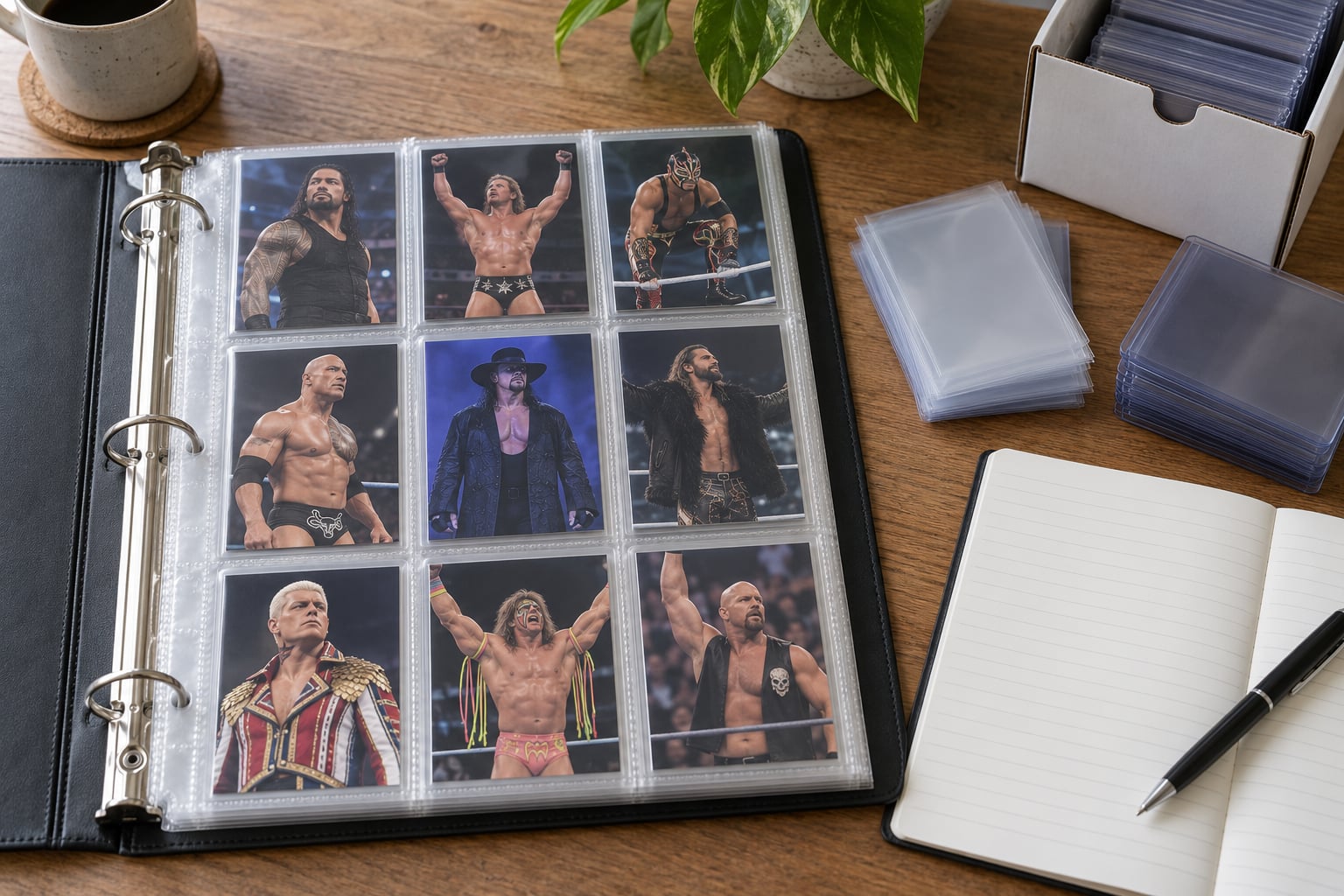
- Storage kit. Penny sleeves, top loaders and a binder with nine-pocket pages.
- A tracking method. A notebook, a spreadsheet, or a card database you actually enjoy using.
- Two or three trusted sellers. A local card shop, a marketplace seller with strong history, or a card show dealer you have dealt with before.
A sheet of card savers for anything fragile is worth adding once you own autographs or memorabilia cards. Those have thickness and edges that sleeves alone will not protect.
Step-by-Step: How to Start Collecting Wrestling Trading Cards
Choose a Collection Focus
Choose a collection focus so your early purchases stay narrow and affordable. One wrestler is the most common answer among new collectors, and it works because every era, brand and product type will usually include that person somewhere.
An era works just as well. The Ruthless Aggression years, the Monday Night Wars and the current AEW and NXT rosters each have distinct card designs, and you can buy them by the handful without chasing a checklist of two hundred cards.
Collecting a whole base set is the option beginners pick first, and it is the most expensive road. A full modern base set means base cards, parallels, insert subsets and colour variants, and the last few cards are where all the money goes. Collect a checklist you can realistically complete, and check the total cost before you start.
Anyone can collect outside WWE. Upper Deck holds the AEW licence, WCW cards from the 1990s still have a strong collector base, Impact Wrestling has issued its own product, and the territories era is where serious vintage hunting begins. Pick the era whose roster you actually want to own.
Set a Budget and Buying Rules
Set your budget in one sitting, before you buy anything. Divide it into two piles: cards you consider a must-have, and cards you would enjoy but can live without. Only the first pile is non-negotiable.
Then write two rules for yourself. I usually suggest something like no purchase above a fixed single-card ceiling without a 24-hour wait, and no sealed product until the checklist is finished. The rules matter more than the number because they still work in a bad month.
Collectors on forums like the UK Fan Forum put the real objection better than any guide can: wrestling cards feel expensive compared with what they were. The answer is not to hunt for rare cards. It is to buy fewer, choose them deliberately and skip anything whose price depends on a hype cycle rather than the wrestler on the card.
Money is worth saying plainly: opening packs rarely pays for itself. Hit rates on modern wrestling product are low, and the average base card is a cheap card. Treat opened cards as bought for enjoyment, not as an income stream.
Learn the Cards You Want to Buy
Learn the specific set before you spend anything on it. You need the card number, the parallel names, how many of each rarity exist, and whether the set is numbered per wrestler or printed in a single run.
Where checklists come from:
- Manufacturer product pages usually publish a full checklist with card numbers shortly after release.
- Marketplace listings for complete sets list every card number, which doubles as a checklist.
- Card databases track set structure and print runs over time.
- Price guides from Beckett and Sports Collectors Digest give sold figures by set, though the print editions date quickly.
Use completed sales, not asking prices, whenever you check market value. A search with the sold or completed filter enabled tells you what a card genuinely moves for; an active listing tells you what somebody hopes.
Condition is the other half of the picture. Centering, corners, edges, surface and print quality all matter, and a clean card with sharp corners usually beats a sharper-looking card with a soft corner. If you cannot judge condition confidently, start with modern cards, where flaws are easier to see.
Buy from Reliable Sources
Buy from reliable sources by starting with a local card shop. The staff will tell you what is actually selling, they usually hold boxes for the weekend, and you can inspect a card before you pay for it. The UK Fan Forum collectors’ advice of sticking with recent product available near retail is sound: recent product is cheap, plentiful and easy to replace.
Big-box retail sells blister cards and a limited selection of packs, which is a fine way to start cheaply. Blisters and packs are simple, low-risk purchases for a first card.
Marketplaces give you the widest choice, including cards you will never find in a shop. Check the seller’s feedback count and return policy before you buy, and use the listing photos plus the card number to confirm you are getting the variation you ordered.
Card shows and signing events let you handle cards in person and trade with other fans. r/WWECards and the wrestlingfigs.com forum are the places to check seller reputations and ask what a fair deal looks like before you commit.
On sealed product, ask questions first: how was it stored, was it resealed, does it come with a guarantee. Break sellers offer different terms, so read them. If a listing sells you the chance at hits rather than the cards themselves, understand the risk ratio before you pay.
Inspect and Protect New Cards
Inspect and protect every card the day it arrives. Handling matters: hold a card by the edges, keep your fingerprints off the front and back, and never slide a card across a dusty table or flick it across a room.
A quick inspection takes seconds. Look for bent corners, edge wear, surface scratches, print lines, discoloration and any sign of trimming. Check autograph cards for authenticity markers and smudged ink, and memorabilia cards for a piece that looks printed rather than real.
Protection follows a simple order:
- Penny sleeve for the card.
- Top loader for the sleeve and card, for anything you plan to keep or transport.
- Card saver or a thicker holder for autograph and memorabilia cards.
- Nine-pocket binder page for the group, kept out of direct light.
- A short box for overflow, stored flat rather than on its side.
Sunlight fades card surfaces and stock permanently, and humidity warps cards and encourages mould inside sleeves. A bedroom shelf or a drawer is better than a window display, and no card belongs in a car.
Record the purchase while it is fresh: card number, set, date, seller and what you paid. Later you will want that record when you trade duplicates or work out what a card is worth.
Common Mistakes
These are the expensive beginner errors, and every one of them is easy to avoid once you know it exists.
- Buying sealed boxes as your first purchase. It feels efficient and it is the worst starting point. You cannot control the checklist, you will hit duplicates, and the money leaves all at once. Fix: buy singles first.
- Chasing every rarity. Colour and numbered parallels exist because they are supposed to be hard. Fix: collect base cards first and treat parallels as a treat.
- Ignoring condition. A worn card is worth far less than the same card in near-mint shape. Fix: inspect corners and edges under light before buying.
- Handling cards bare-handed and putting them loose in a box. Two minutes of handling can undo careful buying. Fix: sleeve and top loader on the day of purchase.
- Grading cards that are not worth grading. The grading fee, slabbing, shipping and the seller’s commission can exceed what the raw card is worth. Fix: only submit a card you believe will sell for several times the total cost, and check the population report before you decide.
- Trusting asking prices. Fix: check completed sales and recent bids, and remember that auction records are not entry prices. The famous high sales are rare cards, not the cards you will actually find.
Storing cards where the sun hits them is a seventh mistake that shows up in almost every collection I have seen go wrong, usually several years after the damage was done.
Tips for Building a Collection You Enjoy
Set goals you can finish. A realistic first goal is one wrestler across three eras, or one base set plus your favourite wrestler’s rookies. Finished collections are what keep people collecting, and completion is easier to enjoy than a half-built checklist.
Track what you own. Use a spreadsheet, a notebook or a card app, and update it on purchase day. The most practical question new collectors ask is which cards are still missing, and a checklist you fill in as you go answers it instantly.
Trade duplicates rather than hoarding them. Common base cards are the easiest thing to trade, and a binder of dupes sitting unsold has no value to you or anyone else. r/WWECards and the wrestlingfigs.com forum both have trade threads where regulars swap duplicates.
Protect your favourites properly. Once you know which cards matter, put those in rigid holders or graded slabs and store them flat in a small case. Everything else can live in a binder.
Track value without obsessing over it. Look up what you own once or twice a year, not weekly. Checking daily is how people end up grading cards they should keep raw and trading cards they were happy to own.
Stay in the community. Card shows, signing events and fan forums make collecting social instead of solitary, and they are the fastest way to learn what a fair deal looks like from someone who has been buying for years.
Frequently Asked Questions
What is the best way to start collecting wrestling trading cards?
Start with singles rather than sealed boxes, and pick one focus first: a single wrestler, a promotion, an era or one base set checklist. Decide what you are collecting before you decide what to buy. Then set a fixed monthly limit you can afford to lose, buy a small number of cards you genuinely want, sleeve and top loader each one on the same day, and record the purchase in a checklist. That sequence keeps costs predictable and avoids the duplicates that make sealed product expensive.
Should beginners buy singles, packs, or boxes?
Singles are the best first format. You choose the exact card, you pay roughly what it is worth and there are no duplicates. Packs and blisters are reasonable for a small, low-risk sample of a base set. Blasters and hobby boxes are best left until you have finished a checklist, because the last cards you need are always the expensive ones. Breaks are the highest risk and the least suitable for a first purchase.
How should I store wrestling trading cards?
Put every card in a penny sleeve, then in a top loader for anything you plan to keep or carry. Store the loaders in nine-pocket pages inside a binder, and keep overflow flat in a short box. Keep cards out of direct sunlight, away from damp or hot attics, and out of a parked car. Autograph and memorabilia cards need card savers or rigid holders because their thickness wears sleeve corners quickly.
Do I need to grade wrestling cards to protect them?
No. Grading is a service that slabs a card for resale, not a form of protection, and a sleeve plus a top loader keeps a card in good shape for a fraction of the cost. Grading only makes financial sense when the card is likely to sell for several times the total cost of the grading fee, shipping and the seller’s commission. Check the population report first, and submit raw only if you are comfortable with a low grade.
How do I know which wrestling cards are worth buying?
Judge a card by three things: the wrestler or era on it, the set and rarity, and the condition. Check completed sales and recent bids rather than asking prices, because active listings show what a seller hopes, not what a card moves for. Be careful with famous auction results for vintage cards, because those are record sales for rare items rather than typical entry-level prices. For beginners, modern base cards of wrestlers you enjoy are the safest value.
Conclusion
Choose one focus, set one budget you can afford to lose, and buy a small number of cards you have researched and will protect from day one. That is the whole beginning. Everything else, checklists, grading, trading, is a second-year problem you can learn once the first binder is full of wrestlers you actually wanted.