A wrestling merchandise royalty is the share of branded merch revenue a promotion or brand pays back to the talent whose name, likeness or catchphrase sells it. Most agreements calculate it as a percentage of net revenue — gross sales minus returns, discounts, production, freight and distribution — and pay it quarterly.
Below is how wrestling merchandise royalties work for talent in practice, from a shirt bought at a Saturday show to a direct deposit three months later. I have kept the figures on the record straight: which ones come from a published royalty check, which come from salary reporting, and which are general market practice rather than any single deal.
Table of Contents
- How Wrestling Merchandise Royalties Work for Talent
- What Counts as Wrestling Merchandise Revenue?
- How Are Talent Royalties Usually Calculated?
- How a royalty percentage is applied to net revenue
- What Does a Wrestling Merchandise Contract Typically Include?
- How Do Approvals and Design Credits Affect Royalties?
- How and When Do Wrestlers Receive Payments?
- How Do Royalties Differ for WWE, AEW, and Independent Wrestling?
- What Can Reduce a Wrestler’s Merchandise Royalty?
- What Questions Should Talent Ask Before Signing?
- Frequently Asked Questions
- Do wrestlers get royalties on every piece of merchandise sold?
- Is a wrestling merchandise royalty based on gross sales or profit?
- Can a promoter delay payment while accounting for merchandise sales?
- What happens when merchandise is returned or refunded?
- Are online sales and international orders included in a wrestler’s royalty?
- How can talent verify the sales used to calculate their royalty?
How Wrestling Merchandise Royalties Work for Talent
The mechanism is the same whether the brand belongs to a major promotion or a small promoter selling tees out of a trunk. A sale happens, costs come off the top, a percentage of what is left goes to the wrestler, and the total is reported and paid on a schedule.
- The sale is recorded. A shirt, a cap or a replica toy is bought, either at an event table, through an official online storefront, or from a wholesale partner such as a retail licensee. That gross amount enters the sales ledger.
- Returns and chargebacks come off. Online buyers return things, cards get declined months later, and sizing does not always work. The refund value is subtracted from the quarter it happened in, sometimes in a later one.
- Product and licensing costs come off. Manufacturing, printing setup, embroidery, packaging and any licensing fee charged by the brand owner reduce the amount before talent participate.
- Freight, fulfillment and distribution come off. Picking, packing, postage, warehouse handling and the distributor’s cut are deducted from the revenue line, which is why online sales are usually worth less to a brand than table sales at a show.
- Net revenue is what remains. This figure — sometimes called net sales or net receipts — is the base almost every royalty percentage is applied to.
- The contracted rate applies to net revenue. If the deal says 5 percent, talent receives 5 percent of net revenue. That rate can be flat, tiered by sales level, or renegotiated later.
- The quarter closes and money is reported and paid. Statements go out with the totals, an advance already paid is deducted, and the balance arrives on the payment date set in the contract.
Two structural details change everything downstream. Talent are usually engaged as independent contractors rather than employees, so contracts carry their own accounting, audit and termination terms instead of following payroll law. And the trademark on the shirt matters: whoever owns that trademark controls what happens to the product line after a contract ends.
| Step | What it means | Direction of the money |
|---|---|---|
| 1. Sale recorded | Gross revenue from tables, web, wholesale and licensees | Up |
| 2. Returns removed | Refunds and chargebacks | Down |
| 3. Production costs | Manufacturing, setup, packaging, licensing fee | Down |
| 4. Freight and fulfillment | Warehouse, postage, distributor cut | Down |
| 5. Net revenue | The royalty base | Baseline |
| 6. Contracted rate | Flat, tiered or advancing percentage | Split |
| 7. Quarterly payment | Statement issued, advance deducted, balance paid | To talent |
What Counts as Wrestling Merchandise Revenue?
Covered revenue is whatever the contract’s definition section says it is, and that definition is doing a lot of work. Most agreements cover the wrestler’s own branded line: the tee, the hoodie, the cap, the poster, the replica action figure and the licensed collectible carrying that name.
Sales channels that usually fall inside the covered definition include event tables at live shows, the promotion’s online storefront, and wholesale shipments to retail licensees. International orders are usually included too, though contracts often convert them at a stated exchange rate and sometimes apply a territory-specific carve-out.
What commonly sits outside the definition is just as important to read. General promotion merchandise that carries the brand rather than the wrestler’s name is often promotion-owned revenue. Secondary items using a nickname or a catchphrase without an executed likeness license may fall outside the covered products as well, which is exactly why Stone Cold Steve Austin’s Austin 3:16 shirt became a negotiation landmark rather than just a big seller.
Bundle and cross-promotional revenue is the murky zone. A shirt sold as part of a subscription box, a figure bundled with a video game, or event tickets packaged with merch can be split several ways under a contract’s allocation clause, or excluded entirely.
How Are Talent Royalties Usually Calculated?
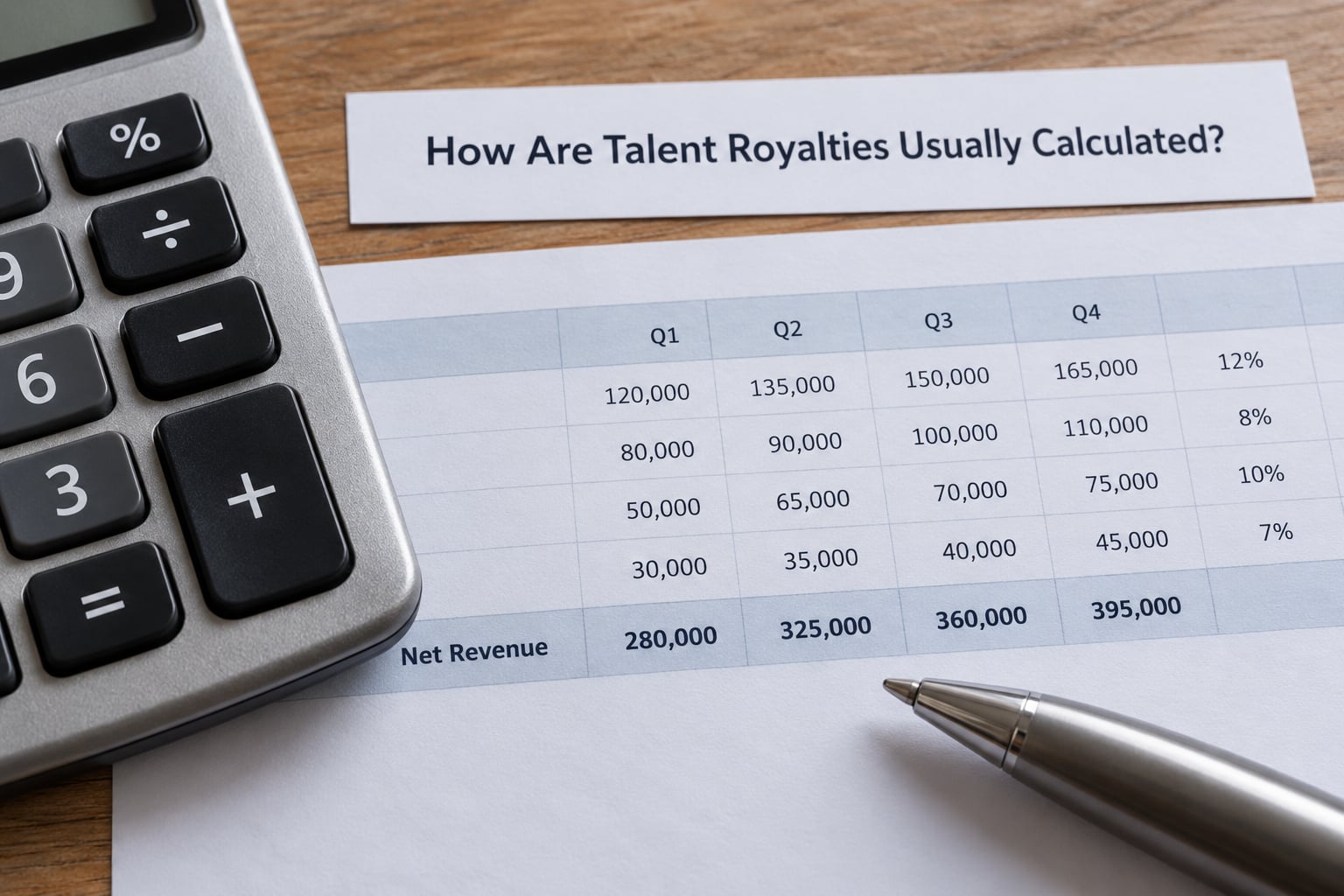
How a royalty percentage is applied to net revenue
The simplest and most common structure is a flat percentage of net revenue. A reported example from salary coverage in January 2024, sourced from 2023 figures, put John Cena at 5 percent of merchandise sales. Treat that as a reported number for one top-tier contract, not a universal rate.
Here is what different rates do to the same quarter of net revenue. The figures are illustrative.
| Quarterly net revenue | At 5 percent | At 10 percent | At 15 percent |
|---|---|---|---|
| 25,000 | 1,250 | 2,500 | 3,750 |
| 100,000 | 5,000 | 10,000 | 15,000 |
| 500,000 | 25,000 | 50,000 | 75,000 |
| 1,000,000 | 50,000 | 100,000 | 150,000 |
Tiered or escalating rates reward a breakout. Once net revenue crosses a threshold, the percentage on the next slice steps up, so a wrestler whose product line suddenly sells hard is not punished for the volume. Steve Austin described exactly this sequence in a 2023 interview: quarterly royalty checks were arriving, the Austin 3:16 shirt was outselling what the checks reflected, and he went back to Vince McMahon to have the percentage renegotiated. The result became known in wrestling circles as the Austin deal, and it became the shorthand for a top talent earning a materially better rate than standard terms.
Advances against royalties and fixed licensing fees work differently. An advance is money paid up front that is recovered from future royalty earnings, so a big advance can shrink checks for several quarters before talent get back to a positive number. A fixed licensing fee is simply a one-off payment for the right to use a name or likeness, with no ongoing share of sales at all.
The only widely published first-party example of the math is Ryback’s. In October 2023 he posted a royalty check of 289.88 for a quarter in which his branded line generated 3,579.79 in revenue, a ratio of about 12 to one and an effective rate near 8 percent. He ran the numbers publicly using what he called Steiner math, and the round figure that circulated afterward was roughly 81,000 in talent royalties for every million a brand earns in royalty revenue.
| Line | Amount (dollars) | Note |
|---|---|---|
| Brand merch revenue, Q3 2023 | 3,579.79 | Figure published by talent |
| Royalty paid to talent | 289.88 | Royalty check |
| Implied effective rate | About 8 percent | Ratio, not a contract rate |
| Rule of thumb | About 81,000 per 1 million | Derived from the same ratio |
What Does a Wrestling Merchandise Contract Typically Include?
A merchandise royalty agreement is shorter than a talent contract but no less dense. These are the clauses to find:
- Royalty rate. The percentage, or the tier schedule, and whether it applies to gross sales or net revenue.
- Covered products. The exact list of items carrying the wrestler’s name, likeness or approved marks.
- Covered channels. Events, web, wholesale, licensees, and which territories count.
- Term. How long the agreement runs, and what happens in the renewal window.
- Accounting period and payment dates. Quarterly is standard, with a stated deadline after quarter close.
- Reporting and statements. What detail the company must provide, and how often, beyond the payment.
- Audit rights. Whether talent may inspect the underlying records, how far back, and who pays for an audit that finds an error.
- Advances and recoupment. The advance amount and the revenue it is recovered from.
- Approval rights. Who signs off on designs, and how long approval can be held up.
- Termination. Notice periods, and whether royalties continue after the agreement ends.
- Trademark ownership. Who owns the name and the marks, and what happens to the product line on exit.
The reporting and audit clauses do more work than most readers expect. Without a right to see unit-level sales and the deduction schedule, talent is accepting a number they cannot check.
How Do Approvals and Design Credits Affect Royalties?
Likeness and image approval is a gate, not a percentage. Until a wrestler approves a design, nothing is produced and no royalty accrues, so a slow approval cycle pushes revenue into a later quarter. Contracts often set a response deadline, after which silence counts as approval, specifically to prevent that delay.
Design credits also come with separate money. A design fee or advance to the wrestler for creating the graphic is typically a distinct payment from the ongoing royalty, and it is not always credited against the royalty base. Production minimums work the other way: an order of a few hundred units can be sold to the promotion as a bulk shipment, counting toward the period’s revenue even though those units may sit in a warehouse for a year.
That last point is the sell-in versus sell-through distinction, and it changes the number substantially. Royalty on a bulk shipment is paid when the product ships. Royalty on actual consumer purchases is paid when the shirt leaves the warehouse. Most agreements use one or the other, and talent with a say in the clause should know which one they have.
Finally, video game, television and other appearance licenses are usually negotiated as flat fees rather than percentages, since there is no product margin to share. Those payments sit outside the merch royalty statement, which is why a wrestler’s income lines can look unrelated to each other.
How and When Do Wrestlers Receive Payments?
The quarterly cycle is the norm, and it is slow by design. Steve Austin described royalty checks arriving every quarter when he talked about his merchandise earnings in 2023. The sequence within a quarter is usually: the period closes, returns have a window to land against it, a statement is issued, and payment follows at a set date.
A statement should show gross sales, the deductions taken, net revenue, the rate applied, any advance recouped, and the amount paid. If a statement shows only a lump sum, that is the clause to renegotiate before signing.
The first payment after a product launch rarely matches the final royalty total. Pre-sell orders, bulk shipments and returns landing in a later quarter all shift revenue between periods, and reserves may be held back while a product line settles.
On taxes, rules vary by country and state and change often. In the United States, payments arriving on a 1099 commonly sit in self-employment income alongside contract earnings, which is one of the reasons contractors are advised to set money aside through the year. Anyone with a specific situation should talk to an accountant rather than a general article.
How Do Royalties Differ for WWE, AEW, and Independent Wrestling?
The direction of travel is the same everywhere; the plumbing differs. Individual contract terms at major promotions are private, so what follows describes business models and public reporting, not anyone’s private deal. Forum threads on r/Accounting and the FAN Wrestling Forum capture the recurring public summary well: talent are typically paid a percentage of the gate based on card position, plus a percentage of their own merch sales.
| Arrangement | Who makes the merch | How talent usually participate |
|---|---|---|
| Major promotion (WWE, AEW) | Promotion and its retail licensees, with licensed manufacturers | Contracted percentage of net branded revenue, paid on the promotion’s accounting cycle |
| Mid-tier promotion | Promotion or an outside merch company | Percentage of a product line, or a flat fee, negotiated per contract |
| Independent promotion | Promotion, or the wrestler using an outside print-on-demand service | Frequently a simpler percentage of table sales, or the wrestler keeping the margin directly |
| Self-distributed | The wrestler, printed on demand and sold online or at shows | Talent keeps the revenue less printing, platform and shipping costs, with no promotion involved |
Independent wrestlers who self-produce can keep a much larger share, which is the single biggest difference between the tiers. Forum participants on r/SquaredCircle and ProBoards consistently describe indie talent selling their own tees at shows and online and retaining far more of each sale than a major promotion split would allow. The trade-off is that the promoter carries no manufacturing risk and the shirt sells only to the crowd already in the building.
Merch also matters differently by career stage. A main eventer on a guaranteed salary treats royalties as upside. A wrestler working twenty independent shows a month treats merch as a real second income, and the two situations negotiate from completely different positions.
What Can Reduce a Wrestler’s Merchandise Royalty?
Deductions are the quiet reason two wrestlers with the same headline rate receive different checks:
- Returns and chargebacks. The biggest one on any online-heavy product line, and it lands after the sale is counted.
- Discounts and promotions. When a brand runs a sale, whether the reduced price or the original price becomes the royalty base depends on the contract.
- Platform and distributor fees. Online marketplaces, payment processors and fulfillment partners each take a cut before net revenue.
- Production and setup costs. Screen setup and per-unit manufacturing often sit inside the deduction schedule rather than being treated as a company cost.
- Unsold inventory. Bulk shipments count when they ship, and later returns or sell-through shortfalls can reverse part of that revenue.
- Advance recoupment. Recovered advances reduce checks until the advance is paid back.
- Excluded channels and items. Anything outside the covered products or territories definition never enters the calculation.
- Taxes. Withheld amounts and the cost of tax on royalties are outside the promotion’s control entirely.
Worth stating plainly for readers who repeat a number they saw on a forum: the belief that talent keep 2 or 3 percent of merchandise profit is not supported by the published figures. The one documented check worked out near 8 percent, and the widely reported top-tier rate sits at 5 percent on gross merchandise sales. Those are different bases, which is exactly why comparing them without the base is misleading.
What Questions Should Talent Ask Before Signing?
These are the questions that decide whether the deal is fair. Ask them before signing, not after the first statement:
- Is the royalty rate applied to gross sales or net revenue, and what is on the deduction list?
- Which products and channels are covered, and which are explicitly excluded?
- Is payment calculated on product shipped or product sold to the customer?
- What is the accounting period, the statement deadline and the payment date?
- Does the statement show unit-level sales and the deduction schedule, or only a total?
- What audit rights apply, how far back do records go, and who pays if an audit finds an underpayment?
- Who owns the trademark, and what happens to the product line if the contract ends?
- Do royalties continue after termination, and for how long?
- Is there an advance, and what revenue is it recouped from?
- Who approves designs, and is there a deadline after which approval is automatic?
Talent are classified as independent contractors, which means these protections come from the contract rather than from employment law. Anyone with real money on the line should have a lawyer who works in talent or licensing read the agreement before signature, since the reporting and audit clauses are where the long-term value sits.
Frequently Asked Questions
Do wrestlers get royalties on every piece of merchandise sold?
No. Royalty applies only to covered products, which usually means items carrying that wrestler’s approved name, likeness or marks. General promotion merchandise, bundled items and anything sold through an excluded channel usually sits outside the definition. Even within a covered line, the percentage applies to net revenue rather than the shelf price, so production, freight, returns and distribution costs come off before the split.
Is a wrestling merchandise royalty based on gross sales or profit?
Almost always net revenue, not profit. Costs for manufacturing, packaging, freight, fulfillment, distribution, discounts and returns are deducted from gross sales first, and the contracted percentage is applied to what remains. Net revenue is a gross figure minus specific listed costs, so a product line can be highly profitable and still leave a thin royalty base. The deduction list is what decides the outcome.
Can a promoter delay payment while accounting for merchandise sales?
Legally, only if the contract allows it. A well-drafted agreement sets an accounting period, a statement deadline and a payment date, and states what happens to late payments. Returns and chargebacks routinely shift revenue between quarters, so a small adjustment after the statement is normal and not the same as a delay. If the contract is silent on timing, that silence is the real risk to flag before signing.
What happens when merchandise is returned or refunded?
The refunded amount is subtracted from revenue, usually in the quarter the refund is processed rather than the quarter of the original sale. On online-heavy lines this can be a meaningful percentage of gross sales, and it is one of the biggest reasons net revenue lands below the headline figure. Some contracts also let a company hold a reserve until a product line settles, which delays the final accounting rather than the money itself.
Are online sales and international orders included in a wrestler’s royalty?
Usually yes, and usually with conditions attached. Online sales count after marketplace, payment processing, fulfillment and shipping costs are deducted, which is why a web sale often produces less royalty than a table sale at a show. International orders are commonly included but converted at a stated exchange rate, and territory clauses can exclude certain regions. Check the covered channels and territory sections rather than assuming either answer.
How can talent verify the sales used to calculate their royalty?
Through the reporting and audit clauses in the contract. Strong terms require a statement showing gross sales, each deduction, net revenue, the rate applied and any advance recouped, plus a right to inspect underlying unit-level records for a set period. Without that detail a talent member is accepting a total they cannot check. If the agreement has no audit right, having a lawyer review it before signature is the sensible move.
The first thing to do is read the definition of net revenue in any agreement you are handed, then check whether reporting and audit rights appear in the same document. Every other number in the deal flows from those two clauses, and they are the only place a wrestler has real leverage before a quarter closes.