How wrestling commentary teams prepare for a show comes down to six things: studying the running order, researching everyone on the card, learning the active storylines, writing their own match notes, sitting in the production meeting, and rehearsing calls out loud. Then they do it all again, faster, on the day itself.
The order is not universal. A weekly television show with a full production department runs a different process from a small independent one-nighter where one person wears every hat. What follows is the common shape of the work, with the parts that genuinely differ flagged along the way.
One clarification first, because it comes up in almost every comment section: no, a commentary team is not handed a script and asked to read it. They get access to planned storylines and often to expected outcomes, and then the live calling is real. The prepared part is the story, not the sentences.
Table of Contents
- How Wrestling Commentary Teams Prepare for a Show
- Read the running order and note what each match has to accomplish
- Research every name on the card
- Learn the active storylines
- Write match notes in their own words
- Talk to the wrestlers and the booker
- Meet production and confirm the boundaries
- Rehearse calls and transitions out loud
- Run the audio and monitor checks
- What Happens Before the Commentary Team Gets the Card?
- Why an early card keeps changing
- Confirmed, planned, and rumored
- How Do Commentators Research the Wrestlers and Promotions?
- Build a match note instead of a highlight reel
- How Do They Build a Storyline-Based Run Sheet?
- How Do Commentary Teams Practice Calls and Improvisation?
- How wrestling commentary teams prepare for the unexpected
- How Do Producers, Camera Operators, and Commentators Coordinate?
- What the announce team cannot change once a segment begins
- How Do Teams Adjust During a Taped or Live Show?
- Recovering from a missed spot or a blank moment
- Frequently Asked Questions
- Do wrestling commentators receive a full script?
- How long does it take to prepare for a wrestling show?
- Do commentators memorize match finishes before a show?
- How do commentators learn the names of unfamiliar wrestlers?
- What happens when a wrestling match changes unexpectedly?
- Conclusion: Start With the Card
How Wrestling Commentary Teams Prepare for a Show
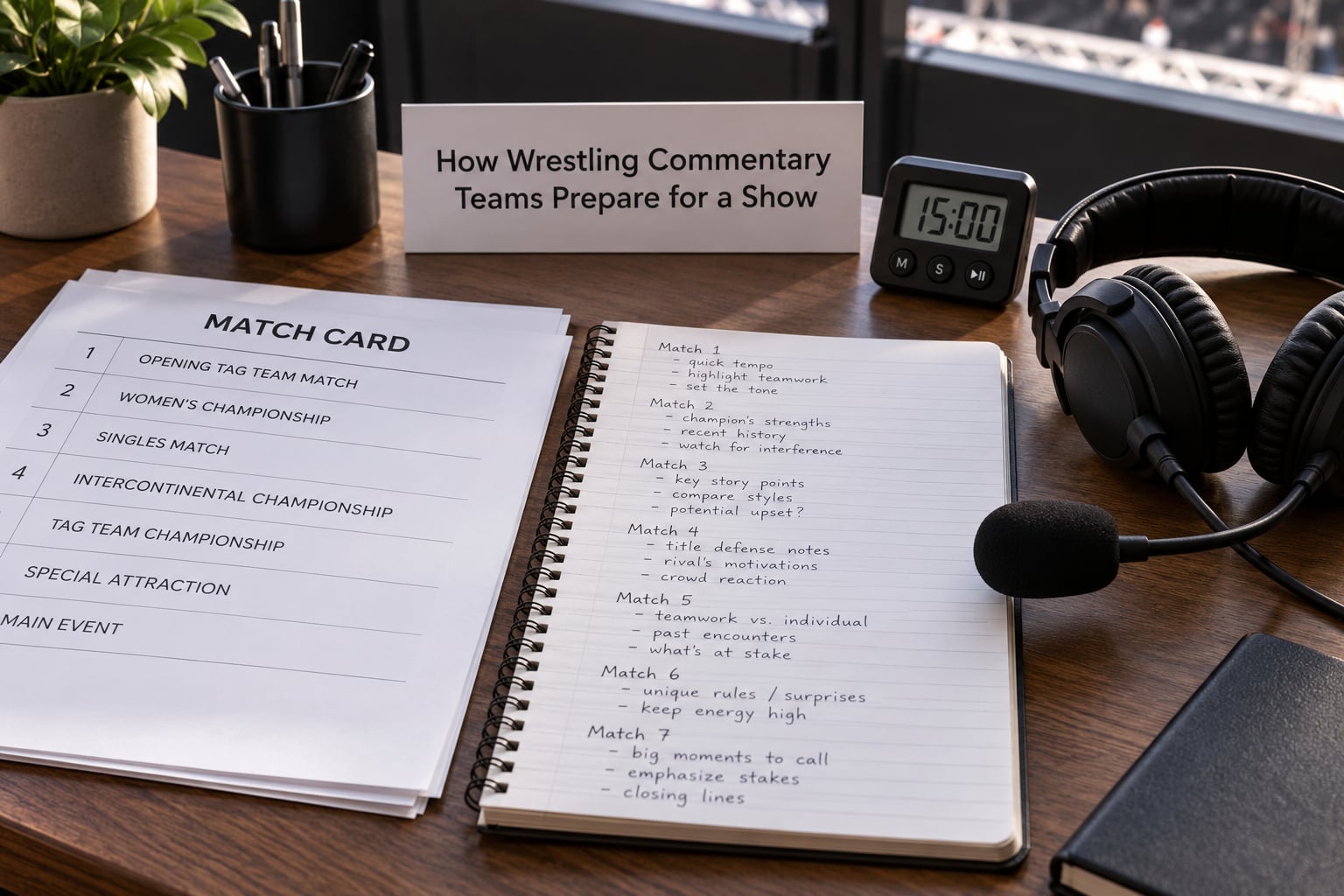
The full workflow runs in eight steps, and most teams work on at least three of them at once. Treat this as the outline rather than a strict timetable.
Read the running order and note what each match has to accomplish
Commentators start with the card, not with the stars. The question on the first pass is not who is winning, it is what each match is for. A match that introduces a new champion is a different job from a match that resolves a nine-month feud, and the calling has to serve that purpose.
Research every name on the card
That means recent matches, signature moves, championship history, finishing moves, how each wrestler speaks, who they are currently allied with or feuding, and where their character arc sits right now. More on the method below.
Learn the active storylines
Storylines have a shape: setup, escalation, turn, payoff. Commentators need to know where tonight’s match falls on that shape, because a payoff that gets explained during the match has already been spoiled by the time the bell rings.
Write match notes in their own words
Notes exist so the commentator knows the beats going in. A useful note has the participants, the stakes, the two or three moments that matter, and a line about how the match ends.
Talk to the wrestlers and the booker
Where access exists, this is where the material improves. Bryan Danielson described sitting in the booker’s office to understand the main story of the show, and talking with the wrestlers about their matches, before writing a pile of notes he often never uses live. Knowing why a sequence exists is different from knowing it happened.
Meet production and confirm the boundaries
Announcers and producers align on time allocations, legal-content lines, sponsor reads, and what is off the table for the night. This is also where the third voice, if there is one, gets assigned a job.
Rehearse calls and transitions out loud
A table read or a verbal run-through catches the problems that only appear when two people try to talk over each other. The goal is not memorised lines. The goal is knowing which handoff goes where.
Run the audio and monitor checks
Headsets, microphone levels, the monitor feed, the mix. A commentator who is prepared but inaudible has not been prepared.
Then the show happens, and the last step is review: watching or listening back, noting what landed, and feeding that into the next card.
What Happens Before the Commentary Team Gets the Card?
Why an early card keeps changing
The first version of a card is a working draft. Names swap when somebody is injured or unreachable. A match gets rebuilt as a stipulation when a promo needs it. A segment gets cut for time and the people in it end up thrown into the card to fill a hole. Independent shows change more than television shows, and television shows change more than a big arena event, where logistics are locked months ahead.
Commentators who plan as if the first card is permanent tend to sound confused on air. Plan as if it is accurate but provisional, and you can absorb a swap without missing a beat.
Confirmed, planned, and rumored
It helps to sort everything into three buckets. Confirmed means it is happening as written. Planned means the booker intends it but the wrestlers can still change details on the night. Rumored means a report exists that nobody in production will confirm.
That last bucket matters most for discipline. Reporters and commentators operate close enough to the production that a careless spoiler can reach an audience before the match does. There is a real professional consequence to confirming something unconfirmed, and the rule most teams work under is simple: describe what is happening in front of you, not what you think is coming.
How Do Commentators Research the Wrestlers and Promotions?
The research method that works best is volume over polish. Watching five complete matches tells you more about a wrestler’s rhythm, timing and in-ring personality than twenty highlight clips, because the rest is where the pacing and the selling live.
Starting from the top of the card, work down. For each name, gather recent matches, so you know what moves they actually use rather than what they are famous for. Then championship history and record, since it decides how a finish is framed. Then finishing moves, and how each one is introduced. Then speaking style, because a call that sounds right for one wrestler sounds wrong for another.
Then look at alliances and feuds. Who has been tagging with whom recently, and who is about to turn. Then the current character arc, particularly if the wrestler has just changed persona, since the old characterization is usually what viewers still expect.
Build a match note instead of a highlight reel
Match notes are short on purpose. A workable note carries the participants and their ring names, the stipulation if there is one, the stakes in a sentence, the two or three beats worth marking, and the planned finish. Michael Hirn put the guiding rule plainly when he described his own preparation: be ready for anything, but know not to push information in just because you have it.
That last part is the skill. Notes are a floor, not a ceiling, and a commentator who reads a note out loud during a good sequence has used preparation badly.
How Do They Build a Storyline-Based Run Sheet?
A card with eight matches and three segments is too much detail to hold live, so it gets compressed into a run sheet. The run sheet is the commentary team’s version of the show: one line per segment, in order, with the essentials and nothing else.
Each part of that sheet gets used at a different moment, which is why the order of the details matters.
| Part of the run sheet | When the team uses it |
|---|---|
| Segment name and participants | Before entrances, to confirm who is next and avoid a name mix-up |
| Entrance music and crowd expectation | During entrances and walkouts, to set tone and energy |
| Stakes in one sentence | In the ring during the early exchanges, once the crowd noise settles |
| Key beats and callback opportunities | Mid-match, as each beat actually occurs rather than on a timer |
| Planned finish | Late in the match, for framing, without announcing it |
| Time warning from production | Anywhere on air, as a signal to compress the match or move on |
| Alternate outcome notes | Only when the match deviates from plan and someone signals it |
| Next segment cue | During the final moments, so the handoff back to the desk is clean |
Everything on that sheet is written to leave room. A run sheet with no space for an unexpected turn produces commentary that fights the action.
How Do Commentary Teams Practice Calls and Improvisation?
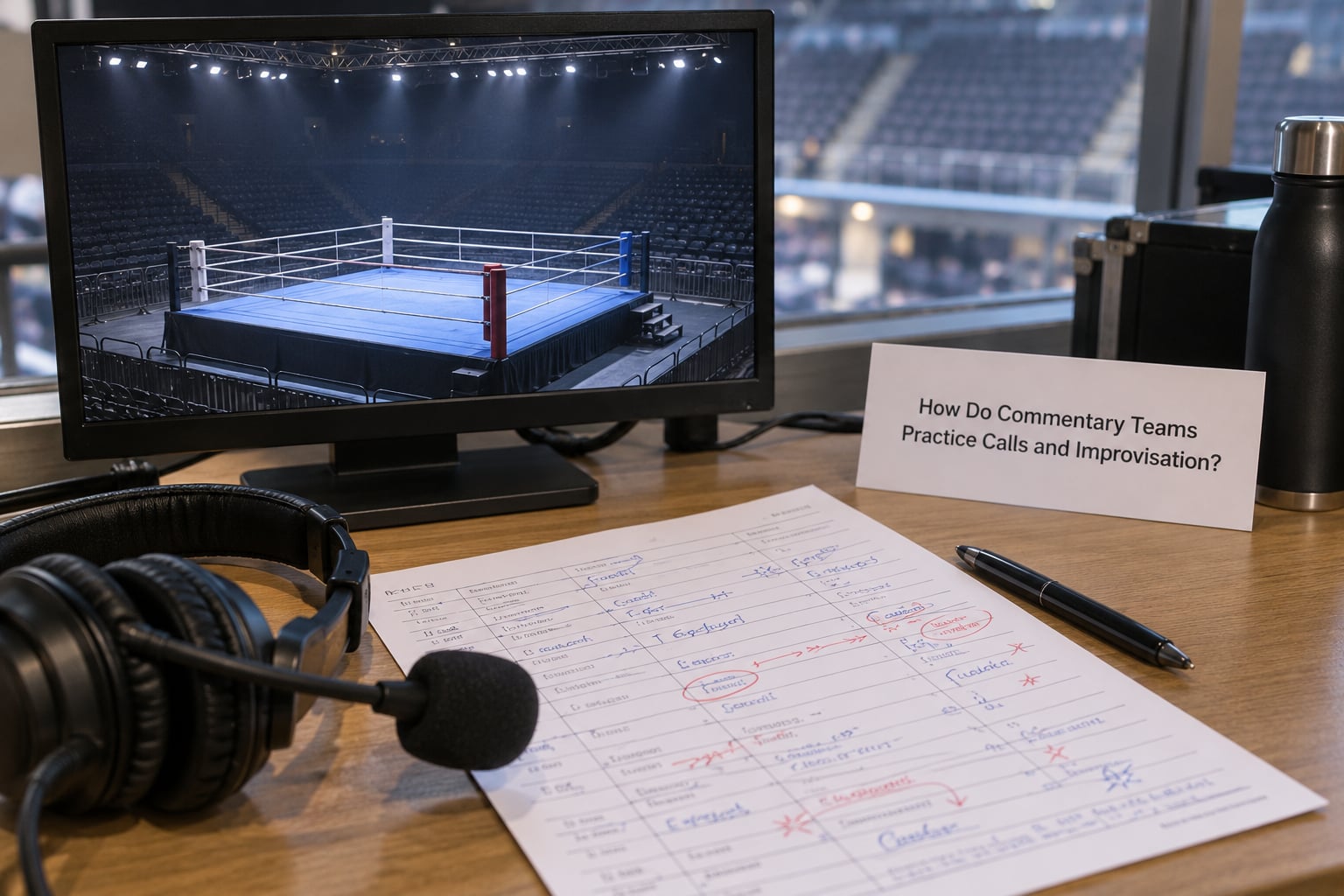
Rehearsal for commentary is mostly rehearsal of timing, because the thing that goes wrong live is rarely knowledge. It is two voices colliding, or one voice talking over the moment that mattered.
A table read covers the transitions. Two or three announcers go through the run sheet out loud, and the awkward bits announce themselves quickly: the handoff where both people start talking, the beat that needs more setup than planned, the joke that needs longer to land than a countdown allows.
Terminology practice comes next, and it is duller than it sounds. Team members agree on how a move gets named, whether a chain of moves gets one phrase or three, and how a submission hold is described when the name is unpronounceable. Consistency matters because the listeners are doing something unusual with the audio. They are half watching and half reading, so a name spelled wrong in the ear becomes the name they remember.
Rehearsing alternative finishes is the part people underestimate. Teams walk through what happens if the match goes the other way, if it runs long, if a wrestler gets hurt. It does not predict the show. It removes the panic, so that when something unplanned happens the team sounds like it belongs there.
How wrestling commentary teams prepare for the unexpected
Danielson described a live moment where he went blank when Excalibur asked him a question during a jet-lagged stretch, and the other announcers carried it. That is the honest version of preparation working. The preparation was not enough that night, and the team absorbed it anyway, which is exactly what a team is for.
Preparation that produces a rigid read is the failure mode. The aim is a team that can improvise safely, not a team that performs a document.
How Do Producers, Camera Operators, and Commentators Coordinate?
Commentary is one department in a broadcast that includes producers, a director, camera operators, ring crew, graphics, music and lighting. Preparation means knowing the shape of the whole thing, even though the team only controls the audio.
Production meetings usually cover the same ground: the running order with timings, which segments have hard limits, the sponsor reads and where they sit, the legal lines around sponsorships and regulated subjects, and the plan if something goes wrong. Announcers bring the parts that affect speech. Names that are easy to mispronounce, feuds that need context for a new audience, and material that should not be discussed on air.
Camera operators matter more than most fans realize. When a wide shot is needed to establish a spot, the announcer has to let it happen. Calling over the top of the shot that shows the move is a common and avoidable mistake, and good teams develop a shared sense of when the producer wants room.
Audio cues come through the headset, usually as a tone and an instruction from the producer: time warnings, a request to wrap a match, or a cut. Commentators get fluent at reading those without breaking tone, which is a separate skill from calling wrestling.
What the announce team cannot change once a segment begins
Once a segment starts, commentary reacts. It cannot restart a match, extend a time limit, change a camera angle, or alter a stipulation. It can pace itself, choose what to emphasise, decide whether to explain or stay quiet, and hand off cleanly to the next segment. That narrow list is where all the live influence lives, which is why preparation concentrates on getting to that position ready.
Independent promotions have almost none of this structure. No booker office, no producer with a cue, sometimes one headset between two commentators. The prep compresses into phone calls with the wrestlers and a printed card, and the technical check happens in a venue five minutes before the doors open.
How Do Teams Adjust During a Taped or Live Show?
On a taped show, a change can be dealt with in the edit. On a live one, the adjustment happens while an audience is watching and the reaction has already started.
Recognising the change is most of it. A match becomes singles from a tag. A stipulation appears that the notes never mentioned. An entrance runs long and pushes the following match. A segment gets cut on the fly. A wrestler goes down holding something and the medical team comes out.
The principles that hold across all of it are short. Stay accurate. If you do not know what just changed, describe only what you can see. Never invent an explanation for something you have not been told, because the invention either gets contradicted on air or turns out to be right later, and both are worse than saying nothing. Keep the presentation intact by falling back on the approved framing, which is one reason the setup material is written before the bell. And return to the planned outline afterwards rather than abandoning it.
Recovering from a missed spot or a blank moment
When something is missed in the ring, the instinct to over-explain is exactly wrong. Silence, or a single bridging sentence, hands the moment back to the crowd. When a commentator blanks, the useful move is to hand off, ask the partner a real question, or drop into the agreed next beat. The audience forgets a pause faster than it forgets a fumbled explanation.
The community view on commentary is mixed, and honestly so. Fans on r/prowrestling and r/Wrasslin tend to complain that independent commentary is unprepared and inconsistent between shows, while also acknowledging how much a good team adds. The benchmark most often cited is Bobby Heenan’s line before the Undertaker’s WrestleMania VIII entrance, roughly that somebody was about to get hurt. Short, flat, and it built an aura nobody else in the match could have built from the commentary booth.
Frequently Asked Questions
Do wrestling commentators receive a full script?
No. A commentary team gets access to planned storylines, notes from the booker and often the expected outcome of a match, but nobody reads a script on air. The prepared part is the story and the beats, not the sentences. Live calling is improvised around that framework, which is why two teams can call the same finish differently.
How long does it take to prepare for a wrestling show?
The honest range is several days for the research and a couple of hours on the day itself. Wrestler research and storyline work happen across the week. The card review, production meeting, final notes and audio check all land on show day. For an independent one-nighter with no production team, the whole process can compress into a day.
Do commentators memorize match finishes before a show?
Usually they know planned finishes, but they memorize the setup rather than the wording. Notes cover the participants, the stakes, the beats worth marking and how the match ends. Knowing a finish is useful for framing the closing minutes; announcing it early is the mistake that ruins the payoff.
How do commentators learn the names of unfamiliar wrestlers?
From written match notes and the run sheet, which carry ring names and pronunciations, supported by the production meeting where names get flagged. Announcers also watch recent matches in full rather than highlights, because watching someone work teaches the name faster than reading it. Teams agree on consistent naming before air.
What happens when a wrestling match changes unexpectedly?
On a taped show the change can be handled in the edit. On a live show, the team describes only what it can see, avoids inventing an explanation, and keeps the approved framing. Comments tend to fall back to established storylines while the situation settles. A change to a stipulation or an added wrestler is routine and rarely noticeable to viewers.
Conclusion: Start With the Card
That is the whole job, and it is less mysterious than it looks. Find the running order, confirm who is actually on the card, learn the storylines that are live this week, write short notes in your own words, sit in with production, say the transitions out loud once, and check the audio before anybody is watching.
If you want to study the craft, start with the running order. Take one card from a show you watched recently and work out what each match was for before you decide who was good. Then go back and listen to the call with that purpose in mind. It is a different show once you know what it was trying to do.